

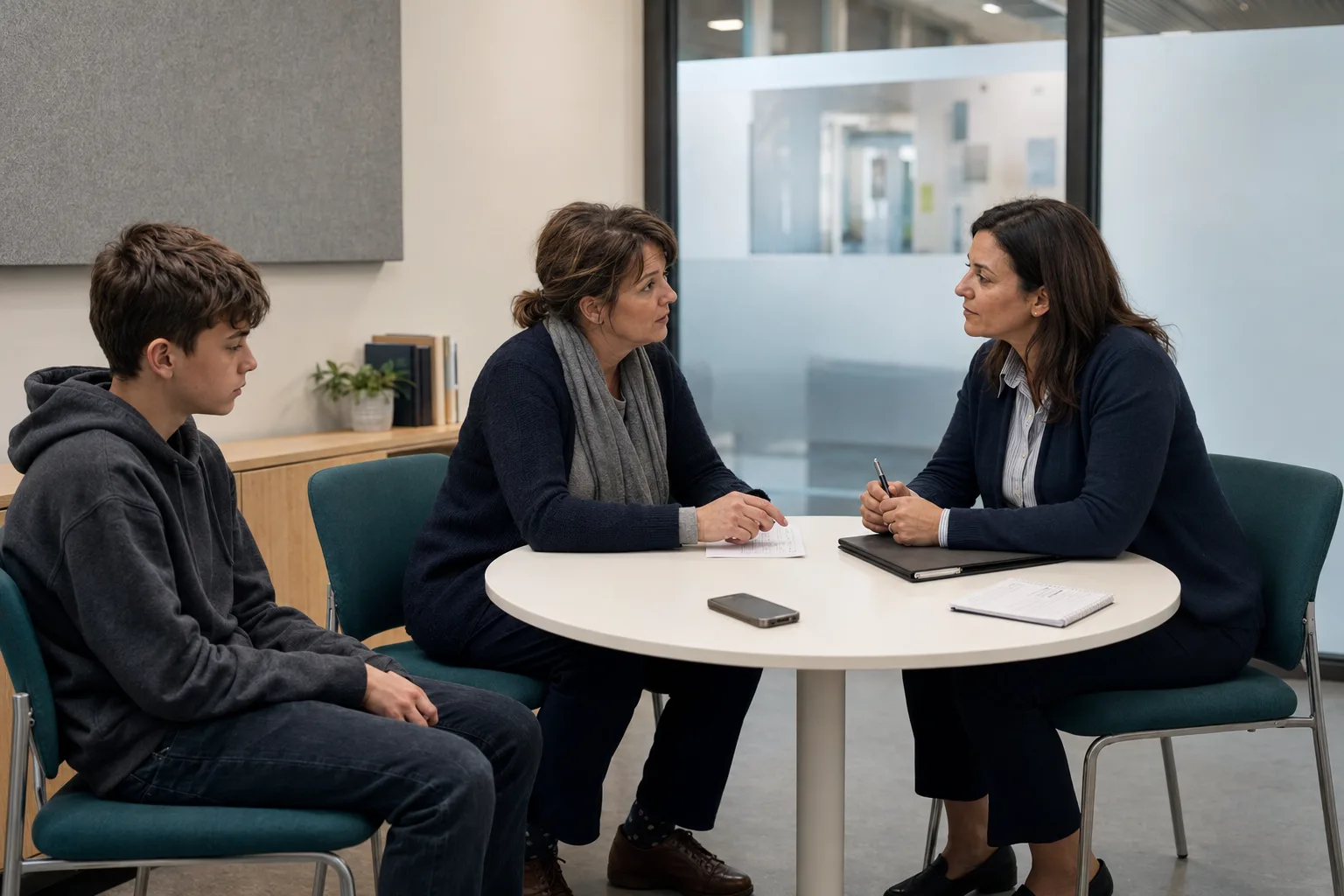
The useful order in the first hours
After a school incident, many parents do the same thing. They tell the whole story at once, ask immediately who is to blame, and leave the conversation without knowing what will happen when their child walks back into school tomorrow. The useful order is almost the reverse.
Start with five priorities, in this order:
- Get facts that are reliable enough to act on: what does the school know, and what is still being checked?
- Check your child’s immediate safety: where are they now, how are they, and what is being put in place to prevent a repeat today or tomorrow?
- Identify one clear contact person: who is coordinating the school’s follow-up?
- Ask for a dated check-in: when will you review the situation again, and how?
- Keep a calm written record: a useful summary, not a thirty-page accusation file.
This order does not minimise what may have happened. It simply prevents an already emotional exchange from turning into a flood of memories, an improvised trial, or an administrative misunderstanding.
With younger children, the class teacher and the school leader are often the first people to contact. With older students, a homeroom, advisory, or class teacher may help you understand the context. But when the issue involves safety, violence, humiliation, threats, repetition, coercion, or images and messages being shared, school leadership should be involved quickly. In many schools, a student welfare, pastoral, safeguarding, counselling, or behaviour lead may also become the practical point of contact.
The questions to ask first: facts, safety, contact person
In the first exchange, your aim is not to obtain the whole case. Your aim is to obtain a usable picture of the situation. These questions are often the most useful:
| Question | What you are really trying to find out | A useful answer sounds like |
|---|---|---|
| What happened, as far as you know at this stage? | To separate confirmed facts, accounts already gathered, and points still unclear | A provisional, dated account without false certainty |
| Is my child safe now? | To know where your child is, how they are, and whether they can return to lessons or activities normally | Concrete information about physical and emotional state, not a vague reassurance |
| What are you putting in place today? | To check immediate protection | Separation, closer supervision, a named adult, changes to a place or time, or another practical measure |
| Who is coordinating the follow-up? | To avoid telling the same story to five different people | A name, a role, and a way to contact them |
| When do we check in again? | To get out of uncertainty | A date or time window, even if provisional |
A good answer is not necessarily a complete answer. In the first hours, it is normal for the school not to have checked everything. But it should be able to say what it already knows, what it is still trying to confirm, and how your child is being protected meanwhile.
If the incident involved an injury or accident
If there was a fall, blow, fainting episode, injury, allergic reaction, or transport for medical care, make the questions more precise:
- Who saw the incident?
- What first aid or immediate care was given, and by whom?
- Where was my child taken afterwards?
- At what time was the family contacted?
- Has an incident or accident report been completed, or is one being prepared?
- What is the process for requesting a copy or summary if I need one?
The exact reporting duty depends on the country, school type, and local policy. For a parent, the practical point is still the same: do not ask only “How could this happen?” Ask also what formal record exists, what it contains, and how you can access the parts that concern your child.
What to ask next: handling, follow-up, checkpoint
Once the basic facts, immediate safety, and contact person are clear, you can move to the second layer of questions: not only what happened, but how the school is now handling the situation.
Depending on the context, the measures may concern the classroom, playground, corridors, lunch area, changing rooms, residential or boarding spaces, school-supervised transport, trips, clubs, or digital spaces linked to school life.
The most useful requests are often these:
- What will you check over the next hours or days?
- Which students or adults will be spoken to or seen again?
- What temporary measures are you putting in place to prevent a repeat?
- What would trigger a new call or message from you to me?
- When will you give me an update?
The right tone is neither passive nor accusatory. You can be firm without arguing the whole case in the first meeting. For example:
“I need to separate what is already established from what is still being checked. And above all, I need to know how you are protecting my child between now and tomorrow.”
Or:
“I am not asking you to settle the whole case today. I am asking for one person to coordinate it, immediate protective measures, and a date for the next update.”
This frame changes the conversation. It avoids turning a response meeting into a general confrontation. It pushes the school to state concrete commitments. It also helps you see quickly whether you are dealing with serious follow-up or only verbal reassurance.
There is one question that is better not placed first: what punishment will there be? In serious cases, discipline matters. But school disciplinary processes usually depend on internal rules, privacy limits, and local law. For you, the first priority is that the behaviour stops, your child is protected, and the situation is followed up properly. If you start too quickly with punishment, you may get an abstract discussion when what you need most is a protective framework.
Similarly, do not begin by asking for every detail about other students or what was said to other families. What you need to obtain is what concerns your child: the measures, the handling of the situation, and the timetable for review.
When to follow up in writing, and what records to keep
Putting things in writing is not a declaration of war. It is a way to stabilise what was said and reduce misunderstandings.
Follow up in writing especially when:
- the incident is serious or potentially serious;
- concrete measures were promised orally;
- no update arrives within the time frame given;
- new facts appear after the first exchange.
A useful written message is short. It does not retell the entire story. It summarises the important points, records your requests, and fixes the next step. A simple structure works well:
- date and nature of the incident;
- what you understand to be confirmed so far;
- measures announced by the school;
- date or time window for the next exchange;
- points still to clarify.
For example:
“Following our conversation about the incident on Tuesday 14 May, I understand the current position to be as follows: … Please could you confirm the measures planned for today and tomorrow, and the date of our next check-in?”
The records worth keeping are also fairly simple:
- dates, times, and places;
- your child’s exact words when they matter, clearly separating quotation from interpretation;
- names and roles of adults contacted;
- emails or messages sent and received;
- screenshots, photos, or messages where they exist;
- first-aid notes, medical appointments, certificates, counselling appointments, school nurse visits, or absences if there was physical harm or strong distress.
Avoid two common mistakes: sending an endless narrative to ten people, and circulating details in parent group chats. Documenting is meant to clarify and protect. It should not create a parallel rumour system.
If you have made a clear first request and the response remains absent, vague, or ineffective, the next level depends on your school system. It may be a senior school leader, board or governing body, district or network office, safeguarding contact, inspection body, ombuds service, education authority, or another formal complaints route. The important point is not to jump levels for every minor misunderstanding; it is to escalate when the protective response is missing, delayed, or no longer proportionate to the risk.
When to change level without waiting
Not every school incident belongs in the same channel. The right order changes according to severity, repetition, and type of risk.
| Situation | Useful first reflex | Logical next step |
|---|---|---|
| Injury, fainting, allergic reaction, or medical emergency | Check immediate care; contact local emergency medical services if there is urgent danger | Then ask for facts, care given, family notification, and the written record |
| Violence, assault, weapon, extortion, serious threat, or danger still in progress | Do not rely only on a school conversation; contact local emergency services or law enforcement where appropriate | Inform school leadership in parallel |
| Repeated targeting, organised exclusion, recurring humiliation, or fear of returning to school | Think bullying, not just “an incident that will pass” | Ask for a formal school response and a dated follow-up plan |
| Messages, manipulated images, impersonation, insults, threats, or image-sharing online | Think cyberbullying or online abuse, even if some of it happens outside school premises | Preserve evidence, report on the platform where relevant, alert the school, and use your local helpline or reporting route if safety is at stake |
| Concern that a child is at risk of serious harm, abuse, exploitation, or neglect | Move beyond the school-only frame | Use the child protection or safeguarding route in your country, and seek urgent help if the risk is immediate |
When the facts look like bullying, do not try to settle the problem alone with the other student or the other family. That can make the situation more public, more defensive, or more difficult to control. The school has a protective role: it should coordinate the response, apply its policy, reduce exposure, and monitor whether the behaviour actually stops.
Your role as a parent is to alert, document, insist on protection, and check that follow-up exists in reality. If what you are seeing is not an isolated event but a repeated process, the reasoning changes: you are no longer simply clarifying a fact; you are trying to stop a pattern.
The thread to keep in mind
After a school incident, the useful sequence is often: clarify, protect, name, date, write.
Clarify the facts without demanding the impossible in the first hour. Protect your child immediately, not after every account has been checked. Name one contact person. Date the next check-in. Then write a short summary so that the conversation does not dissolve into memory, stress, or conflicting versions.
This framework does not solve everything. But it changes the quality of the conversation with the school, and it helps you see faster whether the situation is being resolved, whether the follow-up is insufficient, or whether the alert needs to move to a higher level.