

Active reading, note-taking, and writing are not three separate “school habits”. Used well, they form one learning loop: the student meets new information, decides what matters, reformulates it, then checks whether they can explain it without the page in front of them.
That loop matters because many students work hard in ways that feel safe but do not always build understanding. They read a chapter from beginning to end, highlight half the page, copy a lesson neatly, or rewrite everything the same evening. Those actions can create order. They can also hide the real question: could the student explain the idea, use it in a new example, or remember it a few days later?
For parents, the practical aim is not to police every notebook. It is to help a child move from passive contact with the course to active processing. A useful system is simple enough to repeat: read with a question, take notes by selecting, write in your own words, and turn the result into something that can be tested later.
Why passive reading feels productive but often disappoints
Passive study is attractive because it gives visible proof of effort. A highlighted chapter looks worked on. A full notebook looks serious. A copied summary looks cleaner than the original. The problem is that visible work and mental work are not the same thing.
When a student reads without a question, every sentence has roughly the same status. Important ideas, examples, exceptions and decorative details all pass by in one stream. Highlighting can make the stream look organised, but it does not force the student to decide what the author is saying. Copying can preserve information, but it does not prove that the student has selected, understood or connected it.
This is why many students experience a frustrating gap: “I read it” becomes “I don’t know what to say” when they are asked to answer a question, solve a problem, explain a document, or write a paragraph. The reading was real, but it stayed too close to exposure. It did not become usable knowledge.
A better goal is not to ban highlighting or neat notes. It is to make those actions serve a stronger purpose. A highlighted word should mark a decision. A note should compress meaning. A rewritten sentence should show that the student can say the idea differently. A revision sheet should prepare retrieval, not merely decorate the course.
The useful distinction is this:
| Passive gesture | Stronger version | What changes cognitively |
|---|---|---|
| Rereading a page | Reading to answer a question | Attention becomes selective |
| Highlighting many lines | Marking only claims, definitions, examples or doubts | The student chooses what matters |
| Copying a lesson | Reformulating the lesson | The student processes meaning |
| Making a beautiful sheet | Making a sheet that can be tested | The material becomes reusable |
| Saying “I know it” | Explaining it without looking | Confidence is checked against recall |
Active reading: read so the chapter can be explained later
Active reading means reading with a job to do. The job is not “finish the page”. It is “leave the page with a clearer answer than before”.
Before reading, the student should create a small purpose. This can be a question from the title, a teacher’s instruction, a past exercise, or a parent’s simple prompt: “What are you supposed to understand after this section?” A purpose gives the brain a filter. It tells the student what to look for and what to ignore.
During reading, the student can use a three-column mental routine:
- What is the main idea? This is the claim, rule, process, event or explanation the section is trying to teach.
- What proves or illustrates it? This includes examples, dates, diagrams, experiments, quotations, calculations or cases.
- What do I still not understand? This is where doubts become useful instead of embarrassing.
After reading, the student should close the page for a moment and produce a short explanation. It can be spoken aloud, written in three lines, or turned into two questions and answers. The key is that the explanation must not simply copy the original sentence structure. If the student can only repeat the textbook wording, understanding is still fragile.
A practical active reading routine for a chapter can look like this:
- Preview: read the title, subheadings, diagrams and final summary if there is one.
- Question: write one to three questions the chapter should answer.
- Read in chunks: stop after each section, not after the whole chapter.
- Reformulate: write one sentence beginning with “This section explains that…”
- Check: close the book and answer one question without looking.
- Mark doubts: keep a short list of unclear words, steps or examples.
For younger students, this routine may need to be oral and short. For older students, it can become a written method before tests, essays and presentations. The important point is the same: active reading makes the student transform the text, not just pass through it.
Note-taking is a selection skill, not a handwriting race
Many students think good notes are complete notes. That belief is understandable: when a teacher speaks quickly or a text feels dense, copying everything seems safer than choosing. But complete notes are not always useful notes. They can be too long to revise, too close to the original wording, and too hard to reopen later.
Effective note-taking requires four actions at once, and they are not easy:
- Listen or read for structure: identify the topic, the sequence and the teacher’s emphasis.
- Select: keep the essential claim, rule, example or warning.
- Shorten: use keywords, arrows, abbreviations and compact sentences.
- Rephrase: turn the idea into language the student can understand later.
The difficulty is not only speed. It is judgment. A student has to decide what belongs in the notebook and what can stay outside it. That is why “just copy the board” is sometimes useful for accuracy but not sufficient for learning. Board notes, slides or textbook paragraphs may provide the raw material; the student still needs to build meaning from them.
Digital notes can work well when they are used to select, organise and review. Paper notes can work well when they slow the student enough to think. The real danger is not the tool itself but transcription without processing. A student typing every sentence verbatim may produce many words while doing little selection. A student writing by hand may also copy passively if the goal is only neatness.
Parents can help by checking the function of notes rather than their appearance. Instead of asking “Are your notes clean?”, ask:
- “Can you find the main idea quickly?”
- “Where is the example that explains this rule?”
- “What would you ask yourself to revise this page?”
- “What part would you need to clarify with the teacher or a classmate?”
- “Could you turn this page into three questions?”
Good notes are not necessarily pretty. They are findable, understandable and testable.
Choose the note format by task, not by fashion
No single note-taking format is best for every child, every subject or every lesson. The format should match the type of information and the way the student will use it later.
| Format | Best when | Watch out for |
|---|---|---|
| Linear notes | The lesson follows a clear sequence, argument or procedure | Can become a long copy of the course if the student does not shorten |
| Cornell notes | The student needs cues, questions and a review zone on the same page | Can feel artificial if used mechanically without real questions |
| Tables | The course involves comparisons, categories, causes, effects or cases | Can oversimplify if the student forces every idea into boxes |
| Mind maps | The topic has many connections, branches or examples | Can become decorative if it does not show hierarchy or relationships |
| Short revision sheets | The aim is to prepare a test or oral explanation | Can become too compressed if examples and doubts disappear |
| Question-answer cards | The student needs retrieval practice | Weak if the questions are too easy or only ask for isolated definitions |
The Cornell method is useful for some students because it separates capture from review. The main area holds the lesson. The cue area turns the lesson into questions, keywords or prompts. The bottom area forces a short summary. The method is not magic; it works when the student actually uses the cue area to test themselves later.
Mind maps are similar. They help when they make structure visible: main idea in the centre, branches for categories, examples placed under the right branch, arrows for relationships. They help less when they are simply the course rewritten in colour. A mind map should reduce confusion, not create a prettier version of it.
The best format is often the one a student will actually use again. A slightly imperfect page that can be reopened, questioned and corrected is better than a beautiful page that never becomes part of revision.
Writing to learn: reformulation turns information into understanding
Writing is often treated as the final school product: the essay, the paragraph, the answer, the report. But writing is also a way to learn before the final product exists. When a student writes in their own words, they must choose, order and connect ideas. That effort reveals gaps that passive reading can hide.
Useful learning writing is usually short. It does not need to be elegant. It needs to make thinking visible. Here are several forms that work well across subjects:
- The three-line summary: “What is the main idea? What example proves it? Why does it matter?”
- The self-explanation: “This step works because…”, “This event leads to…”, “This character changes when…”
- The question-answer pair: “What is the rule?” followed by “How would I recognise it in an exercise?”
- The mini oral script: a short written plan for explaining the lesson aloud.
- The mistake note: “I thought X, but the correct idea is Y because…”
- The link sentence: “This idea connects to the previous chapter because…”
This kind of writing helps because it changes the student’s role. They are no longer only receiving information. They are rebuilding it. That rebuilding is slower than highlighting, but it produces material that can be used for revision: questions, explanations, examples, doubts and links.
For parents, the most productive check is often simple: ask the child to explain one paragraph of their notes using different words. If they can do it, the material is becoming flexible. If they cannot, the problem is not necessarily laziness. The child may need a clearer example, a smaller chunk, a vocabulary clarification, or a first sentence starter.
What changes by subject: same loop, different products
The loop — question, select, rephrase, retrieve — stays stable. What changes is the product the student should create.
For a long literary or historical text, active reading means following an argument, a narrative, a point of view or a set of causes. The student should note turning points, key quotations or examples, but also the relationship between them. A useful summary is not a list of everything that happened. It is an answer to “What is this passage doing?”
For science and mathematics, notes need to preserve definitions, conditions and steps. But they should not stop there. The student also needs to explain why a formula applies, what each step changes, and what typical mistake the method avoids. A worked example becomes more useful when the student adds short explanations beside the steps.
For languages, the goal may be vocabulary, grammar, expression and reuse. Copying a word list is rarely enough. The student should add example sentences, contrasts, pronunciation cues if relevant, and prompts that force recall. A good language note is one the student can use to produce speech or writing, not only recognise a word.
For oral presentations, the notes should not be a full script unless the task requires it. They should become a route: opening idea, three main points, examples, transitions and final message. The student then rehearses from prompts, not from a wall of text.
For essays and extended writing, notes should help the student build an argument. That means grouping ideas, choosing evidence, and drafting topic sentences. Writing becomes a thinking tool: if the paragraph cannot be written clearly, the idea may not yet be clear enough.
Should notes be rewritten the same day?
Rewriting notes the same day can help, but only when it is a short active review rather than a complete copy. The question is not “same day or not?” The question is “what mental work happens during the review?”
A useful same-day review can take ten to twenty focused minutes. The student rereads the raw notes, fixes unclear abbreviations, adds missing examples, marks doubts, writes two or three questions, and produces a short summary. That is very different from rewriting every line in a cleaner notebook. Full rewriting may be worthwhile when the original notes are unreadable or badly organised, but as a default habit it can consume time without enough return.
A good rule for families is: clean enough to use, active enough to remember. The notebook does not need to look perfect. It needs to be understandable next week. The student does not need to rewrite everything. They need to make the lesson retrievable.
A same-day review is especially helpful after dense lessons, first exposure to a difficult concept, a missed explanation, or a class where the student copied quickly without understanding. It is less urgent when the lesson was already clear, the notes are usable, and the next revision step is scheduled.
How parents can support without taking over
Parents often see the problem only at the end: a child has a test soon, a notebook full of copied material, and no clear way to revise. It is tempting to respond by reorganising everything for them. That may help once, but it can also keep the student dependent.
A better parent role is to ask questions that train the learning loop:
- “What is the main question this lesson answers?”
- “Which part is definition, which part is example, and which part is method?”
- “Can you explain this page without reading it?”
- “What would be a good test question?”
- “Which note will still make sense next week?”
- “What is unclear enough to ask about?”
The aim is not to turn parents into teachers. It is to make the student’s thinking audible and visible. When a child struggles, the parent can reduce the size of the task: one paragraph, one diagram, one example, one question. When a teenager resists, the parent can focus on outcomes rather than style: “I do not need your notes to look a certain way. I need you to have a way to explain and retrieve the lesson.”
It also helps to separate two problems that often get mixed together. A student may understand the lesson but lack a review system. Another may have a real conceptual gap. Active notes can help with the first and reveal the second. If the child cannot explain the idea even after rereading, reformulating and trying an example, the next step may be teacher feedback, peer explanation, tutoring or another form of support.
Practical recap: what to change first
The simplest improvement is to stop treating reading, note-taking and writing as separate tasks. They should feed one another.
A student reads to answer a question. They take notes to preserve structure and meaning. They write to reformulate. They review by trying to retrieve. If one step is missing, the system weakens: reading stays passive, notes become storage, writing becomes copying, and revision becomes last-minute rereading.
For most families, the best first step is small:
- Choose one lesson or chapter.
- Ask the student to write three questions it should answer.
- Read or review in short chunks.
- Create notes that separate main ideas, examples and doubts.
- Write a three-line summary in the student’s own words.
- Close the page and answer one question from memory.
- Mark what needs clarification before the next study session.
That routine is not glamorous, but it changes the quality of the work. It makes the student decide, explain and check. Over time, those gestures become more important than any single notebook format.
The real sign of progress is not a perfect page. It is a student who can say, with increasing confidence and precision: “Here is what the lesson means, here is the example that proves it, here is what I still need to practise, and here is how I will revise it.”
Sources
Keep reading
Related reading
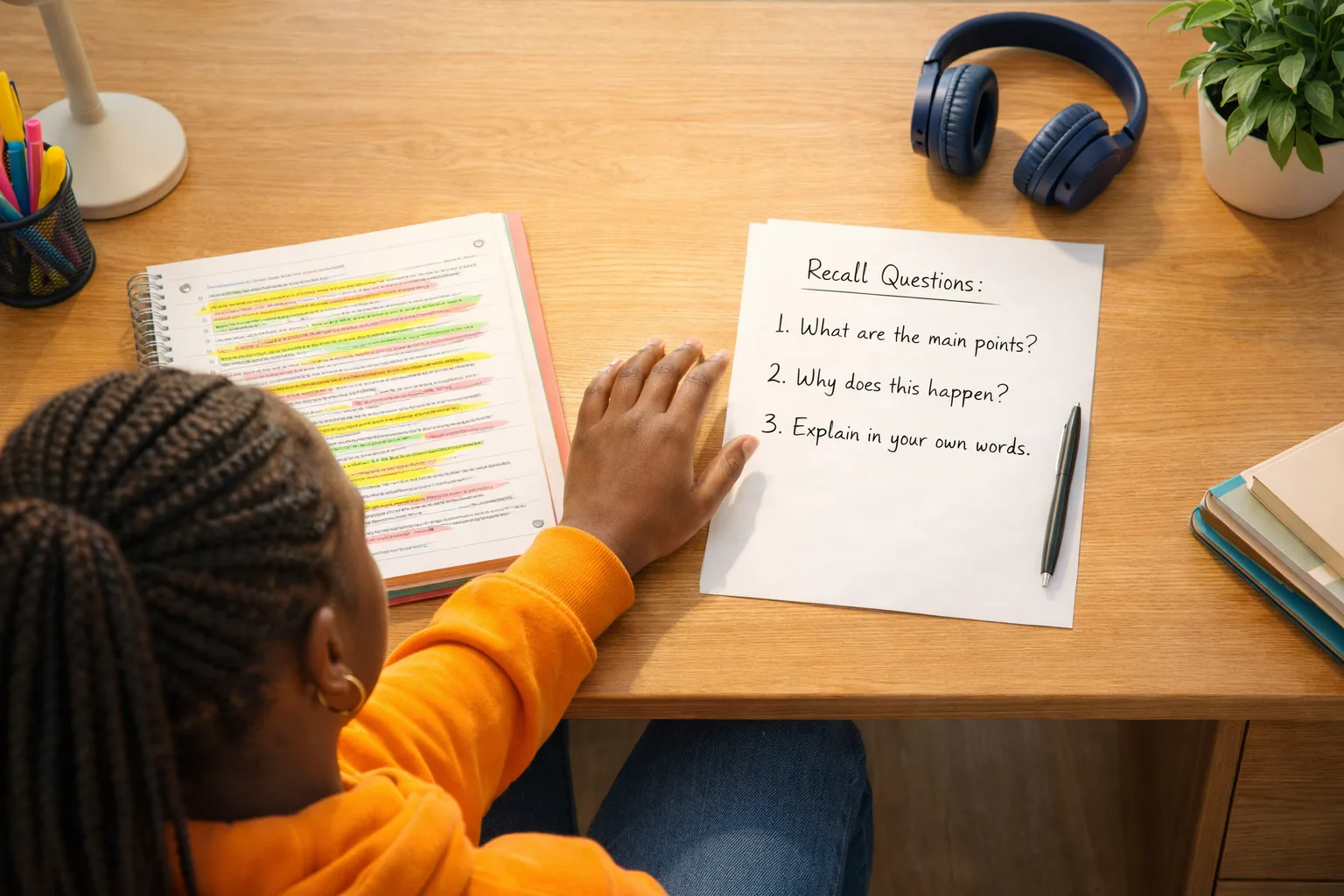
Highlighting is not understanding: why so many students rely on false signals
A brightly highlighted page feels reassuring, but it rarely proves real learning. Here is why highlighting is so appealing, what it actually does, and how to build a simple active reading routine that works across subjects.
Recognise why highlighted pages can feel reassuring while comprehension stays fragile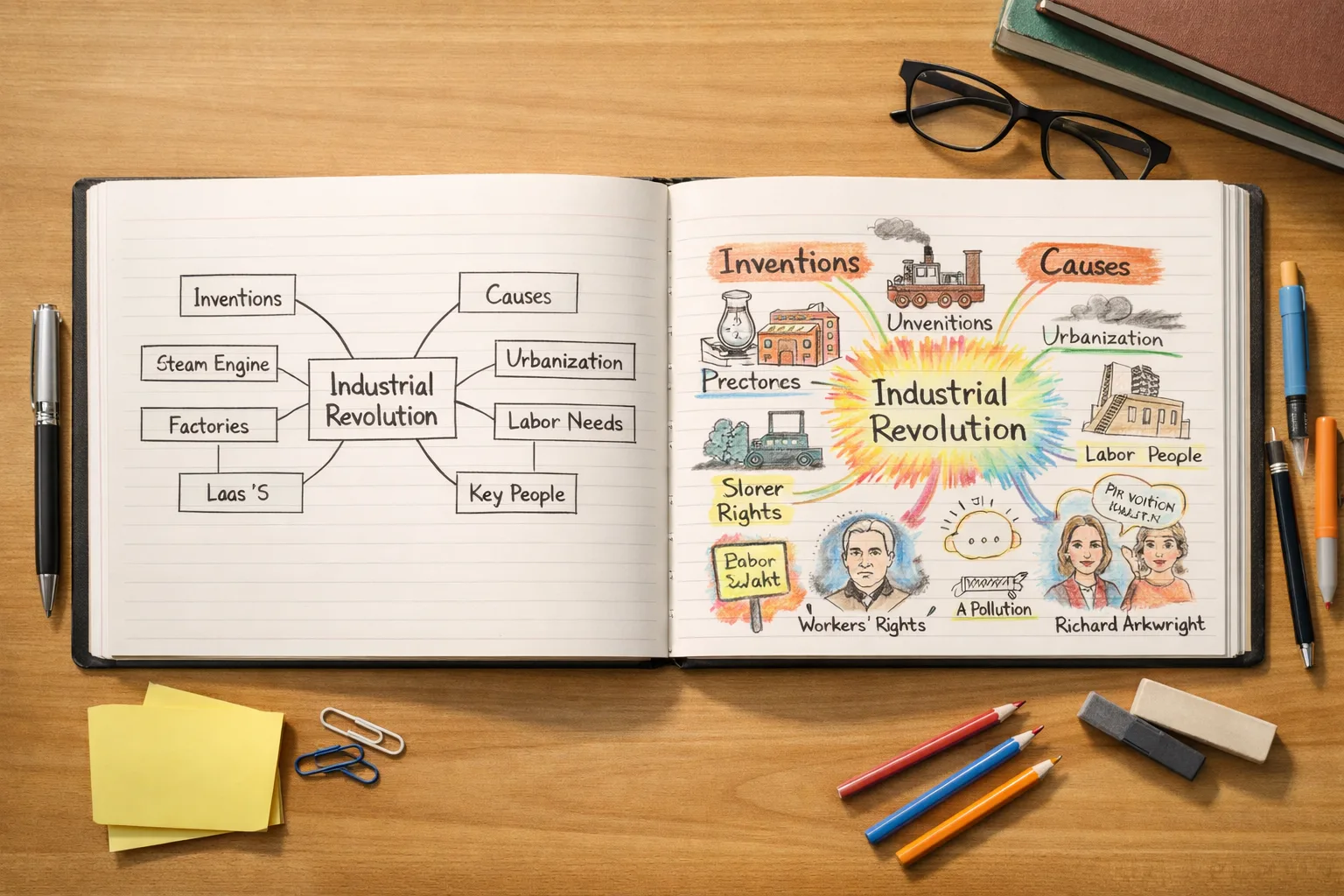
Mind maps: powerful tool or visual gimmick depending on how they’re used
A mind map can genuinely help a student understand and revise — but only if it forces them to organise, connect and recall ideas, not just rewrite the lesson in colour.
Use mind maps to organise relationships rather than decorate the lesson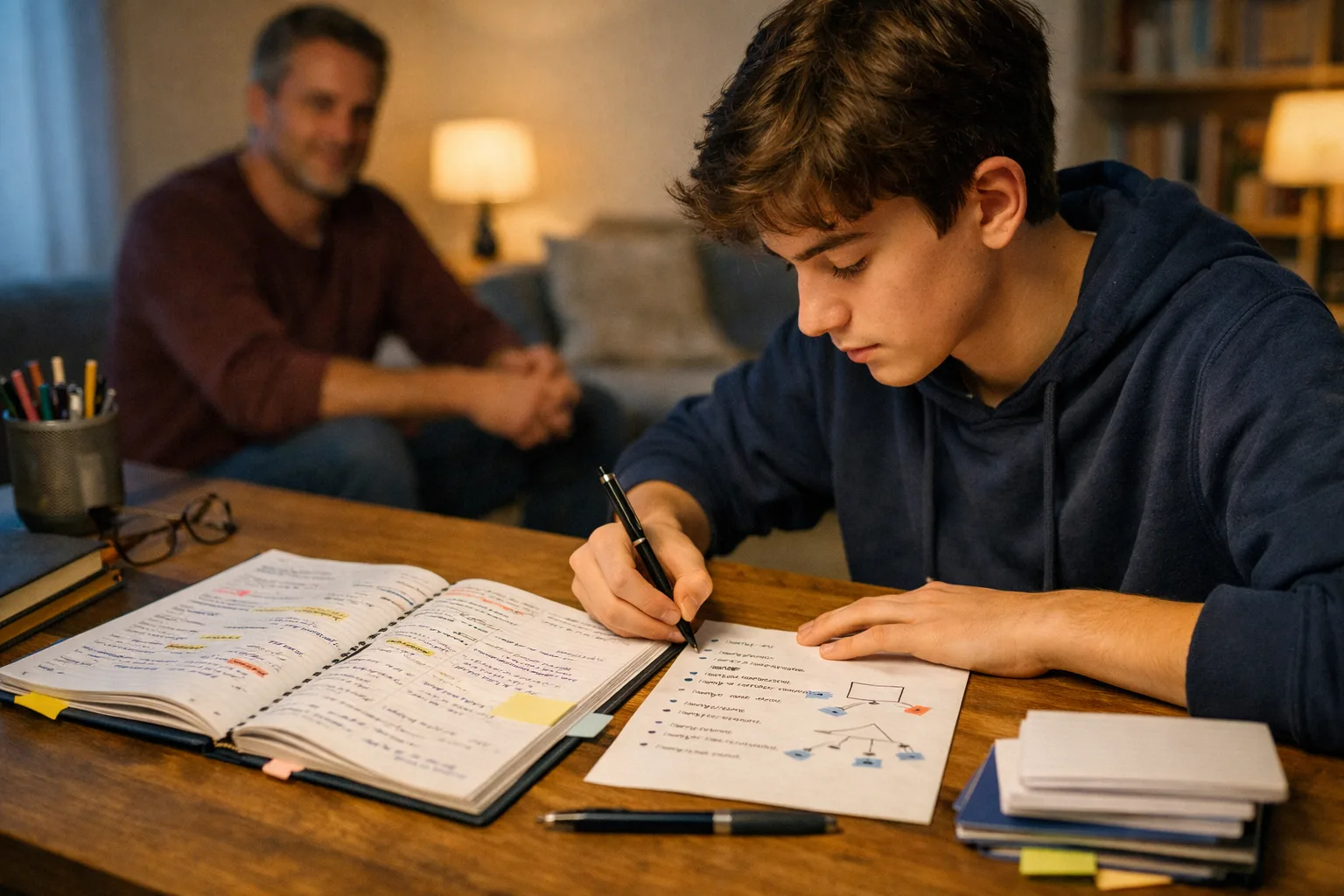
Should students rewrite their notes the same day — or is it just double work?
Rewriting all your notes the same day can feel responsible, but it is not always the best use of time. What usually helps more is a short active review that makes the lesson easier to revisit later.
Decide when same-day note rewriting helps and when it becomes double work
All articles in this category
Every published article in this topic, from newest to oldest.
- Active reading: how to read a chapter so your child can actually explain it
- Writing to learn: why rewriting is better than highlighting
- Highlighting is not understanding: why so many students rely on false signals
- Mind maps: powerful tool or visual gimmick depending on how they’re used
- Cornell note-taking: which students does it really help?
- Taking notes: listen, select, rephrase — instead of copying everything
- Should students rewrite their notes the same day — or is it just double work?