

Standardized and selective tests create a particular kind of family pressure: the result feels important, the preparation market is noisy, and the test can easily start to look bigger than the student’s wider education.
The calm answer is this: prepare for a standardized or selective test as a specific performance task, not as a judgment of the child’s worth or a second full school year. The family’s job is to understand what the test is used for, identify the student’s real bottleneck, practise the format enough to reduce avoidable mistakes, and stop before preparation starts damaging sleep, motivation, other subjects or confidence.
That approach is less dramatic than “do everything possible”. It is also usually more useful. A good preparation plan has boundaries: what the test measures, what score would actually change the outcome, how much time the student can spend without creating new problems, and what kind of support fixes the weakest link.
What standardized and selective tests really measure
A standardized test is designed so that students face broadly comparable conditions: similar instructions, timing, scoring rules and task types. That can make results easier to compare, but it does not make the score a complete portrait of the student.
Most standardized and selective tests measure a combination of four things:
- knowledge or skills that the test explicitly samples;
- familiarity with the format and question style;
- speed, attention and stamina under constraints;
- the student’s performance on one particular day.
The balance between those four elements changes from one test to another. A curriculum-linked exam may reward mastery of taught content. A reasoning-heavy admissions test may reward pattern recognition and time management. A selective entrance exam may use school knowledge, but under a ranking logic where small differences matter more than they would in ordinary classwork.
This distinction matters because families often prepare the wrong problem. If the child lacks the underlying knowledge, more timed papers will only reveal the same gaps again. If the child knows the material but loses marks through pacing, anxiety or careless interpretation of instructions, another content course may not help much. If the test is used only as one indicator among others, a heroic preparation campaign may have less value than maintaining strong schoolwork.
A test score should therefore be read as information, not as identity. It can say, “This format exposed weak algebra fluency,” or “Long reading passages under time pressure are costly,” or “The student is close to the target but needs better error control.” It should not say, “This child is simply capable or incapable.”
The most useful first family conversation is not “How do we beat the test?” but “What decision will this test influence, and what would a better score realistically change?” Without that question, preparation can become infinite.
Choosing a test or strategy without following the noise
Some families face a choice between tests. Others face a choice between levels of preparation: self-study, a short course, tutoring, repeated mock exams or doing very little beyond school. In both cases, the mistake is to copy what the loudest families are doing.
A better choice starts from fit. The right test or strategy is the one that best matches the student’s target path, current strengths, constraints and tolerance for workload.
Use these criteria before committing:
| Question | Why it matters | What to watch |
|---|---|---|
| What is the test used for? | A high-stakes selection tool deserves more preparation than a low-impact diagnostic. | Families sometimes over-prepare for tests that barely affect the decision. |
| Which skills does it reward? | Format fit can matter: speed, writing, calculation, reasoning, memory, oral performance or problem solving. | A student can be strong academically and still be poorly matched to one test format. |
| What preparation overlaps with school? | The best preparation often strengthens ordinary learning too. | Prep that only trains tricks may not transfer beyond the test. |
| What is the calendar cost? | A test scheduled near major school assessments can create hidden risk. | The student may gain on the test and lose ground elsewhere. |
| What does the first diagnostic show? | The starting point determines whether the plan should focus on content, format, speed or confidence. | A generic course can be inefficient if the bottleneck is specific. |
| What would be enough? | Families need a stopping point before they start. | Without a target, preparation expands until everyone is exhausted. |
The “enough” question is especially important. For some students, a modest improvement can change a placement or admissions outcome. For others, the likely gain is too small compared with the cost. The family should define success as a useful decision threshold, not as perfection.
It can help to separate three strategies:
- Minimum viable preparation: understanding the format, doing a diagnostic, correcting obvious gaps, and taking one or two controlled practice sessions.
- Targeted preparation: a few weeks or months of focused work on the student’s highest-value weaknesses, with regular review.
- Intensive preparation: a heavier plan used only when the test is genuinely decisive, the student can tolerate the workload, and the preparation does not damage core schooling.
The crowd often pushes families toward the third option. Many students need the second. Some only need the first.
Build a calibrated preparation system
A good standardized or selective test plan has a rhythm. It does not jump straight from “we should prepare” to endless mock papers.
A practical sequence looks like this:
1. Diagnose before buying help
The first diagnostic should reveal patterns, not just a score. Look at the student’s errors by type:
- content not learned or forgotten;
- misread instructions;
- slow execution;
- weak strategy for long questions;
- careless errors near the end;
- anxiety, freezing or rushing;
- fatigue after a certain duration.
This turns a vague worry into a plan. “Needs more preparation” becomes “needs faster fraction work,” “needs a reading passage routine,” or “needs to stop losing points through skipped instructions.”
2. Repair the highest-value gaps
The repair phase should be narrower than families expect. The goal is not to re-teach everything. It is to fix the gaps that repeatedly cost marks in the test’s format.
That might mean reviewing a small set of grammar rules, rebuilding a calculation routine, practising essay planning, strengthening vocabulary in context, or learning how to analyse a question stem before choosing an answer.
The danger is passive preparation. Reading explanations, watching solution videos and highlighting notes can feel productive while leaving the student unable to retrieve the method under pressure. The more useful pattern is: learn, close the book, try, check, correct, try again later.
3. Use practice tests as instruments, not rituals
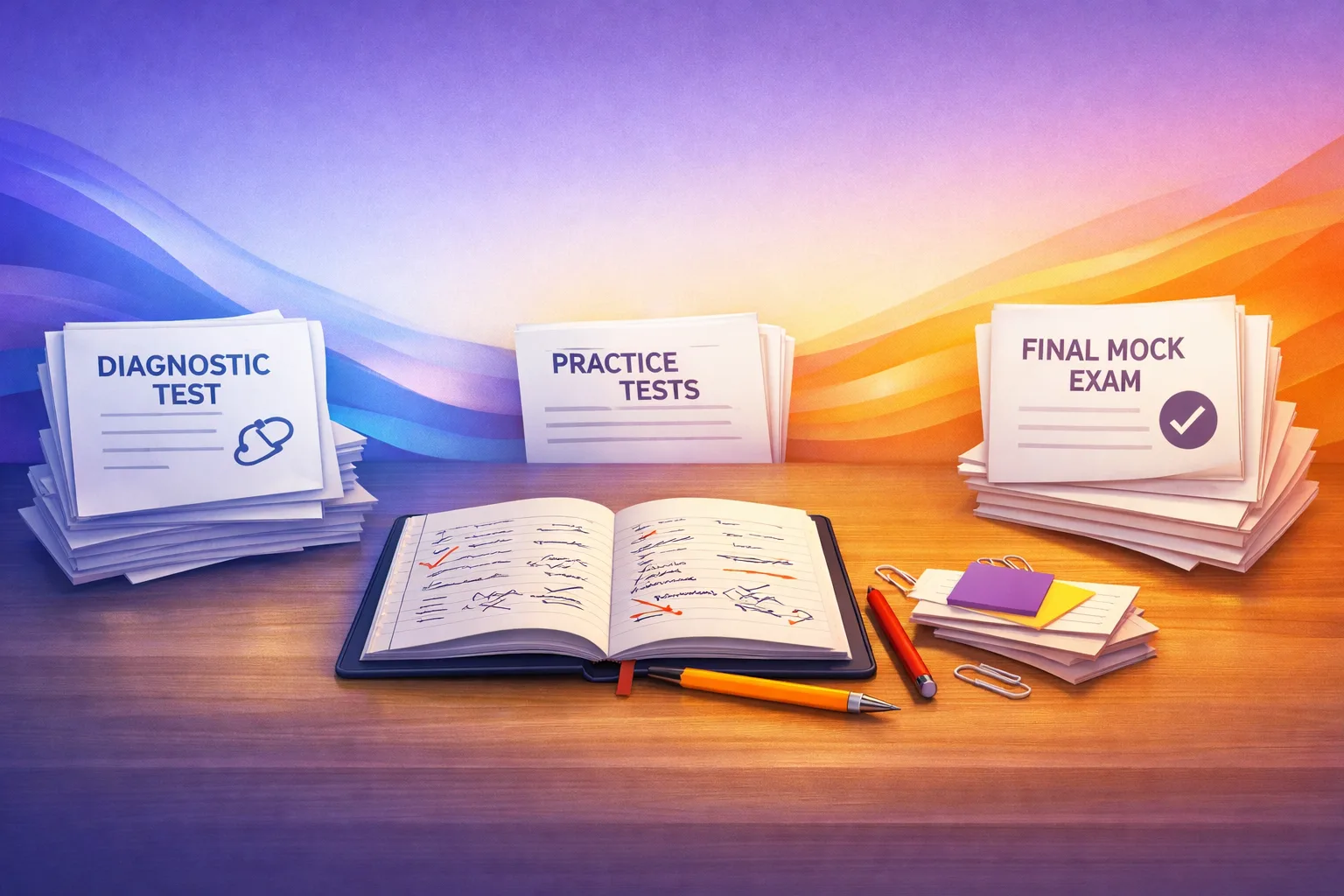
Mock tests are useful when they answer a question. Can the student manage the timing? Are errors clustered in one section? Does performance fall after fatigue? Does the student repeat the same avoidable mistake?
They are much less useful when they become a weekly ritual with no serious review. A full mock test consumes energy. If no one analyses the errors, it mainly teaches the family to watch a number move up and down.
For many students, fewer full mocks with better review will beat more full mocks with shallow correction. The review should produce a short action list: two or three skills to repair, one pacing rule to test next time, and one careless-error habit to monitor.
4. Space the work
Cramming can produce a temporary feeling of control, but standardized and selective tests usually reward fluent retrieval, not last-minute familiarity. Skills become more reliable when practice is spread out and revisited.
That does not mean every student needs months of heavy preparation. It means that even a short plan should avoid one giant final weekend. Several smaller sessions with active recall, mixed practice and review of previous errors usually do more for stability than one dramatic burst.
5. Finish with a taper, not a panic week
The last days before a selective test should protect sleep, confidence and routine. This is the moment to rehearse instructions, organise materials, review recurring errors and practise calm starts. It is not the moment to discover an entire new syllabus.
A final week built on panic can make a prepared student look unprepared. A final week built on consolidation helps the student arrive with usable energy.
Course, tutor, app or self-preparation: choose the support that fixes the bottleneck
Support is useful when it solves a specific problem. It is wasteful when it only makes adults feel that “something is being done”.
Here is a simple way to compare options:
| Option | Best fit | Main risk | Parent question to ask |
|---|---|---|---|
| Self-preparation | Motivated student, clear materials, limited gaps, manageable test stakes. | Drift, procrastination, shallow correction. | Can the student follow a plan and review errors honestly? |
| Group course | Student needs structure, format exposure and a shared pace. | Too generic for specific gaps. | Does the course adapt, or does everyone receive the same programme? |
| Tutor | Specific weaknesses, confidence issues, need for feedback or strategy correction. | Expensive calm without measurable progress. | What will the tutor diagnose and change in the first sessions? |
| App or digital tool | Regular practice, flashcards, planning, active recall, lighter daily structure. | Can become another passive screen if badly used. | Does it make the student retrieve, correct and repeat, or only consume content? |
| School-led support | Strong when the test overlaps with current curriculum and teachers know the format. | May not cover selective strategy or timing. | Is the school support enough for this test’s specific demands? |
The best option is often a combination, but not a pile-up. A student might use self-preparation plus a few tutor sessions for stubborn gaps. Another might need a course for format exposure and an app for daily recall. A third might need no paid help at all, only a clear calendar and serious error review.
A helpful rule is to pay for expertise, feedback or structure, not for reassurance alone. If the support cannot explain what it is changing, the family may be buying emotional relief rather than educational value.
Keep the test from swallowing the whole school year
Selective tests can distort family life because they feel separable from ordinary schoolwork. They sit outside the usual routine, so preparation gets added on top of everything else.
The hidden cost is opportunity cost. Every hour spent on test preparation is not spent on sleep, sport, friendships, reading, ordinary homework, long-term subject understanding or rest. Sometimes that trade-off is worth it. Sometimes it is not.
A sustainable plan protects four things.
First, protect core schoolwork. If test preparation is causing grades or understanding to fall in important subjects, the plan is too expensive. The family may need to reduce intensity, switch support type or delay a retake if that is possible.
Second, protect sleep. Tired students make more careless errors, regulate emotions less well and learn less efficiently. A plan that looks impressive on paper but depends on late nights is fragile.
Third, protect identity. A child who hears only about the test for months can start to feel that family attention depends on performance. The test should be important enough to prepare for, but not so important that it crowds out the rest of the child’s life.
Fourth, protect the parent-child relationship. When every evening becomes a negotiation about practice questions, the adult may become the test’s enforcer. That can work briefly, but it often damages autonomy. The better goal is a visible, agreed routine that reduces daily bargaining.
A useful weekly planning question is: “What can we do this week that improves readiness without stealing from the parts of life that keep the student ready to learn?”
After the score: retake, stop or redirect
The moment after a disappointing score is risky. Families may feel that another attempt is the only rational response because they have already invested time, money and hope. But past investment is not a reason by itself to continue.
A retake makes sense when several conditions are present:
- the score is close enough to a meaningful threshold;
- the student’s error pattern is identifiable and fixable;
- there is enough time to prepare differently, not merely repeat the same plan;
- the next attempt will not seriously harm schoolwork, health or motivation;
- the student still has enough willingness to engage.
A retake is less convincing when the family cannot explain what will change. “We will try harder” is not a strategy. “We will repair timing in section two, review the recurring grammar errors and take one supervised mock under realistic conditions” is a strategy.
Stopping can also be an active decision. It may mean using the existing score, focusing on other parts of an application or selection process, choosing a different route, or protecting the student’s broader learning. Moving on is not the same as giving up when the next attempt has low likely value.
The question is not “Did we do everything?” The better question is “Would another attempt be the best use of this student’s next month?”
Practical FAQ for families
When should preparation start?
Start when the family can answer three questions: what the test is used for, what the student’s current level looks like, and what preparation can fit without harming the rest of school life. For some students, this means a short, focused plan. For others, especially when there are real content gaps or heavy competition, starting earlier allows calmer spacing.
Starting early is not the same as starting intensely. A light diagnostic and occasional review can begin well before a heavier phase.
How many mock tests are enough?
Enough mock tests to learn the format, test stamina, timing and error patterns. Not so many that mocks replace learning.
A full mock should create a review plan. If the student cannot explain what changed after the last mock, the next one is probably premature. Shorter targeted practice can sit between full mocks so that each test checks progress rather than repeats failure.
Should a child prepare for a test that is “only” one part of a broader decision?
Usually yes, but proportionately. If the test is one signal among several, preparation should reduce avoidable underperformance without taking over the year. The family should invest more in the parts that matter most overall: consistent schoolwork, strong learning habits, appropriate rest and any required portfolio, interview or written components.
How should we read a score?
Read the score in relation to the test’s purpose. A raw number means little without knowing the scale, comparison group, score range, threshold or decision context. Also remember that measurement is not perfectly precise. Two nearby scores may not represent a meaningful difference in ability, especially if the test provider describes a score band or range.
The most useful reading is diagnostic: what does this result suggest we should keep, repair or stop doing?
What if test preparation increases anxiety?
Reduce uncertainty before increasing intensity. Anxiety often worsens when students face vague pressure but do not know what to do next. A predictable routine, low-stakes practice, shorter sessions and specific feedback can help.
If anxiety is severe, persistent or affecting sleep, eating, school attendance or daily functioning, the answer is not more test pressure. The family should seek appropriate support through trusted educational or health professionals in their own context.
Is tutoring worth it?
Tutoring is worth considering when the student needs diagnosis, feedback, accountability or help with a specific skill that self-study is not fixing. It is less useful when the student already knows what to do but is not doing it, or when the tutor simply assigns more practice without analysing why errors happen.
Ask for a plan after the first sessions: what is the bottleneck, what will change, and how will progress be visible?
When should we stop preparing?
Stop when the expected gain no longer justifies the cost, when the student has reached the needed threshold, when preparation is harming wider learning, or when the next attempt would repeat the same approach without a credible reason to expect change.
A mature test strategy includes an exit rule. Families who define that rule early are less likely to be trapped by sunk costs later.
A calm way to move forward
Standardized and selective tests deserve respect, not obsession. They can open doors, but they are still limited instruments: they sample certain skills in a particular format, under particular conditions, for a particular decision.
For families, the strongest approach is simple and disciplined:
- clarify what the test really changes;
- diagnose before intensifying;
- prepare the highest-value gaps;
- use practice tests for evidence, not drama;
- choose support based on the bottleneck;
- protect schoolwork, sleep and confidence;
- define the stopping point before emotion takes over.
That is how a test becomes manageable. Not easy, necessarily. Not irrelevant. But contained: one important task inside a wider education, not the measure of the child’s future.
Sources
- Standards for Educational and Psychological Testing
- The science of effective learning with spacing and retrieval practice
- Improving Students’ Learning With Effective Learning Techniques: Promising Directions From Cognitive and Educational Psychology
- Test-Enhanced Learning: Taking Memory Tests Improves Long-Term Retention
Keep reading
Related reading
How many mock tests do you really need before a selective exam?
Before a selective exam, more mock tests are not always better. In many cases, 3 to 6 full mocks are enough, depending on the starting level, the time available and, above all, the quality of the review.
Plan full mock tests around review quality, not volume
Retake the test or move on: how to decide without being trapped by sunk costs
After a disappointing score, retaking the test can feel like the obvious next step. Here is a concrete framework for weighing the likely gain, the hidden cost and the right stopping point.
Decide whether another attempt is worth the time, stress and opportunity cost
All articles in this category
Every published article in this topic, from newest to oldest.
- Intensive revision or a plan over several months: which pace suits which student?
- Retake the test or move on: how to decide without being trapped by sunk costs
- How many mock tests do you really need before a selective exam?
- My child keeps getting the same scores in mock tests: how to tell a real plateau from an ineffective revision method
- How to read a score report: raw score, scaled score, percentile and sub-scores
- AP Exam season: how to handle the workload without sacrificing every other subject