

A student can spend hours with notebooks open, make neat revision sheets, reread the night before a test, and still forget quickly. That does not automatically mean they are lazy or careless. Very often, the effort is real, but the learning actions are in the wrong order.
The central idea is simple: effective learning follows a chain. A student first needs to understand the lesson, then encode it actively, recall it without support, reactivate it later, and finally use it in the format the subject requires. When one link is missing, study time can produce familiarity with the page rather than durable knowledge.
This guide to study skills, revision and memory is organised around three questions families often need to untangle:
| If the problem looks like this | Start by working on | What changes in practice |
|---|---|---|
| The student forgets quickly, only “knows” the lesson with the notebook open, or goes blank when asked a question | Long-term memory and revision retention | Some rereading is replaced by active recall, spaced returns and short self-tests |
| Notes overflow, everything is highlighted, revision sheets keep multiplying, but the lesson does not stabilise | Active reading, note-taking and writing | The student learns to select, rephrase and write in order to understand and prepare recall |
| The same method is used for maths, languages, history, science or literature, with uneven results | Subject-specific study methods | Revision is adapted to the real task: solve, explain, compare, prove, write, speak or apply |
The goal is not to collect more study tricks. It is to see where the real bottleneck is, then choose the smallest method that actually changes learning.
Why students can work hard without really learning
The first useful distinction is between four things that often get blurred at home:
- time spent, which only proves that the student stayed with the task;
- familiarity, which feels like knowledge because the page, diagram or wording is recognisable;
- understanding, which means the student can follow and rephrase the idea;
- retrieval, which means the student can find, organise and use the idea without looking.
Many students confuse familiarity with learning. They reread a lesson, recognise the vocabulary, feel reassured, then discover during a test or oral explanation that they cannot rebuild the answer alone. Others produce a lot: full notebooks, beautiful revision sheets, colour-coded diagrams, long weekend sessions. The activity is visible, but the decisive question remains: what did the student actually have to recall, explain or use from memory?
Unproductive effort often leaves recognisable signs. A student may forget soon after a good test, be unable to redo an exercise that was “understood” in class, feel confident the evening before and then freeze the next day, or keep creating new study materials without clearer performance. In these cases, the problem is not always effort. It is often the absence of a learning sequence.
This changes the parent’s role. Instead of asking only “Have you finished?”, it is often more useful to ask: “What can you explain without looking?”, “What kind of question could be asked?”, “Which older point did you bring back today?”, or “Where did you get stuck when the notes were closed?” The conversation moves from supervising time to checking learning.
There is one important limit. If a student continues to struggle despite structured revision, real effort and reasonable support, the explanation may be broader: anxiety, sleep, attention, an underlying learning difficulty, gaps that have accumulated over time, or a school workload that has become unrealistic. Better study skills can help a great deal, but they do not replace proper support when the difficulty is persistent, intense or long-standing.
The complete chain: learn, remember, recall and use
Students rarely learn well when they skip a link in the chain. A robust sequence looks like this:
- Understand: identify what is new, what is essential and how the ideas connect.
- Encode actively: rephrase, create an example, compare ideas, draw a simple structure or turn the lesson into questions.
- Recall: close the notebook and retrieve what is really available.
- Reactivate: return later, when part of the lesson has started to fade.
- Use the knowledge in the right format: exercise, paragraph, diagram, oral answer, proof, commentary, translation, calculation or explanation.
- Correct errors precisely: find the exact point that resisted instead of settling for “I understood it now”.
This sequence sounds obvious once written down, but many students experience only a shortened version. They understand during class, then move almost directly to rereading. Or they memorise isolated facts without practising how to use them. Or they revise only the urgent chapter and never bring older lessons back into circulation. The result is schoolwork, but not yet a learning system.
The dominant difficulty also changes with age and school stage. Younger students often need help understanding instructions, saying the idea aloud and building small automatic habits. As work becomes more demanding, illusions of mastery become more common: highlighted pages, copied notes, last-minute revision and one method used for every subject. Later, the volume increases, but the bigger shift is the nature of performance: students must select, structure, write, argue, solve under time pressure and explain without a prompt.
A useful question is: which link in the chain is missing today? If the student has not understood, self-testing too early becomes discouraging. If the student has understood but never recalls without support, revision stays fragile. If the student recalls definitions but never uses them in the expected format, performance remains uneven. Study skills become much clearer when the family stops asking for “more work” in general and starts locating the weak link.
What actually builds durable memory
School memory depends less on the number of study materials than on the quality of recall. Rereading can reopen a chapter, but consolidation really begins when the student has to retrieve something without seeing it. That shift from recognition to recall is one of the most important changes a family can make.
It helps to separate methods that are often lumped together:
| Method | What it can do | Main limitation | Practical verdict |
|---|---|---|---|
| Rereading the lesson | Reopens the chapter and restores vocabulary | Mostly builds recognition and a feeling of mastery | Weak on its own |
| Highlighting | Can help mark key points after real selection | Easily becomes a reassuring false signal | Weak on its own |
| Making a revision sheet | Can force selection and hierarchy | Useful only if it later becomes a self-test tool | Useful under conditions |
| Flashcards or question-answer cards | Strong for vocabulary, dates, definitions, formulas and key facts | Not enough for reasoning, writing or complex problem solving | Very useful for the right content |
| Blank page recall or a mini oral | Shows what is genuinely retrievable | Requires accepting the discomfort of partial recall | Very high value |
| Redoing a corrected exercise | Helps review a method and understand a step | Can hide dependence on the previous solution | Useful for learning, not enough to validate autonomy |
| Error correction | Reveals the real blockage | Requires more precision than “I get it now” | Very high value |
| Mixing chapters or exercise types | Trains the choice of the right procedure | Too hard if the basics are not in place yet | Useful once the lesson is understood |
The question is not “Did they revise a lot?” but “What did they have to remember without help?” A durable memory grows when the student returns after a delay, struggles a little, retrieves part of the lesson, corrects the gap, and repeats later. This is less dramatic than a long last-minute session, but usually more stable.
The support must also match the content. Dates, spellings, definitions, vocabulary and formulas often suit short questions. A scientific mechanism, a mathematical method, a literary argument or a historical explanation needs more: steps, examples, links, typical errors and practice in building an answer. Memory is not one technique applied everywhere. It is the art of choosing the right recall task for the knowledge.
A lesson is not truly secure just because it feels clear the same evening. The more useful test is delayed recall: can the student reopen an older topic quickly, retrieve its main structure and use part of it without starting again from zero?
Active reading, note-taking and writing: the neglected link
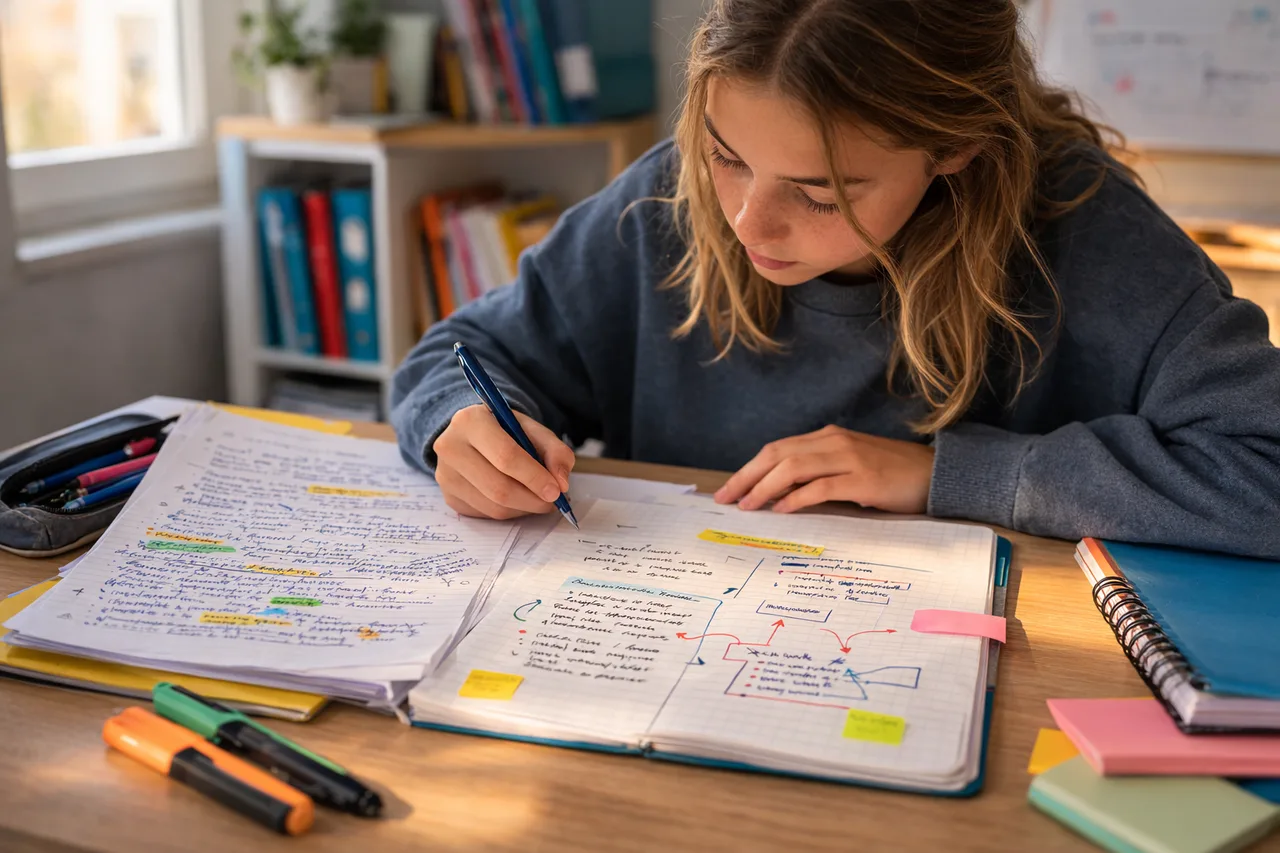
Memory starts badly when the first understanding is fragile. Many students try to memorise material they have only skimmed or copied. We remember more reliably what has been selected, connected and rephrased.
Read to understand before trying to memorise
Active reading does not mean reading with more tension. It means reading with a purpose. What is the main idea? What explains what? Which two notions look similar but are different? What example would prove that I understand? What question might a teacher ask about this passage?
A student who reads like this is already preparing revision. They notice unclear zones, technical words, links between ideas and examples they could use later. Passive reading, by contrast, often leaves behind a familiar page that cannot yet support an answer.
Useful notes are not the same as complete notes
A full notebook is not necessarily a good revision tool. Useful notes capture what matters: the structure of the lesson, key examples, definitions that must be exact, questions to revisit, and the places where the student is likely to confuse two ideas.
This is why common habits need nuance:
- highlighting can help after a real selection process, but it does not replace selection;
- a fixed note-taking frame can help students who need structure, but no layout is magic;
- mind maps are useful when they force the student to organise and connect ideas, not when they become decorative copies;
- rewriting all notes the same day can become double work if the rewriting does not clarify, condense or prepare later recall.
The aim is not to make the notebook impressive. The aim is to make the material easier to reopen and easier to turn into questions.
Write in order to learn, not only to produce homework
Short working writing is often underrated. Rewriting a definition in one’s own words, summarising a mechanism in six lines, justifying an answer, drafting a short historical paragraph, explaining a diagram aloud and then correcting the wording: all of these actions organise thought.
For many students, the decisive move is not “make one more sheet”. It is to turn the lesson into a few written questions and answers. That is where they discover what they understood, what they merely recognised and what they still cannot explain clearly. Writing becomes a rehearsal for recall, not just the final product.
The right method changes with the subject
A common mistake is to look for one universal method: reread, make a sheet, learn by heart, repeat. But each subject asks for a different kind of performance. A method that works for vocabulary may disappoint in maths. A method that helps in history may not prepare a student to write a literary paragraph.
| Subject or task type | Common mistake | More useful approach |
|---|---|---|
| Maths | Doing many pages without identifying the exact recurring error | Classify mistakes, redo a nearby problem without the correction, and explain the chosen method |
| Science | Memorising terms without understanding the mechanism | Explain the process step by step, connect words, diagrams and examples, then apply them to a question |
| History | Learning dates as isolated labels | Turn dates into reference points: cause, consequence, turning point, example and chronology |
| Geography or spatial topics | Making a neat map or diagram without knowing what it proves | Use the visual support to compare places, organise spatial reasoning or explain a pattern |
| Literature and essay subjects | Collecting quotations and course points without structure | Link example to argument, build a plan, practise short paragraphs before longer answers |
| Languages and oral work | Relying on one large weekly session | Revisit briefly and often, say phrases aloud, reuse vocabulary in sentences and practise short spoken answers |
| Spelling and grammar | Repeating rules without training the exact move that fails | Identify the error type, contrast similar forms and practise in short written contexts |
The key question becomes: what form of restitution is the student training for? To solve? To prove? To compare? To explain a mechanism? To remember exact vocabulary? To speak for two minutes? To write a paragraph that has a clear line of thought? Until this is clear, the student can work seriously but miss the target.
This also explains why advice about “learning how to learn” must stay concrete. A good strategy is both general and subject-aware. At the start of a chapter, the student clarifies and structures. In the middle, they self-test and apply. Before an assessment or deadline, they practise in the real format: not just “knowing the lesson”, but using it in the way they will be asked to use it.
A realistic 7-day routine to anchor a chapter
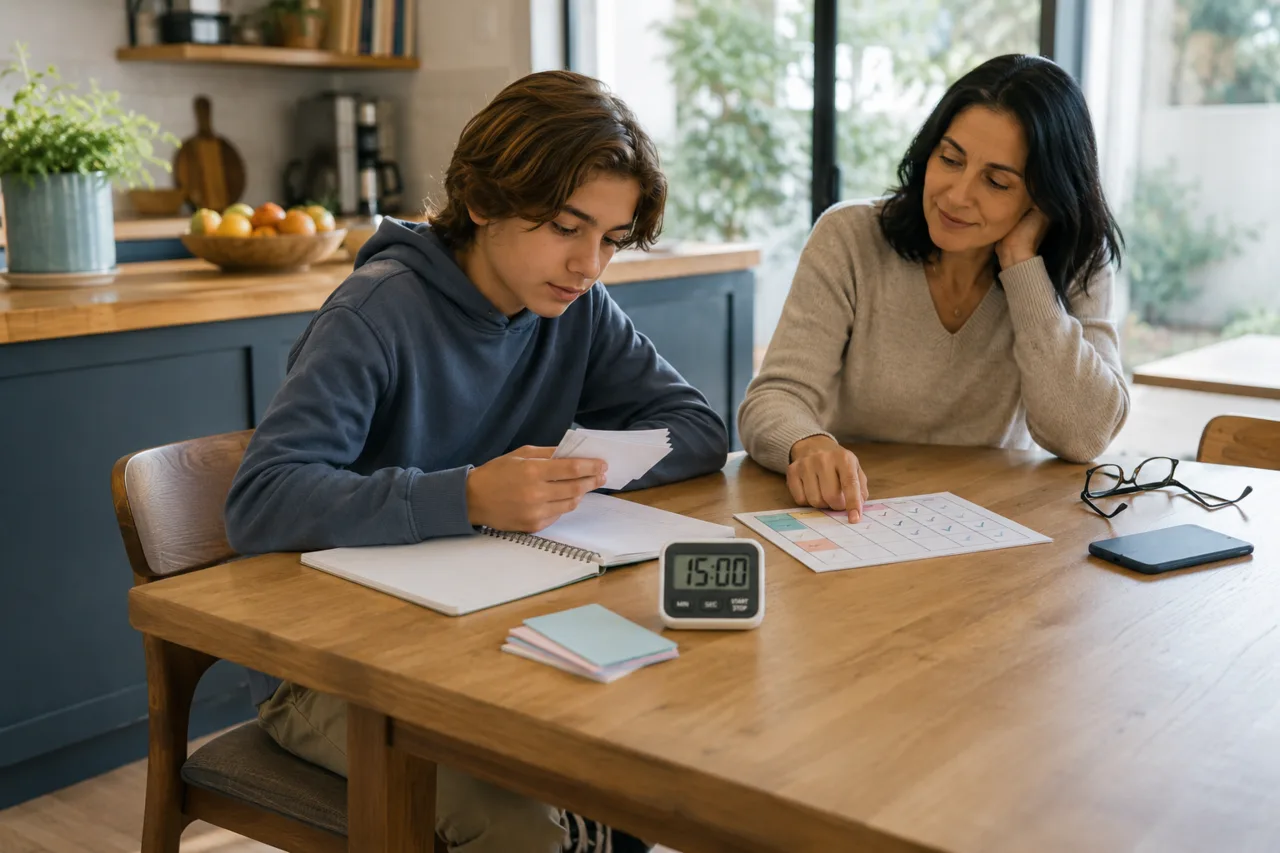
Families do not need a perfect system. They need a routine light enough to survive ordinary evenings. In many cases, short and regular returns beat one isolated long session because they bring the chapter back before it has disappeared.
Here is a simple pattern to adapt:
| Moment | Aim | Minimum action |
|---|---|---|
| Day of the lesson or next day | Put the material in order while the trace is fresh | Reread quickly, fill gaps, note 3 key ideas and 2 possible questions |
| Two days later | Force the first recall | Close the notebook and do a mini blank page, 5 question-answer cards or a short oral explanation |
| About a week later | Check what remains after a real delay | Do a short recall, then one exercise, one paragraph, one diagram explanation or one spoken answer depending on the subject |
| End of the week | Bring back an older topic | Spend 10 minutes on an older lesson without starting it from scratch |
| Before a test, presentation or written task | Practise the expected format | Mix questions, work with light time pressure, correct errors and rehearse the real kind of answer |
This routine is best seen as a realistic floor, not an ideal timetable. For a younger student, five to ten minutes, mostly oral and guided, may be enough. For a student facing heavier workloads, a short visible list of tasks can reduce the friction of starting. Later, more written answers, mixed questions and format-specific practice become necessary.
The decisive point is not to reserve revision for the moment when an assessment is already close. When school pressure rises, the problem is rarely only the number of chapters. It is the difficulty of reopening older material quickly, selecting the essentials and producing an answer under constraints.
A routine should also protect family life. A parent does not need to supervise every detail. Often the most useful support is brief: check that the student has one concrete task, listen to a mini explanation, ask one older question, and help them notice whether they recognised the lesson or truly retrieved it.
How to know whether a lesson is really learned
A lesson is not learned because it comes back quickly when reread. It starts to be learned when the student can do something with it without support. A simple check is more reliable than a general feeling.
Use this checklist:
- Can the student explain the main idea without opening the notebook?
- Can they retrieve key terms, dates, formulas or steps after a delay?
- Can they answer mixed questions, not only questions in lesson order?
- Can they use the idea in an exercise, example, paragraph, diagram or oral answer?
- Can they name their usual mistake?
- Can they distinguish this idea from a nearby idea that is often confused?
- Can they return to an older chapter without starting again from the beginning?
When the answer is no, avoid the vague conclusion “they don’t know it”. Identify the type of failure.
| If the check fails here | The likely issue | What to do next |
|---|---|---|
| Definitions, dates, spellings or vocabulary disappear quickly | Not enough retrieval | Short questions, flashcards, mini recall sessions spaced over time |
| The plan comes back but the explanation is unclear | Understanding is still fragile | Targeted rereading, rephrasing, an example, a short oral explanation |
| The student can follow a correction but not work alone | Familiarity without autonomy | A similar exercise without help, then precise error correction |
| The lesson is known but the written answer is disorganised | Restitution format is the issue | Quick plan, short paragraph, model answer comparison, format practice |
| Everything is clear the same evening but gone a week later | No delayed reactivation | Return after two days, after about a week, then later again |
This checking stage also changes the parent’s place. The parent does not have to become a private tutor or permanent examiner. A lighter role is often more effective: make the student verbalise, ask for an example, listen to a short oral answer, check that an older topic has not vanished, and help distinguish “I recognise it” from “I can use it”.
What to change today
The whole chain of study skills, revision and memory can be reduced to five practical shifts:
- Stop measuring learning only by time spent. Ask what the student can recall, explain and use.
- Replace some rereading with active recall. Use questions, a blank page, a mini oral or an exercise without the correction visible.
- Make notes and revision sheets earn their place. They should select, connect and prepare future self-tests, not simply look complete.
- Adapt the method to the subject. Vocabulary, essays, maths, science mechanisms and oral work do not need the same kind of practice.
- Install a minimal rhythm of reactivation. A few short returns are often more realistic and more useful than one dramatic last-minute session.
Learning, remembering and using a lesson are not mysterious talents. They are a sequence of actions. When that sequence becomes visible, effort becomes less scattered. The student stops relying only on familiar pages and starts building knowledge that can be retrieved, explained and applied. That is the real promise of better study skills: not more pressure, but clearer work and more durable progress.
Sources
- Improving Students' Learning With Effective Learning Techniques: Promising Directions From Cognitive and Educational Psychology
- Test-enhanced learning: taking memory tests improves long-term retention
- Distributed practice in verbal recall tasks: A review and quantitative synthesis
- Metacognition and Self-Regulated Learning - Guidance Report
Keep reading
Related reading

Taking notes: listen, select, rephrase — instead of copying everything
A full notebook is not always a useful one. Here is how to help a student take notes that actually support understanding, memory, and revision.
Build notes that support understanding, memory and later revision.
Modern languages: why five minutes a day beats one big weekly revision session
In modern languages, the real difficulty is often not how much has been covered but whether it can be retrieved quickly enough. Here is why very short daily revision bursts often beat one big weekly session, and how to make them useful for vocabulary, grammar, listening and speak
Apply short daily recall to vocabulary, grammar, listening and speaking.
All the in-depth guides in this topic
Explore our published guides on the main subtopics in this area, from newest to oldest.