

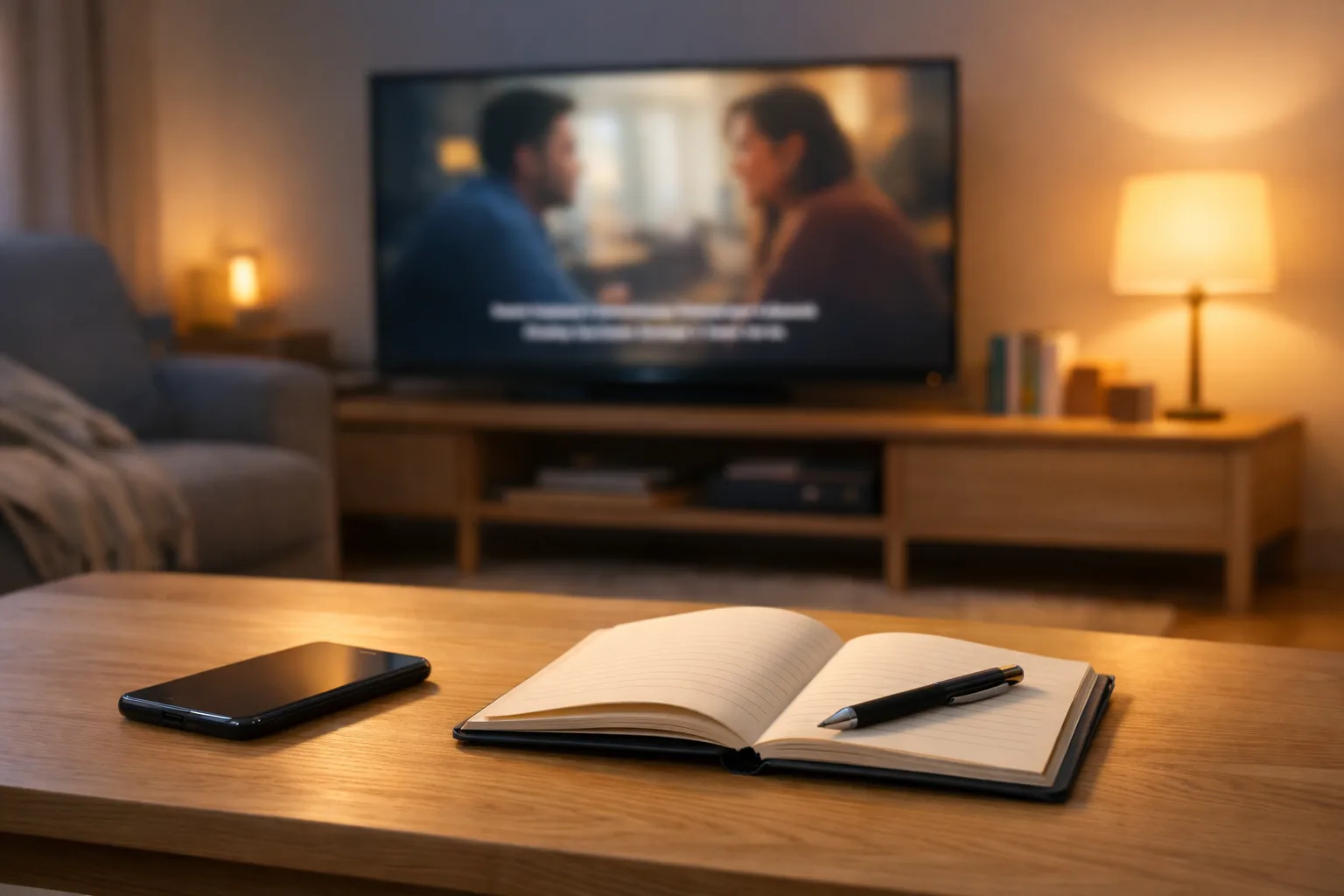
Many families know the scene. A secondary-school pupil puts on a series in English, Spanish, German or another language, then adds almost casually that it is ‘good for languages’. Parents hesitate. Is this a genuinely useful habit, and therefore something to encourage, or simply a convenient argument for more screen time?
The useful answer is less dramatic than the slogans. Yes, watching in the original language can genuinely help, especially with listening, familiarity and some vocabulary. No, it is not a complete method on its own. And as soon as viewing spills into late nights, happens with a phone in hand, or turns a binge into a supposedly ‘cultural’ activity, the language benefit moves into the background.
The useful answer: yes, but not in the way people often imagine
Watching TV series in the original language can be a good complement to language learning. But families often confuse three different things: contact with a language, actual learning, and the convenient relabelling of a strongly desired leisure activity.
A simple distinction helps:
| Situation | Likely effect on language learning | A reasonable parental verdict |
|---|---|---|
| Original-language audio with subtitles in the language the child already knows best, and nothing else | The child stays in contact with the sounds and may notice some recurring words, but the gain is mostly passive | Leisure with a language bonus, not genuine study time |
| Original-language audio with captions in the target language and a roughly suitable level | The student links sounds, written words and repeated expressions more effectively | A genuinely useful complement for listening and vocabulary |
| No captions, even though the level is still too low | A lot is guessed from the images, the plot and familiarity with the series | A common illusion of progress |
| Late-night episodes, autoplay, notifications or a second screen | Language processing becomes fragmented and sleep pays the price | More cultural alibi than learning tool |
So the real question is not only, ‘Is it in the original language?’ It is: under what conditions, for what level, and at what cost to the rest of school life?
What original-language viewing genuinely brings
The strength of a series is not magic. It is repeated exposure. The same voices, turns of phrase, registers and speech patterns come back across many episodes. For pupils who only get a limited number of classroom hours in a foreign language, that extra exposure can matter.
First, the ear gets trained. Many students can recognise a word on the page but struggle to hear it in continuous speech. Original-language viewing exposes them to real speed, contractions, intonation, accents and the way words run together. It does not replace teaching, but it can make the language feel less abstract.
Second, vocabulary becomes less isolated. In a school list, a word often sits on its own. In a series, it comes back with a voice, a situation, an emotion, a gesture and a consequence. That context makes meaning easier to anchor and repeated expressions easier to notice, especially when the same world and characters return from episode to episode.
Third, motivation holds more easily over time. A teenager is unlikely to accept every free moment being turned into a teaching plan. But the same teenager may tolerate a lot of contact with another language if the content genuinely interests them. An imperfect habit that lasts can be more valuable than an ideal method abandoned after three days.
This benefit is strongest when the viewing remains broadly understandable. A series that is far too difficult does not create useful immersion. More often, it creates fatigue, disengagement, or a way of following the plot mainly through images and routine.
What TV series do not replace
This is where the ‘cultural alibi’ appears. A young person may sincerely feel they are improving because they understand a scene, an atmosphere or a relationship between characters better than before. That feeling is not entirely wrong. But it does not tell the whole story.
School does not assess only familiarity with a language. It also asks students to retrieve a word actively, build a sentence, understand a text without visual support, choose the right grammatical form, speak with some precision, or write without leaning on music, facial expressions and images. Watching a series is, most of the time, a receptive activity.
That is why original-language viewing is not a credible substitute for:
- sustained reading in the language;
- vocabulary that is learned and reused;
- writing that receives correction;
- speaking practice in which the student has to search for words for themselves.
A child can improve in listening comprehension and still remain weak in writing or hesitant when speaking. So it is worth rejecting two symmetrical exaggerations. The first is: ‘It is useless.’ That is false. The second is: ‘If they watch in the original language, they are doing their language work.’ That is false as well. In many families, the fairest formula is this: it helps a bit, sometimes quite a lot, but only on certain parts of language learning.
Subtitles, level and age: the settings that change everything
The subtitles debate is often too ideological. Some adults think subtitles must disappear in order to ‘force’ listening. Others assume that any subtitles at all automatically turn screen time into learning. In practice, the answer depends heavily on the student’s real level.
For clarity, it helps to distinguish two modes: subtitles in the language the child already knows best and captions in the language they are trying to learn.
If the level is still fragile
For a student who is genuinely starting out, or who is already struggling in class, original-language audio with subtitles in the stronger language can still have a modest but real value. They hear the rhythm of the language, notice a few repeated words, become more familiar with sentence melody, and above all do not lose the thread completely.
But it helps to call this by its proper name. It is not a revision session. It is leisure that keeps some contact with the language alive. There is no need to ask more of it than it can realistically give.
If there is already a basic foundation
As soon as a student has some foundations, captions in the target language often become more useful. They help connect what is heard and what is seen in writing. For many young people, this is where original-language viewing becomes genuinely productive: words no longer pass only through the ear; they begin to settle visually as well.
A simple strategy often works better than an absolute rule:
- start with captions in the target language;
- switch briefly to the stronger-language subtitles if frustration becomes too high;
- move back to the target-language captions as soon as the episode becomes followable again.
The goal is not methodological purity. The goal is to stay at the edge of difficulty, not in total fog.
If the level is already solid
For an older teenager who is genuinely comfortable, removing captions from time to time can make sense, but usually on short stretches or after a first viewing. ‘No captions at all’ is not a badge of virtue; it is simply a more demanding setting.
In that case, the best transfer back into school rarely comes from heroic viewing with no support. It comes more often from small acts of reuse: retelling a scene in a few sentences, noting three useful expressions, spotting a structure already met in class, or replaying a difficult line.
Age and format matter as well
A younger child often benefits more from a short, repetitive and comprehensible format than from a dense, fast and ironic adult series. As children grow into adolescence, complexity can increase, but the principle stays the same: a slightly easy series followed attentively is often more useful than a prestigious series far above the student’s level.
The content therefore matters almost as much as the language itself. A recurring series with familiar voices and readable situations is usually more exploitable than scattered content, heavy slang or episodes watched in fragments.
When the screen cancels out the language benefit
An episode in the original language does not have the same value if it is watched at half past six on a single screen, or at a quarter to midnight in bed with a phone nearby, intermittent attention and notifications still active. The language is then only part of the story.
The first issue is sleep. Once the series delays sleep or turns into several episodes through autoplay, the school cost can become greater than the small language gain of the moment. A tired student may listen less well in class, remember less effectively and tolerate effort less well the next day. A habit presented as ‘good for languages’ stops being very useful if it consistently damages sleep.
The second issue is divided attention. Many young people are not only watching a series. They are replying to messages, checking social media, looking up an actor, or commenting while they watch. In those conditions, they usually process much less of the language, and more shallowly. This is not a moral point. It is a question of how much language is actually being processed.
The third issue is the confusion between exposure and volume of screen time. A short, calm, understandable session with sensible captions can be quite defensible. Two and a half hours of back-to-back episodes to finish a season obey a different logic. Beyond a certain point, this is no longer opportunistic learning. It is intensive leisure with an educational label attached.
A realistic family framework if you want it to become genuinely useful
Most families do not have the time or desire to turn every episode into a mini lesson. That is not necessary. But a few explicit rules can make a real difference.
1. Name the activity honestly
Watching in the original language can be:
- leisure with a language bonus;
- a useful complement to school learning;
- or a convenient pretext for extra screen time.
Everything becomes easier once the family names the activity correctly. Without any small active trace, do not automatically count the episode as school work.
2. Choose one lever at a time
There is no need to impose target-language captions, vocabulary notes, pause-and-explain moments and oral retelling all at once. Light rules last longer in real family life. For example, choose only one of the following:
- keep captions in the target language;
- jot down three expressions;
- retell the episode briefly afterwards.
One light lever used consistently is worth much more than an ambitious protocol dropped after a week.
3. Protect the finishing time
For many parents, the most profitable rule is not linguistic but temporal: no episode started too late, no endless autoplay, no screen use in bed. A reasonable habit keeps its credibility precisely because it does not eat into sleep, homework or the most important revision time.
4. Ban fake multitasking
If the goal is a genuine language benefit, one screen is enough. No messaging in parallel, no scrolling on another device, no ‘I am watching, but I am also on my phone’. This rule is simple, observable and cognitively sound.
5. Build a light bridge back to school
The link with school should stay light, otherwise the leisure hardens into resistance. But a very small bridge is often enough: reuse an expression seen that week, compare an accent with one heard in class, retell a scene in thirty seconds, or notice a word already met in a lesson. It is this move from passive exposure to active reuse that most reliably turns original-language viewing into something more than decoration.
A good family framework makes the practice visible, sustainable and proportionate.
How to decide at home without turning it into a drama
Before accepting or refusing the argument that it ‘helps with languages’, three questions are usually enough.
1. Does my child understand enough to stay engaged without guessing everything?
If not, the content is probably too difficult, or the subtitle setting is badly chosen.
2. Does the chosen setting genuinely support the language being learnt?
Subtitles in the stronger language help keep the thread; captions in the target language usually help learning more; no captions makes sense only when the foundation is already strong.
3. Does the language benefit protect the rest?
If viewing eats into sleep, homework or attention, the trade-off becomes poor, even if the series is in the original language.
In the end, watching TV series in the original language is neither a pedagogical revolution nor a sham. It is a useful but partial exposure tool. Well set up, it can help. Poorly set up, it mostly gives a school-flavoured justification to screen leisure. The most useful parental response is therefore neither to idealise it nor to dismiss it, but to put it in its proper place: a possible support for language learning, provided it is not asked to do all the work on its own.
Sources
- Vocabulary Acquisition through Viewing Captioned and Subtitled Video: A Scoping Review and Meta-Analysis
- When to switch captions off? Exploring the effects of L2 proficiency and vocabulary knowledge on comprehension of captioned and uncaptioned TV
- Bedtime screen use behaviors and sleep outcomes: Findings from the Adolescent Brain Cognitive Development (ABCD) Study
- United Kingdom Chief Medical Officers’ commentary on ‘Screen-based activities and children and young people’s mental health and psychosocial wellbeing: a systematic map of reviews’
Keep reading
Related reading
Good grades, but at too high a cost: should you still ask for help?
Good grades do not prove that everything is fine. If a child is coping only through endless evenings, exhaustion, tears or constant parental steering, it can make sense to ask for help before the grades fall.
When decent results are coming at the price of exhaustion and endless evenings
Does my child need school adjustments, or mainly a different way of studying?
Concrete guidance for telling the difference between temporary overload, a study-method problem and a more durable difficulty, then deciding whether to observe, speak to school, seek a specialist assessment or ask for adjustments.
How to tell a study-method issue from a support need