

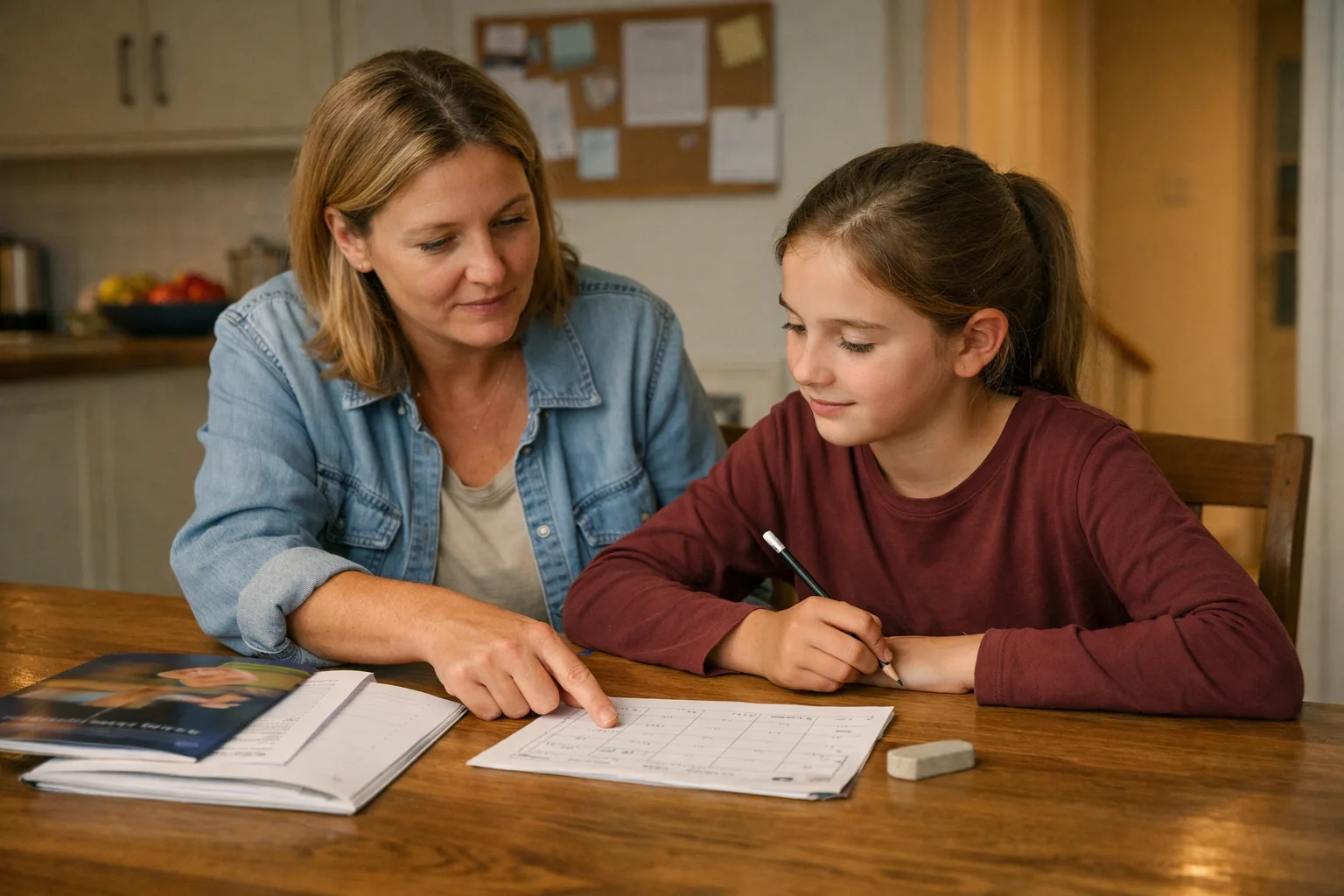
Before you buy another pack of papers or book another tutoring slot, it helps to separate three questions that families often muddle together: is the 11+ genuinely worth pursuing, what does your local route actually require, and how much preparation is enough before home life starts revolving around one test?
The short answer is that good 11+ preparation is usually more bounded, more local and less dramatic than the local playground mood suggests. The 11+ is not one national exam. It is one admissions route, available only in some parts of the UK, with different papers, timelines and oversubscription rules depending on the area and the schools. That means the first job is not to create an exam factory at home. It is to decide whether this route is genuinely open, suitable and desirable for your child.
If you do decide to try, the healthiest version is usually the same: use the official local information first, keep practice regular but limited, protect sleep and ordinary family life, and keep serious backup options in view. A house becomes a training centre when adults start treating one admissions process as a verdict on the child's worth.
Start with the local reality, not the local panic
One reason families overprepare is simple: they assume the 11+ is a single national contest. It is not.
In England, grammar schools are concentrated in a relatively small number of local authorities, and test arrangements differ from place to place. Some areas use GL Assessment materials. Some use other providers. Some test a broader mix of verbal, numerical and non-verbal reasoning. Others lean more heavily on English and maths. In Buckinghamshire, for example, children normally take the Secondary Transfer Test in the autumn term of Year 6, and the local system provides official familiarisation material and a practice test. In Bexley, the test mix is different again. The CSSE route uses separate English and mathematics papers. In other words, untargeted drilling can be a lot of work for surprisingly little decision value.
There is a second practical point that many families miss: sitting the test is not the same as applying for the school. For state secondary admissions in England, you still apply through your home local authority, and the usual deadline is 31 October. In some areas, registration for the test and deadlines for access arrangements happen much earlier. Northern Ireland also runs a separate post-primary admissions system, so families there should work from Education Authority and school guidance rather than English assumptions.
Before you decide how much preparation to do, answer these questions from official local sources:
- Do we actually have a realistic grammar-school route within reasonable travel distance?
- Which schools share a test, and which run different assessments?
- What does the test actually cover in our area?
- When are registration, test and access-arrangements deadlines?
- If our child qualifies, what else decides offers: distance, sibling criteria, catchment or something else?
This is the point at which a lot of unnecessary pressure disappears. Sometimes the real answer is that the route is not genuinely local, the commute would be punishing, or the oversubscription rules make the headline idea less attractive than it first sounded.
Decide whether the route fits your child, not the local status script
The 11+ can be a good route for some children. It is not a moral badge, and it is not a full portrait of a child either.
What tends to matter is not only raw attainment. It is the broader fit between the child and the type of school they may enter: pace, workload, confidence, response to timed tasks, and whether the family can support the process without turning every evening into negotiation.
Here is a more useful comparison than “grammar school equals ambition”:
| Option to compare | Often worth considering when | What to check before you commit |
|---|---|---|
| Local grammar-school route | Your child is secure across core subjects, copes reasonably well with timed work, and the school itself feels like a genuine fit | Admissions rules, travel time, what happens if they qualify but still miss out on a place |
| Strong local comprehensive or all-ability school | The local non-selective option is well run, offers stretch, and may suit your child’s temperament or confidence better | Sets, subject breadth, pastoral culture, behaviour climate, extracurricular life |
| Other competitive local routes | A faith, partially selective or specialist school is a real option in your area | What is actually being selected for, how applications work, and whether the fit is real rather than reputational |
| More than one route kept open | You want options without making one score carry the whole family narrative | Whether you can discuss backups calmly and honestly rather than treating them as failure |
A child may be very bright and still be a poor fit for months of pressure around the 11+. Another may not look especially “exam type” on paper but may cope well with steady preparation and flourish in a more academic environment.
What should make you pause is not one weak paper. It is a deeper mismatch such as:
- the child unraveling under timed conditions to the point that practice becomes mostly emotional management
- a long commute that would make the whole school day heavier than it needs to be
- large underlying gaps in reading, comprehension or maths fluency that are better addressed directly than disguised inside endless test prep
- adults caring far more about the school label than the child seems to care about the school itself
For children with identified or suspected additional needs, the question is not “should they be ruled out?” The question is whether the school and the admissions process can realistically accommodate what they need. If access arrangements may matter, that is something to check early, not after months of drilling.
What sensible 11+ preparation actually looks like
Once a family has decided the route is genuinely worth trying, the aim is not maximum volume. It is useful practice with a limit.
A good rule is that preparation should move through three stages.
1. Use official local familiarisation before generic overload
Start with the official material from the local authority, school group or test provider. That tells you far more than a random pile of mixed papers bought in panic. Because the formats vary so much, “doing lots” is not the same as “doing the right things”.
2. Build rhythm before speed
For many children, shorter sessions spread across the week are more effective and much less corrosive than one long weekend marathon. Research on learning consistently points in the same direction here: spaced practice and practice testing tend to support retention better than passive rereading and cramming. In family life, that usually translates into something simple: a few calm returns to the work beat one giant emotional event.
That also means not every session should be a full timed paper. Much of the useful work is quieter than that: vocabulary, careful reading, checking methods, one or two reasoning question types, and talking through errors.
3. Add timed practice later, and use it diagnostically
Timed papers matter because the 11+ is a timed process. But they become useful only when they tell you something. If every paper ends with “work harder”, the paper is not doing much educational work.
A better rhythm is:
- untimed or lightly timed practice when learning a new question type
- short retrieval-based sessions where your child has to answer from memory or explain a method
- occasional timed sections to build familiarity with pace
- full papers used sparingly, then reviewed carefully
The review matters more than the raw score. Ask: was the problem vocabulary, method, attention, or panic? Those need different responses.
A simple notebook can be enough: three headings, didn’t know, knew but rushed, need a better method. That keeps the work focused and stops every weak result turning into a global judgement.
What about tutoring?
Tutoring can help, especially when a parent-child relationship is becoming too tense or when you need a clear diagnosis of weak spots. But tutoring is useful only if it reduces confusion and conflict. A tutor plus daily drilling plus constant score talk is how families end up recreating a second school at home.
If you use a tutor, the best question is not “how many hours?” It is “what problem is this solving that we cannot solve calmly ourselves?”
Compare more than prestige before you ask your child to carry the pressure
A surprising amount of 11+ stress comes from social mimicry. The family is not always choosing between schools. Sometimes it is choosing between its own judgement and the local status script.
That is why it helps to compare the route before you intensify the preparation. Look at the things that still matter after the test:
- The school itself. Visit it. Read the admissions arrangements. Look at the culture, not just the results.
- The commute. A high-status school with a draining daily journey can become a poor bargain by November of Year 7.
- Oversubscription rules. In some areas, meeting the selective standard does not by itself secure a place. Distance and other criteria may still decide offers.
- Your realistic alternatives. A strong local comprehensive is not a consolation prize if it fits your child better.
- The family cost. Not only money, but time, sibling logistics, after-school life and the emotional temperature of the house.
- Your child’s own reaction. Not every ten-year-old gives a perfectly articulated view, but most children can tell you whether a school visit felt exciting, intimidating, draining or simply not for them.
One useful test is this: if nobody in your area talked about grammar schools as status markers, would you still judge this route to be the best fit? If the answer is unclear, slow down before you add more preparation.
Know the signs that preparation has started to do harm
The 11+ is meant to be an admissions process, not the organising principle of family life.
You are probably overdoing it if:
- every conversation about school turns into a score conversation
- your child is becoming more fearful of trying than interested in improving
- hobbies, reading for pleasure or sleep are being squeezed out
- one weak paper changes the mood of the whole house
- backup schools have become unsayable because they are treated as defeat
- the amount of preparation keeps rising, but nobody can explain what is improving
At that point, the answer is usually not to add another paper. It is to reduce noise and recover judgement.
That may mean pausing full papers for a couple of weeks, returning to shorter untimed practice, visiting non-grammar options properly, or asking your child’s primary teacher for a grounded view of current attainment and school fit. If there may be an access-arrangements issue or an underlying learning difficulty, check the formal process early. More pressure is a poor substitute for better information.
A calm decision framework for families
If you want one compact rule, use this:
- Confirm the route is genuinely local and realistic.
- Decide whether the school type fits the child, not the family myth.
- Prepare in a way that is specific, limited and review-based.
- Keep credible alternatives visible from the start.
That is how you prepare for the 11+ without turning home into a training centre.
A child does not need a household built around selective admissions in order to have ambition. They need adults who can distinguish opportunity from pressure, and preparation from escalation. The aim is not to prove exceptional status at ten or eleven. It is to choose a secondary-school path in which the child can work hard, grow steadily and stay intact.