


The short answer: there is no magic duration
When a parent asks whether they should aim for 25, 40 or 60 minutes, they are often naming the right worry with the wrong tool. The real issue is not the maximum time a student can stay in a chair. It is the length of time they can still work in a genuinely useful way: understand, test themselves, solve, write, retrieve, memorise.
For many families, the most realistic starting point is 25 to 40 minutes. A full hour can make sense, but rarely as the default setting. It is usually more relevant for a student who is already somewhat trained, on a clear task, in a stable environment, at a point in the day when fatigue has not already hollowed the session out.
The practical message from research on spaced practice and retrieval practice points in the same direction: students often learn more from shorter, denser sessions repeated over time than from one long block that looks serious on paper. In plain terms, two honest 25-minute blocks will often do more than one nominal hour diluted by passive rereading, small interruptions and constant negotiation.
Before making the block longer, diagnose the real problem
The same symptom — “they switch off after ten minutes” — can hide very different realities. And those realities do not call for the same response.
- An attention problem: the student starts reasonably well, then loses the thread, forgets the task, jumps between ideas or drifts without noticing.
- Real fatigue: they read more slowly, reread without understanding, become irritable, rush the end or simply fade, especially later in the day.
- Avoidance: everything becomes a way of delaying the real start — sharpening a pencil, looking for a highlighter, getting water, rephrasing the task without actually doing it.
- A poorly designed environment: phone visible, notifications on, multiple tabs open, materials scattered, unsuitable music, a goal that is too vague.
Why does that distinction matter so much? Because a longer timer does not treat the cause. If the student is exhausted, stretching the block turns the session into a tunnel. If they are avoiding the task, 60 minutes becomes 60 minutes of resistance. If the environment is fragmenting attention, a longer session simply increases the time available to be interrupted.
It is also worth resisting a very common trap: comparing one child with a sibling, or with an adult memory of “being able to concentrate for much longer”. Concentration depends on age, time of day, task type, fatigue, the quality of the materials and even the emotional cost of that day’s work. A session that is sustainable on a Saturday morning tells you very little about a Tuesday evening after school, commuting, sport and ordinary family life.
25, 40 or 60 minutes: what each format really allows
The right benchmark is not “as long as possible”. It is “as long as it is still paying off”. This table offers a simple decision frame without turning the choice into a rigid rule.
| Duration | Useful when | Becomes risky when | Realistic goal |
|---|---|---|---|
| 25 minutes | Starting is hard, evening fatigue is real, the student is restarting after drifting, revision is based on active recall, or the work can be broken into small sets of questions or exercises | The task genuinely needs longer continuity and the student spends 10 minutes just getting going | Get into the work without conflict and produce one useful output |
| 40 minutes | A standard homework task is clearly defined, reading is active, exercises are guided, writing is short to medium length, or revision needs to be serious but still sustainable | The student is already drained, materials are scattered, or the goal is still blurry | Get past the first mental warm-up and complete substantial work without too much drop in quality |
| 60 minutes | The student is more autonomous, an exam is approaching, the problem is complex, the writing task is longer, or the chapter really needs continuity | The block mainly exists to “look like a proper session”, or it starts late when attention is already worn down | Keep a line of thought going without sliding into mere desk time |
The 25-minute format is not magical. Its value is mainly practical: it lowers the start-up friction. It works well when the hardest part is getting going, when revision is built around self-testing or flashcards, when a student needs to correct exercises, learn vocabulary, write a short synthesis or simply restart after a heavy day.
The 40-minute format is often the most solid option for many secondary-school students and sixth formers. It gives enough time to enter the task, move beyond the first few minutes of mental settling and produce something more substantial, without immediately demanding an endurance level that is hard to repeat several evenings in a row.
The 60-minute format, by contrast, is usually something to earn rather than impose. It becomes realistic when the student can already work without constant prompting, when the task truly needs continuity — for example drafting an essay, working through a longer maths problem, revising a dense chapter or preparing for a high-stakes assessment — and when the chosen time of day still protects attention. Very often, one hour works better as a second block once the session is already under way than as the compulsory first tunnel of the evening.
What usually wrecks a session before the 15-minute mark
Unsuccessful sessions do not always collapse because they are too long. Very often, they are damaged before they have properly begun. The most common saboteurs are concrete:
- A task that is too vague. “Revise history” is hard to start. “Make eight flashcards on the causes of the First World War and test yourself” is much easier to enter.
- Passive or unreadable materials. Loose notes, a badly organised chapter, an overstuffed revision sheet or an open textbook with no precise question attached.
- The phone in view or within vibration range. Even when it is not picked up, it can still keep part of the mind on standby.
- Too many competing tasks at once. Homework, messages, calculator, exercise book, laptop, video and music all remain open.
- Bad timing. The session starts when tiredness has already replaced real mental availability.
These details can look minor because they do not resemble big “school problems”. In practice, they are expensive. A micro-interruption does not only steal a few seconds. It often forces the student to recover the instruction, rebuild the context and restart the effort. Music can feel helpful because it makes the moment more bearable, but its effect depends heavily on the task. It is more likely to interfere with reading, memorising and writing than with more repetitive work.
You do not need a perfect room or a magazine-worthy desk. What you need is a setup that reduces competition between tasks. In other words, before increasing the length, reduce the leaks. A nominal 60-minute session with 15 minutes lost to setting up, 10 to notifications and 10 to repeated parental reminders is not a real hour of work. It is simply a long block with little work inside it.
A realistic concentration protocol at home
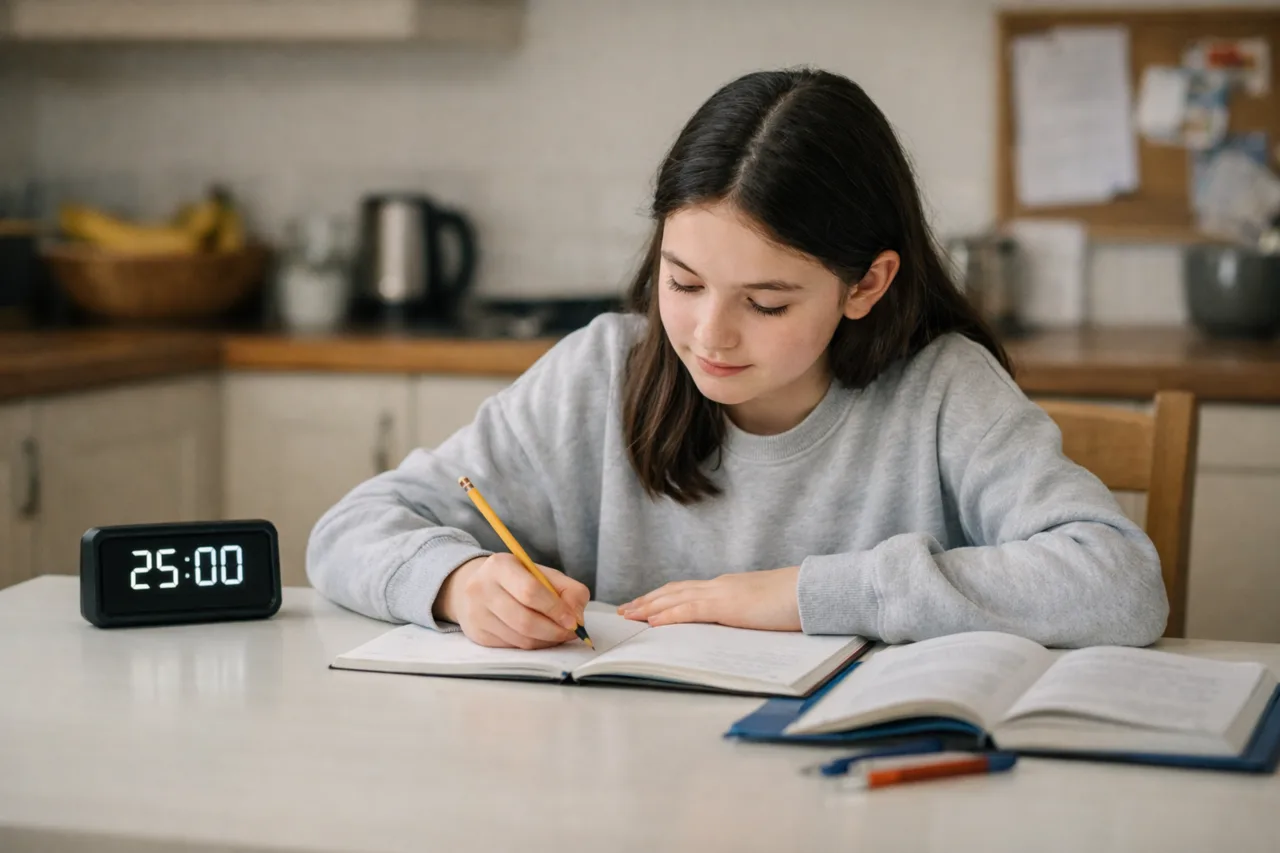
At home, the best protocol is not the one that sounds impressive. It is the one the family can repeat tomorrow without turning every evening into a nightly stand-off. A simple base is enough.
- Define one visible mission. Not “do your homework”, but one action with a clear output: solve three problems, learn ten flashcards, draft one introduction, correct one test paper.
- Choose the first block according to the reality of that evening.
- 25 minutes if the student is resisting the start, coming off a heavy day or trying to rebuild a habit.
- 40 minutes for a standard piece of work that is clearly framed.
- 60 minutes only if the student is already fairly autonomous, the task genuinely needs continuity and the timing is still good.
- Remove one major distractor and one major friction point before starting. Phone out of sight, materials already out, one useful tab only, the task written down in one sentence.
- Work in active mode. Ask questions, retrieve, reformulate, solve, recite, write. A whole session of simple rereading often creates a stronger impression of seriousness than of actual learning.
- End with a restart note. Write down the next small action before the break: “re-read the plan”, “do question 4”, “review the dates”. That sharply lowers the cost of beginning again.
This protocol is deliberately modest. Families fail more often because they scale too big, too early, than because they started too small. Two clean blocks separated by a real short break are usually more sustainable than one large, vague block that is supposed to solve everything at once.
How to tell whether the routine is actually working
The test is not “my child stayed at the desk”. The real test is whether the session produces more useful work with less wear and tear. Five indicators are enough:
- Start-up time falls: the student gets into the task faster.
- The output is visible: an exercise is finished, flashcards exist, a paragraph is drafted, a self-test has been done.
- The parent has to step in less: fewer reminders, less close supervision.
- Recall is better the next day or later in the week: the session leaves a trace, not just a feeling of effort.
- Evenings remain liveable: the routine does not systematically eat into sleep or the whole family atmosphere.
These indicators matter because they stop you confusing displayed duration with real quality. If 60 minutes does not produce more than a 25- or 40-minute block, the problem is not that the student “lacks willpower”. It is that the format is too long, too late, too passive or too badly designed for that kind of work.
When duration is no longer the real issue
If, over one to two weeks, a short and well-designed format is still failing despite a clear mission, sensible timing and a better setup, widen the diagnosis. The obstacle may lie elsewhere: poorly understood content, accumulated gaps, performance anxiety, insufficient sleep, too much outside-school load, a deeper attention difficulty or a low mood.
In those cases, asking for “just a bit longer” often becomes counterproductive. You get more tension, not more learning. Parents can directly influence the structure, the timing, the clarity of tasks and the quality of follow-up. But subject understanding, signs of significant distress, suspicion of attention difficulties or chronic exhaustion may need support from school or a qualified professional. When the problem is concentrated in one subject, contacting the teacher to clarify the actual difficulty is often more useful than adding another twenty minutes of vague work.
The important point is not to turn a lasting difficulty into a trial of character. A timer can help structure a session. It cannot replace a sound method, a good diagnosis or the right support when the problem goes beyond after-school organisation.
What to decide tonight
To act without making family life more complicated, keep this order of priorities in mind:
- Aim first for a profitable session, not a long session. Without other strong information, 25 to 40 minutes is usually a better starting point than a full hour.
- Check what is really sabotaging the block. Fatigue, avoidance, a vague task, the phone, passive materials: duration does not solve all of these.
- Reserve 60 minutes for situations that genuinely justify it. A more autonomous student, a longer task, a better time of day.
- Judge the system across a week, not one evening. What matters is repeatability.
- If even a short format does not hold, change the diagnosis before hardening the demand.
The right duration is not the one that reassures the adult because it looks serious. It is the one that leaves a useful trace, protects energy and can be repeated without exhausting the student or the family.