


Most GCSE revision plans fail for a simple reason: they are written for an imaginary teenager with unlimited energy, flawless organisation and a sudden taste for long evenings at the desk. The plan that lasts is usually smaller, more repetitive and less dramatic.
For most families, a sustainable GCSE revision plan has four features: a fixed weekly rhythm, tasks that are concrete enough to start, active revision instead of passive rereading, and one calm review point each week. You are not trying to create a second school at home. You are trying to make regular revision possible through ordinary tiredness, school pressure and family life.
What GCSE revision is really supposed to do
This article is written mainly with the England GCSE pattern in mind. In practice, that means a qualification structure built around subject specifications, a formal exam series, and the 9 to 1 grading scale. The wider planning logic is useful across the UK, but the exact grading, assessment and board details should always come from your child’s school and exam board.
That matters because revision at GCSE level is often misunderstood. Parents sometimes imagine that by this point a child should be “relearning the whole course” at home. Schools sometimes send broad revision advice that sounds sensible but is too vague to organise a tired 15- or 16-year-old. Students then hear “revise science” or “do English” and do not know where to begin.
In reality, GCSE revision has three jobs:
- Bring taught content back from memory.
- Practise the form of the exam, including question styles, timing and mark-scheme habits.
- Keep track of what still feels weak, rather than pretending every topic is equally secure.
Some subjects also include non-exam assessment or coursework-style elements, depending on the subject and board. That is one more reason not to build a single identical routine for every subject. Maths revision is not the same task as English Literature quotation learning, and neither is the same as preparing for an assessed practical or portfolio deadline.
A good plan therefore does not start with hours. It starts with the real demands of the subjects your child is actually taking.
Why revision plans collapse after about three weeks
When a plan fails, families often blame motivation. More often, the problem is design.
The most common mistakes are predictable:
- The plan is too big from day one. A student who has never revised consistently is unlikely to sustain three hours every school night.
- The sessions are labelled by subject, not by action. “History” is vague. “Learn Cold War causes with five flashcards and one 12-mark plan” is startable.
- Every subject appears every week in the same quantity. That looks fair on paper but ignores weakness, urgency and actual exam demand.
- There is no catch-up space. One missed session then infects the whole timetable.
- The work feels productive but is mostly passive. Rereading, highlighting and copying notes can fill time without testing memory.
- Parents become the enforcement system. The planner then turns into another site of conflict, not a tool the student owns.
By week three, the student is behind, slightly ashamed and beginning to avoid the planner itself. Parents often respond by tightening control. That usually makes the plan feel heavier, not easier to keep.
The better question is not “How do we make them do more?” It is “How do we make the next session easy enough to begin, useful enough to matter, and repeatable enough to survive a bad week?”
Build a plan the family can actually keep

The safest starting point is not an ambitious master timetable. It is a base week: the smallest repeatable version of revision that still moves things forward.
Build it in this order:
- Map the fixed constraints first. Put school hours, travel, clubs, sport, part-time work, therapy, family commitments and likely homework pressure on the page before you add any revision.
- Choose a modest weekly rhythm. For many Year 11 students, that means a few focused weekday sessions and one or two longer weekend blocks. If your child is already exhausted, start smaller than you think.
- Weight subjects by need, not by guilt. Weak, content-heavy or high-anxiety subjects usually need to appear more often than secure ones.
- Protect one buffer slot. This is the slot that stops one rough day turning into a ruined week.
- Schedule a weekly reset. Ten to fifteen minutes is enough to check what happened, what slipped and what needs to move.
A workable plan often looks more like rhythm than like perfection. Here is a pattern that many families can adapt without turning the whole house into exam headquarters:
| Week slot | Typical length | What belongs there | Why it lasts |
|---|---|---|---|
| Weekday focus block | 30 to 45 minutes | One clear task in one subject: retrieval, a short problem set, one essay plan, one timed paragraph | Short enough to start even after school |
| Optional light block | 15 to 25 minutes | Vocabulary, flashcards, quotation recall, correction of yesterday’s mistakes | Useful when energy is low |
| Weekend deeper block | 60 to 90 minutes, with a break if needed | Past-paper questions, mixed-topic practice, topic review plus error analysis | Better for work that needs more concentration |
| Weekly reset | 10 to 15 minutes | Look at school deadlines, move unfinished tasks, choose next week’s priorities | Prevents silent backlog |
Two details make a big difference here.
First, keep the plan visible but simple. A paper planner on the fridge, one page in a notebook, or a shared digital calendar is enough. Over-designed systems often die faster because they create admin before work.
Second, decide in advance what counts as a successful week. For some students, success is four solid sessions. For others, especially those with heavy commutes, special educational needs, illness or emotional strain, success may initially be two weekday blocks and one weekend block. A smaller plan completed consistently is far more powerful than a heroic plan abandoned by Thursday.
Make each revision block do real work
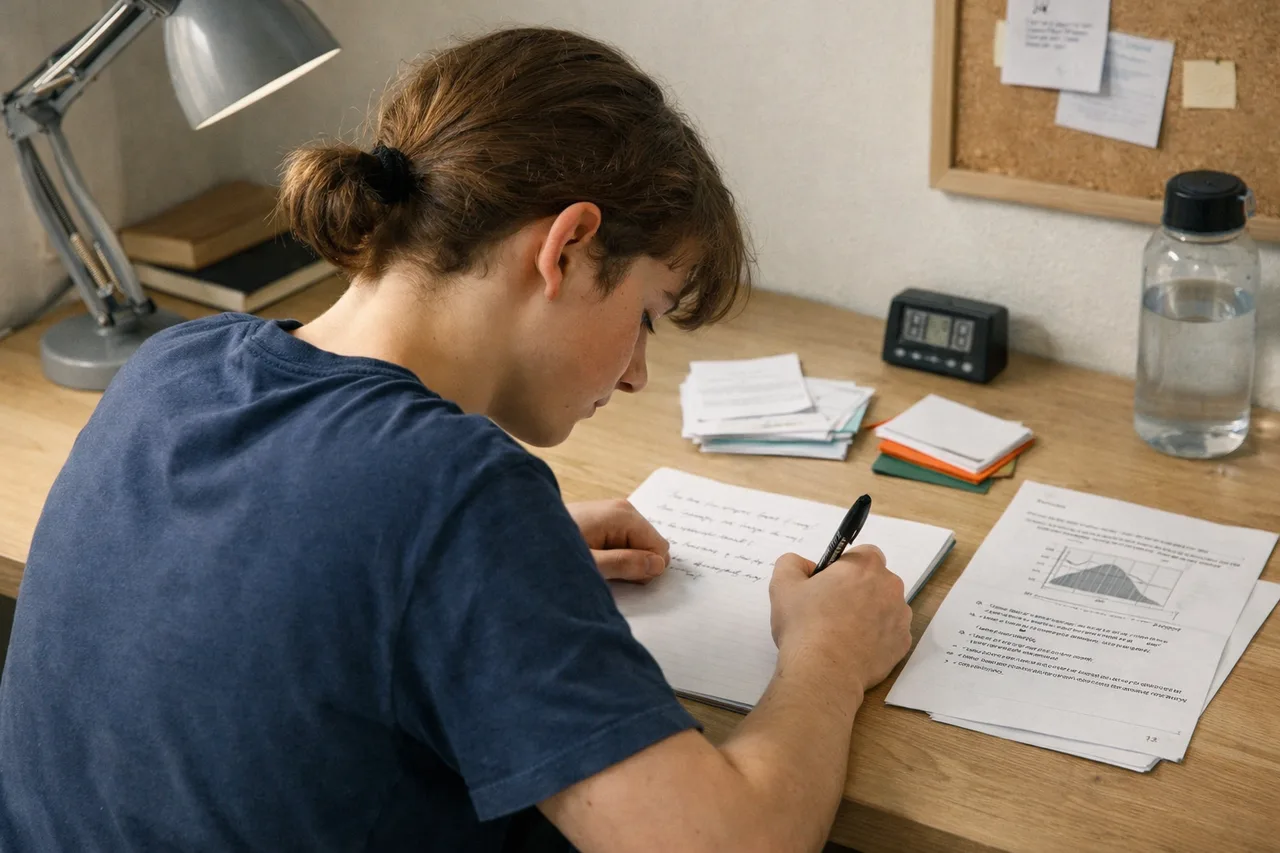
A revision plan only lasts if each session produces visible progress. If a student sits down for 40 minutes and finishes with the vague feeling that they “looked over stuff”, motivation collapses quickly.
A useful GCSE revision block usually has four steps:
- Start with retrieval. Before opening the notes, ask the brain to do some work. That could be flashcards, a blank-page memory dump, quick self-quizzing, quotations from memory, or a few maths questions without hints.
- Check the gaps. Now compare with notes, the textbook or the specification. The point is not to admire the notes. It is to find what was missing or confused.
- Practise in exam form. Turn knowledge into the kind of answer the exam demands: a set of equations, a six-marker, a paragraph, a source question, a translation, a graph interpretation.
- Record the next move. End with one line: what still needs work next time?
This is the practical value of active revision. The student is repeatedly trying to remember, applying what they know, and noticing errors while there is still time to fix them. Rereading has a place, but mainly after an attempt at recall, not instead of it.
It also helps to separate subjects by what “real work” means in each one:
- Maths and many science topics: worked questions, corrections, and identifying exactly where a method breaks down.
- English, history and religious studies: knowledge retrieval, quotation recall, essay planning, timed paragraphs and careful review of structure.
- Languages: vocabulary retrieval, grammar practice, short writing, listening or speaking routines where relevant.
- Subjects with coursework or portfolios: smaller deadline-based tasks, not just broad revision blocks.
One final rule matters more than families expect: do not try to finish a topic once and for all. The plan works better when topics return. A short second or third pass, a few days later, is usually more durable than one giant session that creates the illusion of completion.
How parents can help without becoming the revision manager
Parents matter, but not in the way exam season sometimes suggests. Your job is not to provide constant surveillance, motivational speeches or last-minute panic. It is to create enough structure that your child can work, notice when the structure is failing, and keep the emotional temperature low enough for revision to continue.
What parents can influence directly includes:
- a predictable place and time to work
- a weekly check-in instead of nightly interrogation
- reasonable limits around sleep, screens and drift
- help breaking a vague task into a startable one
- basic protection of food, transport, quiet and routine
What parents influence only indirectly is just as important:
- whether revision feels like ordinary work or a family emergency
- whether mistakes are treated as useful information or as proof of not trying
- whether the student feels monitored every evening or supported over time
A few phrases help more than families expect. “What is tonight’s task?” is usually better than “How much revision have you done?” “Show me where you got stuck” is better than “You need to focus.” “What is the next small step?” is better than “You should be doing more.”
Sleep also belongs inside the revision conversation. Late-night cramming feels serious, but a student who is chronically tired is usually less efficient, more irritable and more likely to give up on the next day’s session. In many homes, a consistent routine will do more for the revision plan than another 45 minutes at 11pm.
The hardest parental skill is restraint. If you find yourself checking every evening, reminding multiple times, and carrying the timetable in your own head, the student has not built a revision system; the family has built a second parenting job. That is rarely sustainable.
When to change the plan or ask for more support
Sometimes a plan fails because it is too large or too vague. Sometimes it fails because something more serious is getting in the way. Those are not the same problem, and families should not treat them as if they are.
Change the plan first if you notice signs such as:
- the student misses sessions mainly because the plan is overloaded
- every task is still too broad to start
- weekend marathons are compensating for impossible weekdays
- the student spends most of the session organising materials instead of using them
- one or two weak subjects are swallowing the entire week
In those cases, shrink the plan, narrow the tasks and rebuild the base week.
But ask for school or professional support sooner rather than later if revision repeatedly triggers panic, shutdown, tears, severe sleep disruption, constant conflict, or an obvious mismatch between effort and output. If reading, writing, processing speed, memory, attention or emotional regulation seem to be major barriers, it is better to speak to the school, head of year, tutor or special educational needs co-ordinator early than to moralise about effort.
There is also a practical exam reason to act early. Schools need time to advise on the right support, adjustments or next steps. Families who wait until the final stretch often discover that the real problem was never “laziness”; it was overload, confusion or an unmet need.
The decision rules that matter most
If you want a GCSE revision plan that lasts more than three weeks, keep these rules in view:
- Make it smaller than your anxiety wants.
- Plan tasks, not just subjects or hours.
- Use retrieval and exam practice, not only rereading.
- Build in one weekly reset and one buffer slot.
- Support steadily, but do not become the whole system.
- Treat persistent distress or major inefficiency as a signal, not a character flaw.
The best revision plan is boring in a good way. It survives ordinary school weeks. It still works after a bad Tuesday. It helps a young person know what to do next without requiring a family summit every evening. That is usually what leads to better preparation in the end.