

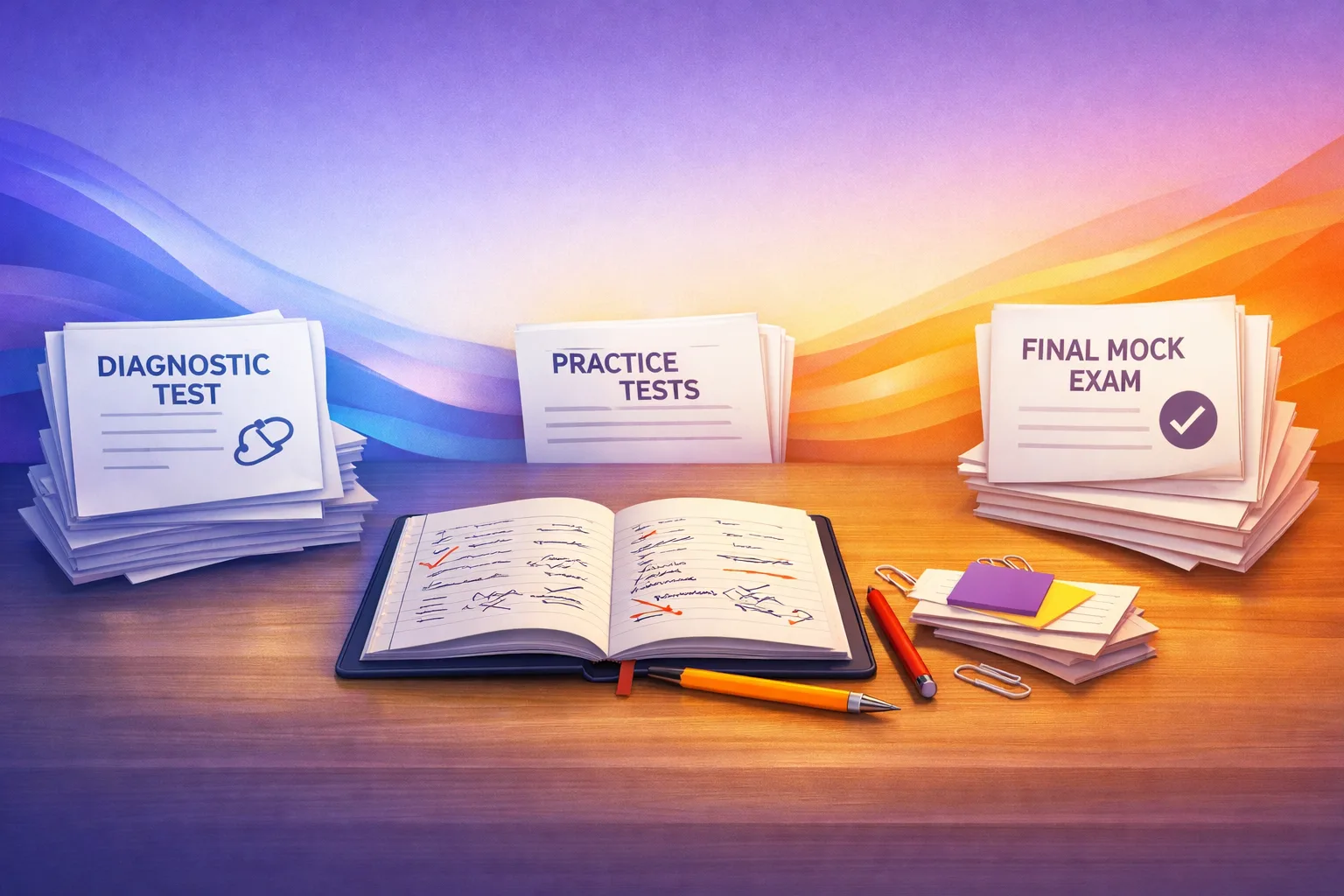
When a child is preparing for a selective exam — whether that means the 11+, an entrance assessment, a scholarship paper or another competitive test — the tempting strategy is simple: keep adding full mock tests so they can “get used to the real thing”. It feels reassuring because it fills the calendar and creates visible milestones. But doing more simulations is not the same as making more progress.
In many cases, a student does not need ten full mocks. Across a whole preparation period, 3 to 6 well-used mock tests are often enough: one starting diagnostic, a small number of practice simulations, then one or two final readiness checks close to the exam. That is not a magic number. It is a useful working range. Beyond that, returns fall quickly if each mock is not followed by precise review and targeted work.
That matters even more when each mock costs not only time and mental energy, but sometimes money, travel or a long family weekend.
So the real question is not only “How many?” It is “What is the next mock for?” A mock that answers no useful question often does little more than measure the current level again.
Not all mock tests do the same job
Families often talk about “a mock” as though it were one single thing. In reality, there are at least three distinct uses. Mixing them up is one of the quickest ways to do too many mocks, or to do them at the wrong moment.
| Type of mock | When it becomes useful | The question it should answer | What not to ask it to do |
|---|---|---|---|
| Diagnostic | At the start of preparation, or when the method changes | Where are the real weaknesses: content knowledge, reasoning, timing, format, stamina? | Predict the final result on its own or define the student’s ability once and for all |
| Practice | After targeted work on a few priority skills | Are the recent adjustments holding up under real constraints? | Replace deeper revision or fix every weakness at once |
| Calibration / readiness check | Closer to the exam, once the base is more stable | Is the student ready under conditions close to the real day? | Build the fundamentals at the last minute |
That distinction changes the practical decision. Many families end up doing five or six “practice” mocks when what they actually needed was one solid diagnostic, then a final readiness check near the end.
It also helps to separate the quality of the paper from the function of the mock. An official past paper or specimen paper is often more valuable for final calibration than for week one. If an exam offers only a small number of official materials, it is usually wiser to keep one or two for the final stretch. By contrast, a commercial or unofficial paper can still be very useful for stamina, pacing or strategy, as long as no one treats it as an exact forecast of the likely score.
Why doing more full simulations does not always help
A full mock consumes more than it seems to. It takes time to sit, mental energy to stay focused, and then real effort to review properly. If you only fund the first step, what you mostly get is a measurement, not a lever for improvement.
Several mechanisms explain why piling them up often reaches a ceiling:
- Marks are usually won between one mock and the next. That is the interval in which a student revisits errors, automatises a method, secures a topic or learns to read the instructions more carefully.
- A full mock is a broad tool, not a precise one. If the main problem sits in one subsection, one question family or the management of only two parts of the exam, another full paper can be an expensive detour.
- Repetition can create an illusion of seriousness. Filling a weekend with another simulation looks disciplined, even when the same mistakes keep returning because they have not been treated at the source.
- Scores move for several reasons at once. Fatigue, slight variations in difficulty, stress, section order and drifting attention all blur the signal if mocks come too close together.
- The emotional cost is not neutral. For a perfectionist or easily discouraged student, three poor simulations in a row can create a story of failure, even though targeted work between them would have been more profitable and less demoralising.
Learning science points in the same direction: what supports durable progress is not just more exposure to the format, but active retrieval and spaced return to material that was not yet secure. In other words, a mock is only useful if it opens a loop: test, understand, rework, retest.
That is why a full mock every week is not automatically a good idea. It can make sense for a student who is already close to the target and mainly needs to stabilise pacing, stamina or time management. But for a student whose foundations are still uneven, that frequency often steals time from the work that would actually lift the score.
How many should you plan for, based on starting point and time available?
There is no universal number. There are, however, useful ranges. The right volume depends less on the prestige of the exam than on two practical questions: are the foundations already fairly secure, and how many weeks are left to turn errors into progress?
The table below is a working guide, not a rule. The numbers assume that each mock is reviewed seriously and that there is real work between two simulations.
| Starting situation | Number of full mocks often useful | Indicative rhythm | Main priority between two mocks |
|---|---|---|---|
| Foundations still fragile, several topics unstable, 8 weeks or more left | 2 to 3 | One diagnostic, then one control mock after a genuine rebuilding phase, then one final calibration | Consolidate content, redo errors, work in targeted blocks |
| Middle range: decent understanding, but uneven scores | 3 to 5 | One diagnostic, one or two spaced practice mocks, then one or two final calibration mocks | Stabilise method, pacing by section and question selection |
| Already close to the target, but inconsistent under pressure | 4 to 6 | Slightly more frequent mocks, without dropping targeted work | Stamina, stress management, pacing, consistency of performance |
| Less than a month before the exam | 2 to 3 | Quick stocktake, one mock after adjustments, one final readiness check | Choose the highest-yield fixes and avoid scattering energy |
Two nuances matter a great deal.
The first is that timed sections count too. When the difficulty is highly localised, two carefully chosen section drills can be worth more than one extra full mock. Many students do not need another marathon. They need better control of one demanding part of the exam.
The second is that some formats do require a little more familiarisation. That is often true when the exam is digital, adaptive, unusually fast, or when the student will sit it with access arrangements that need to be tested in realistic conditions. In those cases, one extra readiness check can be sensible. But again, it should answer a clear question: format, stamina, strategy or timing.
The simplest rule is this: do not add a mock because there happens to be a free Saturday. Add one because you know what that mock is supposed to confirm, challenge or adjust.
How to review a mock test so it actually leads to progress

This is where the difference appears between a simulation that briefly reassures and a simulation that changes performance. Good review is not just counting lost marks. It is looking for the cause of lost marks.
Here is a sober method that works remarkably well.
Reconstruct the conditions of the sitting.
Before looking closely at the paper, note what shaped the performance: time of day, fatigue, the sections where the student sped up too early, questions left because of time pressure, moments of panic or lapses in concentration. A score without context says less than families often think.Sort each error into a family.
Not every error is a content gap. It may come from misreading the instructions, choosing an unsuitable method, making an avoidable processing slip, managing time badly, taking an over-risky approach or simply losing focus. As long as all errors are mixed together, the follow-up work stays random.Isolate the two priorities that cost the most marks.
After a mock, the temptation is to fix everything. That is rarely realistic. It is usually more effective to choose two dominant axes for the next phase: for example, “instruction reading + long-question management” or “core formulas + careless errors at the end”.Redo some missed questions in two passes.
First without heavy time pressure, so the student can rebuild the correct reasoning. Then later, in conditions closer to the real exam, so you can see whether the correction actually holds. Without that second pass, students often confuse immediate recognition with a genuinely stabilised skill.Turn the review into a work plan.
A useful mock leads to a few very concrete decisions: which topics to revisit, which exercise types to repeat, which section to time, which strategy to change, and when to schedule — or postpone — the next mock.
In many families, the question after a simulation is: “What did you get?” A more useful question is: “What did this mock reveal, and what are we changing this week?”
Parents can help without becoming permanent project managers. Their role is not to redo the paper in the student’s place. It can be simpler and more powerful than that:
- protect a real review slot, not just ten rushed minutes;
- help name the error categories;
- check that the next mock has a clear purpose;
- avoid crude comparisons between two scores achieved in different conditions.
Very often, a three-hour mock deserves at least as much seriousness in the review as in the sitting itself. That sounds less dramatic than doing another paper straight away. It is also where much of the return sits.
The decision rule to use, week by week
If you keep only one idea, let it be this: the right number of mock tests is the smallest number that lets you orient, verify and finally calibrate the preparation.
In practice, that often looks like this:
- One diagnostic mock to see where things truly stand.
- A small number of practice mocks only after targeted work has been done.
- One or two final readiness checks close to the exam, in realistic conditions.
For many students, that leads to 3 to 6 full mocks across the whole preparation. Not because the number is universal, but because beyond that you often start buying fatigue, anxiety or sterile repetition instead of better marks.
The best sign that another mock is justified is not parental anxiety or calendar habit. It is a specific hypothesis: “We have reworked this. Let us see whether it now holds under timed conditions.” By contrast, when another simulation would only confirm what everyone already knows, time is usually better spent on active, targeted revision.
A student does not arrive better prepared because more boxes were ticked on a plan. They arrive better prepared when each mock had a job, when errors were turned into useful work, and when the preparation still left real room for sleep, recovery and continuity. That is less spectacular than a stack of completed papers. It is also, very often, more effective.