


During the school holidays, most families are not chasing an abstract ideal. They are trying to avoid two very concrete traps: a phone that slowly swallows the day and rules so hard that the holidays become a permanent tug-of-war.
So the real question is not “should we ban the smartphone?” It is: what are we trying to protect during the holidays? In most homes, the answer is fairly modest: sleep, a few genuinely shared moments, some stretches in which attention stays whole, and, where there is a real need for it, a little continuity in school habits. Not every break needs revision; some do.
In other words, it is perfectly possible to keep a digital life during the holidays without losing all routine — on one condition: set only a few rules, make them explicit, tie them to specific moments, and make sure they are realistic enough to survive even when adults are tired.
During the holidays, phones mostly disrupt getting started, attention and the night
The main problem is not just total screen time. It is where the phone slips in: on waking, in empty moments, during any activity that asks for a little effort, and then again in the evening when the household needs to wind down.
First, it changes the relationship to getting started. Holiday days are usually less structured than term time. As soon as a moment feels empty, slightly boring or mildly demanding, the phone offers an immediate reward: check, reply, scroll, repeat. That makes it harder to move into a slower activity, whether that is reading, writing, helping to prepare lunch, going out, or doing a short bit of revision.
Second, it fragments attention. The evidence does not suggest that every kind of digital use has the same effect. But it does point quite clearly to the cost of recreational multitasking — messaging, scrolling or checking notifications while trying to do something else. A phone can support a school task; it can also cut that task into almost invisible fragments.
Third, it pushes the night later. Stopping is harder in the evening because so much phone content is continuous, personalised and social. You do not leave a message thread, short-video feed or game with the same clean ending as a closed book or a finished board game. The result is familiar: bedtime drifts, waking drifts, and the whole day loses some of its anchors.
One nuance matters here: not all phone use belongs in the same category. Checking in with a friend, listening to a language podcast on a train, doing ten minutes of retrieval practice on a topic already studied, or using the camera to sort messy notes is not the same thing as late-night endless scrolling. The best family framework does not throw every screen use into one bag. It distinguishes the uses that give shape from the uses that scatter attention.
The rules that last are few, visible and tied to moments
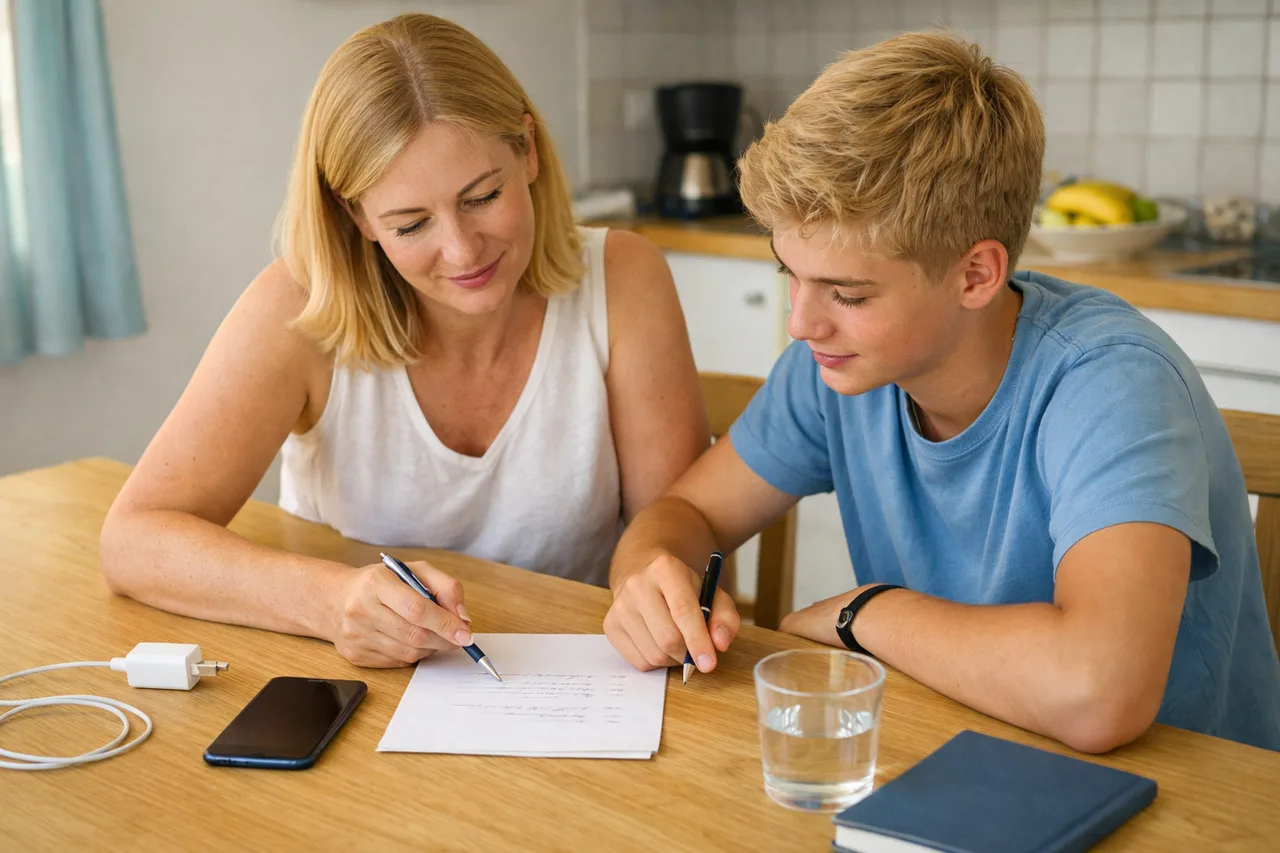
The strongest family rules are rarely vague instructions such as “be sensible with your phone”. They work better when they answer a concrete situation: bedtime, meals, the journey out, reading time, or the short revision slot planned for the week.
Here is a simple framework that often remains workable during the holidays:
| What you are protecting | Why it matters | A workable holiday rule |
|---|---|---|
| The night | The phone easily delays the real stopping point | Give the phone a defined charging place; it does not stay in bed |
| Shared moments | Without a rule, everyone stays reachable somewhere else | Meals, planned outings or a family activity happen without phones in hand |
| Attention | The reflex to check turns one task into many fragments | One function at a time: either the phone is being used for the task, or it is put away |
| Empty moments | Filling every pause makes it harder to settle and start something else | Keep some screen-free moments on purpose, especially early in the day and towards evening |
In practice, three or four rules are usually enough. Beyond that, parents end up managing exceptions and the teenager mostly learns to negotiate. A small stable framework is far more useful than a long daily speech.
It often helps to write those rules down for a short period: a week, a fortnight, or one trip away. Not as a solemn contract, but as a shared reference point. That also makes review easier and calmer. If a rule fails three evenings in a row, that does not automatically mean anyone is lazy or defiant. The rule may simply be badly timed, too vague, or impossible to keep in real family life.
The physical setup matters more than many families expect. A shared charging spot, notifications switched off, earbuds put away when they are not needed, and a book, cards or notebook already on the table all reduce friction. When adults do not have much bandwidth, the environment often does more work than repeated reminders.
The right framework depends on age, profile and the kind of holiday
There is no single good rule for everyone. What changes the picture is not only chronological age, but also self-regulation, social needs, fatigue, and whether there is any schoolwork that genuinely needs to continue.
In earlier secondary school, outside structure is still often necessary
For many younger secondary-school pupils, expecting full self-regulation is unrealistic. The phone remains highly attractive, and the holidays loosen what is left of the usual timetable. A useful framework therefore often looks like this: no phone in bed, clearly defined screen-free moments, and a few ready alternatives when boredom appears.
In later secondary school and sixth form, co-design matters more
Older teenagers usually tolerate a framework better when they understand it and have helped shape it. The conversation can then move away from abstract principles and towards observable effects: “What makes your nights slip later?”, “When do you start losing the thread?”, “What actually helps you restart?” The goal is not total control. It is to help the teenager notice their own tipping points.
After school, the issue becomes mainly self-management
For a student in the first years after school — university, college or an apprenticeship — parents cannot regulate every use from a distance. They can still help think through simple guardrails: where the phone sleeps, when it genuinely earns its place, and how to stop the night from eating the next day.
Profile matters as much as age
Some young people mainly need to protect sleep. Others mainly need to protect the start of work. Others use the phone as an important social link in the summer. In that last case, a brutal cut-off can be counterproductive. It is often better to defend the night and a few uninterrupted stretches than to try to abolish digital social life altogether.
A few signs do justify tightening the framework or looking beyond holiday rules alone: a settled day-night reversal, intense irritability at the smallest interruption, dropping almost every other activity, hidden night use, or an inability to hold even a short task without repeated checking. And if the phone is caught up in something more serious — intense social conflict, cyberbullying, marked distress, or a broader school overload problem — then this is no longer only a question about holiday phone rules.
The phone can also help with learning — if it has a task, a duration and an end

Trying only to “cut screens down” often leads to a dead end. A better strategy is to give the phone a useful but limited role. It stops being only a dispenser of impulses and can become a tool for light continuity.
That can mean very simple uses:
- doing a short question-and-answer session on a topic already studied, instead of passive rereading;
- reviewing a little vocabulary on a journey or while waiting somewhere;
- photographing, sorting or cleaning up notes to make the return to school easier;
- listening to a short audio introduction before reopening a denser chapter.
The decisive point is this: the phone helps when it lowers start-up friction, not when it replaces the whole task. Watching content about studying is not automatically studying. Following “study” accounts or saving endless explainer videos can become a polished way of delaying the moment when the student actually has to recall, write, solve or organise.
For summer revision, short real sequences are usually better than big vague promises. Ten or fifteen minutes of active recall on a topic, repeated several times during the week, will usually do more than one large rereading session at the end of the month. A phone can support that kind of micro-routine perfectly well, provided the beginning and the end are clear.
There does, however, need to be a firm limit. As soon as the task requires sustained reasoning, a full exercise set, an essay plan or slow attentive reading, the phone is usually not the best main surface. It can launch the activity; it cannot always carry it well.
How to set this up without turning the holidays into constant negotiation
The goal is not to win a theoretical debate about screens. The goal is to make daily life more breathable. For that, a simple method is often enough.
- Name what you want to protect. For example: decent nights, one meal that is genuinely shared, two short revision slots in the week, or simply calmer mornings.
- Choose only a few rules. If everything becomes a priority, nothing really is. Three clear rules beat ten reminders.
- Write the rules as situations. For example: “After dinner, phones charge in the kitchen” or “During the short revision slot, the phone is used only for flashcards”.
- Prepare the alternative. A framework holds better when something replaces the automatic habit: cards, a book, a ball, a walk, music chosen in advance, or a planned call with a friend rather than open-ended scrolling.
- Treat slips as adjustments, not moral failures. If the rule does not hold for several days, change the context or the rule itself. Do not restart with a forty-minute sermon.
Parents’ own screens matter too. Not because adults must become flawless examples at all times, but because a family rule that only applies downward quickly feels arbitrary. “No phones at the table” works better if the adults broadly live by it as well.
And one final point matters: the holidays do not need to look like term time. More flexibility is normal. More social life is normal. Less output is normal. But flexibility is not the same as total drift. A minimum rhythm protects freedom better than complete laissez-faire.
What you are protecting is not zero screens, but a rhythm the household can still live with
A good holiday framework does not try to make the phone disappear. It tries to stop the phone from becoming the day’s automatic pilot.
If you keep the essentials, keep these:
- protect the night first, and then a few genuinely shared moments;
- tie rules to situations, not to judgements about character;
- distinguish the uses that scatter attention from the uses that serve a real task;
- give the phone a useful job when possible, instead of talking about it only through bans.
That is usually how families keep a digital life without losing all routine during the school holidays: not through a dramatic detox, but through a few stable, visible reference points that are modest enough to last.
Sources
- Associations between screen use, learning and concentration among children and young people in western countries: a scoping review
- Digital Devices Use and Sleep in Adolescents: An Umbrella Review
- How to Make a Family Media Plan
- Setting Healthy Screen Time Boundaries on Family Vacations
- The science of effective learning with spacing and retrieval practice
Keep reading
Related reading
Good grades, but at too high a cost: should you still ask for help?
Good grades do not prove that everything is fine. If a child is coping only through endless evenings, exhaustion, tears or constant parental steering, it can make sense to ask for help before the grades fall.
When decent marks are hiding exhaustion or overload
School portal: how often should parents check without over-monitoring?
Checking the school portal ten times a day can reassure a parent, but it rarely helps the student. A simple framework for choosing a useful rhythm, spotting the signals that matter, and talking about them without creating continuous surveillance.
Choose a checking rhythm that does not feel like surveillance
Does my child need school adjustments, or mainly a different way of studying?
Concrete guidance for telling the difference between temporary overload, a study-method problem and a more durable difficulty, then deciding whether to observe, speak to school, seek a specialist assessment or ask for adjustments.
Tell the difference between a study-method issue and a more durable difficulty