

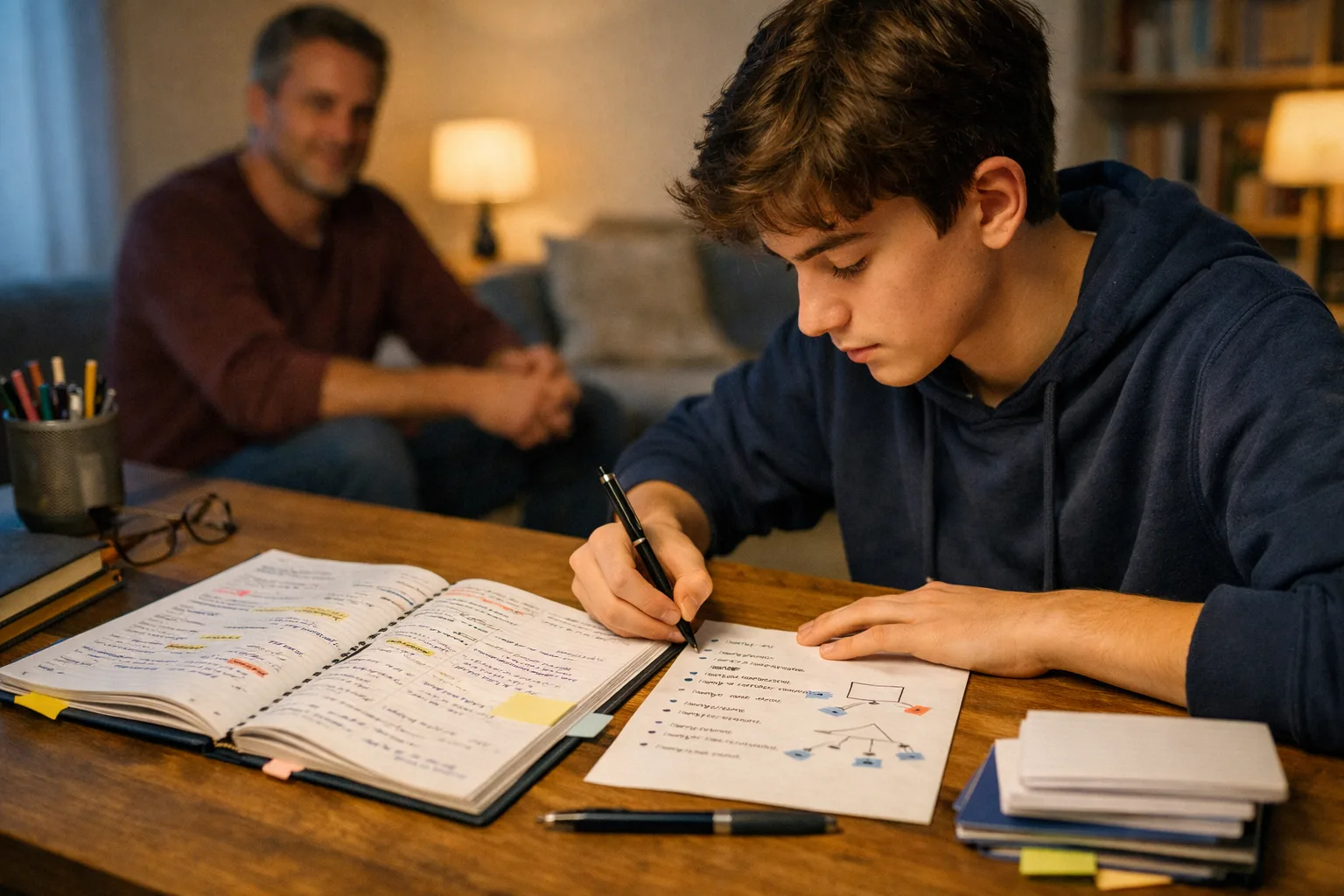
Many families know the scene: a student gets home, opens their notebook and says they need to “rewrite the notes properly tonight” or the lesson will not stick. The instinct is not silly. Going back to a lesson soon after class often helps. But in most cases, rewriting the whole thing the same day is not the best return on time.
What usually works better is a short, active revisit: fill in gaps, pull out the main ideas, ask a few questions, check what can already be said without looking, then plan a later return. A proper revision sheet can be useful, but usually at specific points — not as an automatic reflex after every lesson.
The short answer: revisit the lesson, yes; rewrite it from scratch, no
The most useful thing is not “rewriting the notes” in itself. It is turning a still-fresh lesson into something that can actually be used later for revision. Depending on how it is done, that becomes either real learning or double work.
Before the detail, here is the key distinction:
| After-class action | Time needed | Most likely effect | Keep it? |
|---|---|---|---|
| Rewrite the whole lesson neatly | High | Feels serious, but does little real testing of memory | Rarely |
| Reread, complete and organise the notes | Low to medium | Stabilises the lesson and reveals what is still unclear | Yes |
| Turn the lesson into questions, examples or a mini-outline | Medium | Activates memory and prepares later revision | Yes |
| Make a real revision sheet after several lessons or before an assessment | Medium | Gives a useful overview if it truly condenses the chapter | Yes, in the right cases |
The important difference is this: an active revisit helps, whereas a neat copy often reassures more than it teaches. For many students, a sensible evening habit takes 10 to 15 minutes, not a second full version of the lesson.
Why a clean copy is not enough
If so many students rewrite their notes, it is often because it feels like control. The page looks cleaner, the headings clearer, the colours more reassuring. But memory does not judge neatness. It responds mainly to another question: did the student have to select, organise and retrieve the information?
Three confusions come up again and again.
- Mistaking neatness for understanding. Better-presented notes are easier to reopen, but that does not prove the lesson is understood.
- Mistaking recognition for recall. When students look at their notes, they often feel they “know it”. When they have to explain it without support, their real command becomes visible.
- Mistaking visible work for effective work. Two rewritten pages look impressive. Four difficult recall questions usually look less impressive and often teach more.
Broadly speaking, research on learning points in the same direction: passive strategies such as simple rereading are usually less robust than strategies that ask the student to retrieve, reformulate or use information. That does not make revision sheets useless. It means they become useful when they force thinking, not when they simply move the same lesson onto a cleaner page.
This still needs nuance. Reworking the material the same day can help in three situations:
- The notes are incomplete or hard to read. The first job is to secure the lesson while it is still fresh.
- The teacher moved quickly and the student needs to restore order. Here, the benefit comes from organisation, not from copying for its own sake.
- The chapter is dense and the student already knows it will need several passes. A first short structuring step can make later revision easier.
In other words, the same day is often a good moment to secure the lesson — but not necessarily to produce the final version.
A 10–15 minute method that actually helps memory
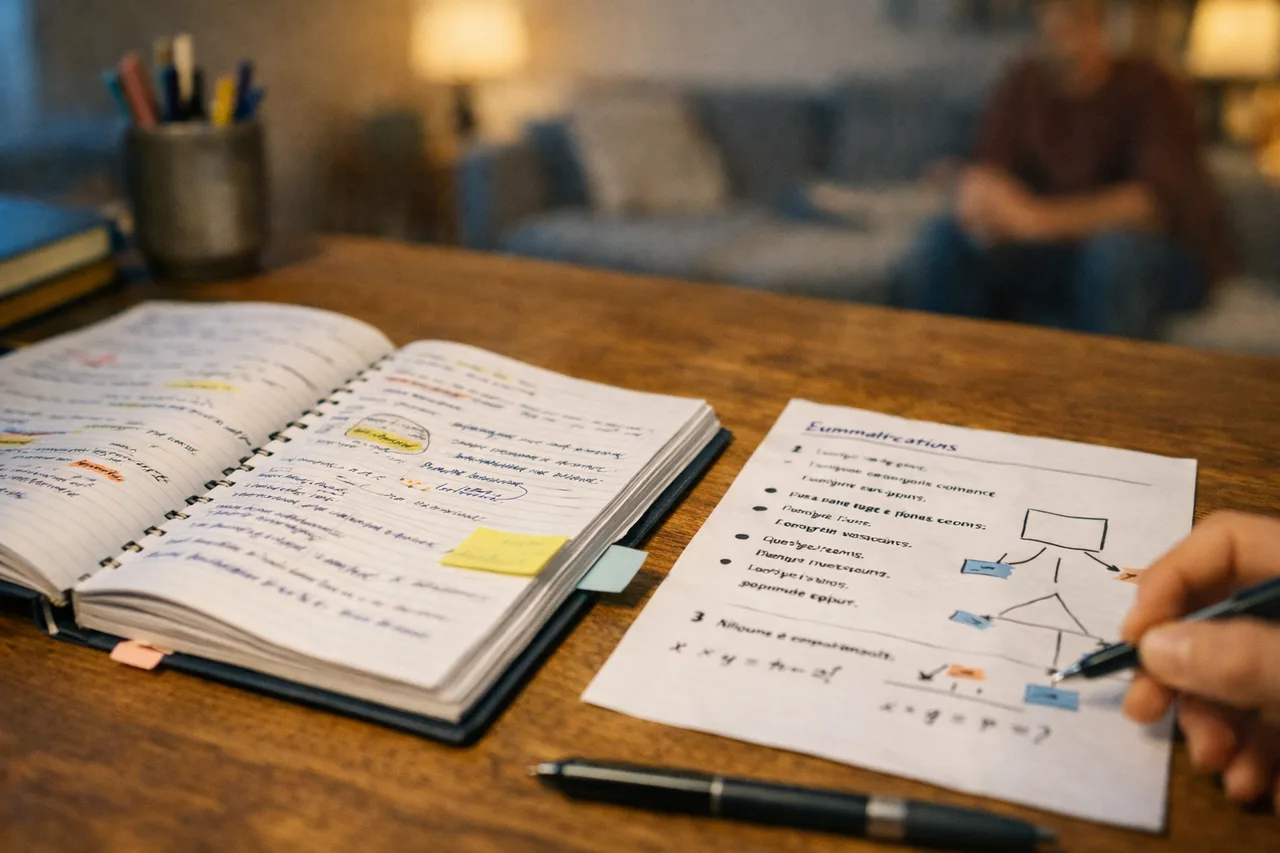
For most secondary-school students, the most efficient routine is short, repeatable and simple enough to survive a busy week. It can look like this:
- Reopen the lesson later that day or the next morning. The aim is not to let several days pass before the first return.
- Without looking, say or write what is already remembered. Three ideas, one definition, one formula, one date, one diagram, or the method for a typical problem.
- Compare with the notes and correct. This is the moment to fill gaps, underline what matters, and mark clearly what is still fuzzy.
- Turn the lesson into a small active tool. For example: five question-and-answer prompts, a mini-outline, three vocabulary cards, a labelled diagram to redraw, or a step-by-step procedure.
- Plan the next return. Even a short one. Without a later revisit, the evening effort often remains isolated.
This routine has two very practical benefits for families. First, it cuts the time spent on work that looks serious but has little effect. Second, it makes later revision much easier because the lesson has already been clarified and transformed.
The common mistake is to aim for a beautiful object. The better aim is to produce something that allows self-testing.
What this can look like in real life
- At the end of a history lesson: three key ideas, two dates, and one cause-and-effect link.
- In biology: redraw a labelled diagram from memory and define four key terms.
- In maths: write the method in steps, note one common mistake, then do one very short question.
- In French or Spanish: recall five words or expressions without support, then write one example sentence for each.
The useful skill, then, is not “being good at making revision sheets”. It is knowing how to turn a lesson into an opportunity for active recall.
Same principle, different format depending on the subject
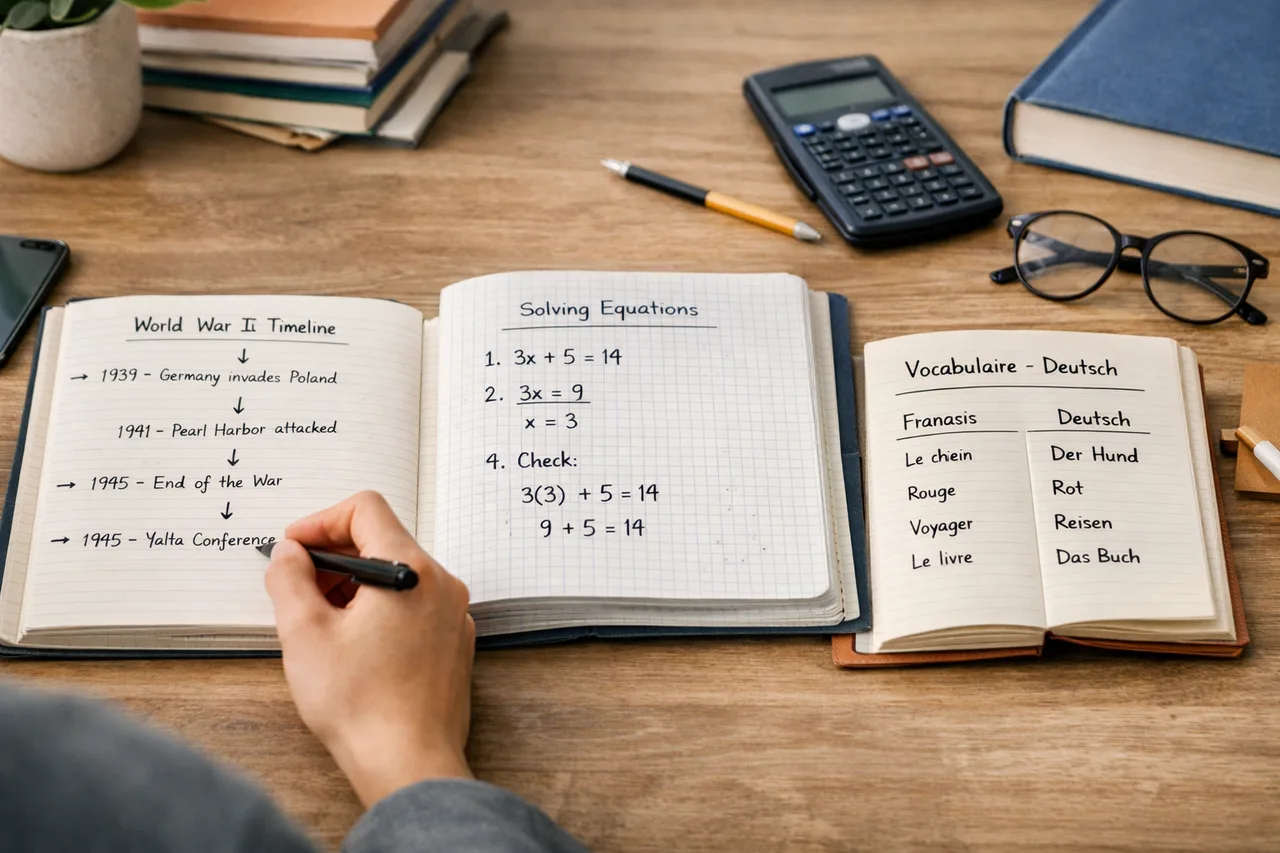
This is where students often go wrong: they use the same format in every subject. But the right transformation depends on what the subject actually asks them to do.
History, geography, biology and social sciences: connect and prioritise
In content-heavy subjects, the same-day version of the notes should mainly help answer three questions: what are the key ideas, how do they connect, and which examples make them concrete?
A good revisit might take the form of a short plan, a timeline, a causes-and-consequences table, or five likely questions. Recopying whole paragraphs rarely adds as much.
Maths, physics and chemistry: be able to do it again, not just reread it
In these subjects, a neat sheet can create a particularly strong illusion. The student sees the formula, recognises the method, and assumes they know it. What matters, though, is the ability to start the process alone.
That same day, it is often better to:
- rewrite the method as simple steps;
- do one example again without the solution;
- note the mistake that usually loses marks;
- separate the cases where the method applies from the cases where it does not.
Here, notes are only useful if they clarify the procedure. Practice remains central.
Languages: turn it quickly into recall and use
For languages, useful notes are usually short. They need to bring out vocabulary, sentence patterns and common traps, then push towards quick reuse: example sentences, a mini-translation, a spoken question, or recall without looking.
English, philosophy and other essay-based subjects: move from notes to the question
In these subjects, an effective sheet does not just repeat notes. It makes the problem visible: the question being asked, the line of argument, the text or example, the structure of a paragraph or plan. Again, the value comes from the intellectual reshaping, not from presentation alone.
What transfers across subjects is not one standard layout. It is a sequence of moves: clarify, choose what matters, test it, and prepare the next return.
When a proper revision sheet becomes useful
Saying “do not rewrite everything the same day” does not mean “never make a full revision sheet”. A proper revision sheet becomes useful when it answers a specific need.
It is often worth doing when:
- several lessons belong to the same chapter and the student needs an overview;
- an assessment is approaching and they need a compact revision sheet;
- notes are scattered across a notebook, loose sheets, textbooks and handouts;
- the teacher’s notes are dense and badly organised;
- the student genuinely revises better from a short summary than from a whole notebook.
By contrast, it becomes double work when:
- it is remade every evening in every subject;
- it is mostly used to neaten what could simply be completed;
- it replaces practice, recall questions or exercises;
- it eats into sleep or drags the evening out;
- it is never reused afterwards.
A simple guide helps here: if the sheet genuinely reduces the complexity of the chapter, it has value; if it reproduces almost everything, it often costs more than it returns.
What parents can do without becoming revision project managers
For parents, the risk runs both ways: pushing a ritual that is too heavy, or giving up entirely because evenings become tense. There is a more realistic middle ground.
Instead of saying “rewrite your notes”, it is often more useful to ask:
- What are the three things you can already say without looking?
- What is still unclear?
- What question do you think could come up from this lesson?
- Show me the short version you could come back to later.
Those questions steer the student towards what matters without forcing the parent to supervise every step.
In the earlier secondary years, parents may need to help install the routine: reopen the lesson, fill gaps, make three questions, put it away. Later on, the more useful role is usually to check the outcome of the reworking rather than to manage the whole process. The aim is not for the parent to manage the method every evening. It is for the student to become progressively able to revisit lessons effectively on their own.
It is also important to notice when the problem goes beyond the revision sheet:
- notes are often unusable;
- the student never knows what to keep;
- work always starts very late;
- the lesson seemed clear in class and opaque the same evening;
- neat copying is hiding deeper comprehension difficulties.
In those cases, the answer is not just a better sheet. The family may need to work on note-taking, understanding in class, organisation, or seek occasional outside support.
The real test: does this prepare future recall?
The right question is not: “Should students rewrite their notes the same day?” The better question is: “Does the work done that day turn the lesson into something they can genuinely use later to recall it?”
If the answer is yes, the habit is useful. If the answer is no, it is often double work.
To keep in mind:
- Yes to a quick return to the lesson.
- No to full clean copying as an automatic reflex.
- Yes to active transformation: questions, a mini-plan, a diagram, an example, a procedure.
- Yes to a real revision sheet when it condenses several lessons or prepares an assessment.
- No to any method that takes time, reassures adults, but does not help the student retrieve the material later on their own.
In practice, many students would gain more by replacing “rewrite the whole thing” with a smaller routine: 10 to 15 minutes to clarify, test and prepare the next recall. It is less impressive. It is often more effective.