

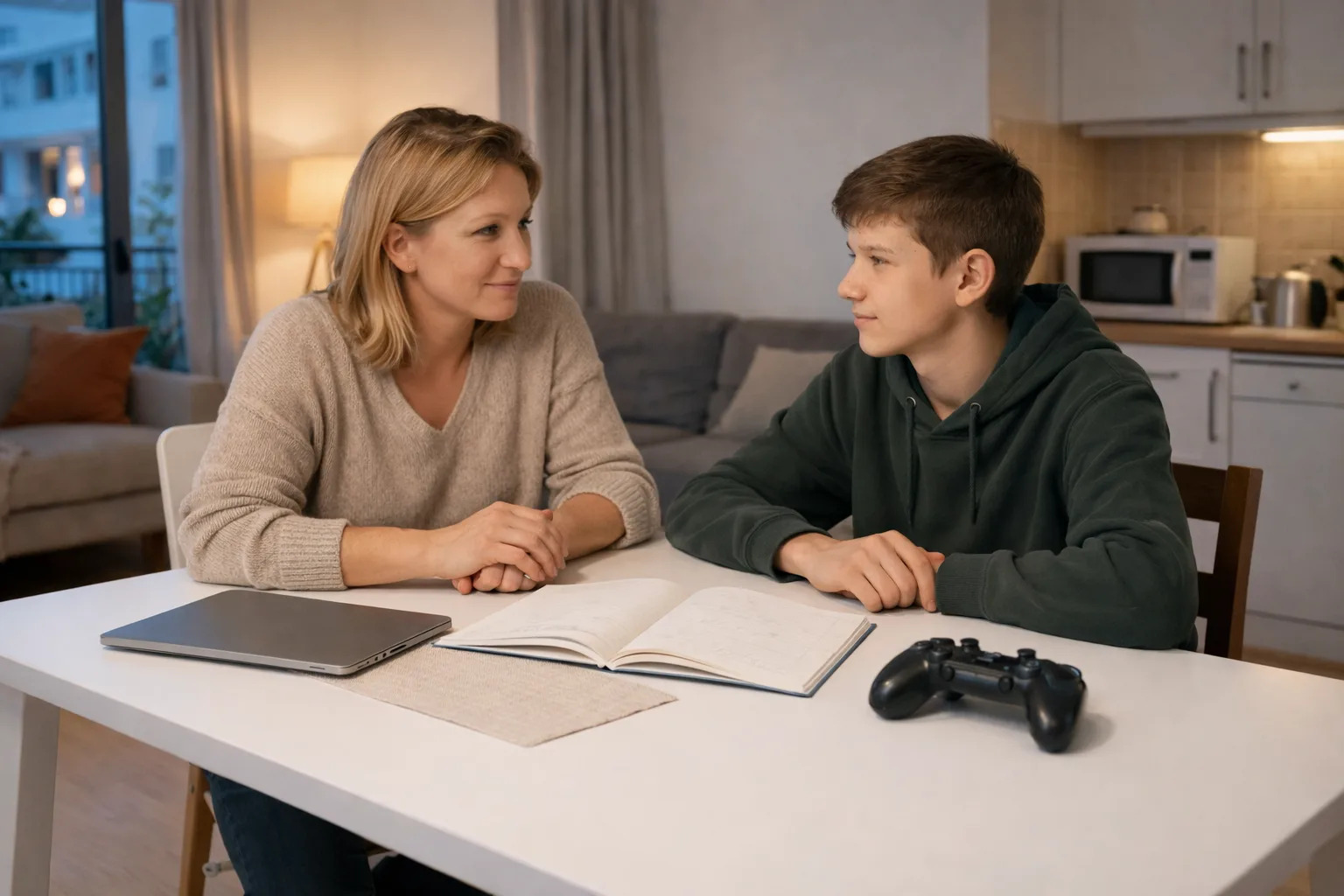
Video games and school: the real question is not “for or against?”, but “under what conditions?”
In many families, video games become a problem only after something else has already started to slip: marks fall, bedtime drifts, evenings drag on, homework ends in conflict. The question then becomes blunt: are video games the problem?
The most useful answer is more precise. Video games do not automatically damage school life. They can do so when they eat into sleep, fragment homework, make stopping unusually hard, or become the default escape whenever schoolwork feels difficult. A workable family framework is therefore neither total demonisation nor total tolerance. It is a way of protecting what school actually needs.
To judge a situation, five questions are more useful than an abstract argument about “screens”:
- When is the child or teenager playing?
- What are they giving up in order to play: sleep, homework, sport, meals, time with friends, reading, rest?
- What state are they in afterwards: calmer, over-stimulated, frustrated, unable to settle back to work?
- Can they stop without a long negotiation every time?
- Does gaming remain a leisure activity, or has it become the near-automatic response to school stress and avoidance?
Two hours on a Saturday afternoon do not have the same effect as an hour of competitive gaming just before bed. Nor is it the same as trying to do homework while a game, voice chat, messages and notifications are all open at once.
It is also worth avoiding another caricature: not all children react in the same way. Some cope reasonably well with a short, planned gaming session. Others find it much harder to stop, especially if they are already more impulsive, inattentive, anxious or discouraged by school. The link can run both ways: digital habits can intensify existing vulnerabilities, and existing vulnerabilities can also push a young person towards more problematic use.
What most often undermines school life
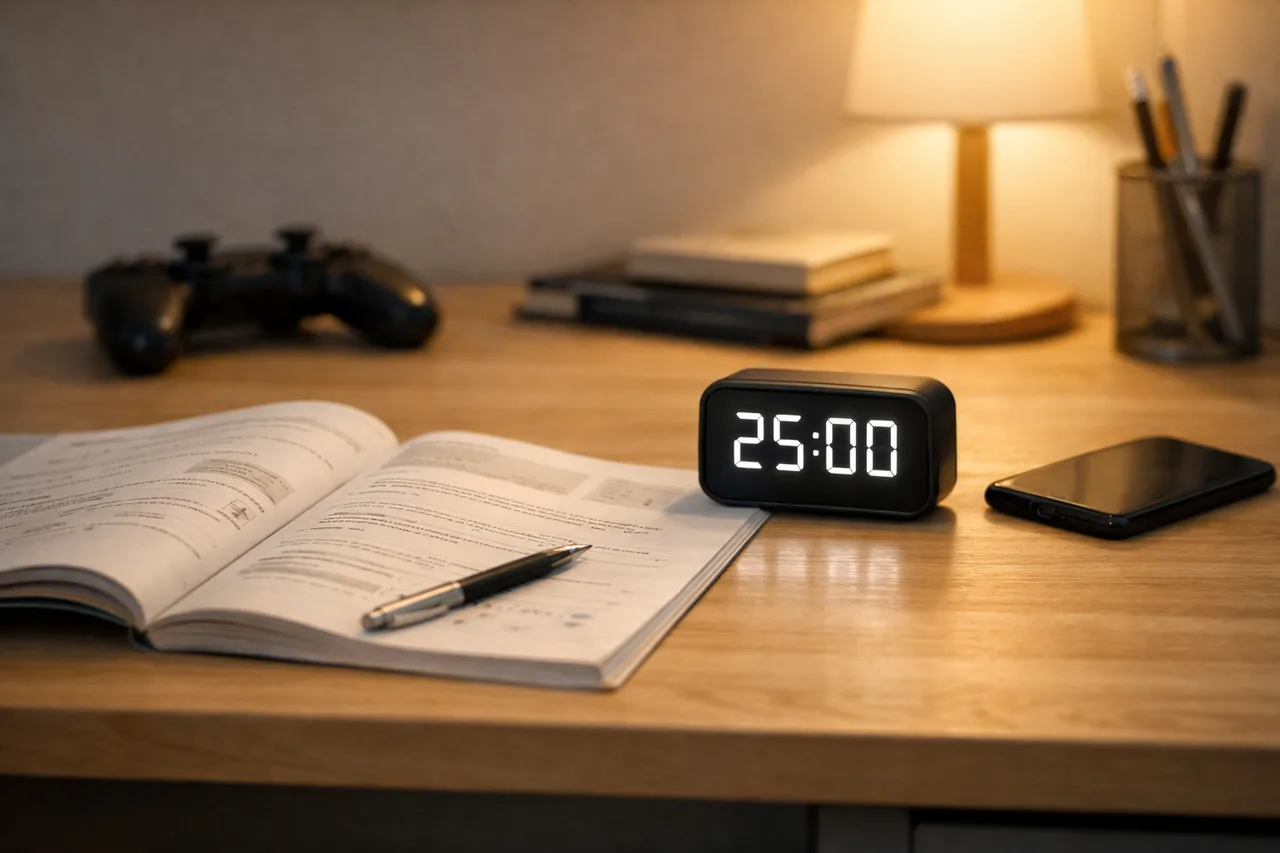
Sleep: the first boundary to protect
When gaming starts to “cost” school, the first damage often comes through sleep. A tired pupil does not just have less energy: they usually concentrate less well, remember less well, tolerate frustration less well and work more slowly. As a rough guide, sleep needs remain high: around 9 to 12 hours for ages 6 to 12, then 8 to 10 hours for ages 13 to 18.
The problem is not only screen light. The content matters too. A competitive, social or highly stimulating session late in the evening activates more than it settles. Online gaming adds its own trap: you do not stop only “when you want”, but at the end of a match, after “one last one”, or when the rest of the team lets go.
Work quality: the myth of harmless multitasking
Many pupils feel they are “still working” while alternating homework, messages, a video in the background and a quick game. In practice, the brain is not doing two demanding tasks at once. It is switching rapidly between them, and each switch has a cost.
At home, that cost is often invisible. The child has been sitting at the desk for an hour, so it looks as if an hour of work has happened. But understanding becomes shallower, working memory fills up faster, and restarting after each interruption is tiring in its own right. That is why a rule such as “one screen at a time during homework” is often more useful than a simple daily quota.
Avoidance: the quietest mechanism
After a disappointing mark, an instruction that feels impossible or a miserable day at school, gaming offers immediate relief: more control, more pleasure, a quicker reward. Wanting to decompress is not abnormal.
The problem begins when gaming becomes the near-automatic exit route from school discomfort. Work gets pushed back ten minutes at a time, restarted too late, followed by guilt, then avoided again. This does not always look like addiction. Very often, it first looks like an avoidance loop.
Build family rules that are realistic enough to hold
A useful framework has four qualities: it is short, observable, consistent between adults and revisable. If it takes a twenty-minute speech every evening to enforce it, it is not really a framework. It is a permanent negotiation.
Start by protecting a few non-negotiables before you discuss gaming time itself:
- Sleep
- A real work block without split attention
- Ordinary obligations: essential homework, bag packed, meals, hygiene, timings
- A life beyond screens: physical activity, friends, family time and offline rest
Only then does it make sense to discuss gaming. Otherwise the conversation gets stuck far too quickly on an arbitrary number of minutes.
| What you are seeing | A framework that is often easier to sustain | Why |
|---|---|---|
| They usually stop without much fuss | A short planned session can sometimes exist, with a finish time agreed in advance | The transition remains manageable |
| Stopping takes endless negotiation or turns into “one last match” | Gaming comes after work, not before | It prevents all the family energy from being spent on stopping |
| Sleep is fragile or mornings are already hard | Finish gaming early, avoid competitive sessions late in the evening, and move devices out of the bedroom if needed | Bedtime becomes the priority again |
| Homework, revision or assessments are already being avoided | Tighter rules and more adult presence | Gaming is at risk of becoming a refuge rather than a hobby |
Write visible rules, not vague principles
“Don’t play too much.”
“Start earlier.”
“You need to organise yourself better.”
These sentences are sincere, but they do not help much. A useful family rule describes what people will actually see. For example:
- “From 5.30 pm to 6.15 pm, homework with no phone and no gaming.”
- “No new match after the agreed finish time.”
- “On school nights, no competitive online gaming in the last part of the evening.”
- “Notifications off during the homework block.”
- “If bedtime keeps slipping, the console and phone charge outside the bedroom.”
Prepare the stop, not just the limit
In many homes, the rule exists but the moment of stopping is left to chaos. That is where most of the conflict sits. Help the young person prepare the transition:
- announce the end before it arrives;
- use a visible countdown timer;
- agree that no new match starts after a certain time;
- on school nights, prefer formats that are easy to interrupt;
- turn the transition into a routine: water, shower, bag packed, then bed.
What changes with age
- In primary school, the structure usually needs to be very visible: devices in shared spaces, simple rules and few exceptions.
- In secondary school, the critical point is often the transition between getting home, homework, messages and online gaming.
- In the later secondary years, a purely policing approach rarely lasts. A clearer agreement about sleep, evenings before assessments and what happens when the rule stops holding is usually more effective.
When digital tools genuinely help learning

The same phone can sabotage homework or help learning. The difference is not the device itself, but the mental use being made of it.
A digital use is genuinely helpful for school when it meets three conditions:
- it requires the student to do something, not just consume;
- it is bounded by a clear task and an identifiable stretch of time;
- it leaves a reusable trace: answers, a short summary, a draft, a recording, flashcards, corrections.
In practice, digital tools help when they are used to:
- revise through active recall instead of passive rereading;
- watch an explanation, then summarise it in your own words;
- practise vocabulary, dates, formulae or definitions;
- run a small structured project: coding, music, editing, creating, targeted research.
Video games themselves can sometimes mobilise English, cooperation, strategy or perseverance. That is interesting, but it is not the same thing as a lesson learned, an exercise completed or a proper night’s sleep. Possible benefits from a leisure activity do not cancel the concrete conditions school still needs.
When this is no longer just an ordinary family argument
Liking games a lot is not enough to speak of a disorder. Strong enthusiasm, pleasure and even phases of excess exist in many adolescents without amounting to pathology.
The situation deserves more attention when several signs settle over time: repeated inability to stop despite known consequences, lying, hidden late-night play, very difficult mornings, a clear drop in schoolwork, abandonment of activities that used to matter, or near-systematic irritability when asked to stop.
Clinical reference points focus mainly on loss of control, growing priority given to gaming over other activities and continuing despite negative consequences. In those cases, do not rush to the label “addiction”, but do not minimise it either. Very often, it is necessary to look at what the gaming is covering: anxiety, ADHD, a sense of failure, isolation, low mood, family conflict or organisational difficulty.
If the impact becomes substantial, a GP, psychologist, or an appropriate member of the school’s pastoral or SEND staff can help distinguish intense interest, school avoidance, attention difficulties, emotional distress and gaming disorder.
Video games and school: a simple framework to test this week
If this subject is going round in circles at home, do not start with a grand theory about screens. Start with a testable framework for a few days, using very few rules:
- No double-screen use during homework.
- No gaming that bites into bedtime.
- A gaming window known in advance, with a real finish.
- A separate digital window clearly aimed at learning, revision or creating.
- A brief family check-in on what changes: morning tiredness, arguments, homework finished, the overall mood of the evening.
The right framework is not the one that bans the most. It is the one that protects sleep, work quality and growing autonomy without turning parents into permanent supervisors or the teenager into someone who always feels in the dock.
After a week, look at the facts rather than the ideology: are mornings easier, homework less fragmented and evenings less tense? That is usually a better starting point than arguing in the abstract about whether games are “good” or “bad”.
Sources
Keep reading
Related reading
Does my child need school adjustments, or mainly a different way of studying?
Concrete guidance for telling the difference between temporary overload, a study-method problem and a more durable difficulty, then deciding whether to observe, speak to school, seek a specialist assessment or ask for adjustments.
Work out whether this is mainly a study-method problem or a broader support need
How to prepare for a school meeting if you suspect ADHD or a learning difficulty
Before a meeting with school, the goal is not to arrive with a diagnosis already decided, but with concrete examples, the right questions and a clear idea of what should happen next.
Prepare a useful school meeting when attention or learning difficulties may be part of the picture
Good grades, but at too high a cost: should you still ask for help?
Good grades do not prove that everything is fine. If a child is coping only through endless evenings, exhaustion, tears or constant parental steering, it can make sense to ask for help before the grades fall.
Look beyond marks alone when evenings, sleep or stress are becoming too costly
School portal: how often should parents check without over-monitoring?
Checking the school portal ten times a day can reassure a parent, but it rarely helps the student. A simple framework for choosing a useful rhythm, spotting the signals that matter, and talking about them without creating continuous surveillance.
Keep some parental visibility without sliding into constant monitoring