

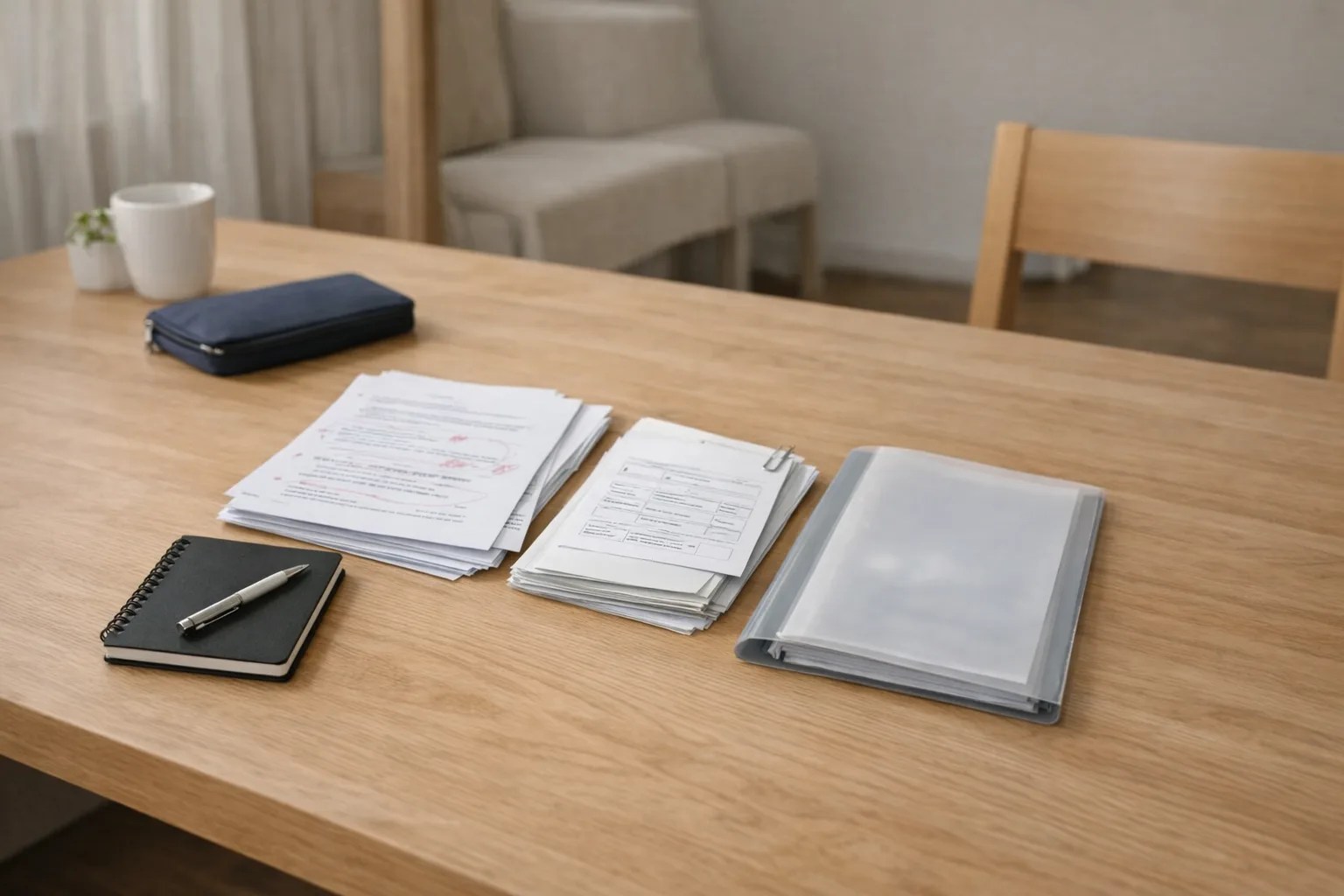
Many parents arrive at a school meeting with a very clear feeling — something is not working — but no clear way to turn that concern into something usable. For a school or college to put targeted support in place or consider adjustments, it rarely needs “perfect proof”. It needs concrete, organised information tied to real school tasks.
Across Great Britain the labels differ — SEND in England, ALN in Wales, Additional Support Needs in Scotland — but the working logic is similar. The school needs to understand where the barrier appears, how often it happens, under which conditions, and what already helps a little.
The most useful starting point is usually four kinds of evidence: a few dated pieces of work, a short note of repeated patterns, a description of the functional impact on school tasks, and the support already tried with its effect.
In other words, a brief, readable pack is usually more useful than an enormous file or a very worried but vague story. And if the situation is acute — refusal to attend, marked distress, suspected bullying, pain, or major fatigue — the alert should go in before the pack feels complete.
The evidence that actually helps a school act
Whether you are speaking to a SENCo (special educational needs co-ordinator) or another support lead, the real question is not “does this child want to work?”. It is: what concrete barrier is getting in the way of the task, and in which situations? That is why a general grade average, a strong parental worry, or a diagnosis on its own may not be enough.
The most useful starting point is often this:
| What to gather | Why it helps | What to avoid or keep in reserve |
|---|---|---|
| 3 to 5 dated pieces of work showing the typical difficulty | The school can see the real task, not just the feeling around it | The full pile of exercise books, tests and printouts |
| A few observation notes on time, help needed and context | They show frequency and conditions | Vague memories such as “it is always like this” |
| Useful contrasts: oral/written, timed/untimed, class/home, copying/short answer | They help target the right kind of support | A single overall grade or one final mark |
| What has already been tried, and with what effect | The school avoids restarting from zero | A long list of every possible theory |
| One relevant outside document, if you already have it | It can clarify current functioning | Sending a full external file with no explanation |
A useful pack usually answers four simple questions:
- Which task is the sticking point? Reading a long instruction, copying, drafting, starting, staying on task, finishing in time, note-taking, memorising, organising materials.
- What is the practical impact on schooling? Unfinished work, unusual fatigue, slow pace, avoidance, copying errors, a drop in marks mainly in certain formats.
- Under which conditions does it change? Subject, time of day, noise, timed work, adult support, broken-down instructions, keyboard instead of handwriting, digital rather than paper.
- What has already helped, even slightly? An instruction read aloud, extra time in class, a model answer, short breaks, rephrased instructions, a keyboard, a plan given in advance.
For example, “timed written assessments fall sharply, while oral answers are accurate” is much more useful than “they do not show what they know”. The first statement opens practical options. The second stays too broad.
In many schools, targeted support, a short monitoring period, or trial adjustments can begin from this kind of evidence. For formal exam access arrangements or more formal plans, the rules are tighter. The route differs across England, Wales and Scotland, but the same principle often applies: the school usually needs evidence of need and evidence that the adjustment reflects the pupil’s normal way of working in day-to-day learning.
Note patterns, not just incidents
One bad homework evening is not yet a pattern. What helps a school is regularity. Over several days or a few weeks, note only a small number of things, but note the same things each time.
- The subject and task type: extended writing, copying, problem solving, test, presentation, homework, reading an instruction.
- The context: in class or at home, alone or supported, timed or not, quiet or noisy.
- The visible time and effort: unusual duration, slowness, fatigue, physical complaints, giving up, needing to restart.
- The level of help needed: one reminder, rephrasing, constant presence, help to start, support at each step.
- The observable outcome: finished or unfinished work, copying mistakes, missed steps, misunderstood instruction, acceptable quality but very slow.
- What changes the outcome: broken-down instructions, a worked example, enlarged print, keyboard, short break, oral reading of the task, where they sit in the room.
You are not trying to monitor everything. You are trying to see whether the difficulty repeats in certain subjects, at certain times, or in certain formats — or whether it is much more general.
Useful ways to write it down:
- “In history, oral understanding is fine, but note-taking makes them lose the thread.”
- “In maths, guided exercises go through, but multi-step problems stall quickly.”
- “Starting takes twenty minutes unless the task is broken into smaller steps.”
- “After ten to fifteen minutes of handwriting, legibility drops and fatigue rises.”
School portals, parent apps, teacher messages, attendance records and missing homework can provide useful timestamps. But they do not, on their own, show what is breaking down inside the task. Use them to date and cross-check, not to replace observation.
A few clean weeks of notes are usually more useful than months of mixed memory. The aim is not to become the family detective of school life, but to produce a reliable, sober picture of the problem.
Separate observable facts from interpretations
This is often the most useful shift. Observable facts make a working conversation possible. Interpretations can harden the exchange too early or push it in the wrong direction.
| Observable fact | Interpretation to hold back |
|---|---|
| “Across four pieces of extended writing, none was finished in the allotted time.” | “They just lack willpower.” |
| “After ten minutes of copying, the handwriting becomes hard to read and the pupil says their hand hurts.” | “It must be dysgraphia.” |
| “Multi-step instructions often need individual rephrasing.” | “She never listens.” |
| “Results drop mainly when the task involves copying, organising and producing quickly.” | “He is not at the level.” |
Of course, parents often have hypotheses. Some may be right. But they are more useful when presented as questions, not as verdicts.
A very useful formula is: “Our working hypothesis is that there may be this kind of difficulty, but first here is what we are observing repeatedly.” That leaves the school room to confirm, nuance, or suggest another reading.
The pupil’s own words can matter too. A sentence such as “If someone reads the instruction, I do better”, “I understand it, but I write too slowly” or “When there are too many steps, I no longer know where to start” is not technical proof. But it is valuable information about the real experience of the task.
This distinction protects everyone. It protects parents from rushing into labels. It protects the child from moral judgement. And it helps the school think in terms of functioning, not assumptions.
Present a short, readable pack instead of flooding the meeting
A school does not need a prosecution bundle. It needs a usable basis for discussion. In many cases, the most effective pack is one summary page plus a few carefully chosen attachments.
A simple and solid format looks like this:
A one-page summary
- the central question: “We want to understand whether targeted support or an adjustment is needed for timed written tasks”;
- the repeated patterns you have noticed;
- the practical impact on schoolwork or attendance;
- what already helps a little;
- what you want from the meeting.
No more than 3 to 5 attachments
- an unfinished piece of work;
- a task showing the gap between what the pupil knows and what they manage to produce;
- an example where a simple support clearly improves the result;
- if useful, one teacher message or a short log of well-dated episodes.
A mini log grouped by theme
- do not line up every evening in order;
- group instead by headings such as “slow writing”, “difficulty starting”, “better orally than in writing”, “exhausted after 20 minutes”.
Only the outside documents that genuinely help
- if you already have a report or letter from an educational psychologist, clinician or therapist, bring the part that best explains current functioning;
- a summary page or conclusion is often enough to open the discussion;
- always connect that document to recent school examples.
Two or three precise questions for the meeting
- Are you seeing the same difficulty in class?
- Which trial adjustments would be realistic?
- Who will observe what, for how long, and when will we review it?
The key point is this: relevance matters more than volume. Twenty-seven unlabelled scans rarely help. It is usually better to ask whether the school prefers a short summary in advance, a few targeted attachments by email, or a paper pack brought on the day.
Keep the rest in reserve. If the school asks for more, you can provide it. But do not start by drowning the person in front of you in unsorted material.
At the end of the meeting, try to leave with four concrete points: what has been retained, what will be tried, who is responsible, and when the review will happen. A good meeting leaves a brief written trace, not just an impression.
When not to wait for the “right” pack
The pack is there to clarify a request. It should not delay an alert.
Do not wait to ask for a quick meeting if what you are seeing is mainly:
- marked psychological distress, panic, or a sudden collapse in functioning;
- refusal to attend, absences starting to build, or mornings that have become unmanageable;
- suspected bullying, humiliation, exclusion, or fear linked to school;
- pain, migraines, sleep disruption, exhaustion or overload clearly affecting attendance or work;
- a sharp decline after illness, injury, concussion, surgery, or another major change.
In those cases, contact the school quickly and, if needed, your GP or the relevant health professional before the paperwork is tidy. The evidence can be organised afterwards.
The reverse can also happen: once the observations are written down cleanly, you realise that the core problem is not mainly an adjustment question. Sometimes the main issue is fear of mistakes, avoidance after failure, social humiliation, attendance anxiety, or a school climate problem that is damaging everything else. The right next step is not always the same.
Before the meeting, aim for this minimum useful set:
- one clear central question;
- 3 to 5 dated pieces of work;
- a short note of repeated patterns;
- the support already tried and its effect;
- 2 to 3 precise requests or questions.
If that fits on one page plus a few short annexes, you are usually closer to a useful meeting than with an endless dossier. What moves a school is not the sheer volume of proof. It is the quality of the observations, the link to the task, and the clarity of the request.