

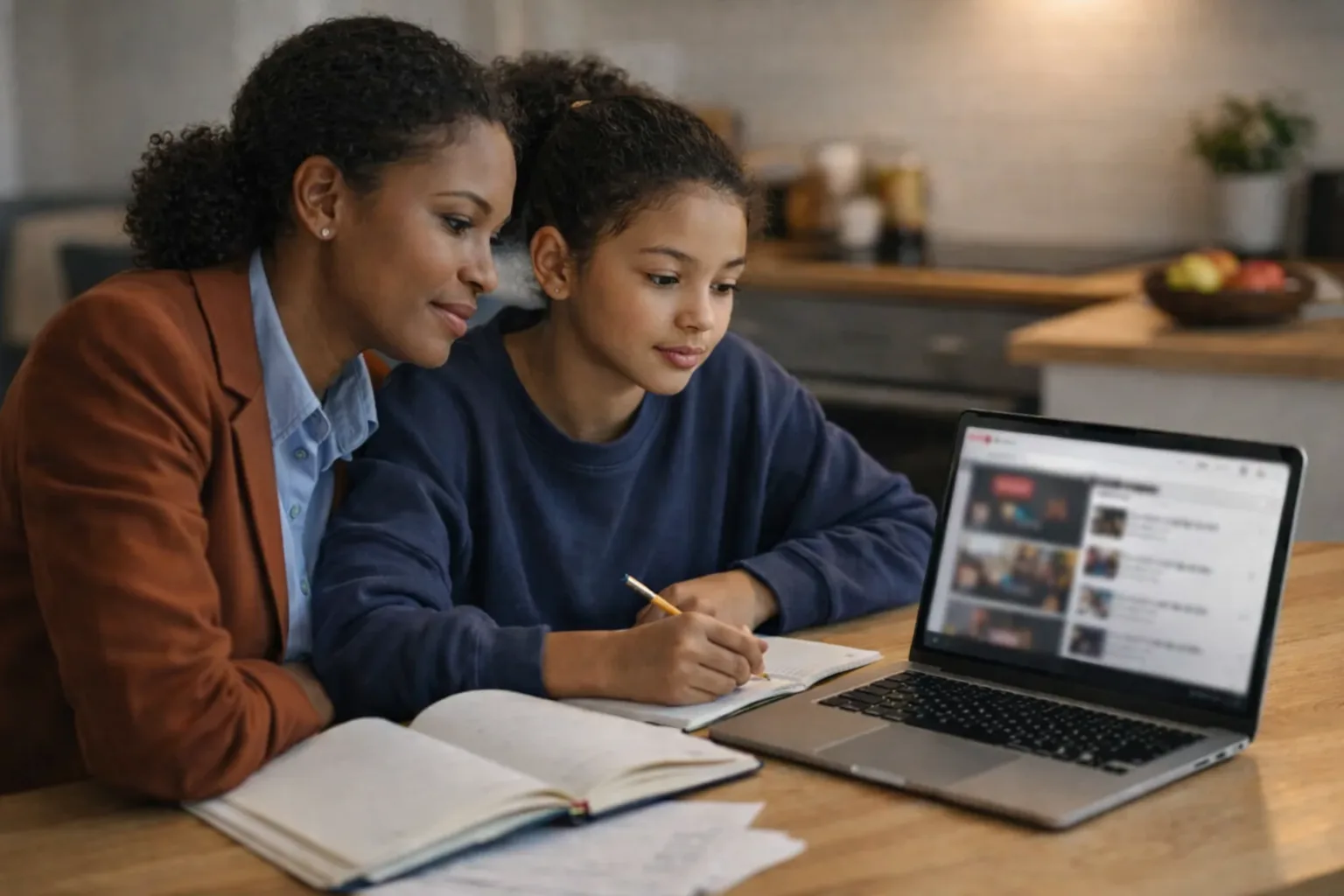
Your child says they revised on YouTube. Should you encourage it, limit it, or steer it differently? The useful family answer is straightforward: YouTube can be a good entry point, but it is rarely a complete revision method.
A genuinely educational resource does more than make a topic feel easy while the video is playing. It helps a student understand one specific idea, find their way around the explanation, and then do something with what they have just watched. By contrast, a video can look wonderfully clear and still create an illusion of progress: everything seems obvious during the viewing, but the student cannot explain it back or do it alone afterwards.
So the useful parent question is not “YouTube: yes or no?”. It is: which video, for which need, in what conditions, and with what reality check at the end?
Why judging YouTube is harder than it looks
YouTube puts serious teaching channels, excellent explainers, rough tutorials, study-motivation videos and school-adjacent content on the same platform. The problem is not that all of it is equal. The problem is that enough of it looks similar enough to blur judgement.
Subscriber counts, polished editing and very fluent delivery are not enough to prove that a video genuinely helps learning. They are presentation signals, not educational guarantees.
That is also why extreme positions are not very helpful. Banning all educational video makes little sense: some students really do understand better after hearing a different wording, seeing an animated demonstration, or calmly replaying a method they missed in class. But allowing everything is no better: a video can hold attention without building durable understanding.
Digital tools do not have one single effect. A targeted eight-minute clip watched at a desk with an exercise book open is not the same thing as a chain of recommendations watched on a phone late at night. In the first case, the screen serves the work. In the second, it can fragment attention, blur the original goal and prolong wakefulness when the evening really needs to get simpler.
Age matters too. In the early secondary years, a useful video should usually stay very close to the exact lesson being taught, with an explicit level and an example the student can reuse immediately. By the GCSE years, through sixth form and into the first stage of university or college, a student can compare several explanations more freely, but still needs to check that the vocabulary, method and level of demand match their own course.
The 7 signs of a genuinely educational resource
Before a channel becomes part of regular revision, check the following signs. None is magical on its own, but together they give you a solid indication.
| What to check | Why it matters | Strong sign | Weak sign |
|---|---|---|---|
| Clear goal and level | The student can tell whether the video answers the real question | The topic is announced clearly and the level is easy to identify | Vague title, broad promise, several levels mixed together |
| Identifiable author | You can see who is speaking and in what capacity | Clear channel description, visible subject focus, background or references stated openly | Authority performed without context, total anonymity, expert tone without frame |
| Reusable structure | Revision depends on being able to return to the right point | Chapters, coherent playlists, logical progression between videos | One long flow, hard to revisit, unordered accumulation |
| Worked example | Understanding needs to show the reasoning, not just the answer | Steps are shown, a mistake is corrected, a boundary case or counter-example appears | Final answer only, slogan instead of explanation |
| Managed cognitive load | A crowded video makes the student work harder on the format than the idea | Stable pace, useful visuals, limited background noise, clear hierarchy | Constant jump cuts, loud music, text everywhere, humour that breaks the explanation |
| Support for review | A good resource leaves something reusable behind | Transcript, captions used sensibly, useful description, exercise or attached document | Nothing to reread, nothing to retrieve, nothing to compare with class notes |
| Active check built in | Real learning shows up in what happens next | The video suggests pausing, asks a question, gives a mini-task or prompts rephrasing | Passive watching, automatic next video, feeling of clarity without any test |
Chapters, coherent playlists, a serious channel description or an available transcript do not prove educational quality by themselves. They do, however, suggest that the creator has thought beyond the first click and has made the content easier to revisit. That is already an important difference between content designed mainly to be watched and content designed to be reused.
The most neglected criterion in many families is cognitive load. A video can be likeable, dynamic and even brilliant while still overwhelming the student with too many signals at once: too much text, too many effects, too many ideas introduced at the same speed, and not enough hierarchy. When everything is highlighted, very little actually stands out.
A transcript or captions can also help because they make it easier to reread a passage, jump back to a specific moment and compare vocabulary with the class notes. But this too requires judgement: automatically generated captions can contain errors, so they are a support, not a substitute for a solid explanation.
When a video really helps — and when it is not enough
A YouTube video is often useful when a student needs to:
- unlock one specific idea that is still unclear in the textbook or their notes;
- review a method step by step, such as a proof, a problem type, a grammar analysis or a pronunciation point;
- hear a different explanation without changing the whole working framework;
- visualise a process that is hard to picture on paper;
- prepare a short restart before attempting an exercise that is already planned.
By contrast, video becomes insufficient or misleading when it is asked to do what it cannot do on its own:
- memorise for the student over time;
- replace written practice, exercises, extended writing or independent problem-solving;
- fill large, older gaps without any human support;
- serve as the main revision method evening after evening;
- count as evidence of learning simply because time was spent on a screen.
It also helps to separate genuinely educational content from content that is merely compatible with school life. A study-with-me video, a motivational Short or a compilation of “revision hacks” may help some students get started. But that is not the same as a strong learning resource. It does not clearly teach a concept, guide a progression or check understanding.
If YouTube repeatedly seems necessary just to get through ordinary homework, or if the student still cannot work independently after watching, the real question may no longer be the quality of the video. It may be whether the problem is mainly about study method, overload, confidence, or a wider learning difficulty.
Turning a viewer into a learner
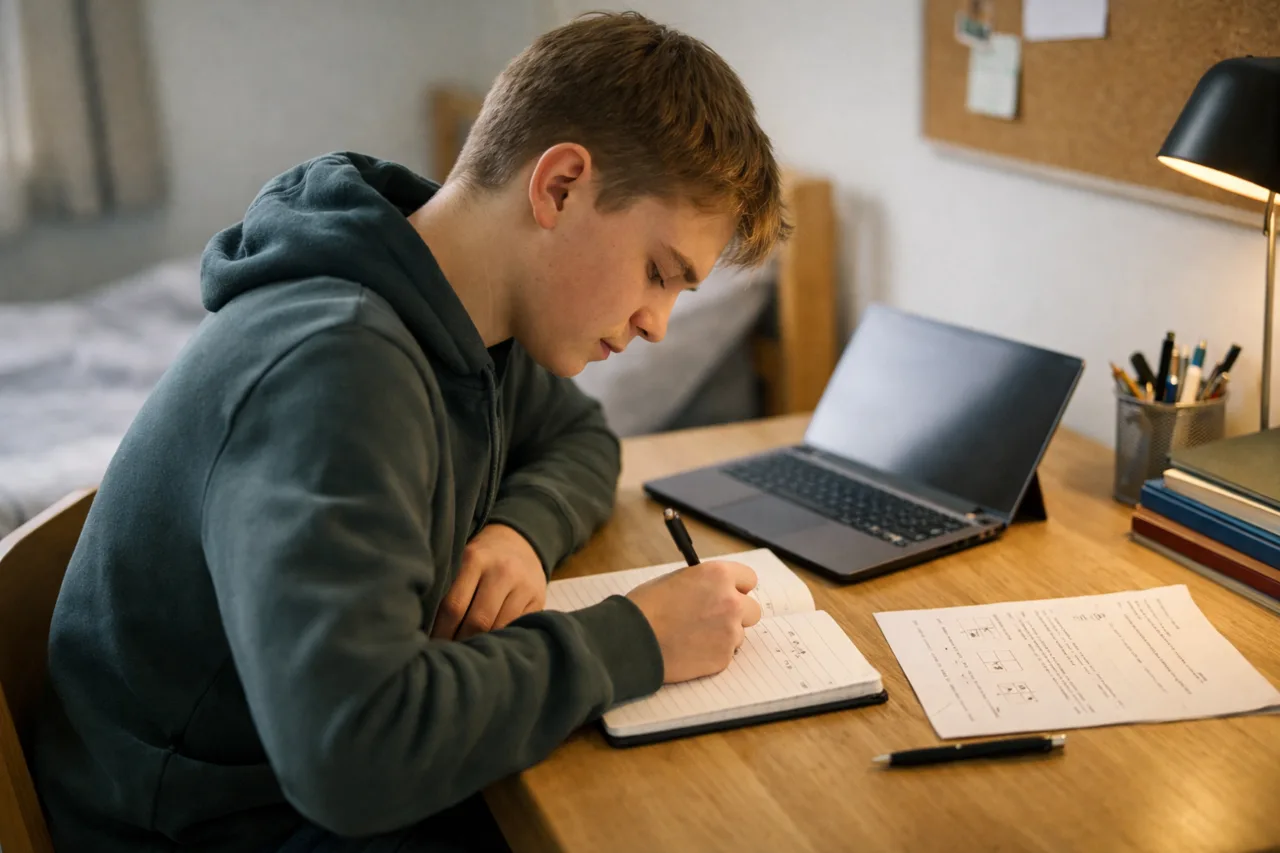
The most useful family reflex is not to ask, “Was it clear?” The better question is: what can you do now without the video? A useful resource should lead to active mental work, not just a temporary feeling of understanding.
Here is a simple protocol that is realistic in many households:
Before the video, define one precise question.
Not “I’m going to do some maths”, but “I want to understand how to identify a relative clause” or “I need to revise the method for solving a linear equation”. This step prevents wandering from tab to tab.During the video, pause regularly.
Every few minutes, the student should be able to note the main idea in their own words, copy one essential step, or say exactly where the difficulty starts. If the pace is too fast for that, the video may be impressive, but it is not well matched to its real use.After the video, close the screen and retrieve from memory.
This is the decisive moment: explain the idea without support, redo one simple example, answer two quick questions, or compare the reasoning with the class notes. If nothing can be produced without replaying the video, there was exposure, not learning.
That final step changes everything. Many young people confuse recognising an explanation when they see it with being able to produce it later. For parents, this is one of the clearest indicators available. The real proof is not “I understood it while they were saying it”. The real proof is “I can now explain it or apply it on my own”.
Setting realistic family rules around YouTube
Useful rules are neither moralising nor maximalist. Their job is to make YouTube a limited tool in the service of work, not an endless extension of screen time.
In many homes, a few simple rules are enough:
- start from a lesson question, not from the homepage;
- one video should match one precise goal, not a vague intention to “revise a bit”;
- notebook open, notifications off, autoplay off;
- after the video, the student must produce something: an oral explanation, an exercise, a short summary, a diagram;
- if nothing is clearer after ten to fifteen minutes, change support or ask for help;
- YouTube revision should not normally happen in bed on a smartphone just before sleep, except perhaps as a very short one-off check;
- genuinely useful channels should be saved in a small personal or family shortlist, so that every session does not begin again inside the recommendations.
These rules do two things at once. They reduce false work, because time spent is no longer confused with progress made. And they limit the side effects that digital tools can have on attention, evenings and family atmosphere. A parent does not need to become a permanent supervisor. The more useful role is to help install a stable routine and then ask for evidence of learning rather than a report of what was watched.
The 2-minute check before you keep a channel
Before deciding that a channel deserves a regular place in revision, ask these five questions:
- Who is speaking, and for which level?
- Is the video structured, easy to revisit and easy to find later?
- Do you actually see reasoning, steps and examples, or only the final result?
- Can your child restate the main point or redo one example without reopening the screen?
- Does this content genuinely help with the current lesson, or does it simply sound intelligent and motivating?
If four or five answers are positive, you probably have a useful supplement. If two or fewer are positive, the content may still be interesting, but it is too weak to become a regular revision resource. In between, keep it as occasional support, not as the centre of the method.
In the end, YouTube is neither the enemy of school nor a magical shortcut. It is a secondary tool that becomes useful when it is targeted, structured, testable and followed by work done away from the screen.
Common questions
Can educational Shorts help?
Yes, but mostly as a prompt for curiosity or a very brief reminder. Their format is rarely developed enough to build robust understanding or to serve as the core of revision.
Is a channel run by a teacher automatically better?
It is a good sign, not a guarantee. A teacher can make an excellent video, but also one that is too fast, too broad or too far from your child’s real level. You still need to look at the structure, the worked example and what your child can do afterwards without the screen.
What if my child says they learn on YouTube but remember very little?
Ask for immediate retrieval without the screen: one minute of explanation, one short exercise, a sketch, or two fast questions. If that is impossible, shorten the viewing time, narrow the search to one single concept, and make the video occasional support rather than the revision session itself.
The useful family metric is not the number of videos watched. It is the number of ideas genuinely understood and then reused without the screen.
Sources
Keep reading
Related reading
School portal: how often should parents check without over-monitoring?
Checking the school portal ten times a day can reassure a parent, but it rarely helps the student. A simple framework for choosing a useful rhythm, spotting the signals that matter, and talking about them without creating continuous surveillance.
Choose a checking rhythm that helps without turning support into surveillance.
Does my child need school adjustments, or mainly a different way of studying?
Concrete guidance for telling the difference between temporary overload, a study-method problem and a more durable difficulty, then deciding whether to observe, speak to school, seek a specialist assessment or ask for adjustments.
Tell the difference between a study-method problem and a more durable difficulty.
Good grades, but at too high a cost: should you still ask for help?
Good grades do not prove that everything is fine. If a child is coping only through endless evenings, exhaustion, tears or constant parental steering, it can make sense to ask for help before the grades fall.
Spot when apparently successful revision is costing too much time, sleep or calm.