

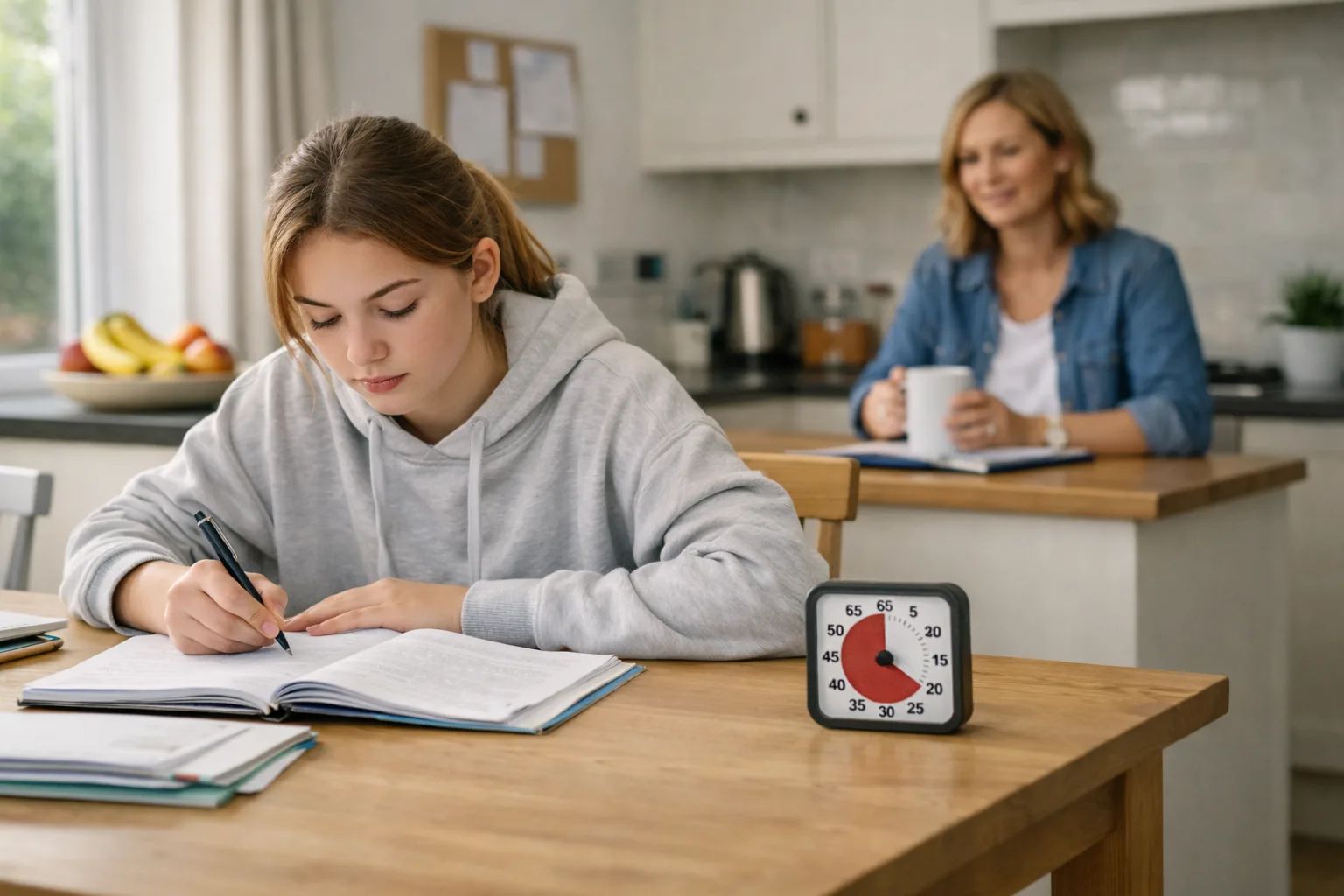
Saturday morning arrives and the school week does not feel fully over. One worksheet is still hanging around, a quiz is coming up, papers are scattered, and the household hesitates between two bad options: let it slide, or turn the weekend into an anxious extension of school.
The better answer is neither total looseness nor a four-hour Sunday grind. Weekend schoolwork can be useful, but only if it lightens the week ahead, consolidates learning, or prepares calmly for a near deadline. It should not be asked to absorb every missing routine, every bit of family guilt, or every fear about grades.
In practice, a good weekend study block is short, specific, explicit, and finished. To build one, you first need to identify the real problem. Is the student not understanding? Not sure how to study? Putting off the start? Or already overloaded? The answer changes what helps.
The weekend can help, but it should not carry the whole week
Out-of-class work can support learning when it clearly extends what happened in class and when its purpose makes sense to the student. For families, that changes everything: a useful weekend is not a busy one. It is one that reduces Monday's mental clutter.
In other words, the weekend is not there to become a second school week. It works better as a safety net than as a permanent crisis unit. You can use it to consolidate a recent lesson, prepare a small part of the coming week, finish a task that was already started, or put materials back in order before everything piles up. By contrast, the vague instruction to “work a bit because it will help” usually creates resistance more than progress.
In many families, it helps to distinguish three legitimate uses:
- Consolidate: revisit a recent idea, redo a few questions, and check what is actually staying in memory.
- Get slightly ahead: prepare one small part of the following week so that everything does not bunch up at once.
- Close the loop: finish something already underway, as long as the task is limited and the endpoint is known in advance.
The weekend becomes counterproductive when it is asked to repair everything at once. That exhausts the student, eats family life, and creates the feeling that nobody is ever really caught up. The problem is not only the amount of work. It is the psychological experience: a load with no edges, no hierarchy, and no visible ending.
Before adding hours, find the real bottleneck
When a parent says, “They never do schoolwork on the weekend,” they are often describing a symptom that is too broad. The same behavior can hide very different realities. And you do not respond in the same way to a problem of understanding, method, starting, or overload.
The table below gives a more useful diagnosis than the simple idea of “not enough effort.”
| What you notice on the weekend | Likely bottleneck | What actually helps | What often makes it worse |
|---|---|---|---|
| The student circles around the task for a long time, then gets going once started | Starting is hard; the task feels threatening; there is too much friction at the start | One tiny first action, a clear start time, a visible goal | Lectures about motivation |
| The student sits there but rereads passively and remembers very little | Method problem | Questions, retrieval from memory, short exercises, self-testing | Telling them to read it again without changing the method |
| The student gets stuck as soon as they have to apply the idea | Fragile understanding or older gaps | Rework one guided example, identify the exact error, seek help if it keeps happening | Adding more time without clarifying the underlying issue |
| Everything spills over despite genuine effort | Schedule overload or fuzzy organization | Prioritize, reduce, and decide on Friday what matters most | Trying to cram everything into Sunday |
| Tension rises every time a test approaches | Anxiety, perfectionism, or too much perceived stakes | Break the task down, start earlier, and make it finite | Last-minute marathons |
This distinction matters because more time applied to the wrong problem solves very little. A child who does not understand does not first need more hours. A teenager who rereads passively does not first need a more present parent. And a schedule that is already too full does not first need one more instruction.
When the real bottleneck is understanding, the parent's role stays limited. You can help restate the instruction, identify where things start to go wrong, or encourage the student to ask for clarification. But you should not become the long-term substitute for an explanation that really needs to go back to the class, the teacher, or another competent adult.
A weekend framework that actually helps
The best family framework is not the one that looks impressive. It is the one that survives real life: tired adults, errands, sports, transport, siblings, and plans that shift. A modest structure you can repeat is better than a heroic plan that collapses after two weekends.
A simple format often works better than a long, vague stretch of supposed study time.
Give the weekend one main function.
A weekend cannot do everything. Ask: this week, is it mainly for consolidation, for getting slightly ahead, or for closing the loop on one task? That single question stops every weekend from becoming an infinite list.Plan one or two limited blocks, not a vague half day.
For many middle schoolers, a short but clearly bounded session works better than an entire afternoon spent being “supposed to work.” In high school, you can stretch the block a little if the task is well defined. In the first years of college, the logic is still similar: a few identifiable blocks are usually better than continuous saturation.Choose active tasks.
Weekend study quickly becomes stressful when it means staring at pages and hoping something will go in. It is usually more effective to answer questions, redo a few exercises, explain an idea out loud, write from memory what was retained, or make a small revision aid. The key is not how long the student sits at the table. The key is whether anyone can check what actually stuck.Set a real finish line.
“Work until it is good” is an excellent way to build a tunnel. Prefer an observable ending: two exercises redone properly, one short list of questions completed, a simplified summary page, five flashcards, or a mini-plan for Monday.End with a restart cue, not a moral speech.
At the end, the student should know what comes next in the week, not hear another sermon. One sentence is enough: “On Monday, start with chapter 3,” or “On Tuesday, test yourself on the definitions from memory.” The weekend has worked when it makes the restart easier.
A few mistakes are especially costly:
- starting a big session late on Sunday, when fatigue and anticipatory stress about the coming week are already rising;
- supervising for the entire duration instead of framing the start and the finish;
- mixing schoolwork with wider family grievances;
- leaving the task open, with no completion criterion;
- assuming that a quiet child at a desk must be learning.
The framework also has to protect what weekend schoolwork can easily damage: sleep, ordinary family breathing room, and some real sense of free time. When a supposedly serious routine consistently eats Sunday evening, it may look responsible while actually making Monday attention weaker.
Handing control back gradually

Autonomy is not declared on a Saturday morning. If you suddenly remove help from a student who is highly dependent on adult steering, you do not usually produce responsibility. You produce drift, then conflict. But if you organize everything yourself, you teach the opposite lesson: schoolwork is an adult-managed project.
The more useful logic is a gradual transfer of control.
At first, the parent can help with framing: clarify the goal, limit the session, and help the student identify the first small action. Then the adult steps back one notch: the student proposes the plan and the adult only checks whether it makes sense. Later, when the habit is stronger, the follow-up can move to a light checkpoint: a short review at the end of the weekend, or a Sunday evening exchange about what is ready and what is not.
Three questions are especially helpful because they support method without taking the whole task back:
- What exactly do you need to produce?
- How will you know you are finished?
- What will you do if you are stuck after ten minutes?
Those questions are often more useful than “Have you started yet?” or “Did you really study?” They ask for clarity, not promises. They move the exchange away from surveillance and toward organization.
The balance changes with age. In middle school, co-building the framework is often still necessary. In high school, the parent can more often ask for a proposal instead of supplying the plan. In early college, the family role becomes more conversational: helping the student prioritize, protect basic life balance, and avoid living every week in permanent catch-up mode.
What parents can influence directly is the frame: the time, the limit, the environment, the language used, and the protection of sleep. They can influence method indirectly, by asking the right questions and encouraging active tasks. What they cannot do alone is solve chronic misunderstanding, established anxiety, or a workload that is objectively too heavy.
When weekend schoolwork is revealing a deeper problem
The real warning sign is not that a child sometimes needs to do a little schoolwork on the weekend. It is that nearly every weekend gets swallowed by school, with rising tension and little visible benefit.
It is worth digging further if, over several weeks, you notice several of these signs:
- schoolwork regularly spills into a large part of Saturday or Sunday;
- Sunday evening becomes a moment of panic, tears, arguments, or shutdown;
- the student sacrifices sleep to catch up;
- one subject absorbs a disproportionate amount of time despite real effort;
- time spent rises, but understanding and confidence do not;
- the whole household starts organizing itself around this school emergency.
In those situations, the most useful parental message is rarely “work even harder.” It is more often: we are going to reduce the blur, identify the real problem, and find the right relay. Sometimes that means emailing a teacher with one precise question. Sometimes it means reviewing the number of extracurricular commitments or changing the way tests are prepared. Sometimes, when distress, anxiety, or sleep disruption are taking up too much room, it justifies support from a counselor, pediatrician, or another qualified professional.
The weekend should not be used to hide a more structural problem. If it has become the usual container for everything that did not fit into the week, the answer is not to make Sunday tougher. It is to rethink the whole system.
The Friday evening test
Before deciding that there will be weekend schoolwork, parents and students should be able to answer four questions clearly:
- What? Is the task precise?
- Why? Is it for consolidation, getting slightly ahead, or closing the loop?
- How? Is the method active, or only passive and vague?
- When do we stop? Is the ending visible?
If you cannot answer those four questions, the problem is probably not a lack of hours. It is a lack of shape.
Weekend schoolwork becomes useful when it stops feeling like a tunnel. It should look more like a short, readable intervention that gives air back to the week and, gradually, control back to the student. When it protects learning, sleep, and the family relationship at the same time, it is finally doing its real job: not filling time, but creating stability.
Sources
Keep reading
Related reading

Why a teenager’s attention collapses faster than you think
A teenager who switches off quickly does not necessarily have an attention problem. Fatigue, avoidance, a vague task and constant micro-interruptions often explain far more.
Understand whether the real issue is attention, fatigue, avoidance, or a vague task
Evening study: how late is too late for real learning?
There is no universal 9 pm or 10 pm cut-off for evening study. The real limit is the point at which work starts to damage sleep or is done in a state of fatigue that no longer supports real learning.
See when evening study starts costing more than it helps
Talking about marks without damaging self-esteem: an underrated parenting skill
A mark can open up a real diagnosis or turn into a judgement on the child. Here’s how to discuss school results with clear standards, precision and growing autonomy, without creating shame or constant monitoring.
Talk about grades without turning weekend work into extra pressure