

There is no universal study method — only methods that fit the task
A child can work for an hour and still make little progress if the method does not match the subject. The problem is not always motivation, seriousness, or intelligence. Very often, the student is applying the same routine everywhere: rereading the lesson, copying notes again, doing many exercises without analysing mistakes, or memorising words without being able to use them.
The central idea is simple: study methods by subject should start from the kind of performance the subject asks for. In mathematics, a student must often choose a procedure, justify steps, and recover from errors. In science, they need terms, but also mechanisms: what causes what, under which conditions, and how to explain it. In history or social subjects, they must connect facts, causes, examples, and arguments. In languages, short frequent retrieval and production usually matter more than one large session. In spelling or writing, knowing the rule is not enough if the student cannot apply it while producing a sentence.
So the first parent question is not “Did you study?” but “What exactly does this subject require my child to do?”
| If the subject mainly asks the student to... | The study method should emphasise... | A weak method often looks like... |
|---|---|---|
| Solve problems | Error analysis, worked examples, varied practice | Repeating pages without knowing why mistakes happen |
| Explain mechanisms | Drawing causal chains, self-explaining, predicting outcomes | Learning definitions without linking them |
| Remember structured knowledge | Retrieval, timelines, examples, comparisons | Reciting isolated facts |
| Speak, listen, or write fluently | Short frequent practice and production | One long session of passive review |
| Write clearly | Planning, sentence-level practice, feedback loops | Reading model answers without producing any answer |
| Spell accurately | Targeted application in real writing | Dictation alone, with the same mistakes returning |
This does not mean every subject needs a complicated system. It means the method should be modest, precise, and honest about the real task. A good study session leaves traces: a corrected error, a recalled idea without the book, a mechanism explained in the student’s own words, a paragraph drafted, or vocabulary used in a sentence. A weak session often leaves only a feeling of time spent.
First diagnose the difficulty, not the subject

When a child says “I’m bad at science” or “I never understand languages”, the sentence is usually too broad to be useful. A subject label hides several possible blockages. The student may understand in class but forget at home. They may know the lesson but panic when the wording changes. They may remember facts but fail to structure an answer. They may learn vocabulary but not retrieve it quickly enough while speaking or writing.
A more useful diagnosis separates seven difficulties.
Understanding is the ability to explain why something works, not just repeat the final sentence. In mathematics and science, this often shows up when the exercise changes slightly. A child who can redo the example but freezes on a new version may not yet understand the underlying idea.
Memory is the ability to retrieve knowledge without seeing it. Rereading can make a page feel familiar, but familiarity is not the same as recall. The student should occasionally close the book and answer, sketch, explain, or list from memory.
Automation is speed and reliability for basic moves. Times tables, common grammar patterns, unit conversions, spelling patterns, and frequently used formulas can become bottlenecks if they require too much mental effort each time.
Reading the task is the ability to notice what the question actually asks. Some students know the content but lose marks because they answer a nearby question, miss a condition, or overlook a command word such as compare, justify, explain, or prove.
Written expression is not only “having ideas”. It includes choosing an order, making links explicit, using examples, and writing sentences that carry the reasoning.
Oral or language production is different again. A student may recognise words when reading but not retrieve them quickly enough while speaking. This is why languages often reward short, regular practice more than rare marathon sessions.
Confidence matters, but it should not become the only explanation. A child who says “I can’t do it” may need reassurance, but they may also need a smaller first step, a different kind of practice, or clearer feedback.
A quick diagnostic routine can help: ask the student to do one small task without the book, then observe where the process breaks. Can they start? Do they know which method to use? Do they remember the key idea? Do they understand the correction? Can they explain the mistake afterward? The answer tells you far more than the number of minutes spent at the desk.
What changes from one discipline to another
The same broad learning principles appear across subjects: spaced practice, retrieval, feedback, and active use. But the form changes because the school task changes.
Mathematics and quantitative subjects: make mistakes informative
In mathematics, doing more can help only if the student knows what the extra practice is for. Ten exercises repeated with the same misunderstanding may strengthen the wrong habit. A better routine starts from the error: Was it a concept problem, a method choice, a calculation slip, a notation issue, or a rushed reading of the question?
A useful mathematics session often includes three moves: redo one corrected mistake without looking, solve one similar exercise with a small variation, then explain the trigger that tells the student which method to use. The aim is not to admire the correction; it is to make the next decision more reliable.
Worked examples can help, but only if the student does not merely watch the solution. They should pause and ask: “Why this step? Why now? What would change if the numbers or wording changed?” This self-explanation makes the example a tool for understanding rather than a page to copy.
Science: link terms to mechanisms
In science, vocabulary is necessary, but words alone can be deceptive. A student may learn evaporation, force, cell, circuit, pressure, or ecosystem and still be unable to answer a question because the missing piece is the mechanism.
A stronger method asks the student to build a chain: initial situation, change, cause, effect, condition, and observable consequence. Instead of only defining a term, they can draw a simple process diagram, predict what happens if one variable changes, or explain the idea to a younger student. If the explanation collapses when the words are removed, the concept is not yet secure.
History, geography, and social subjects: organise meaning, not only facts
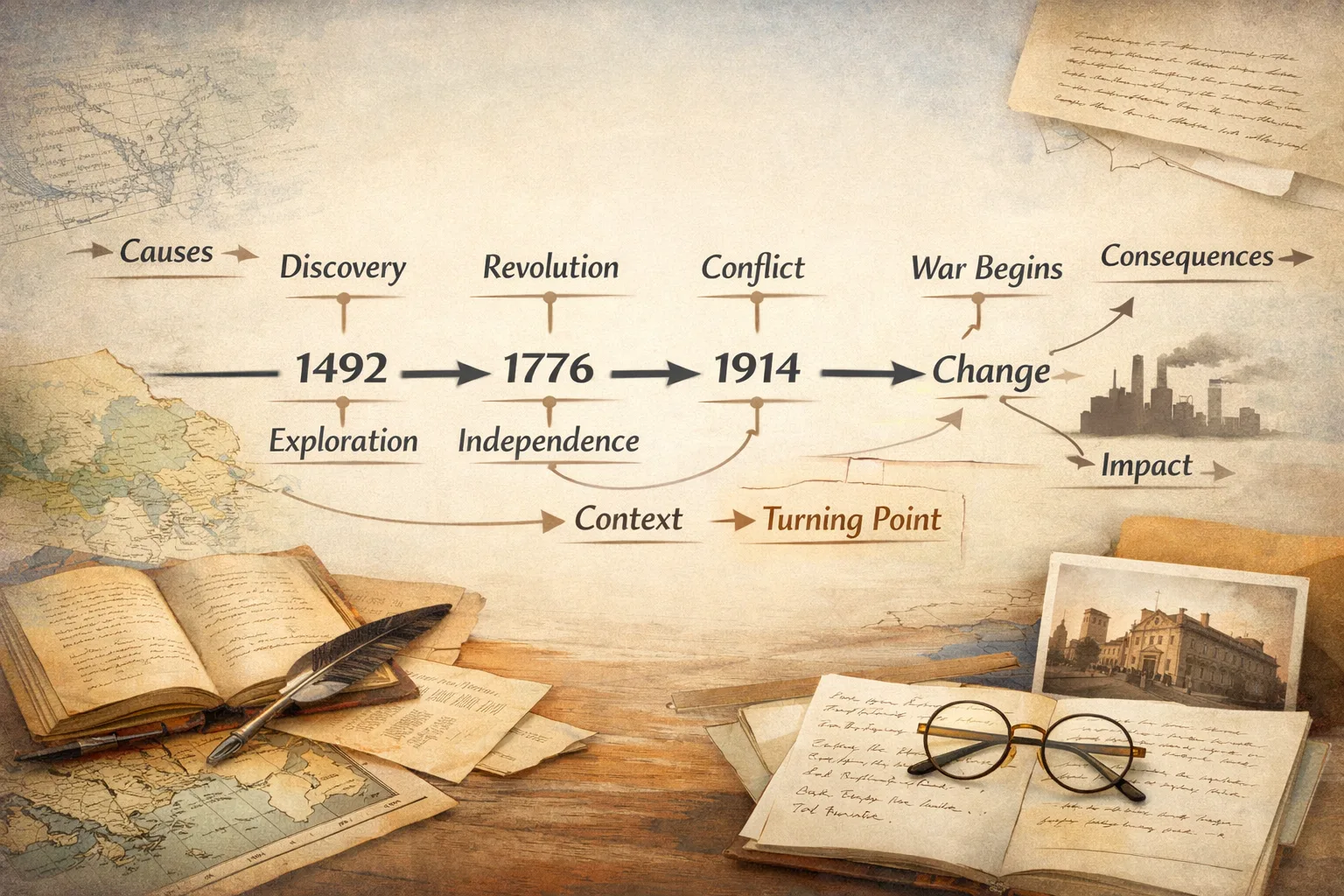
Dates, places, names, and concepts matter, but they become usable only when they are placed inside meaning. In history, a date is rarely useful as an isolated number. It should anchor a before-and-after, a cause, a consequence, or a turning point. In geography or social subjects, examples should not be collected at random; they should support a type of explanation.
A good routine might ask: What is the main question of this chapter? What are the three or four ideas that answer it? Which examples prove or illustrate each idea? What confusion is likely with a neighbouring topic? This turns a lesson from a long list into a structure the student can rebuild.
Languages: small, frequent use beats rare intensity
Languages require retrieval under pressure: hearing, choosing, pronouncing, writing, or responding before everything feels perfectly ready. That is why a five-minute daily routine can be more powerful than a single large weekly session if the five minutes are active.
Useful short language work can include recalling ten words from memory, using three of them in sentences, listening to a short passage and noting what was understood, saying a sentence aloud, or transforming a model sentence into a new one. The goal is not to “cover” a lot. It is to make retrieval faster and less fragile.
Spelling, grammar, and writing: move from rule to use
A student can recite a spelling or grammar rule and still fail to use it in real writing. This is not necessarily bad faith. Applying a rule while producing a sentence requires attention, habit, and the ability to spot the relevant moment.
The method should therefore include small production tasks: write three sentences that force the rule to appear, underline the decision point, correct one repeated error, then reuse the same pattern in a new sentence. For longer writing, the student needs planning and revision, not just model answers. A model answer becomes useful only when the student compares it with their own choices: order of ideas, precision of examples, links between sentences, and clarity of conclusion.
General knowledge: build reference points without turning everything into a test
General knowledge grows through encounters, conversation, repetition, and connection. It is weakened when home becomes a constant quiz. A child who is always tested can start to hide what they do not know.
A calmer method is to create reference points: a map, a timeline, a news item explained briefly, a museum visit, a documentary, a book, a family discussion, or a comparison with something already known. The parent’s role is not to interrogate endlessly, but to help the child connect new information to existing hooks.
Build short routines that respect the subject
A practical study plan should vary the form of the session, not only the duration. The same 20 minutes can be used badly or well depending on the subject.
For a 20-minute mathematics session, the student might spend 5 minutes rereading the corrected mistake, 8 minutes redoing it without looking, 5 minutes solving a similar problem, and 2 minutes writing the warning sign: “I confuse proportionality with addition,” “I forget the unit,” or “I choose the formula before reading the condition.”
For a 20-minute science session, they might spend 5 minutes recalling the key terms, 10 minutes drawing or explaining the mechanism, and 5 minutes answering a “what would happen if...” question. If the student can define the term but cannot predict the effect of a change, the next session should focus on understanding, not memorisation.
For a 20-minute history or social-subject session, they might close the book and rebuild the chapter as a question, three main ideas, and one example for each idea. Then they can check the lesson and add what was missing. This trains structured recall rather than page familiarity.
For a language session, 5 to 10 minutes may be enough if it happens often and requires active use: recall vocabulary, say a few sentences aloud, transform a sentence, listen briefly, or write a tiny answer. The danger is a session that feels comfortable because the student only looks at familiar words.
For a writing or spelling session, the student should produce something. Even a short paragraph, three targeted sentences, or a corrected mini-draft is better than only reading advice about writing. Feedback becomes useful when it is converted into one next writing move.
A 40-minute session should not simply double the same activity. It can combine phases: first recall, then practice, then correction, then a short transfer task. Transfer matters because school assessments rarely ask students to reproduce the exact same page. They ask them to use knowledge in a slightly changed situation.
The parent’s role can stay light. Instead of supervising every detail, ask one of three questions at the end: “What can you do now without the book?” “Which mistake will you watch for next time?” “What would show that this is improving?” These questions keep the focus on progress without turning every evening into a battle.
Beware of false progress: effort that looks serious but stays passive
Some study behaviours are reassuring because they look calm and industrious. The problem is that they can create an illusion of learning.
Rereading the lesson can be useful at the beginning, especially when the student is lost. But if the whole session is rereading, the student may only be recognising information, not retrieving it. Add a closed-book moment: list, explain, answer, sketch, or teach back.
Copying notes again can help if the original notes are chaotic and the student is rebuilding the structure. It is less useful when it becomes decoration: neat pages, colour, and titles with no real processing. The test is simple: after copying, can the student explain the structure without the page?
Watching a correction can be necessary, but it is not the same as knowing how to solve the problem. The student should cover the correction and redo the task later. If they cannot restart, the correction has not yet become usable knowledge.
Learning definitions by heart can help in subjects where precise words matter, but definitions should be paired with examples, non-examples, and use in a question. “I know the definition” is not the finish line if the assessment asks for explanation.
Doing many exercises can be useful when the method is basically understood and fluency is the goal. It is inefficient when the student is repeating the same error. In that case, fewer exercises with deeper correction often produce more progress.
Parents can help by praising the right kind of effort: not “You spent a long time”, but “You found the mistake”, “You tested yourself without looking”, “You changed method when the old one was not working”, or “You can now explain the link.” This keeps encouragement connected to learning, not only endurance.
How to measure real progress without obsessing over grades
Grades and comments matter, but they arrive late. Families need earlier signals to know whether the method is working.
Real progress is often visible in small behaviours. The student starts faster because the first step is clearer. They make fewer repeated mistakes. They can explain a concept without the exact wording of the lesson. They notice when a question asks for comparison rather than description. They retrieve vocabulary more quickly. They correct a paragraph with a specific target instead of vaguely “making it better”.
A useful weekly review can be very short:
| Question | What it reveals |
|---|---|
| What did you recall without the book this week? | Whether memory is becoming active |
| Which mistake came back more than once? | Where targeted practice is needed |
| Which subject felt easier to start? | Whether routines reduce friction |
| What changed after correction? | Whether feedback is being used |
| What still collapses when the wording changes? | Whether understanding is transferable |
This review should not become an interrogation. Its purpose is to decide the next adjustment: more retrieval, more explanation, more short practice, more work on reading questions, or more support from the teacher when the difficulty is too deep to solve alone.
Also remember that some difficulties are not purely methodological. Persistent gaps, anxiety, attention difficulties, language barriers, sensory issues, or a mismatch between school expectations and the child’s current level may require additional support. A subject-specific method helps, but it should not be used to blame the child when the problem is larger.
What to do this week if your child is stuck in several subjects
Start small. Choose one subject and one visible blockage. Do not redesign the whole school routine at once.
First, ask the student to perform a tiny task without the book: solve one problem, explain one mechanism, rebuild one timeline, use five words in sentences, or correct three spelling decisions. Second, name the blockage as precisely as possible. Third, choose one method for the next three sessions. Fourth, check for a concrete sign of progress.
The best subject-specific study method is not the most impressive one. It is the one that changes what the student can actually do: start, recall, explain, solve, write, speak, correct, or transfer.
Common parent questions
Should my child study every subject every day?
Not necessarily. Some subjects, especially languages or automatised skills, benefit from short frequent contact. Others can work well with slightly longer sessions if the student is actively recalling, practising, and correcting. The key is frequency where forgetting or fluency is the bottleneck, and depth where understanding or expression is the bottleneck.
Is memorisation still important?
Yes, but it should be active and connected. Students need facts, terms, formulas, examples, and vocabulary. The risk is isolated memorisation that cannot be used. A good method asks the student to retrieve knowledge and then apply it in the form the subject requires.
When should a parent step back?
Step back when the student knows the next action, can check the result, and is not using parental presence as the only trigger to start. Stay lightly involved when the issue is diagnosis, planning, or discouragement. The goal is not total independence overnight; it is a gradual transfer of control.
What if the student works seriously but still does not improve?
Look for a mismatch between method and difficulty. If the student rereads but cannot recall, add retrieval. If they know terms but cannot answer questions, add mechanisms. If they do many exercises but repeat the same mistake, slow down and analyse the error. If none of this helps, the difficulty may need teacher feedback, tutoring, assessment, or a different kind of support.
Subject-specific study methods are not about making school more complicated. They are about using effort where it changes something.
Sources
Keep reading
Related reading
History revision: how to remember dates without losing their meaning
In history, memorising dates is not enough. Here is how to help a student turn them into usable reference points, choose the right method for the task, and recognise real progress.
Keep dates connected to causes, examples and argument structure.
Spelling: how to move beyond dictation and half-learnt rules
Your child knows the rule but keeps making the same spelling mistakes? The key is usually not more dictation, but finding the real blockage and training the right move.
Replace repeated dictation with targeted spelling moves.
How to broaden your child’s general knowledge without turning home into a constant quiz
Useful general knowledge is not built through rapid-fire questions. It grows through reference points, calm conversation and light revisiting. Here is how to widen it at home without making knowledge feel like a test.
Build broad reference points without making home feel like a quiz.
All articles in this category
Every published article in this topic, from newest to oldest.
- In maths, revisiting mistakes often helps more than doing pages of practice
- In science, learning the terms without understanding the mechanisms: a classic trap
- Modern languages: why five minutes a day beats one big weekly revision session
- Spelling: how to move beyond dictation and half-learnt rules
- History revision: how to remember dates without losing their meaning
- In geography, maps and diagrams should help students think, not just decorate the page
- How to broaden your child’s general knowledge without turning home into a constant quiz