

Exam preparation and performance: the simple framework that actually helps
Exam preparation usually becomes stressful when every task looks equally urgent. A student rereads a chapter, rewrites notes, opens a practice paper, checks a group chat, worries about the grade, starts a colour-coded plan, then feels behind again. Parents can see the effort, but not always the direction.
The useful answer is not “work more”. It is to match the work to the time remaining and to make every revision session answer one of four questions:
- What do I need to remember?
- Can I retrieve it without looking?
- Can I use it under exam conditions?
- What mistake must not happen again?
Good exam preparation and performance depend on that loop. Content must be learned, but it also has to be recalled, applied, timed and emotionally managed. A student who only rereads may feel busy without becoming much more exam-ready. A student who only does practice papers may repeat the same gaps. A student who plans beautifully but ignores sleep and recovery may arrive with a fragile attention span.
A stronger approach is: diagnose the exam, prioritise high-yield work, practise retrieval, simulate the format, protect energy, and use the final days to stabilise rather than reinvent the method. This page is a practical guide for parents and students who want to revise seriously without turning exam season into a permanent family emergency.
Put each problem in the right preparation horizon
The right strategy changes with the time left. Many revision mistakes come from using the wrong horizon: doing last-minute memorisation two months early, or trying to redesign the whole course the night before.
| Time remaining | Main goal | Best use of effort | Common trap |
|---|---|---|---|
| Several months | Build the base | Regular retrieval, course organisation, weak-topic repair | Waiting until pressure creates motivation |
| Around two months | Prioritise and diagnose | Map chapters, start practice questions, build an error log | Trying to “revise everything” with equal weight |
| Two to three weeks | Convert knowledge into performance | Timed tasks, mixed practice, targeted review | Spending too long making perfect notes |
| Final week | Stabilise and reduce uncertainty | Short retrieval rounds, formulae/key facts, exam routines | Starting new heavy resources or comparing with others |
| Evening before | Preserve sleep and confidence | Pack materials, light recall, calm wind-down | Panic cramming late into the night |
| After a paper | Recover and redirect | Brief debrief, one lesson, reset for the next exam | Long post-mortems that drain attention |
Several months out, the best preparation is not dramatic. It is regular enough to prevent the course from becoming a single huge pile. This is where short self-quizzes, spaced review and tidy materials matter most.
Two months out, the student needs a map. Which topics are secure? Which are familiar but fragile? Which are almost blank? Which exam formats require method as much as knowledge: essays, problem solving, oral answers, lab-style questions, source analysis, multiple-choice reasoning?
In the final week, the job is no longer to create a perfect student from scratch. It is to make the existing preparation usable. That means reducing avoidable errors, checking the highest-yield facts or methods, rehearsing the first few minutes of the exam, and keeping the body capable of concentration.
Separate work that pays from work that only feels reassuring
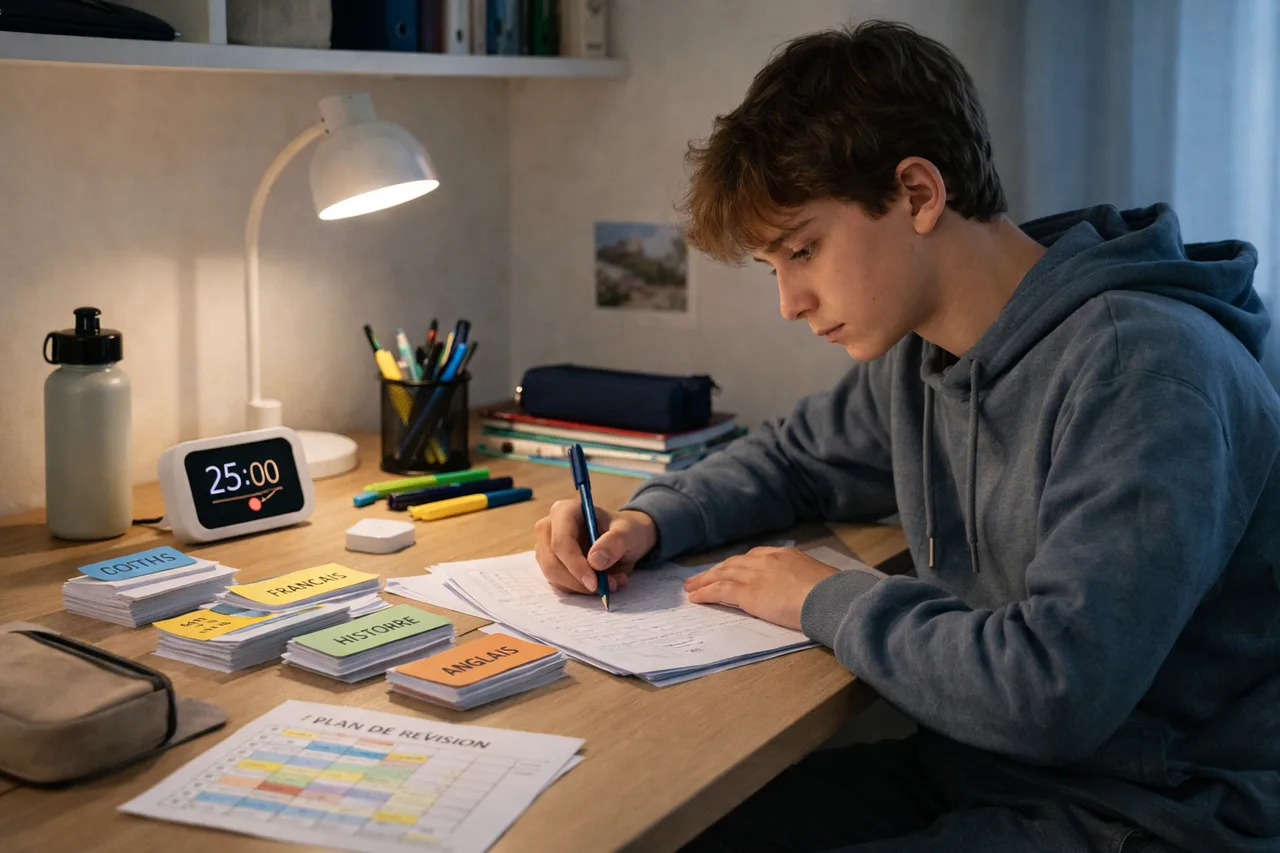
A lot of revision feels comforting because it is visible: highlighted pages, copied summaries, long plans, neat folders, full desks. Some of that can help at the beginning, especially when lessons are disorganised. But exam performance usually improves more when students move from recognition to retrieval and from general review to specific error correction.
The question is not “Did I look at the lesson?” but “Can I produce the answer, choose the method, explain the idea, or solve the task without the lesson in front of me?”
Research on learning techniques has repeatedly given strong support to practice testing and distributed practice, while passive rereading and highlighting tend to be less reliable when used alone. In family language, that means: do not judge revision by how long the student sits with the textbook open. Judge it by what they can retrieve, apply and correct.
A practical high-yield sequence looks like this:
- Start with a closed-book attempt. The student writes what they remember, answers questions, solves an example, or explains the concept aloud.
- Check against the source. The point is not to feel ashamed of blanks; it is to find the exact missing pieces.
- Create an error log. Each entry should be specific: “forgot the definition”, “used the wrong formula”, “lost time on the introduction”, “misread the command word”.
- Revise the cause, not only the symptom. If the error is conceptual, rework the explanation. If it is procedural, practise the method. If it is attention-based, create a checking routine.
- Return later. A corrected mistake is not secure until the student can avoid it again after a delay.
This is also how to decide what to drop when time is short. Work is usually worth doing if it improves recall, closes a repeated gap, trains the exam format, or protects attention. Work is often less urgent if it only makes materials look nicer, repeats what is already secure, or delays the uncomfortable moment of testing oneself.
Past papers and practice questions are useful, but only if they are corrected properly. A student who does five papers quickly and never analyses the errors may learn less than a student who does one paper carefully, marks it, identifies three repeat patterns, and retests those patterns two days later.
The same principle applies to oral exams and presentations. Reading notes silently is weak preparation for speaking under pressure. The student needs to practise saying the first sentence, structuring the answer, recovering from a pause, and explaining one idea clearly without hiding behind the page.
Build a revision plan that survives real life
A revision plan is useful only if it can survive school days, fatigue, family routines, sport, transport, meals, friendship, and the fact that students are not machines. The best plan is not the most ambitious one. It is the one that creates repeated contact with the right material without burning the student out.
A realistic weekly plan usually has four ingredients:
- Fixed commitments first. School hours, meals, sleep, transport and non-negotiable activities go on the plan before revision.
- Shorter focused blocks. Many students do better with blocks of around 30 to 60 minutes than with vague “study all evening” promises.
- Mixed subjects. Alternating subjects can reduce boredom and helps the student avoid spending every evening on the subject they already prefer.
- Buffer time. A plan with no buffer becomes a guilt machine as soon as one session is missed.
For a busy teenager, a school-day pattern might be: decompression after school, one focused block on a difficult subject, a break or movement, one lighter retrieval block, then a wind-down period before sleep. On weekends or lighter days, one longer timed task can be added, but it should be followed by correction, not by another unmarked task.
Sleep is not a luxury add-on to revision. It supports attention, memory and emotional regulation. Many health organisations recommend that teenagers get about 8 to 10 hours of sleep a night, and exam preparation that repeatedly cuts into sleep can become self-defeating. The last hour before bed is often better used to lower arousal, prepare materials for tomorrow, and do light recall than to force one more panicked chapter.
Phones are not evil, but they are excellent at fragmenting attention. A practical rule is to decide in advance when the phone is away, when it can be used for a real study purpose, and when it is freely available. The mistake is to negotiate that boundary every five minutes while the student is tired.
Caffeine and energy drinks deserve the same realism. A small amount may feel helpful to some older students, but excess caffeine can worsen agitation, sleep and anxiety. For younger students, tired students or anxious students, the better performance lever is usually sleep, hydration, food, movement and a saner workload.
A good plan also includes simulation. Not every day, and not as punishment, but often enough that the exam format becomes familiar. This may mean answering under timed conditions, writing a plan before an essay, doing questions without notes, rehearsing an oral introduction, or practising how to allocate time across sections.
The goal is not to remove all stress. It is to reduce uncertainty. Students feel calmer when they know what to do today, what matters most, and how they will respond if they get stuck.
Prepare performance without superstition

Exam performance has a physical and emotional side. A student can know the material and still lose marks through panic, rushing, blanking, misreading, perfectionism or collapse after one difficult question. This does not mean the student is weak. It means performance needs rehearsal too.
The first tool is an exam-entry routine. It should be simple enough to use when anxious:
- Put materials in place.
- Breathe out slowly two or three times.
- Read the instructions before touching the questions.
- Mark the easiest starting point.
- Decide the first time checkpoint.
- Begin with a task that creates momentum, if the format allows.
For blackouts, the aim is not to “force memory” immediately. That often increases panic. A better sequence is: pause, breathe out, write anything certain, return to the question wording, underline the task, retrieve a related example, then move on if the block remains. Movement through the paper often unlocks memory later.
For timed writing, students should practise “good enough and complete” rather than “perfect and unfinished”. A beautiful first paragraph does not compensate for an absent answer later. The plan should include when to stop polishing and move to the next section.
For oral exams, performance practice should include the awkward parts: starting, pausing, asking for a moment, correcting oneself, and continuing after a hesitation. A student who has only practised perfect answers may interpret one blank as disaster. A student who has practised recovery has more options.
Stress management techniques such as breathing, grounding, movement and brief relaxation can help some students lower arousal enough to think. They are not magic, and they do not replace preparation. Their role is to make knowledge accessible when the body is treating the exam as a threat.
Parents should also know the warning line. Normal exam stress comes and goes, and usually improves after rest, reassurance, a clearer plan or the end of the exam period. More serious concern is warranted if anxiety, low mood, sleep disruption, panic, hopelessness, self-harm talk, eating problems, or refusal to function persists or intensifies. In those cases, exam advice is not enough; the family should seek appropriate professional or school-based support in their own context.
After a difficult paper, the best response is short and deliberate. Let the student eat, move, rest or be quiet. Then ask only what is useful: “Is there one thing we need to adjust for the next paper?” If yes, adjust it. If no, stop the post-mortem. Comparing answers in a group chat rarely improves the next result.
Help without adding noise
Parents often want to help because they can see the stakes and the stress. The danger is that help becomes extra pressure: repeated reminders, anxious questions, comparisons, lectures about the future, or late-night conflict over a plan that no one can follow.
The most useful parental role is not to become the examiner. It is to protect the conditions in which the student can do the next useful thing.
That can look like practical support:
- making the week visible without controlling every minute;
- helping the student choose the next task when everything feels too big;
- checking that sleep, food and breaks are not collapsing;
- offering to quiz from a lesson rather than telling the student to “revise more”;
- reducing avoidable household demands during the most intense exam period when possible;
- keeping the conversation anchored in process, not only grades.
The wording matters. “Are you ready?” can sound like a threat even when meant kindly. “What is the next useful task?” is usually calmer. “You should know this by now” closes thinking. “Show me where it breaks down” opens it. “Everyone else is working harder” usually adds shame. “Let’s choose the highest-yield thing for the next 40 minutes” gives direction.
For younger students, parents may need to structure more of the environment: short sessions, visible materials, regular breaks, and a clear stopping point. For older teenagers, support often works better as a negotiated system: what the student owns, what the parent may check, and when the parent should step back.
If conflict is constant, reduce the number of daily negotiations. Choose one planning moment, one check-in, and one agreed signal for when the student wants help. Exam season is already demanding; it should not turn every evening into a referendum on character.
FAQ and practical recap
How early should exam preparation start?
The earlier the student starts, the less dramatic the work needs to be. Several months out, the priority is regular contact with lessons, retrieval and fixing weak foundations. A few weeks out, the priority shifts toward practice questions, timing and targeted correction. In the final days, stability matters more than volume.
What should a student prioritise when there is not enough time?
Prioritise topics that are likely to appear, topics with repeated errors, formats that carry many marks, and gaps that block several other chapters. Drop or shrink tasks that only make the student feel organised without improving recall or performance.
Are practice papers enough?
They are powerful when used well. The student needs to mark them, understand the mistakes, revise the causes, and return to similar questions later. Practice without correction can simply rehearse the same weaknesses.
Should a student study the night before an exam?
Light review can be useful. Panic cramming late into the night usually is not. The evening before is better for checking materials, doing brief recall, reviewing a few high-yield points, and protecting sleep. The student should not start an entirely new heavy resource unless there is a very specific reason.
What helps exam stress most?
There is no single cure. The strongest combination is usually preparation that creates real competence, a plan that reduces uncertainty, sleep and recovery, realistic practice under exam conditions, and a simple routine for moments of panic. If stress becomes severe or persistent, the answer should include professional or school support, not only revision tips.
What should happen after a bad exam?
First, recover. Then do a short useful debrief: what was controllable, what needs adjusting, and what should be left behind. The next exam needs attention more than the last exam needs endless analysis.
The practical takeaway
Exam preparation and performance improve when families stop treating revision as a vague measure of effort and start treating it as a sequence of decisions. What is the time horizon? What is the highest-yield task? Can the student retrieve without looking? Have mistakes been corrected? Has the exam format been rehearsed? Is sleep being protected? Is the parent helping the next action, or adding noise?
For most students, the best next step is small and concrete: choose one subject, do a closed-book attempt, check it, write down the top three errors, and schedule a return to those errors later. That single loop is often more useful than another evening spent staring at notes and hoping confidence appears.
Sources
All articles in this category
Every published article in this topic, from newest to oldest.
- One week before an exam: what to stop doing immediately
- Two months before an exam: what should you really prioritise?
- After a school result: how to respond to joy, disappointment or mixed feelings without overreacting
- Mock exams are for diagnosis, not for judging a student’s worth
- The Night Before an Exam: What to Do, What to Avoid and What to Resist