

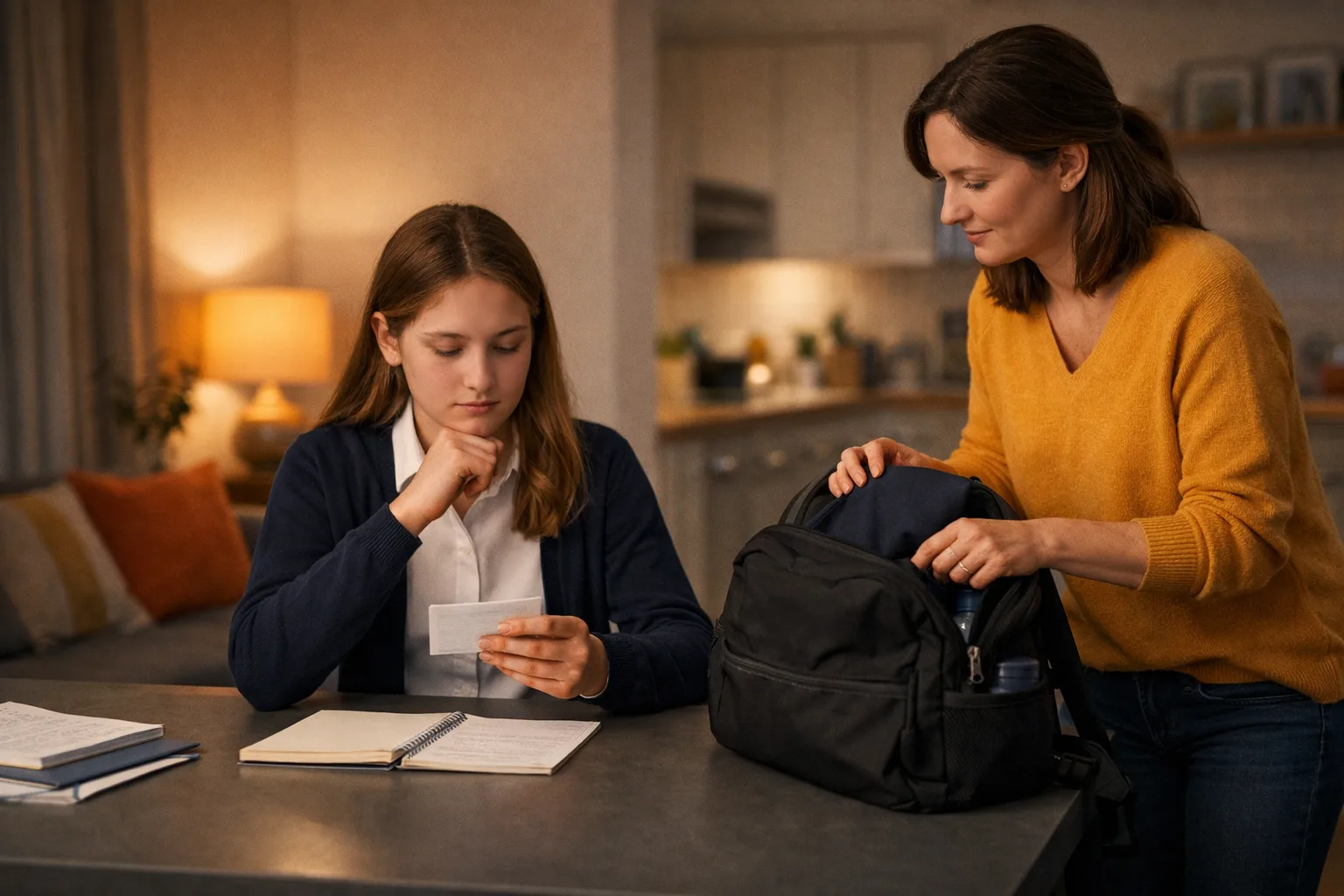
The night before an exam, many families hesitate between two bad options: keep pushing until late, or give up altogether in a kind of resignation. The better question is simpler: what actually increases the odds of a student being able to think clearly and perform tomorrow morning?
The short answer fits on one line: the night before rarely raises a student's level dramatically. It is mainly for securing the essentials, making the material easier to access, sorting the logistics and protecting sleep. If a student is behind, the evening has to become an exercise in triage, not a heroic attempt to recover several weeks in a few hours.
In other words, the useful evening is often less impressive than people imagine. It is targeted, limited and calm enough not to sabotage the next day.
The night before does not have the same job in every situation
Families often confuse three different time horizons: the deeper preparation built over weeks, the short-term adjustment that happens in the last twenty-four hours, and the emergency moment when a student realises too late that they do not know enough. The night before does not serve the same function in all three cases.
| The real situation the night before | Most useful priority | What to stop trying to do |
|---|---|---|
| The student has revised steadily | Reactivate key material, prepare the bag and protect the night | Go back through the whole syllabus “just in case” |
| The student has a few weak but clearly identified areas | Target a small number of high-yield points: methods, recurring mistakes, hinge concepts | Open brand-new topics or start a late-night marathon |
| The student is genuinely behind or close to panic | Do survival triage: exam format, non-negotiables, first steps in solving, writing or speaking | Pretend a short night can compensate for weeks of shaky preparation |
This table is not there to offer false reassurance. It is there to help you choose the right job. The night before does not build the base; it secures access to what already exists. That can feel frustrating, but it is also what avoids the biggest waste of time and energy.
When a student is objectively behind, it is better to accept imperfection and rank priorities. On an ordinary weekday evening, most students gain more from clarifying the instructions, the core methods and the ideas that organise the subject than from opening six chapters badly and remembering none of them.
What to do the night before an exam
For many students, the right evening is quite short: one useful last recap, a little practical preparation, then a clear stop. The exact content depends on the paper, but the logic stays the same.
Limit the scope of the evening on purpose.
Before starting, decide what actually matters. Three or four visible priorities are often enough: one method, two key topics, a few recurring errors, an essay structure, a formula list, or one oral answer practised aloud. If everything stays open, nothing is really prioritised.Use active recall rather than passive rereading.
The useful move is to try to retrieve without looking: recite a structure, redo a demonstration, answer questions, explain a concept out loud, or complete two or three typical questions without the mark scheme in front of you. If something blocks, check briefly, then test again.
For a problem-solving paper, it is usually more useful to review procedures and common traps. For a more essay-based subject, it is usually better to reactivate structures, definitions, key examples and important distinctions. For an oral exam, one final run-through out loud is often worth more than late, silent muttering.Secure the logistics while the mind is still clear.
The night before is the right moment to pack the bag, check the candidate instructions or ID if needed, lay out pens, the calculator if allowed, any permitted tools, the route, the leaving time and the alarm. If specific rules apply, check the official instructions from the school, college, university or exam board — not the class group chat. This looks ordinary, but it prevents a surprising amount of morning stress.Prepare the first few minutes of the exam.
An anxious student often benefits from a very simple opening script: read the whole paper or prompt, identify the command words, note an order of attack, start with an accessible task, or keep a few minutes for a rough plan before writing fully. The night before, that small script is often more valuable than another quarter of an hour of flustered revision.Set a stopping time and protect the night.
Sleep is not a reward after work; it is part of the work. For most teenagers, a full night's sleep matters more than one extra late hour of revision. Even when the exam is in the afternoon, it is usually better to keep the morning for a light reactivation than to steal sleep the night before.
So the best evening is not the fullest one. It is the one that leaves the brain still usable tomorrow.
What to avoid, even when it looks like hard work
The classic mistakes all have one thing in common: they raise stress faster than they raise performance.
Rereading everything without testing anything.
The pages feel familiar, which is comforting, but familiarity is not the same as what a student will actually be able to retrieve under pressure.Starting a full past paper too late.
A whole paper begun late in the evening often ends half-finished, under fatigue, or with a fresh sense of failure. Two or three focused tasks are usually more useful.Changing method the night before.
A new app, a new revision source, a new routine, a new caffeine strategy, a new miracle promise: novelty often adds noise at the exact moment when the student needs less friction.Staying plugged into the class group until bedtime.
Last-minute messages mostly reveal what other people claim to be revising. They are very efficient at spreading panic and much less efficient at stabilising what the student already knows.Turning the evening into continuous parental checking.
An improvised grilling, comparisons with other students, or check-ins every twenty minutes can feel like support. In practice, they often blur the student's thinking more than they help.
It is also worth avoiding a common judgement error: taking one identified weak point as proof that nothing is ready. The night before, one blind spot should be treated as one blind spot, not as a total verdict on the whole exam.
What to resist when anxiety starts taking over
The enemy on the night before is not always missing content. Quite often, it is the shift from useful work to anxious obedience.
The first thing to resist is the fantasy of total catch-up. Under pressure, people want to add, open and pile up more material. Yet the more panic rises, the more selection matters. A tired brain does not benefit much from disorderly accumulation.
The second thing to resist is global self-judgement. “I know nothing” or “I'm going to fail everything” are not diagnoses. They are stress statements. The more useful question is: which three things do I most need back in working memory right now?
The third thing to resist is the “just a bit more” reflex. For many students, the last twenty minutes do not help them learn more; they help them avoid the moment of stopping. Not knowing how to stop is a classic way to sacrifice tomorrow for the sake of a misleading feeling of effort tonight.
For some very anxious students, it can also help to put worries down on paper for a few minutes and then close the page. This is not a magic fix, and it does not erase a lack of preparation. But when thoughts are looping, briefly externalising them can free a little mental space.
The goal is not perfect calm. Some tension before an exam is normal. What matters is preventing that tension from taking over all the useful space.
What parents can do without adding pressure

The most useful parental help on the night before is usually not academic. It is mostly structural: reduce noise, protect the frame of the evening and help it end cleanly.
In practical terms, parents can act directly on a few things: the atmosphere at home, interruptions, the meal, the time the evening ends, the bag being ready, tomorrow's journey and the fact that the evening does not turn into a referendum on the student's worth. These sound like small details, but they are exactly the details most likely to unravel the night before.
Parents can also influence their child's mental state indirectly. That distinction matters. No one can manufacture weeks of preparation in an emergency, but families can avoid adding emotional noise. Saying less and structuring better is often more useful than trying one last time to “motivate” the student.
Some sentences are usually more helpful than others:
- “What do you need in order to finish this properly?”
- “Let's check the bag and tomorrow's timing, then stop.”
- “You do not need a heroic evening. You need to be able to think tomorrow.”
Other phrases tend to add pressure very quickly:
- “Are you sure you've done enough?”
- “Do one more topic, just in case.”
- “Everyone else is probably further ahead.”
The right level of parental involvement also depends on age. In early secondary school, a parent can help more directly to close the scope, prepare the bag and set a stopping time. In the GCSE and sixth-form years, the challenge is often to stay present without taking over the whole organisation again. In early higher education, help is mostly logistical and relational: being available, sorting transport, protecting quiet, making sure the basics are covered, but without continuous supervision.
Finally, if the night before repeatedly turns into a severe crisis — marked insomnia, panic, vomiting or repeated shutdowns — it should not be reduced to poor willpower. In that situation, a conversation with the school, college or a health professional may become worth considering.
The useful evening in six points
- Choose a few clear priorities, not the whole syllabus.
- Test actively instead of simply rereading.
- Prepare the materials, timing and practical instructions for the next day.
- Cut off the channels that spread panic.
- Set a real stopping time to protect sleep.
- Help the student arrive mentally available, not theatrically overworked.
A well-handled night before an exam rarely looks heroic. It looks more like a controlled end to preparation: enough work to reactivate, enough discipline to stop, enough calm to let tomorrow breathe. It is less dramatic than a last-minute marathon. In real life, it is usually far more intelligent.
Sources
- Improving Students' Learning With Effective Learning Techniques: Promising Directions From Cognitive and Educational Psychology
- Information for candidates – Joint Council for Qualifications
- Teen Sleep Duration Health Advisory
- Sleep deprivation and memory: Meta-analytic reviews of studies on sleep deprivation before and after learning