


Many parents recognise this situation: a student has spent time on a chapter, says it was “clear”, can point to the important parts… but then struggles when asked to explain, summarise, or apply it.
The problem is not always effort. Very often, it is the way the chapter was read.
To be able to actually use what they have read, students need to read with an output in mind: an explanation, a summary, an answer, a diagram, an example, an application. Useful reading is not just moving through text — it is alternating between understanding, reformulating, and checking.
In other words, the real question is not: “Have you read the chapter?” It is: “Can you explain it without looking?”
That shift — from seen content to reusable knowledge — is what changes the quality of learning.
Reading a chapter is not enough to be able to use it
In school, “knowing a chapter” rarely means repeating a few sentences. Depending on the subject, students usually need to:
- retrieve the key ideas;
- organise them logically;
- express them in a way that fits the question.
In history, that might mean explaining causes and consequences. In science, describing a process precisely. In English, identifying a main idea and supporting it with evidence.
In all cases, recognising the content when the book is open is not enough.
This is where confusion often appears. Many students mistake familiarity for mastery. The page looks familiar, the headings ring a bell, some terms feel known. But once the support disappears, their thinking becomes vague or empty.
The chapter has been seen — not yet owned.
At lower secondary level, this often shows up as “I know it when I look at it”. Later on, the cost increases: the student feels they have worked, but their answers remain vague, poorly structured, or too close to the original text.
Why passive reading feels reassuring but does not prepare recall
Passive reading is appealing because it feels tidy and efficient. The student moves forward, highlights, rereads a difficult sentence, turns the page. Everything looks organised.
But what feels productive is not always what builds usable memory.
When the chapter is visible, it constantly provides cues: headings, layout, bold words, examples. The student feels they “know” — but they are mostly recognising what they just saw.
Common habits in passive reading include:
- highlighting too early, before understanding the structure;
- copying full sentences instead of reformulating;
- rereading immediately instead of testing recall;
- reading the whole chapter in one go without pauses;
- judging work by time spent rather than ability to explain.
Research on learning methods consistently shows one practical point for families: rereading and highlighting alone help little if they are not followed by questions, reformulation, or recall without support.
The most useful moment is often the least comfortable: when the student closes the book and realises what they cannot yet explain.
That moment is not failure. It is the most informative part of the process. It shows exactly where understanding or memory is still incomplete.
A simple method for active reading

An effective method does not need to be complicated. It needs to be short, repeatable, and light enough to use across subjects.
For dense chapters, it is better to work in blocks of one to three pages rather than reading everything at once.
For students who tire quickly, the block can be even smaller: a paragraph, a box, a diagram and its explanation.
1. Set a clear task before reading
Before opening the chapter, the student should know what they will need to do afterwards. Not “read it”, but for example:
- define a concept;
- explain a process;
- compare two ideas;
- reconstruct the structure of the chapter;
- answer likely questions.
This changes attention. Reading “to see what is there” is very different from reading “to explain”.
2. Identify the structure before the details
In one or two minutes, the student scans headings, subheadings, key terms, diagrams, examples.
The goal is not to read everything immediately, but to grasp the structure.
A useful habit is to turn headings into questions. “Causes of erosion” becomes “What are the causes of erosion?”
The brain then reads with a purpose.
3. Read in short blocks and really pause
After each small section, the student stops.
They can note just three things:
- the main idea;
- the link with the previous part;
- one unclear point or key example.
That is enough. A good reading trace is not a mini copy of the chapter. It is a tool to recover meaning later.
4. Close the book and reformulate
This is the core step.
After reading a block, the student hides the text for one or two minutes and tries to answer simple questions:
- What is this part really about?
- How does it connect to the previous one?
- What example shows I understand?
- Which term must I keep precise?
If the explanation is unclear or too close to the text, the gap appears immediately. This is far more useful than automatic rereading.
5. Reopen only to correct and simplify
The book is reopened after the attempt.
The student checks what was missing, corrects a key word, adds a link, and then produces a light support: a mini-plan, a few recall questions, a diagram, a cause/effect table.
At the end, the chapter should leave a usable trace.
If everything disappears as soon as the book closes, the reading has not yet produced stable learning.
The same method works differently across subjects
Active reading always involves understanding, linking, reformulating, and recalling. But what to look for changes depending on the subject.
| Subject | What to focus on while reading | How to check recall |
|---|---|---|
| History, geography, economics | central question, causes, consequences, actors, supporting examples | explain the logic without rereading and use relevant examples |
| Science | steps of a process, conditions, role of each element, link between text and diagram | describe the process in order and explain what changes if one element is missing |
| English, literature, philosophy | main idea, reasoning, key concepts, useful examples or quotations | reformulate the argument and justify it with evidence |
| Languages | overall meaning, connectors, who speaks, what really blocks understanding | summarise without word-for-word recall and answer content questions |
| Mathematics | meaning of definitions, when a method applies, conditions of use | explain when to use the method and test it on a short problem |
A key consequence: a student does not read well because they have “looked at everything”. They read well when they have identified what they will need to reuse.
After reading, keep the chapter alive
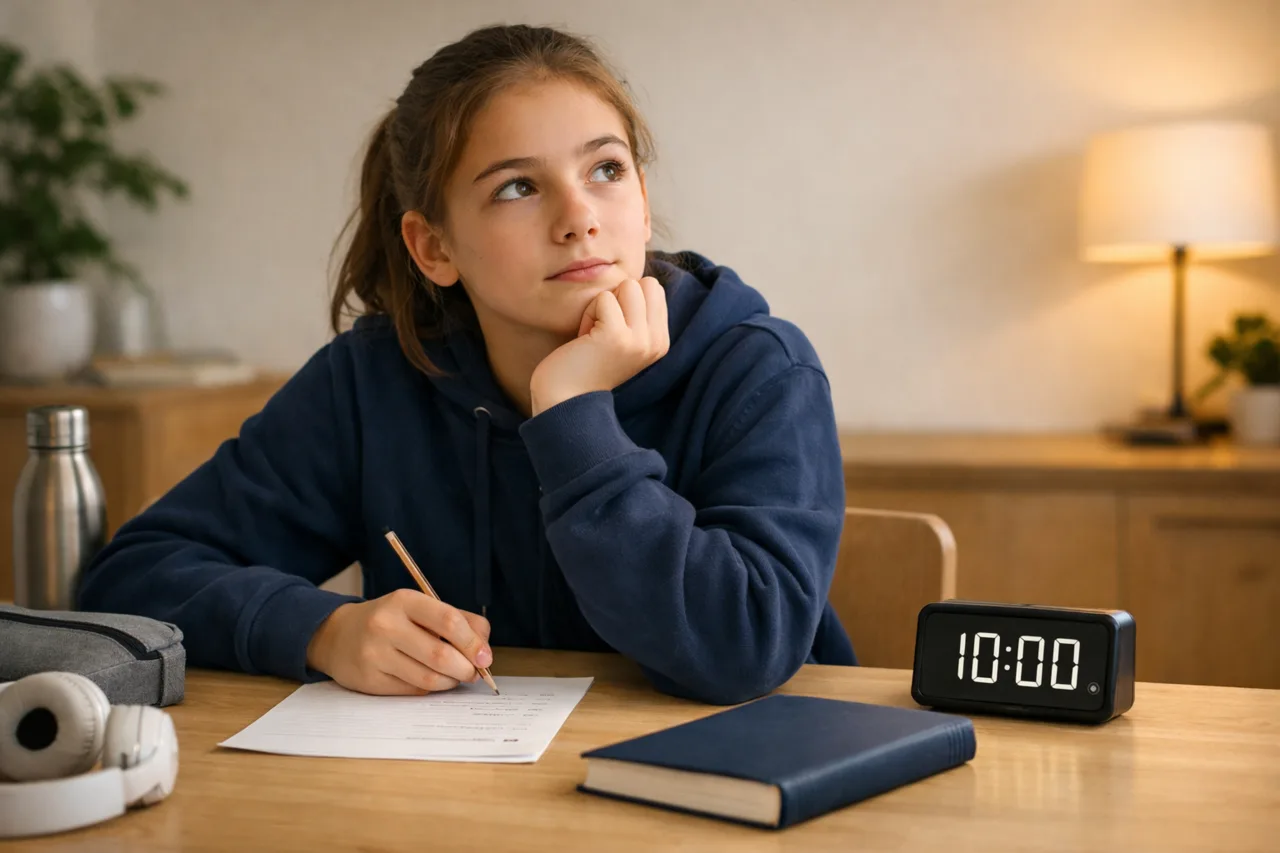
Many students make a real effort on the day, then do not return to the chapter until the test. This is often where learning fades.
To be able to recall it later, the chapter needs one or two short reactivations.
A simple routine is often enough:
- Right after reading: a 60–90 second recall, book closed.
- The next day or two days later: three to five recall questions, without rereading first.
- A few days later: a quick application, a short plan, a diagram, or a clearer explanation.
The key is not duration, but format. The goal is to recall first, then reopen only what is missing.
Useful prompts include:
- What is the main idea of the chapter?
- How is it structured?
- How does it connect to previous topics?
- What do I still confuse?
- What example proves I understand?
This approach reduces last-minute cramming and quickly shows whether the learning is solid or only feels clear.
What parents can realistically do at home
Parents do not need to become teachers. What helps most is creating a simple framework for checking understanding.
Small actions are often enough:
- ask for a one-minute explanation with the book closed;
- ask linking questions, not just factual ones;
- help break a long chapter into smaller parts;
- come back the next day with one key question;
- accept an imperfect explanation first, then refine it.
Less helpful habits include checking only whether the chapter was read, focusing on highlighting, demanding immediate memorisation, or correcting every sentence too early.
With younger students, speaking and simple diagrams often work better than written summaries. With older students, a short plan or a quick voice note can be enough.
The goal remains the same: shift the effort towards expressed understanding, not just time spent studying.
Even with limited time, five focused minutes are often more effective than a long, unfocused presence.
When the issue goes beyond reading method
Active reading helps many students, but not all difficulties come from method alone.
If a child struggles to identify main ideas even in short texts, reads extremely slowly, or becomes disproportionately exhausted, the issue may be deeper.
Be attentive when difficulties appear across several subjects, or when understanding is much stronger orally than in writing.
In these cases, discussing with teachers can help identify whether the issue relates to vocabulary, comprehension, attention, or fatigue.
A good method does not replace targeted support when needed. But in many everyday situations, it prevents a major waste: spending time reading without being able to explain anything afterwards.
A simple rule to keep in mind
To know whether a chapter has been read effectively, one question is enough:
What remains when the book is closed?
If only a vague sense of familiarity remains, the work is not yet active enough.
If the student can explain the main idea, reconstruct the structure, clarify an important point, and identify what is still missing, then learning has started to stabilise.
In practice, a shorter reading with pauses for recall is far more effective than a long passive pass through the chapter.
It is rarely the volume of text that makes the difference.
It is the quality of the back-and-forth between reading, reformulating, and recalling.
Keep reading
Related reading
Why students forget so quickly after a test
A decent mark does not guarantee lasting memory. Here is why students forget after a test, and how parents can try a simple active-recall routine over two weeks.
Understand why knowledge fades quickly after tests and how to prevent it
Cornell note-taking: which students does it really help?
Cornell note-taking does not help every student in the same way. Here is how it works, who benefits most, where it falls short, and how to introduce it at home without turning it into another battle.
See how note-taking structure affects understanding and recall