

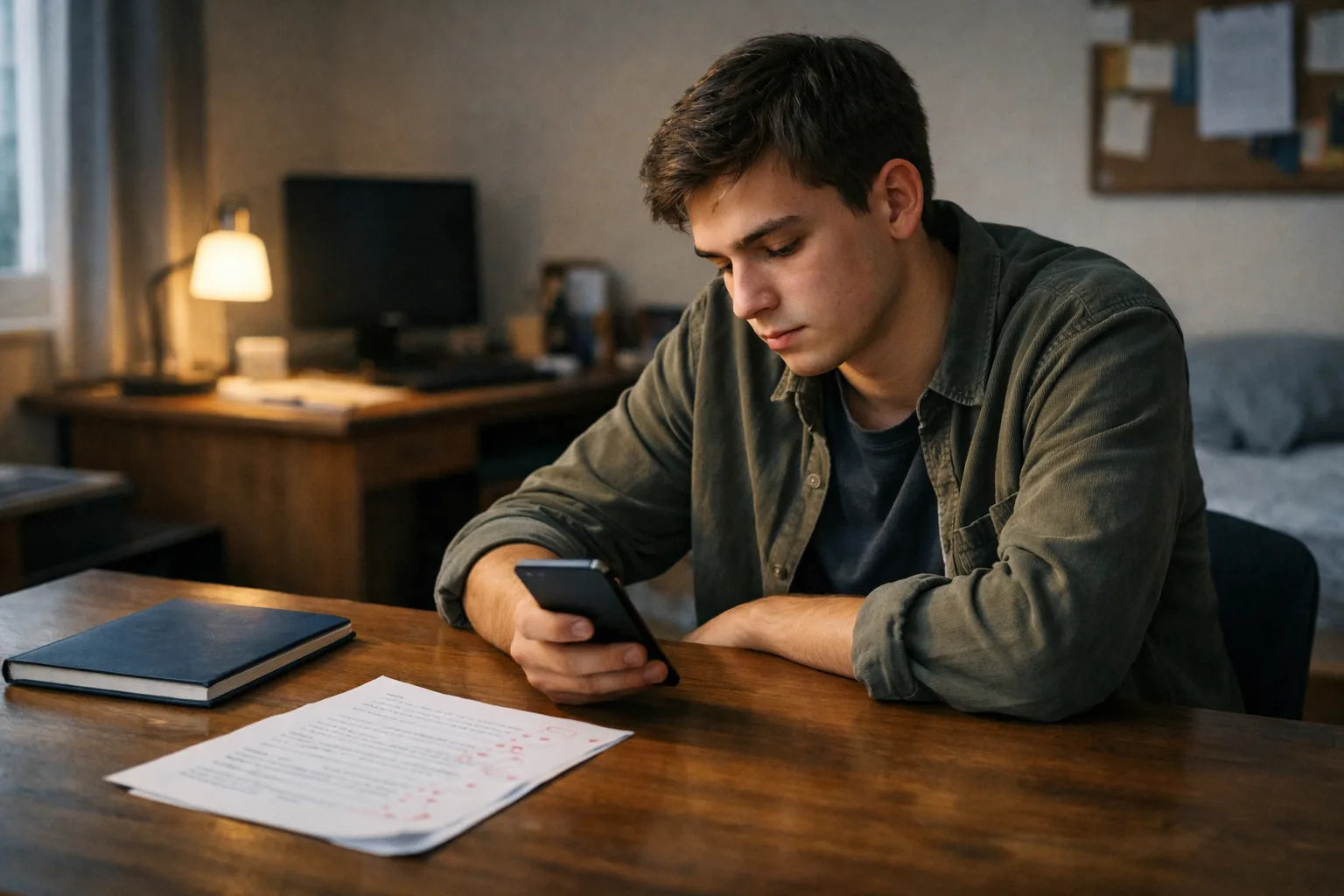
A bad mark, then an hour on the phone, then even less willingness to reopen the work. Many families know this scene. The problem is not only lost time. Very often, it is an escape loop: the mark triggers a painful emotion, the feed brings immediate relief, and schoolwork becomes even harder to restart.
Here, doomscrolling means the endless scrolling that happens when a student feels bad and wants, for a moment, not to think.
The best response is neither a sudden ban nor a resigned hands-off approach. Parents need to understand what the phone is doing in that precise moment, then help the young person find one concrete foothold.
After a bad mark, the phone is doing more than wasting time
After a school setback, many teenagers are not looking for pleasure first. They are looking for a quick exit from discomfort: shame, anger, fear of disappointing someone, the feeling of being useless, or simple mental overload. A phone is exceptionally available for that job.
That distinction matters for parents. If you read the whole scene only as a discipline problem, you can miss its real function. The scrolling often works as an emotional buffer. In the moment, the student feels less exposed to the mark, the teacher's comment, or the prospect of having to go back to the work.
The cost comes later. The work has not moved on, the teacher's corrections have not been understood, and the brain gradually links schoolwork with something to avoid. This is not just laziness. It is an unintended learning process: when school makes me feel bad, I go into the feed.
The escape loop: why immediate relief strengthens avoidance
The pattern often looks like this:
- A school trigger happens: a low mark, a comment, a failed test, an exercise that makes no sense.
- A painful emotion rises: stress, shame, frustration, discouragement.
- The phone brings immediate relief: novelty, distraction, the feeling of forgetting, sometimes social comparison, sometimes a kind of mental numbing.
- The work remains untouched: it is still waiting, often with less time left and a heavier mental load.
- The next restart feels even more aversive: reopening the book now brings back both the original setback and the avoidance episode that followed it.
That is what makes the pattern deceptive. Scrolling works in the short term. It calms, diverts and occupies. Precisely for that reason, it can become a habit. In behavioural psychology, this is close to what is called negative reinforcement: the behaviour survives because it temporarily removes something unpleasant. In family life, the translation is simple: the more a young person links the phone with relief after a school difficulty, the more likely they are to return to it after the next setback.
This also explains why some lectures fail. Saying only, “you just need to get on with it”, attacks the visible symptom, not the mechanism. To break the loop, parents usually need to reduce the initial discomfort, close off endless scrolling at the critical moment, and make the restart of work much smaller and clearer.
What strengthens this loop: timing, function and friction
Not every kind of digital use has the same effect. Three variables matter more than the weekly screen-time number.
Timing. A phone does not have the same effect on a relaxed Saturday afternoon as it does immediately after a bad mark, in the middle of homework, or very late at night. Moments of school vulnerability are the ones in which scrolling is most likely to become an escape reflex.
Function. A screen can be used to learn, to message a friend, to watch something chosen in advance, or to dissolve into an endless feed. The useful question is not “screen or no screen?”. It is: does this use help the student recover and restart, or does it mostly postpone the problem?
Friction. Notifications, autoplay, infinite feeds and instant switching between apps reduce almost to zero the effort needed to leave the work. The easier the escape route, the harder it is for a task that already feels emotionally heavy to compete.
In practice, this often affects three important things. Attention becomes fragmented, so the homework or revision session feels longer and more painful than it really is. The quality of the work drops, not only because of lost time, but because of broken mental continuity. And when scrolling spills into the evening, sleep often worsens, which makes the next day harder again. A tired teenager tolerates frustration less well, starts less well, and returns to distraction more quickly.
That is why two caricatures are not very helpful. One says that a phone inevitably destroys the capacity to work. The other says it is only a modern detail. The reality that helps families is more precise: a phone becomes a genuine school problem when it attaches itself to moments of failure, fatigue and aversive restart.
What parents can do in the first 30 minutes
The goal is not to solve the entire study-method problem on the spot. It is to stop one bad mark turning into a lost evening and stronger avoidance.
- Stabilise first, analyse later. Before asking why the mark was low, it usually helps to let the student settle a little. A useful sentence sounds more like: “I can see that has really knocked you. We can look at it once you've come down a bit.” You are not denying the mark, but you are not turning the first few minutes into a cross-examination either.
- Allow a bounded pause, not a drift into the feed. A pause can help. Endless scrolling rarely does. Suggest something with a clear limit: a snack, a shower, ten minutes of music, a short walk, unpacking the bag, a glass of water. The point is not “no screens” in the abstract. It is no infinite feed as the first reflex after the shock.
- Make the restart radically smaller. The restart should not sound like “right, now revise the whole chapter”. It should sound like one tiny closed action: reread the marked feedback on a single question, write down the three main mistakes, photograph the marked test so it can be revisited later, redo one question, get tomorrow's materials ready, or send a message to the teacher if something is genuinely unclear.
- Separate the mark from the verdict on the person. Many students internally hear: “I failed” = “I am useless”. The parental job is to pull the discussion back to a workable object: an idea that was not understood, revision done too late, an instruction read badly, too much fatigue, or a method that did not fit the task. As long as the mark remains a global condemnation, avoidance keeps winning.
This changes with age.
- In the earlier secondary years, adults often need to make the restart very concrete and very short. Younger teenagers do not always yet have the language to name the emotion or regulate themselves quickly.
- In later secondary school and sixth form, negotiation matters more. Too much control can lead to lying, hiding or open opposition. Clear rules around the risky moments, however, still help a great deal.
- In the first year after school, parents can no longer run the daily system. What they can still do is help the student spot the familiar sequence: bad mark, scrolling, delay, short night, fresh avoidance. At that stage, the useful level of help is conversation, light structure and, when needed, pointing them towards appropriate support.
Realistic family rules around the phone after a school setback
The rules that work best do not try to govern a young person's whole digital life. They target the moments in which avoidance is being built. A framework like this is often more sustainable than a general ban.
| Rule | Why it helps | What makes it hold |
|---|---|---|
| No endless scrolling for 15 to 20 minutes after a bad mark | It breaks the automatic link between school shock and digital escape | The rule is agreed before the problem happens, not invented in anger |
| One screen at a time during homework or revision | It reduces invisible switching that kills momentum | Notifications are off and the useful materials are ready beforehand |
| No autoplay and no notifications during a revision block | It increases the friction of distraction | The young person knows when the block ends and what counts as success |
| If evenings repeatedly slide, the phone sleeps outside the bedroom | It protects sleep, which protects recovery and the next day's restart | The rule also applies at weekends, or the exceptions are very clearly defined |
A vague rule such as “don't overdo the phone” produces endless arguments. A useful rule says where, when, for what purpose, and with what exception. It becomes stronger when it has been discussed calmly, written down simply, and revised if it does not survive real family life.
Parents do not need to be perfect to be credible. A minimum of consistency does matter, though. It is hard to defend a concentration rule if the adult also keeps interrupting homework time or conversation time to answer their own phone.
Using digital tools to counter avoidance instead of feeding it
The same smartphone can serve escape or restart. The difference is the task you give it.
The digital uses that genuinely help after a bad mark usually have three features: one clear function, a visible stopping point, and a direct link to the real lesson or piece of work. For example:
- take a photo of the marked paper and circle the three mistakes to revisit;
- turn one short part of the lesson into a few question-and-answer prompts to test memory;
- set a short restart timer and work until it ends on just one idea;
- listen to a brief explanation or revisit one targeted example before trying the question again;
- note the next deadline and plan one small review in advance instead of a last-minute panic session.
What rarely helps is saying, “just study on your phone”, without any more structure. A digital tool becomes useful only if it reduces the friction of starting. If it opens a direct corridor towards social media, messages and comparison, it makes the problem worse.
It is often useful to distinguish two very concrete modes:
- escape mode: bed, feed, open browsing, no planned finish;
- work mode: table or desk, one app or one function, defined duration, tiny but precise goal.
Putting digital tools back on the side of work does not mean everything should happen on a screen. For some students, paper is still better for deep understanding. But digital tools can become an excellent restart aid when the main obstacle is not pure comprehension, but the inability to begin again.
When this is no longer just a bad habit
The phone may be only the visible part of a bigger difficulty. It is worth widening the lens when one or more of the following signs appear:
- the student hides marks, lies about work, or avoids any school conversation;
- scrolling regularly runs late into the night and sleep has clearly worsened;
- a bad mark triggers harsh self-attacking comments, frequent tears, or real panic;
- the difficulties no longer concern one subject or one test, but school more broadly;
- stomach aches, refusal to go to school, a sharp drop in marks, or withdrawal start to appear;
- you suspect something deeper: significant anxiety, bullying, attention difficulties, burnout, or an unidentified learning difficulty.
In those cases, better phone management is not enough. It may be time to speak to the school — whether that means the form tutor, head of year, pastoral team or SENCO, depending on the setting — and sometimes to ask for outside help from a GP, psychologist or another relevant professional. The point is not to dramatise every episode of excessive scrolling. It is to avoid reducing established school distress to a simple lack of willpower.
What matters most
If you want one clear framework after a bad mark, keep these points in mind:
- Doomscrolling is often emotional escape before it is a discipline problem.
- Immediate relief strengthens avoidance when nothing else helps the student restart.
- Useful rules target the vulnerable moments: straight after the setback, during work, and late at night.
- The best antidote is not a long speech, but a tiny, clear and doable restart.
- Digital tools can help when they serve a closed, concrete task rather than an endless feed.
A realistic family goal is therefore not “never use the phone again after a bad mark”. It is to break the automatic link between school failure and digital escape, so that another sequence can take its place: shock, short pause, simple restart, understanding, then adjustment.
Keep reading
Related reading
Does my child need school adjustments, or mainly a different way of studying?
Concrete guidance for telling the difference between temporary overload, a study-method problem and a more durable difficulty, then deciding whether to observe, speak to school, seek a specialist assessment or ask for adjustments.
Distinguish a study-method problem from a wider learning or support issue
How to prepare for a school meeting if you suspect ADHD or a learning difficulty
Before a meeting with school, the goal is not to arrive with a diagnosis already decided, but with concrete examples, the right questions and a clear idea of what should happen next.
Prepare a concrete conversation with school if you suspect ADHD or a learning difficulty
What evidence should you gather before asking for support or adjustments at school?
Before you ask a school for extra support or adjustments, collect fewer documents but better ones: dated pieces of work, brief notes on repeated patterns, the practical impact on school tasks, and the help already tried.
Know which patterns and examples to collect before asking for support
School portal: how often should parents check without over-monitoring?
Checking the school portal ten times a day can reassure a parent, but it rarely helps the student. A simple framework for choosing a useful rhythm, spotting the signals that matter, and talking about them without creating continuous surveillance.
Choose a useful school-portal checking rhythm without sliding into over-monitoring
Good grades, but at too high a cost: should you still ask for help?
Good grades do not prove that everything is fine. If a child is coping only through endless evenings, exhaustion, tears or constant parental steering, it can make sense to ask for help before the grades fall.
See when apparently coping students are paying too high a hidden cost