

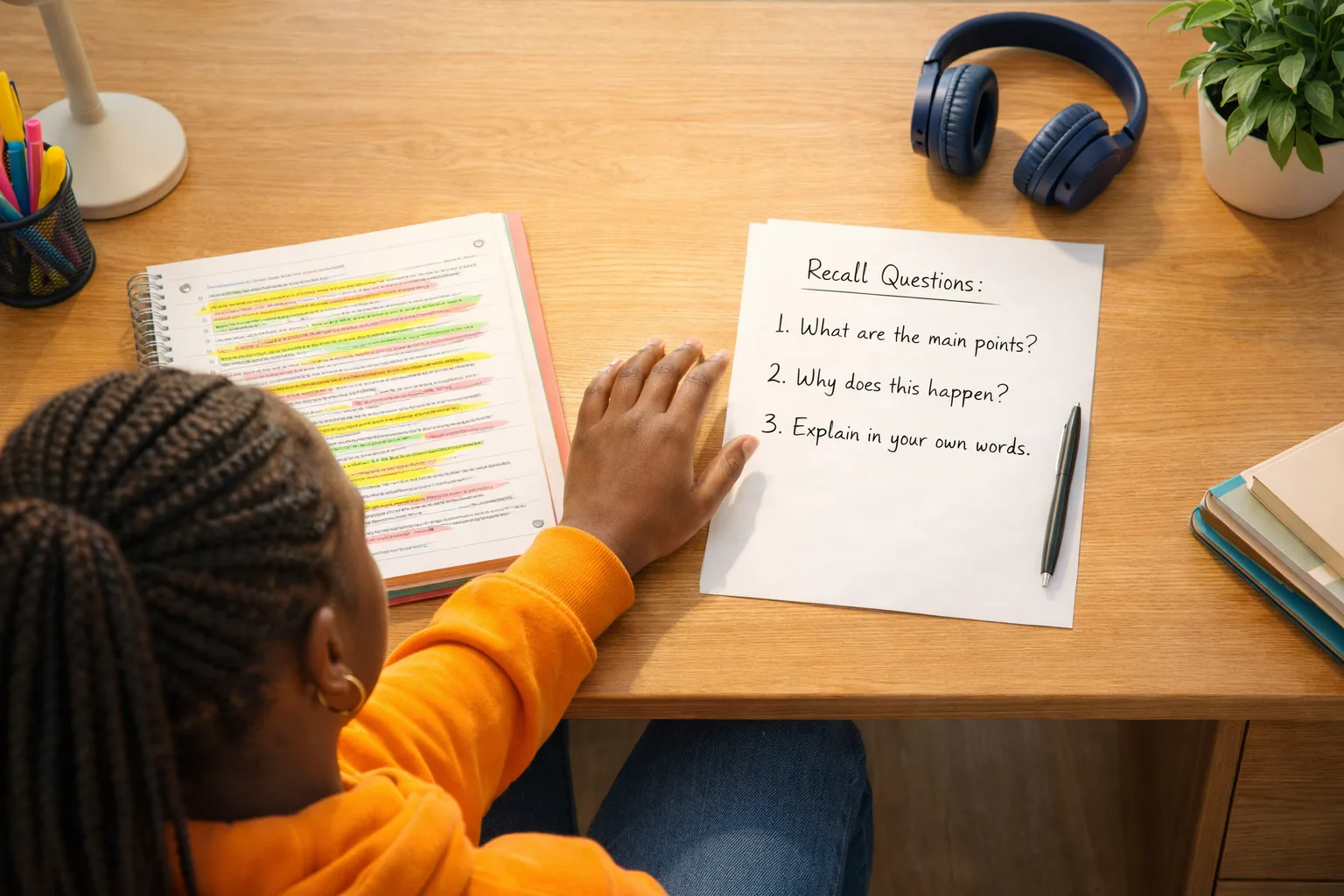
Your child spends time on their notes, highlighter in hand. By the end, the page looks neat, colourful, almost reassuring. And yet, when you ask them to explain the lesson without looking, everything becomes vague.
This gap is common. It reveals a frequent confusion between spotting information on a page and actually remembering, understanding, and reusing it.
The central idea is simple: highlighting on its own mainly helps you find information again visually; it does far less to check what is truly stored in memory. That is precisely why it feels so satisfying. It creates an immediate sense of progress, while much of real learning happens when the text is no longer in front of you.
Why false signals feel so reassuring

Highlighting ticks almost every box of a comfortable school habit. It is quick to start, visible, quiet, and leaves a clear trace of effort. For a tired or slightly anxious student, that matters: they can feel they have moved forward without yet facing the more demanding step—rephrasing, recalling, sorting, and connecting ideas.
The problem is that the brain easily confuses familiarity with mastery. When a passage looks clear while reading it, it can feel as though it will be remembered later. But a lesson seen is not a lesson retrievable. Many students can recognise a sentence in their notebook but cannot explain it in their own words two hours later.
This also explains why some study sessions feel productive but do not prepare well for tests. During revision, the student sees the text, the keywords, the layout. In a test, all of that disappears. What matters then is not visual clarity, but the ability to retrieve the idea, the example, the definition, or the reasoning step without support.
In other words, performance during study is not always a reliable indicator of durable learning. What feels easy can be misleading. And what feels slightly harder—testing yourself, summarising, recalling without looking—is often a better signal.
What highlighting can do — and what it cannot
It would be excessive to say highlighting is useless. It can serve as a navigation tool, provided we stay realistic about its role. It helps locate a definition, a date, a key idea, or a formula to revisit. But it does not replace understanding, memorisation, or practice.
The real issue is not the colour—it is how it is used. When everything is highlighted, nothing is prioritised. When highlighting comes before understanding, students colour what “looks important” without knowing why. And when the session stops there, they leave with a clearer page, not necessarily clearer thinking.
This simple table helps reset expectations:
| Action | Immediate feeling | What it actually shows | Better use |
|---|---|---|---|
| Highlighting a lot | “I’ve worked” | I’ve seen the passage again | Highlight very selectively after understanding |
| Rereading several times | “I know this” | The content feels familiar | Add recall without support |
| Testing yourself | “This is harder” | I see what really sticks | Do this before rereading |
| Rephrasing or making questions | “This is slower” | I transform the information | Strong for understanding and memory |
The key question is not “Is the page well annotated?” but “Could the student retrieve the idea without the page?”. As long as the answer is no, highlighting remains a preparation step—not proof that learning has happened.
It can still be useful in three specific cases:
- to mark a definition, date, formula, or key term to revisit;
- to signal the structure of a passage already understood (main idea, argument, example);
- to flag what is still unclear, so it can be worked on actively.
A simple rule protects against misuse: highlight little, late, and to come back to it—not to end the session.
A short, repeatable method for active reading

Many students do not study too little—they study too passively. The issue is often not time spent, but the type of effort required. A useful method must therefore be short enough to repeat and active enough to leave a real trace in memory.
Here is a simple four-step loop.
Read with a precise question.
Instead of vaguely “going over the lesson”, look for something specific: What is the main idea? What mechanism must I explain? What example illustrates the rule?Close the material and recall.
The student says aloud or writes two or three sentences from memory. It does not need to be perfect. The goal is to get the idea out of their head, not to produce a polished answer.Check and correct.
Reopen the notes, compare, fill gaps, and correct mistakes. This is where errors become useful—they show what needs further work instead of remaining hidden under a colourful page.Transform the information.
Create a small proof of learning: a question–answer pair, a personal example, a quick diagram, a short timeline, or a reasoning step rebuilt without the model.
In practice, this often takes ten minutes for a small section—and is usually more effective than thirty minutes of highlighted rereading. What the student gains is not only memory, but also a clearer diagnosis: they can finally distinguish what they recognise from what they truly know.
The simplest test at home
For many families, the most effective change is very small: replacing “Have you revised?” with “Can you explain it to me without looking?”.
If the student can explain the main idea, give an example, or outline the structure, the session produced something solid. If not, there is no need to judge—just change the method.
How to transfer this skill across subjects
Active reading does not look exactly the same everywhere. What changes is not the principle, but the type of proof expected.
In humanities (history, literature, social sciences)
The goal is not word-for-word recall, but the ability to retrieve the argument, causes, consequences, examples, and contrasts. After reading, the student can ask: What is this paragraph arguing? What example could I give without the text? What links these two parts?
In sciences
Highlighting can help locate terms, but real understanding shows when the student can describe a mechanism, rebuild a sequence, name the steps of a process, or interpret a diagram. A good test is not “I recognise the diagram”, but “I can redraw and explain it roughly.”
In mathematics
This is often where false signals are most costly. Highlighting a solution may create clarity, but seeing a solution is not the same as producing the next one. Useful recall means redoing a step, justifying a method, or solving a similar problem without the model.
In languages
Highlighting vocabulary helps spotting words, but not using them. It is more effective to turn lessons into short translations, fill-in sentences, mini Q&A, or personal sentences using the word or rule. Again, the shift is from recognition to use.
Across all subjects, the guiding question remains the same: not “What have I seen?”, but “What can I say, do, or apply without support?”
What parents can change without becoming full-time supervisors
Most parents do not have the time or desire to turn every evening into a tutoring session—and that is not necessary. The key is less about controlling more, and more about shifting the definition of what counts as “work done”.
Three adjustments often have more impact than general reminders about effort:
- Limit first-pass highlighting. Read and understand first; highlight later if it still helps.
- Ask for a brief proof, not a long performance. A 30-second explanation, a mini outline, or a rephrased definition is more useful than a perfectly neat notebook.
- Make delayed review exist. Revisiting the next day for three minutes often matters more than a single long session the night before.
For younger or more anxious students, support can be simple. A parent might ask one question: “What is the most important idea?” or “Show me what you could redo on your own.” Older students can be expected to take more responsibility.
There are also warning signs to notice. If a student highlights heavily in most subjects, cannot explain anything without looking, or spends a lot of time rereading without visible progress, the issue may be methodological. If, even with a more active approach, understanding remains very fragile or expression is extremely blocked, it may be worth discussing with a teacher.
It is important to avoid the false debate between “they work” and “they don’t work”. Many students do work—they simply invest their effort in habits that feel reassuring more than they actually help learning.
Keep the right criterion
Highlighting is not the enemy. It is a modest tool that is easy to overestimate. The real shift is to stop treating the visual trace of work as proof of learning.
The most useful question is therefore not “How many pages did you go over?” but “What can you retrieve without looking?”.
From there, the nature of work changes. It becomes slightly less comfortable in the moment—but far more honest, and usually far more effective.
Keep reading
Related reading

Why students forget so quickly after a test
A decent mark does not guarantee lasting memory. Here is why students forget after a test, and how parents can try a simple active-recall routine over two weeks.
Understand why knowledge fades quickly after tests
Cornell note-taking: which students does it really help?
Cornell note-taking does not help every student in the same way. Here is how it works, who benefits most, where it falls short, and how to introduce it at home without turning it into another battle.
See when structured note-taking methods actually help