

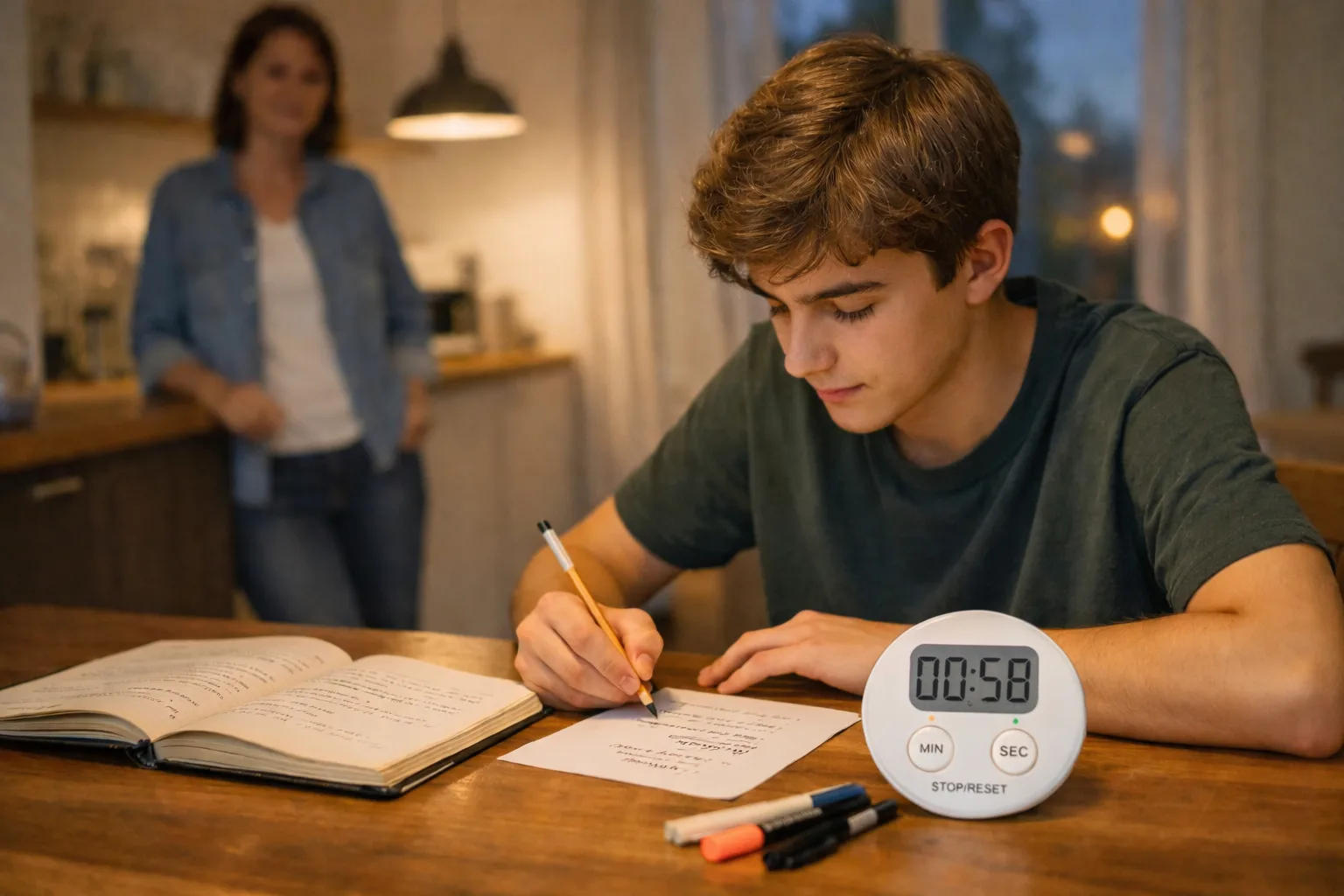
Your child reopens a chapter they studied three weeks ago and says, “I can’t remember any of it.” The most common reaction is to start again from the beginning. That is understandable, but often counterproductive.
In many cases, the right move is not to redo the whole chapter. It is to reactivate it: trigger a first attempt at recall, see what still holds, correct the gaps, then schedule a short return a few days later. In other words, how do you reactivate an old chapter in ten minutes without starting again from scratch? By starting with recall, not rereading.
Ten minutes will not rebuild everything. But it can put the chapter back into circulation far more usefully than simple rereading, and it can help families avoid an exhausting trap: treating every older lesson as if it were a full project to reopen from zero.
Why an old chapter can feel “gone” when it is not
When a chapter seems to have vanished, the problem is often access becoming harder, not total erasure. The information comes back slowly, in fragments, or only once the notes are open. That is normal after a few days or a few weeks.
This misleads many families because the difficulty makes the session feel as though it is failing. In reality, a slightly effortful recall can be exactly what makes the session useful. The student has to rebuild the title, main ideas, examples and logical links instead of simply recognising what is already in front of them.
So the success criterion has to change. The real question is not, “Does this chapter look familiar?” The real question is: “What can I explain on my own, without support?”
In lower secondary, the apparent loss is often about keywords, definitions and the order of the lesson. In sixth form and the first year or two of university, the bigger problem is often different: the student remembers isolated points but has lost the links between them. In both cases, the strategy should not be to redo everything. It should be to test what still comes back and what no longer does.
The most common mistake: starting again from the beginning
An ineffective session almost always starts with the notes already open. The student rereads, highlights again, or rewrites a summary. It feels serious because it looks tidy, long and studious. But it tells you very little about what they will actually be able to retrieve later on their own.
Here is the practical difference:
| Reflex | What it gives straight away | Its real limitation |
|---|---|---|
| Reread everything | A sense of familiarity | The student recognises the chapter without testing what they can retrieve alone |
| Highlight again or rewrite notes | The feeling of having “worked properly” | A lot of time goes into material that is already visible |
| Test first, then correct | A real diagnosis of the gaps | It is slightly less comfortable, but far more informative |
The visual familiarity of a chapter is misleading. Recognising a formula, a plan or a definition when it is in front of you is not the same as recalling it two days later. That is why students sometimes feel they have revised seriously when, in fact, they have mainly maintained a sense of déjà vu.
Of course, starting from the beginning is sometimes justified: if the chapter was never properly understood, if the notes are unusable, or if the basic ideas are still very confused. But when the chapter has already been studied and roughly understood, rereading everything usually wastes the most valuable first minutes.
How to reactivate an old chapter in ten minutes

This method works because it combines three things in the right order: active recall, targeted checking, and a planned return. The order matters.
Two minutes: recall from memory, with the notes shut.
On a blank sheet, the student writes what comes back without looking: the chapter title, three main ideas, two keywords, one example, one formula, one date or one rule depending on the subject. If they get stuck, you can give one broad prompt such as, “What was this chapter about?” No more than that.Three minutes: answer three to five short questions.
The questions need to force retrieval, not recognition. For example: What was the central idea? What were the stages of the process? Which formula was needed, and in what case? What is the difference between these two notions? One well-chosen question is more useful than ten mechanical ones.Three minutes: open the notes only to correct.
The notes now serve to compare, not to begin. Fill in what is missing, correct errors, and mark one precise confusion. The aim is not to reread everything line by line, but to identify exactly what resisted recall.One minute: prepare the next entry point.
The student writes two questions to ask themselves later, or creates two very simple flashcards. A good flashcard is short and focused. “All of chapter 5” is not a flashcard. “What are the two main causes of...?” is.One minute: set the next date.
Decide immediately when the chapter will be reopened: in two or three days, then roughly a week later. Without that second pass, the ten-minute session can still help, but it loses a large part of its value.
If the session felt difficult, that is not necessarily a bad sign. What matters is that it leads to precise correction and to a planned return.
Adjust it by subject
The same logic works across subjects, but not with the same questions:
- Maths, physics, chemistry: retrieve the condition for using a formula, redo one mini worked example, name the classic mistake to avoid.
- History, geography, economics or philosophy: rebuild the chapter plan, retrieve two key notions, one example, one cause and one consequence.
- English and languages: retrieve core vocabulary, one language rule, then produce two sentences or find one example from a text.
- Biology, science, and early higher education courses: rebuild a mechanism, its stages and the links between ideas instead of isolated words.
A short, clear reactivation is usually worth more than a long, vague session in which the student never quite knows what they are checking.
How to test this method over one or two weeks
To judge whether the method works, look at what changes from one session to the next, not only at how the first evening felt. A good reactivation shortens the start-up time and reduces the number of gaps.
Here is a simple two-week test:
| When | Time | Goal |
|---|---|---|
| Day 0 | 10 minutes | First recall, spot the gaps, correct selectively |
| Day 2 or 3 | 5 to 7 minutes | Retrieve the fragile points again from memory |
| Day 7 | 5 to 10 minutes | Check whether the chapter comes back faster and more accurately |
| Day 12 or before an assessment | 5 minutes | Final wake-up of the chapter, without a full restart |
If several older chapters are piling up, rotate them rather than stacking them. One older chapter that has genuinely been reactivated is more useful than four chapters vaguely reread the night before.
The useful signs are often simple:
- the student starts faster;
- they hesitate on fewer points;
- their answers become more structured;
- they need to open the notes later in the session;
- they can say more clearly what they had forgotten instead of declaring, “I know nothing.”
These indicators are more reliable than time spent. Forty minutes of rereading can feel reassuring. Five to ten minutes of well-run recall often teaches more.
How to follow progress without running everything
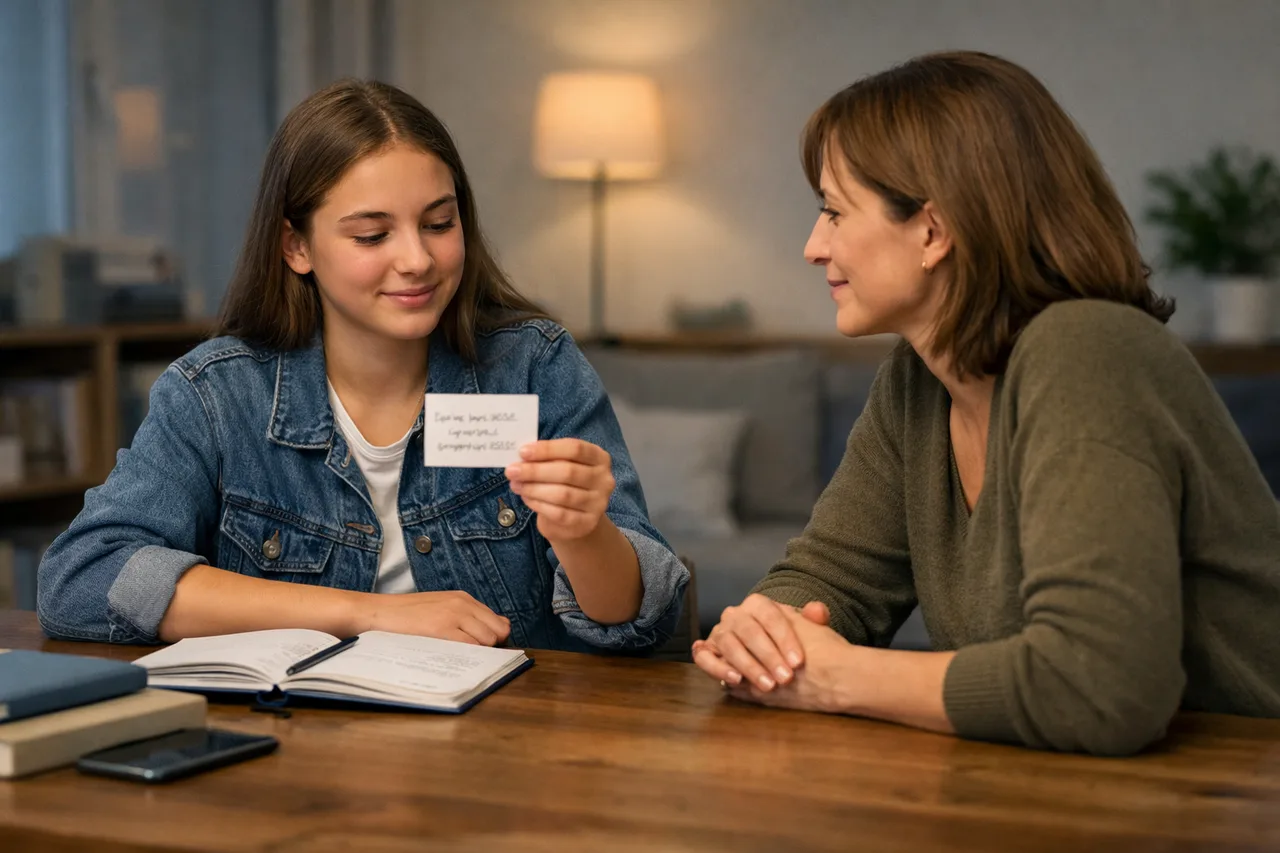
Many parents want to help without becoming the revision manager. On this issue, the most useful follow-up focuses on the process, not on controlling every detail of the chapter.
What you can do directly:
- ask for a one-minute recall, with the notes shut, instead of a vague “Have you revised?”;
- ask one simple question such as, “What did not come back today?”;
- check that there is a next reactivation date;
- keep the session to one old chapter at a time, especially when your child is already tired.
What it is better to avoid:
- sitting next to your child for the whole session;
- correcting every hesitation before they have tried to think;
- turning every gap into a conversation about effort or laziness;
- judging the session by how long it lasted rather than by what it produced.
The useful trace can be modest: one sheet with a few recalled words, two corrected mistakes, and two questions for next time. That is often enough to know whether the session was genuinely useful.
Your influence is mostly indirect. You can make it easier to start, reduce the surrounding noise, protect a short regular slot, and avoid panicking when the first recall is incomplete. What you cannot do is replace the original understanding of the lesson or solve a lasting conceptual problem on your own.
When reactivation is not enough
The ten-minute method assumes there is something to reactivate. If the chapter was never understood in the first place, it will not be enough.
You need a different level of help when several of these signs are present:
- your child cannot explain the main idea even after correction;
- the notes are too incomplete or too messy to use as a base;
- the confusion concerns the core ideas, not just an old detail;
- every older chapter collapses in the same way;
- after two or three cycles, recall does not become faster;
- anxiety, avoidance or conflict are taking over the whole session.
In those cases, the right answer is not to keep extending the same session. It is often a different kind of support: a deeper reteach of the lesson, one precise question to the teacher, help from a strong classmate, targeted tutoring, or sometimes wider attention to work habits, fatigue, or a persistent difficulty.
In other words, reactivation is excellent for waking up sleeping knowledge. It is not designed to replace initial learning or to hide a deeper problem.
What to remember
If you want to reactivate an old chapter in ten minutes without starting again from scratch, keep three rules in mind:
- Start with the notes shut.
- Correct only after a genuine recall attempt.
- Schedule the next return straight away.
The benefit is not only about memory. It is also about family life. When an old chapter is no longer treated as a huge block to redo, the student starts more easily, the parent intervenes less, and revision becomes more sustainable.
The decision framework is simple: if the chapter comes back partially, reactivate it. If nothing comes back at first but the chapter becomes clearer after correction, schedule a close follow-up. If it was never understood, change the kind of help instead of replaying the same longer session.
Sources
- Improving Students’ Learning With Effective Learning Techniques: Promising Directions From Cognitive and Educational Psychology
- The science of effective learning with spacing and retrieval practice
- Metacognition and Self-Regulated Learning
- Retrieval Practice in Classroom Settings: A Review of Applied Research
Keep reading
Related reading
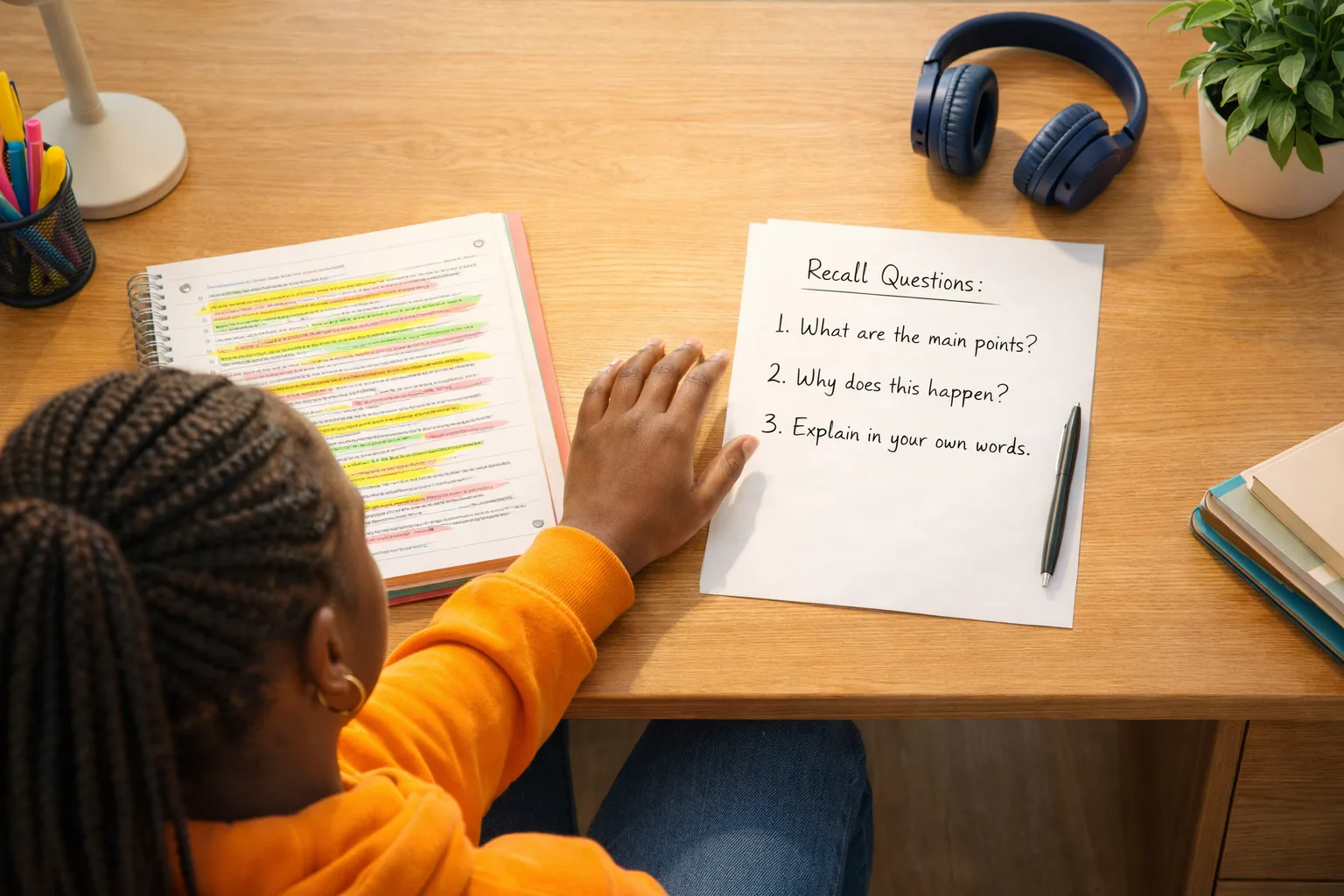
Highlighting is not understanding: why so many students rely on false signals
A brightly highlighted page feels reassuring, but it rarely proves real learning. Here is why highlighting is so appealing, what it actually does, and how to build a simple active reading routine that works across subjects.
Why highlighting and rereading feel useful even when recall is weak
Why students forget so quickly after a test
A decent mark does not guarantee lasting memory. Here is why students forget after a test, and how parents can try a simple active-recall routine over two weeks.
What forgetting after a test really tells you about long-term memory
Active reading: how to read a chapter so your child can actually explain it
Finishing a chapter is not the same as being able to explain it. Here is a simple active reading method to help your child understand, reformulate, and recall what they study across subjects.
How to make a chapter easier to explain before revision even begins
Taking notes: listen, select, rephrase — instead of copying everything
A full notebook is not always a useful one. Here is how to help a student take notes that actually support understanding, memory, and revision.
How to build notes that are usable when an old chapter has to be reopened