

Why students forget even after a serious revision session
Durable memory is not built by spending longer with an open notebook. It is built when a student can bring an idea back without seeing it, notice what is missing, correct it, and meet it again after enough time has passed for forgetting to begin.
That is the practical answer for families: to remember lessons for longer, a student needs a loop of learn → retrieve → correct → reactivate. Re-reading and neat notes can support the first step, but they do not reliably create the later steps. The uncomfortable moment when the notebook is closed is often where the real learning starts.
Many students forget quickly for reasons that are easy to misread. They may have worked hard, listened in class, copied the lesson, and even recognised every paragraph the night before. The problem is that recognition is not the same as recall. A page can look familiar while the idea remains unavailable when the student has to explain it, apply it, or answer a question from memory.
This is why a child can say “I knew it yesterday” and still go blank during revision or in class. The earlier session may have trained familiarity with the material, not independent access to it. Durable memory asks a different question: can the student rebuild the idea when the support has disappeared?
For parents, this distinction is reassuring. Forgetting is not always laziness, lack of intelligence, or bad faith. It is often a sign that the revision activity was too passive, too guided, or too compressed into one intense moment.
The memory loop: encode, retrieve, correct, reactivate
A useful memory routine has four parts.
Encoding means first making the lesson usable. The student identifies the main idea, key words, definitions, formulae, dates, steps, examples, or reasoning pattern. Encoding is stronger when the student understands enough of the material to organise it, but it does not require perfect mastery before any memorisation begins.
Retrieval means trying to produce the content without looking. This can be a blank page, a short oral explanation, a flashcard answer, a worked problem, or a quick quiz. Retrieval feels less smooth than re-reading because it exposes gaps. That difficulty is the point: it shows the student what is actually available from memory.
Correction turns gaps into learning. The student reopens the lesson, checks what was missing or wrong, and rewrites the answer in a sharper form. Correction matters because repeated mistakes can become rehearsed mistakes if nobody checks them.
Reactivation brings the lesson back later. Memory is not secured by one successful evening. It becomes more durable when the student revisits the chapter after a delay, especially once the lesson no longer feels fresh.
The order is flexible, but the loop is not. A student may need more explanation before retrieval in a difficult topic, or more practice questions in a technical subject. Still, the goal remains the same: do not stop at “I understand when I look at it.” Move toward “I can recover it, use it, and repair it when I am wrong.”
This also clarifies the old debate between memorising and understanding. They support each other. Some knowledge must be memorised early enough to make reasoning possible: vocabulary, number facts, definitions, formulae, dates, symbols, or method steps. But memorisation without meaning becomes brittle. Understanding without retrieval can feel clear in the moment and disappear later.
Revision methods are not equal: judge them by what they make the student do
Most revision methods can help in the right place. The mistake is treating them as if they all build the same kind of memory.
| Method | When it helps | Main risk |
|---|---|---|
| Re-reading | First contact with a dense lesson, checking a forgotten detail, calming down before work starts | It can create familiarity without recall |
| Highlighting | Spotting structure in a text or lesson | It can become decoration if the student never retrieves the idea |
| Revision sheets | Condensing a chapter, choosing what matters, rebuilding links between ideas | They can become time-consuming copy work |
| Flashcards | Definitions, vocabulary, facts, formulas, short explanations, error points | They can fragment a topic if every detail becomes a card |
| Blank-page recall | Checking whether the student can rebuild a lesson alone | It feels harder and can discourage students if used too early |
| Quizzes and self-tests | Turning revision into retrieval and feedback | Poor questions can train recognition rather than real recall |
| Practice questions | Applying knowledge, especially in technical or problem-based subjects | Repeating the same type can create a false sense of mastery |
| Error correction | Finding the exact place where understanding or memory breaks | Students often skip it because it feels less productive than doing more |
A good rule is simple: the more the method makes the student retrieve, explain, apply, or correct, the more likely it is to build durable memory. The more it keeps the answer visible, the more carefully it should be used.
This does not mean passive methods are forbidden. Re-reading can prepare a difficult self-test. A revision sheet can reveal the shape of a chapter. Highlighting can help a younger learner notice what matters. But these methods should be treated as preparation for active work, not as proof that the lesson has been learned.
A strong revision session often combines methods rather than choosing one forever: five minutes to reopen the lesson, ten minutes to retrieve, five minutes to correct, then a short delayed return later in the week.
A realistic routine for one lesson, one week, and one month
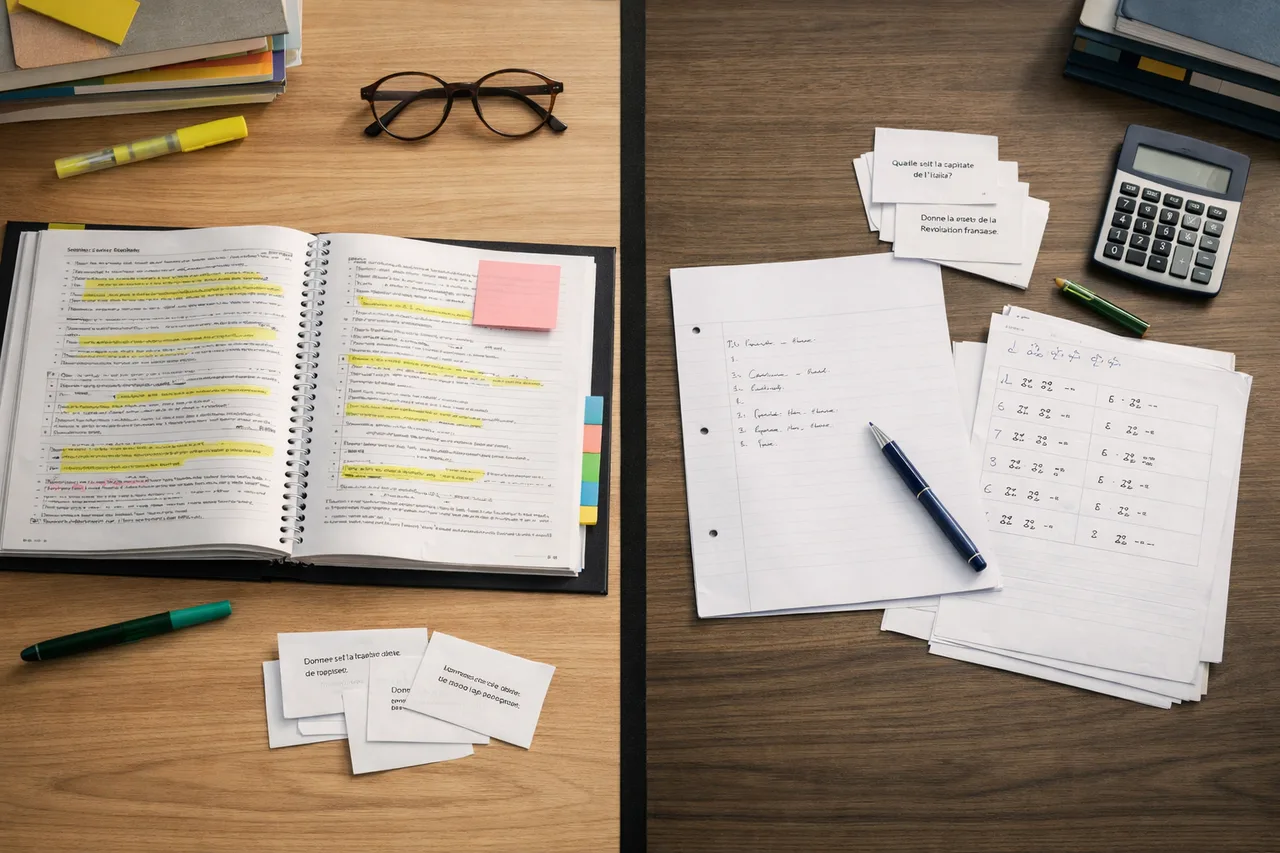
Durable memory needs rhythm, but the rhythm must be possible on ordinary school days. A plan that requires a parent to run a full tutoring session every evening will collapse in many homes.
For a new lesson, the first step is modest. On the day of the lesson or soon after it, the student should make the material reopenable: title, main question, key terms, examples, and one or two likely test points. This is not a perfect revision sheet. It is a usable starting point.
A few days later, the student should close the notes and try a short recall task: write the main ideas on a blank page, answer five flashcards, explain the method aloud, or solve one representative question. The aim is not to be brilliant. It is to discover what can be retrieved.
About a week later, the student should return to the same lesson without starting from zero. This reactivation can be short: a mixed quiz, a blank-page outline, one corrected exercise, or a two-minute oral explanation. The delay is important because it reveals whether the lesson survives beyond immediate familiarity.
Before an assessment, revision should shift from “have I seen this?” to “can I use this under changing conditions?” That means mixed questions, self-explanation, correcting old mistakes, and practising the kind of output expected: written answer, calculation, diagram, oral explanation, proof, translation, or analysis.
After the assessment, the chapter should not disappear completely. A short return a few weeks later can protect useful knowledge from becoming “exam-only” memory. This is especially valuable for subjects where later topics depend on earlier ones.
The routine can be adapted by age. Younger children may need shorter, more concrete retrieval: one definition, one example, one explanation to a parent. Older students can handle more independent cycles: choosing cards, mixing chapters, tracking recurring errors, and planning delayed reviews. The principle stays the same: small returns beat one dramatic last-minute effort.
How to know whether a chapter is really learned
The strongest test of durable memory is not whether the student feels ready. It is whether the student can produce something useful without the lesson in front of them.
A chapter is probably becoming secure when the student can:
- explain the main idea in their own words without copying the lesson;
- recall key terms, formulas, dates, examples, or steps with only a light cue;
- answer questions in a different order from the notebook;
- correct an error and explain why the first answer was wrong;
- use the idea in a new exercise, text, problem, or example;
- return to the chapter after a delay without starting again from the beginning.
Several simple tests work at home. The student can cover the lesson and rebuild a blank-page outline. They can record a one-minute oral explanation. They can answer flashcards in both directions: term to definition and definition to term. They can mix old and new questions so the brain has to choose the method rather than follow a visible sequence.
Parents do not need to become examiners. A useful parent prompt is: “Show me what you can recover without looking, then show me what you corrected.” This keeps the focus on the learning process rather than on interrogation.
When a student goes blank, the answer is not always “study more.” It may be “change the cue.” Ask for a first word, a diagram, an example, or the easiest part of the method. If recall restarts after a cue, the memory may exist but be poorly accessible. If the student still cannot rebuild anything, the lesson probably needs more encoding before self-testing will help.
Shortcuts that make memory fragile
The first fragile shortcut is making revision look impressive. A beautiful page, colour-coded notes, or a long copied summary can be useful if it reorganises knowledge. It is much less useful if it mainly postpones the moment of recall. The question is not “does the work look serious?” but “did the student retrieve or use the content?”
The second shortcut is making too many flashcards. Flashcards are powerful when they target the right things: definitions, distinctions, formulas, examples, steps, vocabulary, and common errors. They become weaker when every sentence becomes a card. A good card should force a useful answer, not train the student to recognise a tiny fragment.
The third shortcut is repeating only what already works. Students naturally return to the exercise type that feels comfortable. Durable memory needs some mixing: old and new, easy and difficult, definition and application, direct question and disguised question. Mixing is less pleasant, but it better resembles real use.
The fourth shortcut is treating correction as punishment. Error correction is not proof that the student has failed; it is one of the best places to learn. A corrected error shows the family exactly where memory, understanding, attention, or method broke down. Repeating ten new exercises without analysing the first error can simply create ten more opportunities to miss the same point.
The fifth shortcut is turning every revision moment into a family conflict. A tense parent-child interrogation may create compliance for one evening, but it rarely builds autonomy. The aim is to make the student’s output visible enough for support, not to make the parent responsible for every recall attempt.
What parents can do without becoming revision managers
The parent’s role is not to hold the entire memory system in their head. It is to help the child build conditions where the right work is more likely to happen.
Start by asking for an output, not a performance. “What can you recover without looking?” is better than “Have you revised?” because it turns an invisible activity into evidence. The output can be tiny: three key words, one formula, one example, one corrected mistake.
Then reduce friction. Keep materials easy to reopen. Separate the first five minutes from the rest: choose the lesson, choose the task, start with one question. Many students do not avoid revision because they reject learning; they avoid the vague beginning.
Parents can also protect the rhythm. A ten-minute return to an old lesson may look too small to matter, but it is often exactly the kind of delayed reactivation that protects memory. The family does not need a perfect revision culture. It needs repeated, realistic moments where the student retrieves, checks, and returns.
Finally, adjust expectations to the child. A younger learner may need more prompting and concrete questions. A teenager may need more autonomy, but still benefit from a visible plan and light accountability. A child with major gaps may need explanation before retrieval. A high-performing student may need more mixed practice because familiar exercises can hide fragility.
Questions parents often ask about durable memory
Are flashcards better than revision sheets?
They solve different problems. A revision sheet helps the student organise a chapter and decide what matters. Flashcards help the student retrieve specific pieces of knowledge repeatedly. For durable memory, the best choice is often a small revision sheet to understand the structure, then a limited set of flashcards for the elements that must come back quickly.
How often should a student revisit a lesson?
There is no universal calendar that fits every age, subject, and workload. A practical rhythm is to return once soon after the lesson, once after a delay, once before the assessment, and once later if the chapter will be useful again. The point is not to create a rigid schedule; it is to avoid leaving the chapter untouched until the night before it is needed.
Is forgetting after a test normal?
Yes. If a lesson is revised only for one assessment and then abandoned, it is common for recall to fade. The more important the chapter is for future learning, the more it deserves a short reactivation later. The aim is not to remember every school detail forever, but to keep the foundations that will be reused.
Should parents test their child every evening?
Usually no. Daily interrogation can become heavy and adversarial. A lighter approach is to agree on visible outputs: one blank-page attempt, a few flashcards, one corrected exercise, or a short explanation. The student should gradually own more of the process.
Practical recap: the small system that matters most
If a family wants durable memory without overhauling the whole evening routine, start here:
- Make the lesson usable: identify the main idea, key terms, examples, and expected outputs.
- Close the notes: retrieve something before looking again.
- Correct quickly: compare with the lesson and repair the gap.
- Return later: revisit the chapter after a delay, even briefly.
- Mix the questions: avoid practising only the easiest or most familiar form.
- Keep parents as supports, not permanent revision managers.
The goal is not to make every child study like a memory researcher. It is to replace vague revision with a small repeatable loop. When the student learns, retrieves, corrects, and reactivates, memory becomes less dependent on panic, reminders, and last-minute pressure.
For a deeper next step, the most useful routes are practical: learn how to turn one lesson into a self-test, and learn how to balance memorisation with understanding so the student is neither reciting empty words nor waiting forever to feel “ready.”
Sources
- Illusions of Competence in Monitoring One’s Knowledge During Study
- Distributed Practice in Verbal Recall Tasks: A Review and Quantitative Synthesis
- Improving Students’ Learning With Effective Learning Techniques: Promising Directions From Cognitive and Educational Psychology
- Test-Enhanced Learning: Taking Memory Tests Improves Long-Term Retention
- Retrieval Practice Produces More Learning Than Elaborative Studying With Concept Mapping
Keep reading
Related reading

Memorise first or understand first? The right order for making progress
Should a child memorise definitions, formulas or dates before they really understand them? In practice, understanding and memory support each other, but not in just any order. Here is a simple way to avoid empty recitation and the endless wait for “perfect understanding”.
Decide what to memorise early and what needs understanding first
Going blank in revision: how to turn a lesson into a self-test
When a student seems to know a topic but freezes as soon as the notes are closed, the problem is not always memory. Here is how to turn one lesson into a simple self-test, with a two-week routine parents can support without constant supervision.
Turn one lesson into a practical self-test routine
All articles in this category
Every published article in this topic, from newest to oldest.
- Going blank in revision: how to turn a lesson into a self-test
- Memorise first or understand first? The right order for making progress
- Rereading is not revision: what parents should know
- Redoing an exercise after seeing the answer: useful revision or a false sense of mastery?
- Revision sheets: when they help and when they waste time
- How to reactivate an old chapter in ten minutes without starting from scratch
- Why students forget so quickly after a test