


Near a test, the same scene appears in many homes: a student spends an hour rewriting a chapter neatly, adds colour, condenses it, then puts the revision sheet away with the feeling that they have worked seriously. Sometimes they have. Sometimes, though, that hour has done more to reassure them than to help them remember.
The useful answer for families is fairly simple: revision sheets help when they force the student to select what matters, then retrieve it without looking at the original notes. They waste time when they become a mini-copy of the chapter: neat, dense and rarely used again.
So the real question is not, “Have they made their revision sheets?” It is, “Do these sheets help them recall the information tomorrow, three days later, and on the day of the test?”
Why a revision sheet can feel helpful when it is mostly reassuring
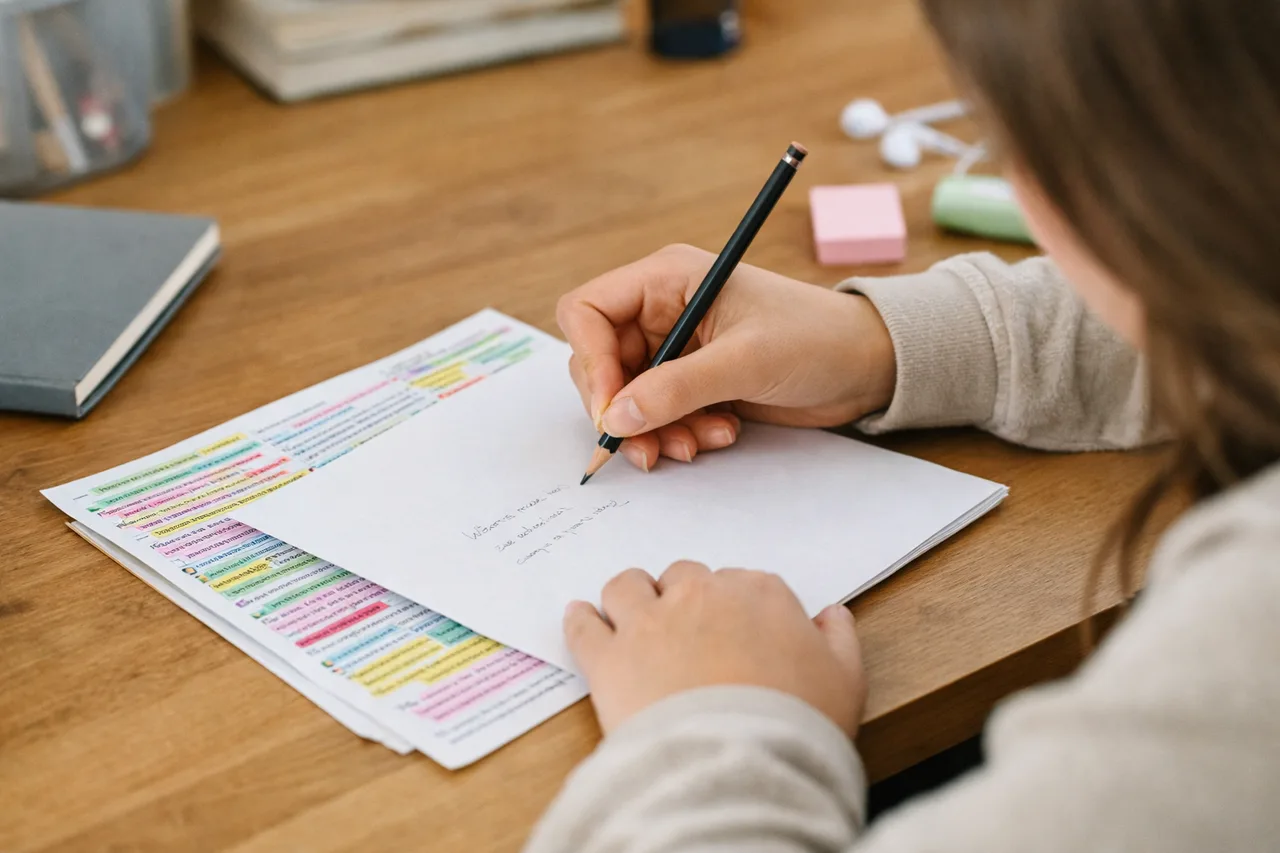
Families often get caught by a very ordinary mechanism: familiarity can feel like mastery. When a student rereads notes they have just copied out, everything seems clearer. The wording feels familiar, the headings come back quickly, the key terms “sound right”. That sense of ease is pleasant, but it does not yet prove that the content will still be retrievable later, without support.
That is why a beautiful revision sheet can hide a weak signal. The more the original wording stays in front of the student, the easier it is to feel that they know it. On the day of the test, though, the notes are gone. What matters is not how easily they can recognise the information, but whether they can bring it back.
In cognitive science, this is often described as active recall: trying to pull information back from memory instead of simply seeing it again. It is less comfortable. Students hesitate more, get stuck more, and discover more gaps. Yet that slight effort is often a better indicator of real learning than smooth rereading. Researchers also use the expression desirable difficulties for tasks that feel a little harder, but in the right dose, help memory stick more reliably.
For a revision sheet, that changes everything. A sheet can serve three different functions:
- sorting a chapter that feels too dense;
- organising the important ideas;
- testing what the student can retrieve afterwards without the notes.
The first two functions are useful. But if the third one never happens, the sheet remains mostly a tidying-up exercise. It may support understanding. It does not automatically support durable memory.
When revision sheets genuinely help — and when they waste time
The word “sheet” actually covers several different tools. Part of the confusion starts there. A summary sheet, a flashcard and a method sheet do not do the same job.
Here is a simple way to decide where each one fits.
| Type of sheet | Useful for | Main limitation |
|---|---|---|
| Summary sheet | Clarifying a chapter, seeing its structure, selecting the essentials | It can create the illusion of knowing if it is only reread |
| Question-and-answer card / flashcard | Checking what the student can retrieve, revising in short bursts, returning to the same material several times | It works badly when the questions are vague or too long |
| Method sheet | Remembering a procedure, formula, common trap or diagram to rebuild | It does not replace practice on exercises or written tasks |
The practical consequence matters: the most useful revision sheet for memory is not always the longest or the most “complete” one. Very often, it is the most targeted one — the one that forces the student to answer, explain, retrieve or rephrase.
Summary sheet or flashcards?
A summary sheet is not useless. It can be very helpful at the start, especially when the notes are messy, much too long, or badly structured. For some students, simply identifying the main headings, central ideas and key examples already improves understanding.
But that sheet is not proof that learning has happened. It becomes genuinely useful when it is turned into questions: “What are the three causes?”, “Explain this mechanism without looking”, “Rebuild the diagram from memory”, “Which example fits this definition?”
In other words, summarising can help a student enter a chapter; self-testing does more to keep it there.
The right use depends on the subject
Revision sheets are particularly useful for content where the student needs to retrieve definitions, dates, vocabulary, mechanisms, contrasts, stages or short reference points.
For highly procedural subjects such as maths, physics or some parts of economics, their place is narrower. A sheet can remind the student of a method, a common mistake, a model of reasoning or a formula. But it does not replace doing a problem again without help.
For history, languages, biology, or some parts of law and psychology, short cards can work very well. For English literature, philosophy or other extended-writing subjects, sheets can help students retain references, short quotations, plans, arguments or examples, but they still need to be combined with real written or oral practice.
What changes with age
In the earlier secondary years, the main issue is often learning to reduce and phrase things accurately. A student may need help deciding what is worth putting on a sheet at all, and how to turn a chapter heading into a simple question.
By sixth form and the first year of university, the problem often changes. The student knows perfectly well how to make revision sheets, but spends far too long on them. As the volume of content grows, families usually need to become stricter about time spent making the sheet and more demanding about time spent reusing it.
The most common mistake: confusing making the sheet with revising
The most frequent mistake is not making revision sheets. It is believing that making the sheet already counts as most of the revision.
That confusion is understandable. Producing a sheet creates visible progress: the chapter finally exists in a shorter, cleaner, more readable form. For parents, that is reassuring too. There is something concrete to look at. Memory, though, does not always respond to what is most visible.
When making the sheet takes over, a few warning signs appear:
- the student copies almost the whole chapter instead of selecting;
- they spend more time rewriting than asking themselves questions;
- they wait until every sheet is finished before they start testing themselves;
- they reread the sheet with the original notes next to it;
- they judge the session by how tidy it looks, or by how many pages were produced, rather than by what they can now retrieve.
That is usually the point where revision sheets become expensive: a lot of time, very little recall, and a false sense of security.
A simple rule helps: making the sheet should cost less than using it. If a sheet took forty minutes to make and is only looked at for five, it is probably too heavy. If it took fifteen minutes and is used four times for self-testing, it becomes a real revision tool.
Another marker is even more concrete: a useful sheet should reveal fairly quickly what is not secure yet. If, after several days, the student still cannot answer without looking, the solution is rarely to “redo the sheet better”. More often, it is to change the format, reduce the amount of content per card, or switch partly to another kind of practice.
A simple method to test over two weeks
The best approach is not to rebuild the whole system at once. Try the method on just one or two chapters over two weeks. The goal is not perfect sheets. The goal is to find out whether the student remembers more with less wasted time.
Here is a simple routine.
- Choose a small scope. One history chapter, one vocabulary list, one biology mechanism, one set of formulas with use cases, or two economics concepts is enough. There is no need to begin with a whole subject.
- Limit making time to 20 or 30 minutes. From the original notes, the student produces either one very short summary sheet or no more than 8 to 12 cards. Each card should cover one idea only: one question, one definition, one contrast, one stage, one diagram to rebuild, or one example to retrieve.
- Turn the sheet into a recall tool immediately. In the first session itself, hide the notes. The student tries to answer aloud, in writing, or on scrap paper. Only then do they check.
- Space the returns. One short session the next day, another two or three days later, then another at the end of the week often works better than one heavy block.
- Mark the fragile cards. No need for ten colours: three states are enough, such as “secure”, “review”, and “still hazy”.
- Finish with a mini-test without support. At the end of the fortnight, the student answers five or six questions without looking, rebuilds a diagram, or explains the chapter aloud.
That can be translated into a very simple timetable:
- Day 1: short creation phase + first recall attempt;
- Day 2: 10 minutes of questions without the notes;
- Day 4 or 5: another pass focused on the weak cards;
- Day 7 or 8: mix the questions so the student is not relying on a fixed order;
- Day 12 to 14: final mini-test without support.
This method works especially well if the family accepts one counter-intuitive idea: fewer cards, reused several times, usually beat one large sheet that is never used again.
For exercise-based subjects, the same logic still works. A card can ask the student to identify the right method, name the useful tool, spot the common trap, or explain the first step. Then they do a short exercise without help. The sheet is no longer a substitute for work; it becomes a trigger for the right kind of work.
How parents can keep an eye on this without micromanaging

Many parents can see the problem clearly enough: they want to help, but they do not want to become the permanent project manager of revision. On this issue, it is usually less useful to monitor how the sheets are being made than to watch a few simple signs of progress.
The most useful indicators are often these:
- starting is easier: the student knows how to begin instead of hovering around the desk for twenty minutes;
- recall is clearer: they can explain part of the lesson without having it in front of them;
- gaps are identified: they can say what is still shaky instead of saying, “I think it’s fine”;
- revisiting is short but regular: several short sessions replace one chaotic evening before the test;
- dependence on the parent falls: every step does not need prompting.
In practice, instead of asking, “Have you finished your revision sheets?”, it is often more useful to ask:
- “Show me three questions your sheet lets you work on.”
- “What can you recall without looking?”
- “Which cards are still unclear today?”
- “When will you come back to them next?”
Those questions shift attention from the product to the use. They help the student think about method without turning the parent into the person who polices the paperwork.
When should you look beyond a simple method adjustment? If the student retains almost nothing despite several returns, does not understand the original lesson, takes a disproportionate amount of time to condense one chapter, or if every session ends in conflict or anxiety, the issue probably goes beyond revision sheets. At that point, it makes sense to look more broadly at understanding, attention, overload, confidence, tiredness, or the need for more targeted academic support.
What to keep in mind before redoing the whole folder
Revision sheets are neither a gimmick nor a miracle method. They are useful when they work as a bridge between the lesson and active recall. They waste time when they stay on the side of copying, tidying and familiarity.
If you want to decide whether they are worth the effort in your family, four questions are enough:
- Does the sheet force the student to choose what matters most?
- Is it used to answer without looking at the original notes?
- Does it come back several times over a few days?
- Do you see better recall, not just a neater sheet?
If the answer is yes, revision sheets deserve a place. If the answer is no, the solution is not necessarily more work. It is often a different shape of work.
The fairest test is still a very simple one: take one chapter, limit the time spent making the sheet, increase the time spent retrieving from it, then see what the student really knows a week later. That is often the moment when families discover whether the sheet is helping memory — or only the feeling of having revised.
Sources
- Test-enhanced learning: taking memory tests improves long-term retention
- Making Things Hard on Yourself, But in a Good Way: Creating Desirable Difficulties to Enhance Learning
- Improving Students' Learning With Effective Learning Techniques: Promising Directions From Cognitive and Educational Psychology
- Retrieval Practice in Classroom Settings: A Review of Applied Research
Keep reading
Related reading

Why students forget so quickly after a test
A decent mark does not guarantee lasting memory. Here is why students forget after a test, and how parents can try a simple active-recall routine over two weeks.
Why a decent test mark does not guarantee lasting memory
Active reading: how to read a chapter so your child can actually explain it
Finishing a chapter is not the same as being able to explain it. Here is a simple active reading method to help your child understand, reformulate, and recall what they study across subjects.
How to turn a chapter into something your child can explain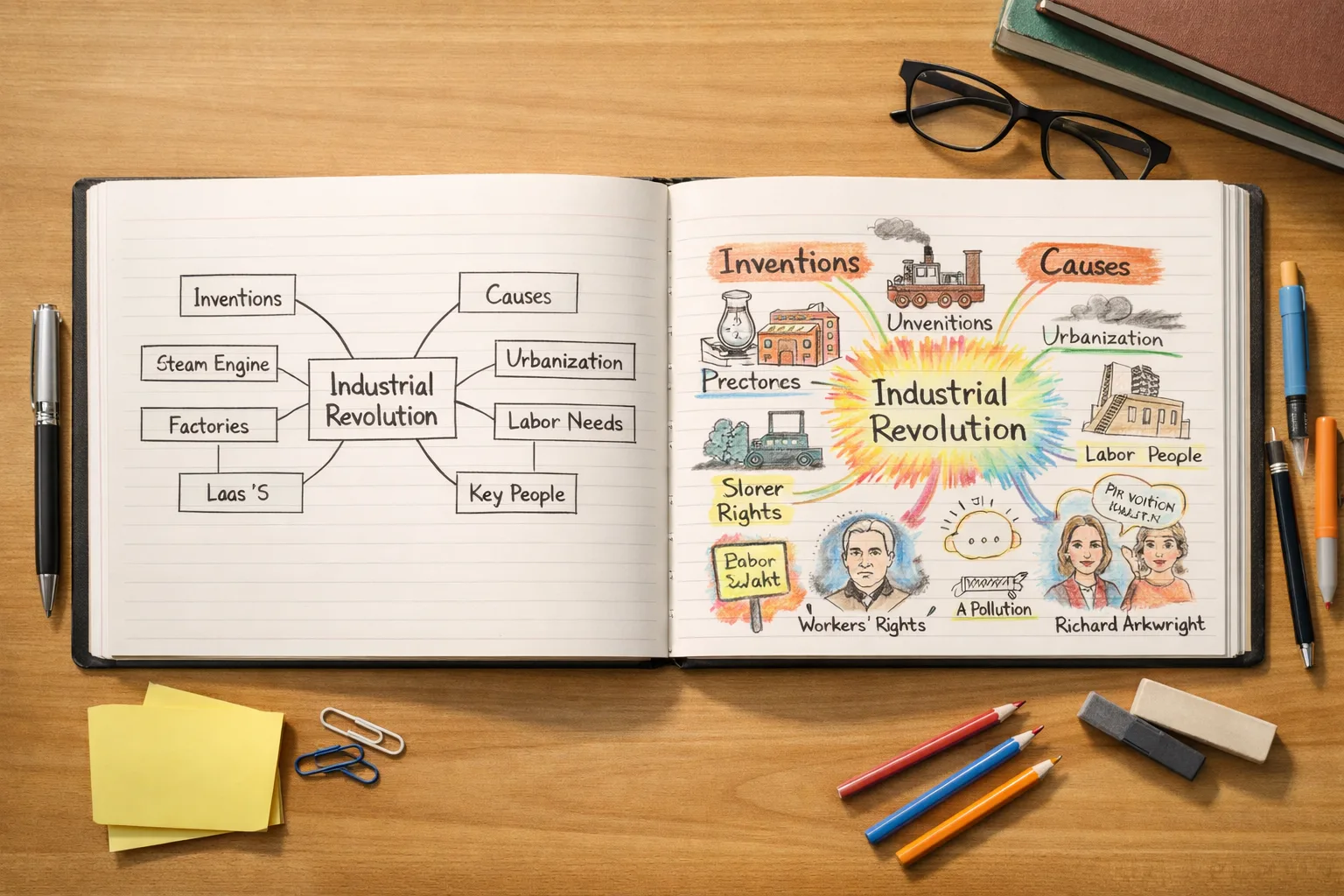
Mind maps: powerful tool or visual gimmick depending on how they’re used
A mind map can genuinely help a student understand and revise — but only if it forces them to organise, connect and recall ideas, not just rewrite the lesson in colour.
Another visual study tool: when it helps, and when it only looks productive