


Your child has spent forty minutes rereading a chapter, highlighted two pages and tells you they have revised. Yet the next day they stall on simple questions. That gap does not necessarily mean they did not work. It often points to something else: they did something reassuring, but not very diagnostic.
Rereading is not revision in the full sense of the word. Rereading can help bring a chapter back to mind, clarify a difficult passage or prepare for real practice. But on its own, it mainly checks familiarity with the page. Useful revision also has to make a student retrieve, phrase or use information without seeing it.
For parents, that distinction matters. It helps you stop confusing time spent with real progress. It also makes it easier to support your child without turning every evening into a mini test.
Why rereading often feels more effective than it is
Rereading is appealing because it quickly creates a sense of fluency. When the chapter title, diagram, highlighted lines and key sentences are all in front of the student, the brain recognises the material more easily. That ease is often mistaken for proof of learning.
The problem is that school rarely asks students simply to recognise a paragraph they have already seen. It asks them to retrieve a definition, explain an idea, repeat a method, compare two notions, argue a point or use a chapter inside an exercise. In other words, it asks for memory that is available on demand, not just a feeling of having seen the page before.
The contrast looks like this:
| Revision move | What it gives quickly | What it still does not prove |
|---|---|---|
| Rereading or highlighting notes | A sense that the material feels familiar again | The ability to retrieve it alone with the notes closed |
| Saying it back, writing from memory or answering questions | A clearer picture of gaps and solid points | A comfortable session in the moment |
| Reworking an exercise with the mark scheme or model beside you | The feeling of following the method | Real independence once the support disappears |
Counter-intuitive but important: what feels more effortful is often what tells you more. A useful revision session is not necessarily the one that feels smooth. It is the one that shows what still stands once the notes are closed.
The most common mistake: confusing seeing with knowing
The classic mistake is not rereading once. It is turning rereading into the main event and then concluding that the chapter has been learned. Many families fall into that trap because a student can genuinely understand what they are reading while they are reading it. But understanding with the notes in front of you is not yet the same as being able to retrieve it later.
For a notion to be properly revised, a student usually needs to cross three thresholds:
- Recognising: the page looks familiar and rings a bell.
- Retrieving: with the notes closed, they can say back the idea, definition or steps.
- Reusing: they can give an example, solve a case, justify an answer or compare two ideas.
Rereading mainly works on the first threshold. Most tests, timed assessments and exams ask for the next two.
The balance changes with age. In the early years of secondary school, a strong first step can simply be asking a child to explain the lesson aloud in plain language, with one example. In GCSE and sixth-form years, written output becomes more important: a short answer plan, a worked proof, a mini essay, a labelled diagram or a short problem done without the mark scheme beside them. In the first stage of higher education, the bar rises again: selecting what matters most, linking several ideas and sustaining a longer line of reasoning.
That also explains why some students feel they have revised seriously and experience a poor mark as an injustice. They have not necessarily lacked effort. Sometimes they have used a strategy that felt reassuring but did not really test what they could retrieve on their own.
A simple two-week method to try
There is no need to reorganise the whole household. Take just one chapter and test a light routine over ten to fourteen days. The goal is not to work for longer. The goal is to work differently.
Day 0: close the notes, then recall.
In 10 to 15 minutes, the student closes the notebook and writes on a blank sheet five essential ideas, two or three key words or definitions, then one example, date, formula or method step depending on the subject. Only after that do they reopen the notes and compare.Day 1 or 2: short return without support.
In 5 to 10 minutes, they come back to the same sheet or to a few simple questions and try to answer without looking. If they get stuck, they take a brief look at the notes, then try again with the notes closed. The aim is not to avoid every mistake. The aim is to make memory do some work.Day 4 or 5: recall plus a small application.
Now add a task that forces the student to use the chapter: explain it in 90 seconds, do a mini exercise, rebuild a diagram, sort key ideas or justify an answer. This is where they move from 'I recognise it' to 'I can use it'.Day 8 to 10: one last short return.
Try one more brief retrieval before rereading what still resists. There is no need for a long session. In many cases, three or four short, spaced returns help more than one big reread the night before.
This routine is deliberately modest. It fits real family life better than a perfect plan that nobody keeps up. If the student has many subjects, it is usually better to try this logic on one or two important topics than impose it everywhere at once.
At the end of the two weeks, do not look for perfect recitation. Look for finer signs: a less hesitant start, more precise gaps, a more structured explanation, and fewer moments when your child says they knew it when they were looking at it.
How to help without becoming the evening examiner

The most useful parental follow-up is less about total time spent and more about whether there is any trace of real retrieval. The helpful question is not only 'Have you revised?' but also 'What could you retrieve without opening your notes?'
A few simple habits are often enough:
- ask for a very short explanation out loud or on paper rather than a vague report about time spent;
- ask what is still missing, not only what has been reread;
- help schedule the next short return instead of stretching the evening session indefinitely;
- value corrected errors and regularity more than the feeling of having looked at everything.
In the early years of secondary school, that help can stay very light: two oral questions, one definition, one example. In GCSE or sixth-form years, it is often more useful to ask for a short written output. In early higher education, the parental role usually becomes more indirect: helping a student protect some quiet time, remember a deadline or keep a routine, without replacing their own organisation.
The most encouraging improvements are often discreet. The student sees more quickly where to start, spots weak points earlier, needs to reopen the notes less often halfway through an explanation, and a week later the whole chapter has not vanished. By contrast, some signs suggest looking beyond revision technique: notes that are too confused to use, major misunderstandings, chronic tiredness, high stress or persistent blocks across several subjects. In those situations, revision strategy matters, but it may not be enough on its own.
Where rereading still helps
Saying that rereading is not revision does not mean it should be banned. It has a role, but a precise one.
Rereading is useful when it helps a student to:
- get the thread of a chapter back just after the lesson;
- spot an unclear passage or incomplete notes;
- correct an active-recall attempt after first trying without support;
- recover an exact detail before a test, especially in subjects rich in dates, quotations, texts or specialist vocabulary.
In other words, the useful formula is often this: reread to prepare or correct retrieval, not to convince yourself you already know.
That nuance matters for students with messy notes, attention difficulties, dyslexia or strong anxiety about the blank page. In those cases, the most effective version of recall is not always a silent blank sheet. It may be oral recall, an audio recording, a small set of question-and-answer cards, an incomplete diagram to finish or a very short exercise. The principle stays the same: bring the information out of memory first, then check.
And when the problem is not memory but understanding itself, it helps to say so clearly. A student who does not understand the chapter will not be rescued by a better revision technique. They may first need an explanation, clearer notes, a conversation with the teacher or more targeted support.
What to try next week
Next week, there is no need for a grand family reform. Try three simple decisions on one chapter only:
- replace one session of pure rereading with a short closed-book explanation or written recall;
- do another 5- to 10-minute return two or three days later, then once more the following week;
- look not only at time spent, but at what your child can now explain, write or use alone.
That is the key point for parents: rereading is not revision because it more easily creates a feeling of mastery than proof of available memory. Once that difference becomes clear, revision at home often becomes more useful, calmer and a little less misleading.
Keep reading
Related reading

Why students forget so quickly after a test
A decent mark does not guarantee lasting memory. Here is why students forget after a test, and how parents can try a simple active-recall routine over two weeks.
Why a decent mark can still fade quickly after the test
Active reading: how to read a chapter so your child can actually explain it
Finishing a chapter is not the same as being able to explain it. Here is a simple active reading method to help your child understand, reformulate, and recall what they study across subjects.
How to turn reading a chapter into something your child can explain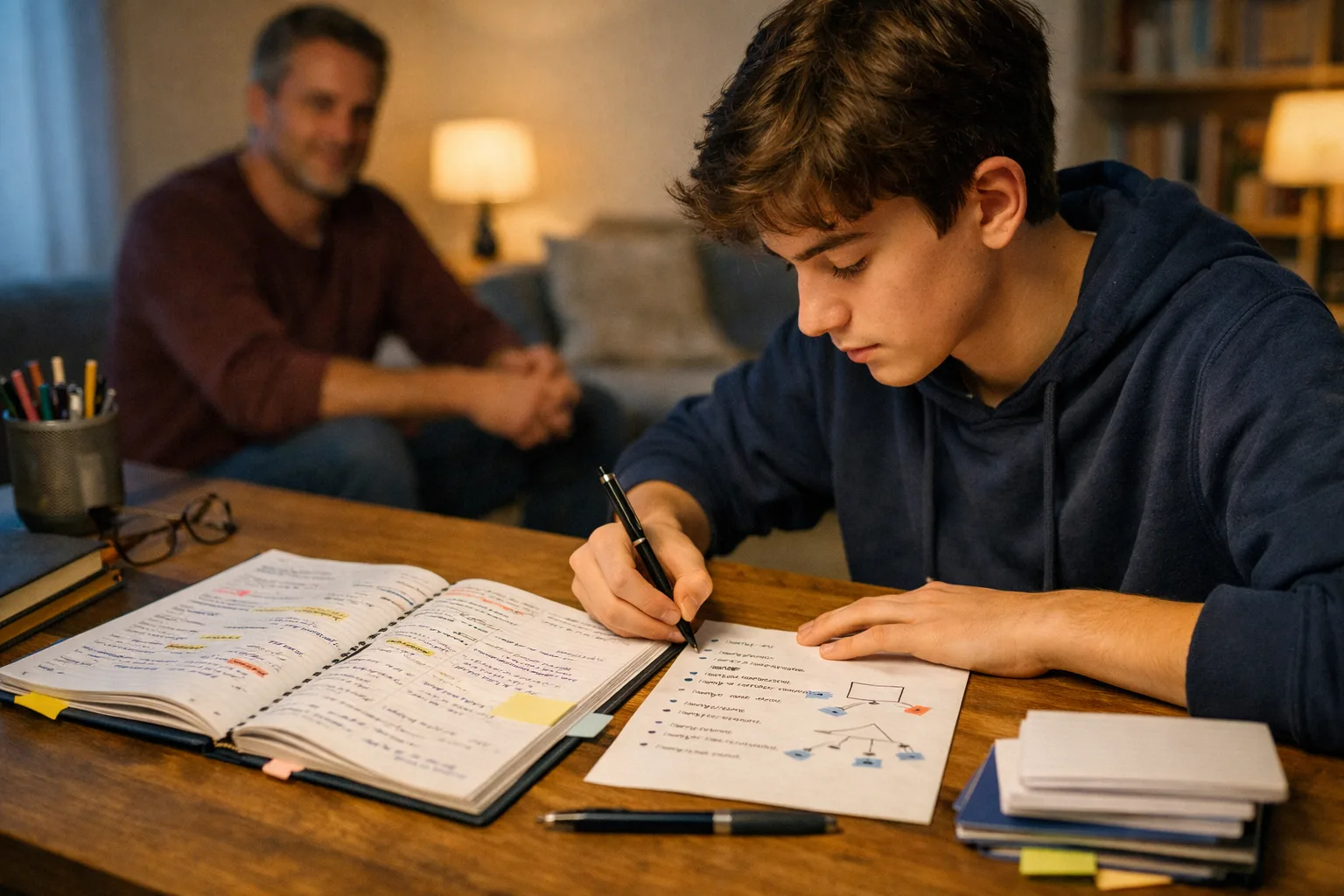
Should students rewrite their notes the same day — or is it just double work?
Rewriting all your notes the same day can feel responsible, but it is not always the best use of time. What usually helps more is a short active review that makes the lesson easier to revisit later.
When rewriting notes helps and when it is just more comforting work