

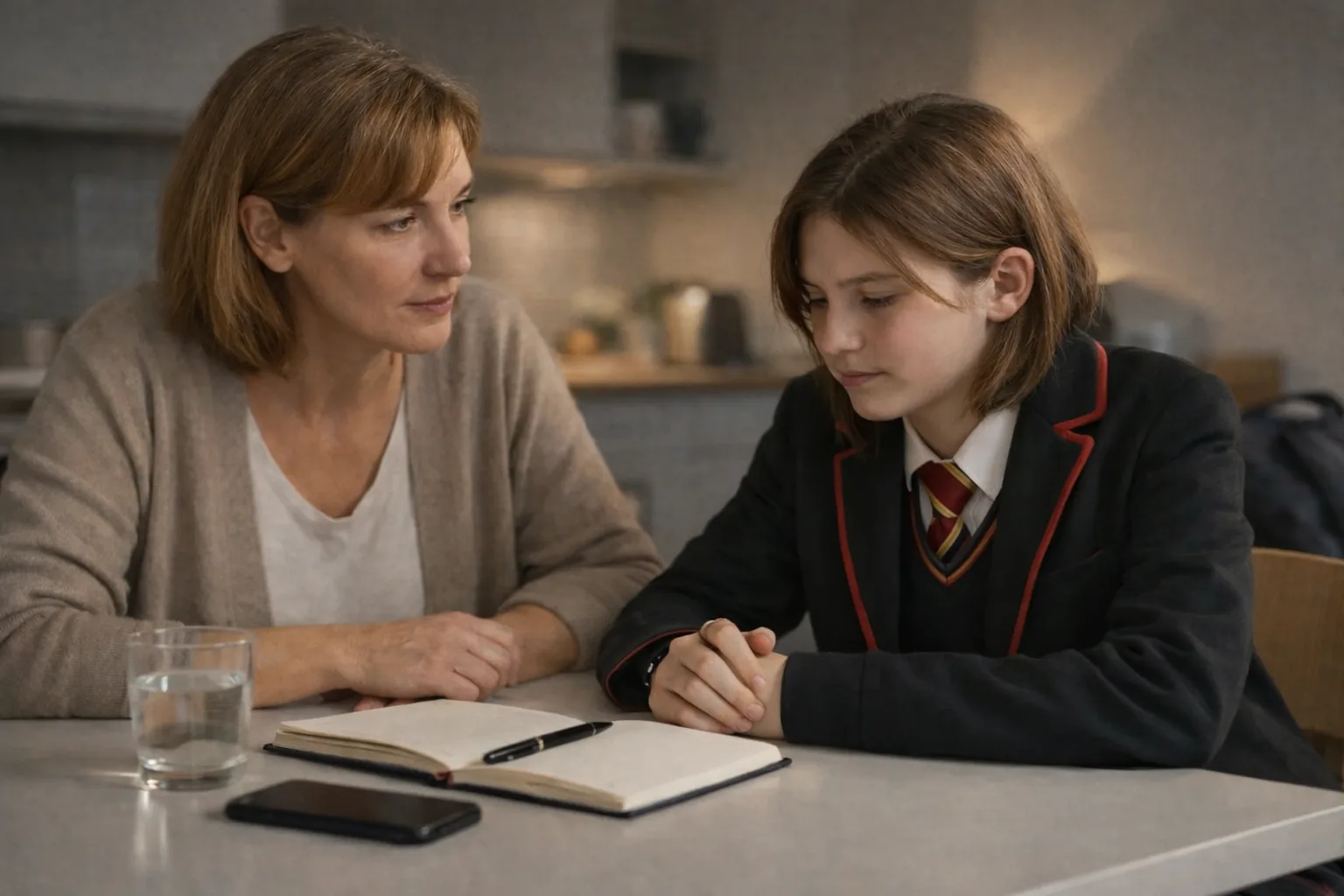
You do not need a perfect evidence file before you start acting. In the first 48 hours, your job is not to prove every detail. It is to protect, listen, preserve what matters and bring the right adults in quickly.
That window matters because a child who already feels ashamed, isolated or exhausted often says less tomorrow than they can say today. Digital evidence can disappear. And the next trip back to school can put them straight back into the same lunch hall, corridor, bus seat or group chat without any real protection.
So the helpful response is neither panic nor waiting for certainty. Start with calm protection, basic fact-finding and an adult plan.
Why the first 48 hours matter
Bullying does not only damage mood. It can very quickly reduce concentration, the sense of safety and trust in adults. That is why a casual “we’ll see tomorrow” can cost more than parents realise.
In the first days, the effects often show up on three levels at once:
- School life: difficulty concentrating, patchy attention, avoided homework, missing lessons, sudden refusals around specific places or times of day.
- Emotional life: shame, anxiety, hypervigilance, poor sleep, stomach aches, headaches or unusual irritability.
- Relationships: isolation, loss of trust, silence, fear that speaking will make things worse, more tension at home.
Acting quickly does not mean overreacting. It means interrupting a spiral: isolation, repeated exposure, lost evidence, then exhaustion. Even if the situation turns out to be a serious conflict rather than established bullying, you have not “done too much”. You have responded to a child who does not feel safe.
The quieter signs adults often miss
Many children do not say, “I’m being bullied.” They say, “It’s nothing”, “It was only banter”, or “I don’t want to talk about it.” That language of minimising is not proof that everything is fine. Very often, it is a way to keep some control, avoid shame or prevent the adult reaction they fear.
What separates conflict from a bullying dynamic
A conflict can be mutual, occasional and limited in time. Bullying settles into a pattern where one child feels targeted, isolated, dominated or repeatedly exposed. The imbalance of power may come from popularity, age, numbers, physical strength, social status, a class group, a group chat or humiliating material being circulated.
You also do not need to wait for a perfect pattern of repetition before acting. A serious threat, sexual humiliation, the sharing of an intimate image, extortion, physical aggression or intense fear about going back to school justifies immediate adult involvement.
Signs that deserve to be taken seriously
One sign on its own is not always enough. A cluster of signs, especially if they appear suddenly, deserves attention:
- stomach aches, migraines, exhaustion or tears before school, especially in the evening or morning;
- refusal of a very specific place: the playground, lunch hall, changing rooms, bus, corridor, journey home or PE;
- falling attention, missing homework, an unusual drop in results or a sharp loss of interest in school;
- lost possessions, damaged clothing, unexplained requests for money or broken equipment;
- sudden isolation, loss of friends or a new need to stay close to adults;
- agitation or secrecy around the phone, distress after notifications, fear of opening certain messages;
- shame-based or self-blaming language such as “I must have done something”, “They’ll say I’m snitching”, or “It’ll be worse if you do anything”.
If you are hesitating between “ordinary teenage difficulty” and “something is wrong”, use a simple rule: do not normalise a sudden change that comes with fear, avoidance or shame.
The priorities in the first 24 hours
Your goal is not to obtain a perfect account. Your goal is to find out whether your child is safe, what they fear most, and what needs preserving before the situation gets blurred, denied or erased.
Open a calm, short, believable conversation.
Avoid an interrogation. Start with what you have noticed: “I can see you do not want to go to lunch and you look panicked when your phone lights up. I need to understand enough to help protect you.” With a teenager, it often helps to leave some choice: now or later, in the car or on a walk, with you or with another trusted adult. With a younger child, take more initiative and keep questions short and concrete.Check straight away for immediate danger.
Ask clearly, without drama: are there threats, physical violence, sexual messages, demands for money, fear of a particular person or place tomorrow, thoughts of self-harm, or fear of going back in at all? A direct question usually gives you a better risk picture than circling around it.Preserve what already exists.
For digital incidents: screenshots, usernames, dates, times, links, profile images and voice notes if relevant. For offline incidents: a dated note of what happened, where it happened, who may have seen it, and photographs of damaged property or injuries if that is useful and respectful. The key point is simple: save what exists, but do not push your child to stay exposed in order to collect more evidence.Reduce exposure before the next school day.
Identify one safe adult, one safe place and one risky time. Who can meet your child on arrival? What happens at break, lunch, in corridors, on the bus or in changing rooms? If this is cyberbullying, save the evidence before muting, blocking, reporting or leaving the group. Do not improvise with total silence or a sudden phone confiscation if that cuts your child off from support or destroys useful evidence.
At this stage, your child does not need a parent-detective. They need an adult who can hear difficult things, stay steady and show that something concrete will happen quickly.
Between 24 and 48 hours: move from suspicion to school action
The second day is about getting beyond the family conversation. If the issue involves school, school transport, other pupils from the school, an activity linked to school, or online behaviour that spills into school life, tell an adult who can act inside the institution.
The exact titles vary across the UK and between schools: form tutor, head of year, pastoral lead, safeguarding lead, deputy head or headteacher. Do not get stuck on the perfect title. Start with the person most likely to organise quick protection.
When you contact the school, keep it factual. Include:
- what you have observed;
- since when;
- where and when it seems to happen most;
- who may be involved, if you know;
- what your child fears most about the next school day;
- what you have already saved.
It is usually more effective to ask for specific protective steps than to write “please deal with this”. It is also reasonable to ask for the school’s anti-bullying policy, behaviour policy and complaints procedure if you cannot easily find them.
| What you need to secure | A concrete request | Why it matters |
|---|---|---|
| A named adult contact | “Who can meet my child tomorrow morning and check in again later that day?” | Your child knows exactly where to go if something starts again. |
| Protection at the risky times | “How will break, lunch, corridors, the bus, changing rooms or the journey home be made safer?” | Bullying rarely happens only in lesson time. |
| A written record and next review point | “Can you confirm in writing that you’ve received this concern and tell me when we will review the situation?” | This reduces vagueness, misunderstandings and the feeling that nothing is moving. |
| A plan for online material | “If this is circulating in pupil group chats or social media, who is coordinating the response with families and platforms?” | School harm often continues in the evening if no one owns the online part. |
| Short-term flexibility if needed | “Can we adjust seating, lunch arrangements, a presentation, a changing room or one deadline for a few days?” | Safety and mental availability sometimes need to come before normal performance. |
If the school’s first response stays vague or ineffective, move to the complaints procedure rather than relying on repeated informal reassurance.
What you can influence here is real, but indirect. You cannot control other pupils by yourself. You can insist that there is an adult framework, a named follow-up and a plan for the places where your child is most exposed.
Mistakes that often make things worse
Some reactions come from love but increase fear, isolation or loss of evidence.
- Waiting for perfect proof. Shame, silence and avoidance rarely produce a tidy case file on their own.
- Turning your child into the prosecution witness. Asking for the full timeline, exact wording and every detail again and again can shut down a child who already feels humiliated.
- Promising total secrecy. You can promise to act with your child, not to tell no one if safety requires adult action.
- Confronting the other child, the group or the parents at the school gate, in the car park or in the parents’ WhatsApp group. This can move the conflict elsewhere, expose your child further and make the school response harder.
- Cleaning up the digital side too fast. Deleting, replying, posting back or leaving a group before saving what matters can destroy the most useful evidence.
- Reducing the response to “ignore them” or “stand up for yourself”. A few children can do that effectively. Many simply feel more alone when the whole problem is handed back to them.
Another common mistake is sending your child back “as normal” the next day with no named adult and no minimum safety plan. An ordinary return is not always a safe return.
After the alert: rebuild safety and trust
Even when the first incidents stop, the body does not always believe the danger has passed. Your child may stay on edge, sleep badly, expect the worst or scan every look and notification. That is a normal reaction after repeated exposure or humiliation.
What genuinely helps over the next days and weeks
- have short, regular check-ins rather than a full debrief every evening;
- tell your child what has been said to school, so they are not discovering decisions made entirely over their head;
- check what has changed in practice at school: arrival, break, lunch, corridors, the journey home and online groups;
- rebuild at least one place of belonging: one safe friend, one trusted adult, one activity not contaminated by the situation;
- watch the impact on schoolwork without treating marks as the first or only indicator: concentration, sleep and a sense of safety often recover before results do.
When psychological or medical support becomes relevant
Do not wait for things to “blow up” before asking for help. Psychological, pastoral or medical support becomes worth pursuing if you are seeing persistent anxiety, panic attacks, repeated physical symptoms, very poor sleep, school refusal that is settling in, a collapsing mood, self-harm or talk about disappearing. That is not alarmist. It is how you stop a social-climate problem turning into deeper distress.
When this is an urgent situation, not a 48-hour one
The logic of “the first 48 hours” stops when this is no longer a suspicion to clarify but an immediate risk to manage.
Act the same day if you are dealing with any of the following:
- a credible threat of violence, physical assault, stalking-like behaviour, extortion or robbery;
- sexual humiliation, coercive sexual messages, the sharing of intimate images or threats to share them;
- suicidal talk, self-harm, disappearance, severe panic, or a child who says they cannot be kept safe;
- an injury, a major panic episode, or inability to return to the setting without immediate protection;
- intense cyberbullying across several channels that is continuing through the night despite first blocking or reporting steps.
If there is immediate danger or you do not feel you can keep your child safe, call 999 or go to A&E. In England, Scotland and Wales, if you need urgent mental health help but the situation is not immediately life-threatening, use NHS 111 and choose the mental health option. If a sexual image of someone under 18 has been shared online, Childline’s Report Remove can help get it taken down, and Childline can also be reached on 0800 1111 for confidential support.
In these situations, do not leave your child to manage the screenshots, replies, reporting or school contact alone. An adult coordinates; the child is protected.
What to remember
If you are unsure what to do first, keep this order of priority in mind:
- Take the suspicion seriously before you have perfect proof.
- Listen and assess risk before chasing a complete account.
- Preserve and document before deleting, replying or confronting.
- Alert the right adults and secure a concrete plan before sending your child back into the same exposure.
The best first move is neither anger nor denial. It is calm, fast and credible protection.
Sources
Keep reading
Related reading

What evidence should you gather before asking for support or adjustments at school?
Before you ask a school for extra support or adjustments, collect fewer documents but better ones: dated pieces of work, brief notes on repeated patterns, the practical impact on school tasks, and the help already tried.
A calmer way to keep only the evidence that actually helps
Good grades, but at too high a cost: should you still ask for help?
Good grades do not prove that everything is fine. If a child is coping only through endless evenings, exhaustion, tears or constant parental steering, it can make sense to ask for help before the grades fall.
Why decent results do not always mean your child is coping
School portal: how often should parents check without over-monitoring?
Checking the school portal ten times a day can reassure a parent, but it rarely helps the student. A simple framework for choosing a useful rhythm, spotting the signals that matter, and talking about them without creating continuous surveillance.
How to notice school signals without turning home into surveillance