

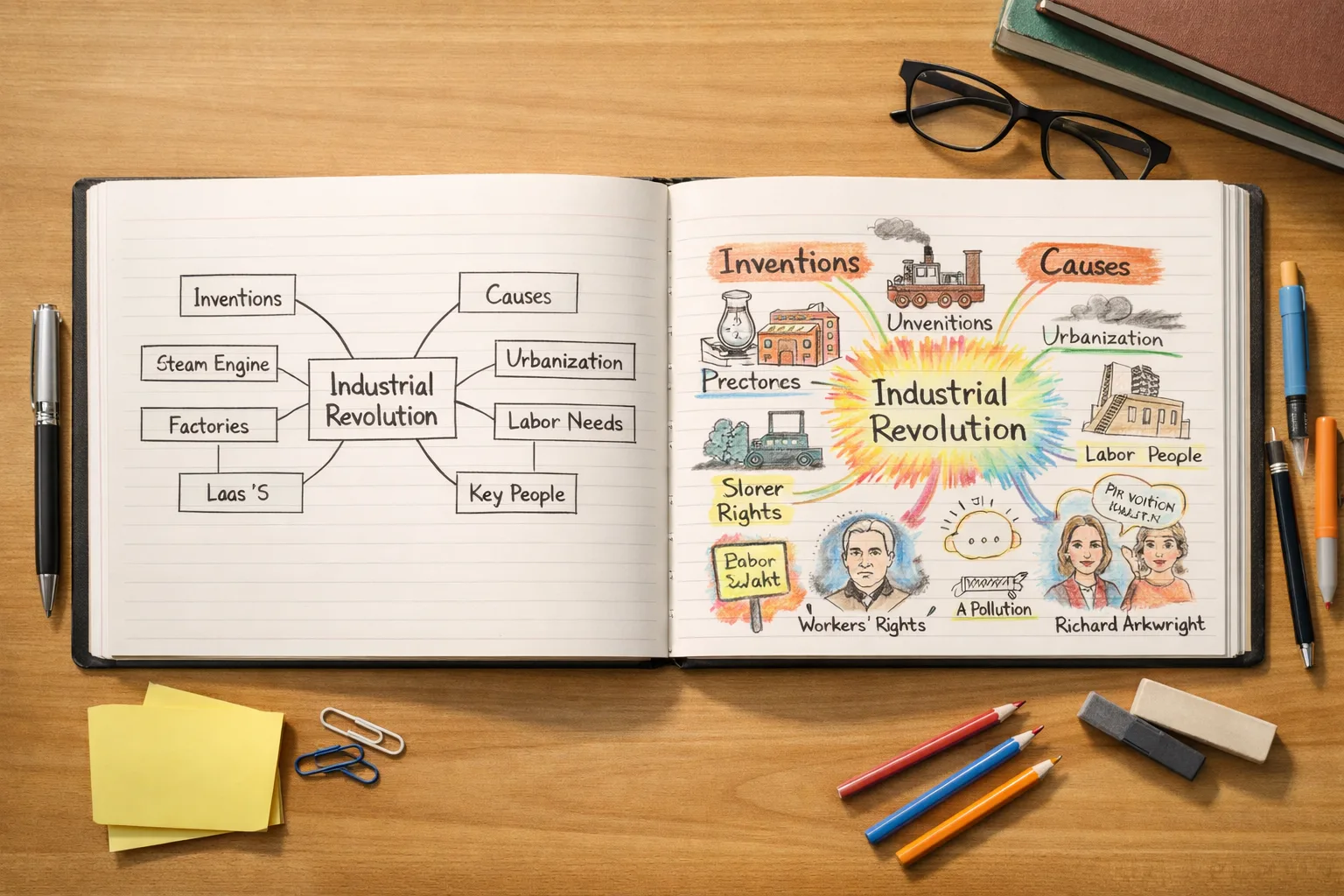
Mind maps have a strong reputation. They give the impression of a clear, active, almost already memorised lesson. Yet many families recognise the same situation: a student has spent a long time colouring branches, but still struggles to explain the topic without their notebook.
The short answer is simple: a mind map is genuinely useful when it forces a student to sort, prioritise and connect ideas, and then retrieve them from memory. It becomes a visual gimmick when it mainly serves to rewrite the lesson in a more attractive form. The benefit does not come from the drawing or the colours, but from the kind of thinking the activity requires.
The real problem: moving from “seen” content to organised understanding
A mind map is not primarily a decorative tool. It is a compression tool. It becomes useful when a student transforms a dense lesson into a simple structure: a central idea, major blocks, sub-ideas, relationships, and a few key examples.
The school problem here is very familiar. A student has "seen" the lesson, sometimes even highlighted it, but cannot answer three basic questions:
- What is this lesson really about?
- What are the main ideas?
- How are the ideas connected?
As long as these remain unclear, revision stays fragile.
This is where a mind map can help. It forces decisions: what to keep, what to remove, how to group, how to name. In other words, it turns passive reading or note-taking into active organisation.
The benefit is especially strong when the subject requires understanding structure: categories, causes and consequences, stages of a process, systems, or families of concepts.
On the other hand, mind maps help much less when the task is to memorise precise wording, follow a strictly linear argument, or automate a procedure. A useful rule at home is this: mind maps are for seeing the structure, not for doing everything.
Powerful tool or gimmick? The difference is not about colours
The key distinction is often misunderstood. Research tends to focus more on concept maps than on typical school-style mind maps. This matters: concept maps explicitly require students to show relationships between ideas, whereas mind maps — more free and radial — can be either deep or superficial.
This is why mind maps are neither a scam nor a miracle method. They can help learning, but their advantage is not automatic.
- Compared to passive rereading, they often help.
- Compared to already active strategies (good summaries, structured notes), the difference is smaller.
- For long-term memory, they do not automatically outperform techniques like active recall or spaced practice.
What really makes the difference is how they are used:
| Use of the mind map | What the student actually does | Likely effect |
|---|---|---|
| Rewriting the lesson as colourful branches | Copying, rereading, decorating | Limited benefit, high risk of overconfidence |
| Reducing the lesson to keywords and clear links | Selecting, organising, connecting | Good support for understanding structure |
| Rebuilding the map from memory | Retrieving, checking, completing | Much stronger impact on long-term learning |
The decisive point is this: a mind map does not help because it is visual, but because it forces demanding thinking. Without that effort, it remains a neat-looking page.
Why students often use them too passively
Many students get little benefit from mind maps because they treat them as a finished product rather than as a thinking process.
First, they often create them too early. During the lesson itself — especially at speed — they do not yet understand enough to prioritise. They compensate by copying. A more effective sequence is usually: functional notes during the lesson, then a short mind map afterwards.
Second, they include too much. Full sentences, endless branches, icons everywhere, colours on every line. A useful map relies on keywords, clear grouping, and sometimes a verb to clarify relationships: “leads to”, “depends on”, “contrasts with”. Colour only earns its place when it encodes real information (type of idea, level of importance, opposition).
Third, they keep the lesson open the whole time. In that case, the map becomes an illustrated rewrite. Time is spent, but memory is barely engaged. This is a classic illusion of mastery: the page looks clear, the student feels ready, but struggles without support.
A more subtle trap is perfectionism. Some students aim for a beautiful page before aiming for usable knowledge. For them, mind maps become costly in time and energy, sometimes even undermining confidence. In such cases, a simpler and more constrained format is often more effective.
A simple, repeatable method for effective mind maps
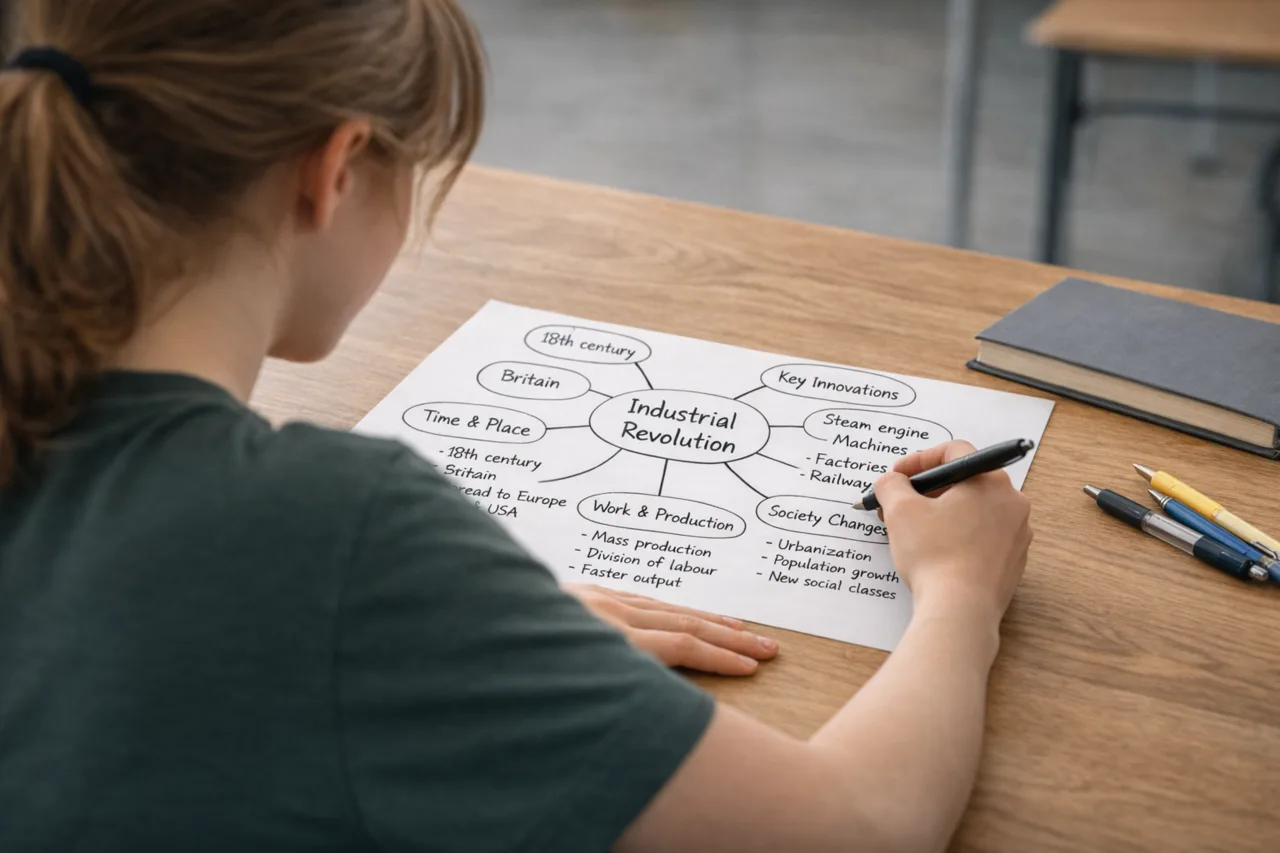
The most useful format is rarely a large map for the entire chapter, but a short reconstruction of a lesson or subtopic. Here is a realistic method.
- Start with a quick recall without looking at the lesson. For one minute, the student explains the topic and 3–4 ideas they remember. This already reveals gaps.
- Limit to 4–7 main branches. This constraint forces prioritisation. If everything is important, nothing is.
- Use keywords, not sentences. Each branch should carry a concept, not a mini-copy. Add a verb if the relationship matters: “causes”, “explains”, “requires”.
- Keep only details that change meaning. A key date, a core formula, a canonical example. The rest belongs elsewhere (exercises, flashcards, notes).
- Finish with retrieval. Close the notebook, explain the map aloud, try to redraw the main structure, then add in another colour what was missing.
This last step is often the most valuable. As long as the support is open, the student is organising. When it is closed, they start learning.
At lower secondary level, an adult can help choose main branches or simplify overloaded maps. At upper secondary and early higher education, more autonomy and more precise links can be expected.
In all cases, if the mind map takes the whole evening, the tool is probably consuming more than it gives. A useful mind map looks more like a smart draft than a polished poster.
How to adapt mind maps across subjects
Transfer is possible, but only if the function of the map changes depending on the subject.
| Subject | Useful role of mind maps | What to add alongside |
|---|---|---|
| History, geography, social sciences | Link actors, concepts, causes, consequences | Dates, examples, structured paragraphs |
| Biology, sciences | Organise systems, cycles, classifications | Labelled diagrams, precise definitions, exercises |
| English, literature, philosophy | Clarify themes, arguments, plans | Quotations, close reading, full writing |
| Languages | Structure vocabulary fields, grammar points | Speaking, writing, repeated practice |
| Maths, physics | Show links between concepts and conditions | Exercises, proofs, procedural practice |
The general rule is simple: the more a subject requires seeing a network of ideas, the more mind maps help. The more it requires writing, calculating or precise execution, the more they should remain secondary.
For some students who struggle with purely verbal material, visual structure can be particularly helpful. But that does not mean a completely free blank page is always best. A guided format — with a few fixed branches or a precise question — often works better than total freedom.
When another format is a better choice
The right question is not “are mind maps effective?”, but effective for what exact task?
It is often better to choose another tool when structure is not the main goal:
- To memorise precise definitions or dates: flashcards or short written recall are more direct.
- To follow a dense, linear lesson: structured note-taking is often more stable than mapping in real time.
- To learn problem-solving (maths, physics, grammar): guided practice is essential.
- For perfectionist or slow-working students: a constrained half-page summary may be more efficient.
This connects directly to a common question parents ask: should students systematically rewrite their notes? In many cases, a short active restructuring (like a focused mind map) is more useful than rewriting everything.
A simple test to decide at home
To know whether mind maps are actually helping your child, three questions are enough:
- Can they explain the structure of the lesson without looking?
- Does the map show clear relationships, or just isolated words?
- Can they rebuild a simplified version one or two days later?
If the answer is yes, the mind map is likely a powerful tool for that topic and that student. If it is mainly neat, exhaustive and static, it is closer to a visual gimmick.
The most useful idea to keep is this: a good mind map does not replace lessons, exercises or retrieval practice. It helps students do something many do not do spontaneously: move from seen content to organised content, and then to retrievable knowledge.
That is already a lot. But it is not magic — and that is precisely why it can be so useful.
Keep reading
Related reading

Why students forget so quickly after a test
A decent mark does not guarantee lasting memory. Here is why students forget after a test, and how parents can try a simple active-recall routine over two weeks.
Understand why knowledge fades and how to strengthen memory after revision
Cornell note-taking: which students does it really help?
Cornell note-taking does not help every student in the same way. Here is how it works, who benefits most, where it falls short, and how to introduce it at home without turning it into another battle.
Explore an alternative structured note-taking method and who it suits