

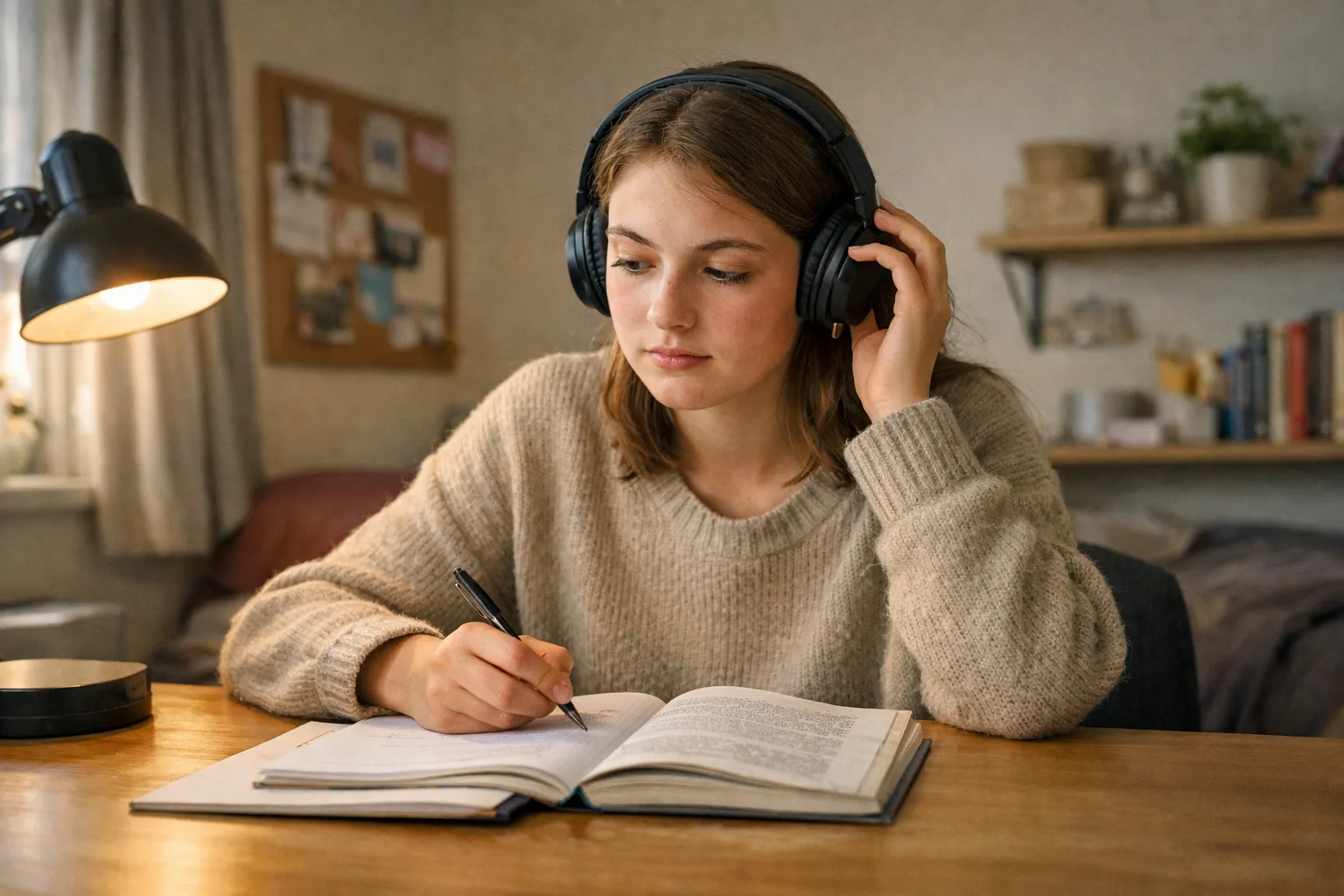
Your child says they “work better” with headphones on. What you mainly see is a headset, a phone, playlists changing every few minutes, and you wonder whether any real learning is happening — or whether the session simply feels easier to sit through.
The most useful answer is less moral than practical. Music is neither a magic study aid nor a bad habit to ban on principle. It can help with some simple or repetitive tasks by making the effort feel less unpleasant. But as soon as a pupil has to read a dense text, memorise, write, solve a new problem or hold several steps in mind, it often gets in the way more than it helps.
At home, the real aim is not to win a battle over headphones. It is to work out what kind of task is being done, what kind of sound is in the background, and what measurable result you actually get after a few days.
The short answer
Studying with music can be useful in one fairly precise case: when the task is already understood, fairly repetitive, and not very language-heavy, and when the background sound stays unobtrusive. In that situation, music does not necessarily improve learning itself. It may simply make the session more tolerable, lift alertness a little, or help a pupil stay with a monotonous task.
By contrast, for anything that requires understanding, remembering, reformulating or reasoning, the most reliable rule is still simple: silence usually wins. Lyrics compete with the language of the lesson, and even instrumental music can take up attention if it is too noticeable, too loud, too new, or controlled from a phone that keeps inviting the student to touch it.
For families, that leads to a very practical order of priority:
- Silence first for reading, learning new material, self-testing, flashcards, long-answer writing, or solving an unfamiliar problem.
- Music can be tested for routine exercises, tidying notes, neat copying-up, or tasks that are already well practised.
- A broader question needs asking if music becomes necessary for absolutely everything. At that point, the real issue is often fatigue, avoidance, a poorly broken-down task, or genuinely fragile attention regulation.
In other words, the right question is not “music or no music?”. It is “for which task, with which settings, and with what visible effect on the work produced?”
What music often masks
Music is often treated as a discipline issue. In practice, it is often a clue that something else is wrong.
It is not always an attention problem
A pupil who is exhausted after a long day may reach for sound simply to avoid falling asleep over the page. In that case, the main issue is not the playlist but the timing of the session, sleep debt, or the lack of a real decompression period after school. The headphones become a patch over tiredness that is still fully there.
It can be avoidance more than concentration
Some tasks feel mentally expensive because they are vague, stressful or badly understood. Choosing music can then function as a kind of session painkiller: it makes the moment less unpleasant, but it does not solve the real problem. If twenty minutes of homework requires fifteen minutes of choosing tracks, adjusting sound, and changing songs, the music is no longer helping the pupil work. It has become a doorway into avoidance.
It can be a badly designed study environment
A derailed session is not always a session where a child “lacks discipline”. Often the work has started with no precise instruction, a visible phone, scattered materials, no clear first step, and a duration that was never realistic in the first place. In an unclear setup, background music becomes one more thing to manage instead of a simple backdrop.
Sometimes attention regulation really is fragile
There are also cases where the issue goes beyond the music itself. For some pupils — including some with suspected or diagnosed ADHD — a carefully chosen background sound may improve engagement on a particular task. But that does not create a general rule. Findings are mixed, and they vary with the task, the kind of music, and the student profile. If the pupil switches off in silence, with music, in class, at home, and in other structured activities too, the playlist is probably not the main subject. Then it is worth looking more broadly at sleep, overload, comprehension, habits, stress, and sometimes fuller assessment.
What music actually changes, depending on the task
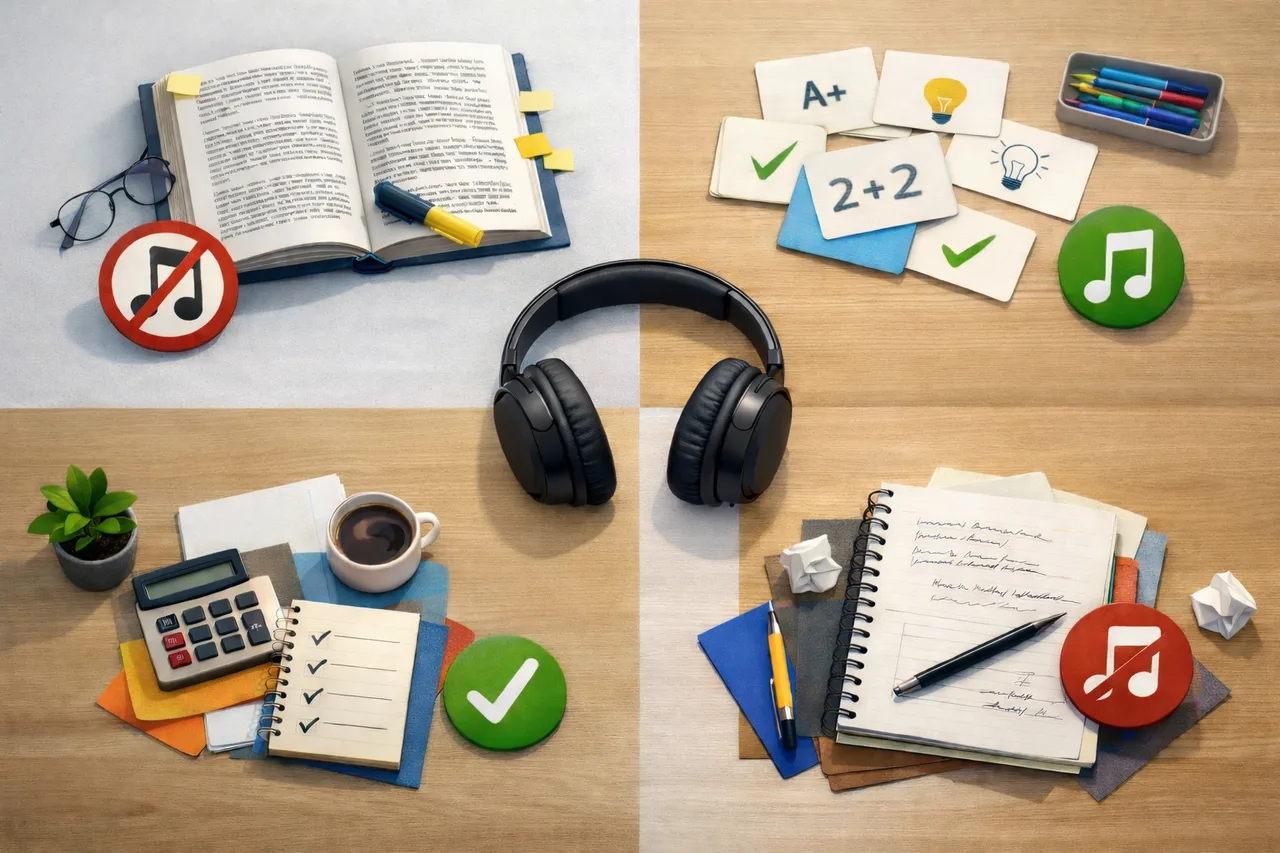
Why can the same music seem to “help” with one exercise and sabotage another? Because school tasks do not all use the same mental resources.
When a pupil reads, writes, memorises or follows a complex instruction, they rely heavily on verbal working memory — the limited mental space used to keep words, instructions and reasoning active at the same time. Lyrics compete directly with that system. Even without lyrics, a track that is highly noticeable, fast, or emotionally gripping can take away attention that the text, retrieval attempt or reasoning process also needs.
By contrast, on a simple, monotonous or already mastered task, music can sometimes help not because it makes the pupil “smarter”, but because it changes mood, alertness or tolerance for boredom. That is a crucial distinction. Making a session easier to endure is not the same as improving deep learning.
A sensible starting rule looks like this:
| Type of task | Can music help? | Main risk | Most sensible setting |
|---|---|---|---|
| Tidying notes, neat copying-up, highlighting material already understood | Sometimes | Drifting towards the phone or wasting time changing tracks | One fixed playlist, low volume, no lyrics |
| Routine exercises that are already well practised | Sometimes | Accuracy drops when the sound becomes too noticeable | Same setting, with a check on mistakes |
| Reading a chapter, understanding an instruction, learning new content | Usually not | Competition with language processing | Silence if possible |
| Active memorising, vocabulary, dates, flashcards, self-testing | Usually not | Feeling fluent without building solid recall | Silence during retrieval practice |
| Long-answer writing, essay planning, unfamiliar problem-solving, multi-step reasoning | Often not | Working-memory overload and avoidable mistakes | Silence or neutral ambient noise |
The overall rule then becomes clearer: the more verbal, new or demanding the task is, the more silence becomes an advantage. The simpler, more repetitive or more familiar it is, the easier it is to defend a musical exception — but only after testing it honestly.
It is also worth being careful with genre myths. “Classical music” is not magical in itself. If it sometimes works better, that is often because it contains fewer lyrics and is easier to keep in the background. Stable instrumental lo-fi can play the same role. By contrast, dramatic orchestral music, lyrics in the same language as the task, or a brand-new favourite song can be much more intrusive than a familiar instrumental track.
The concrete triggers that derail a study session
Before you allow or ban headphones, it helps to identify what is actually causing the session to fall apart. The most frequent saboteurs are very concrete:
- An objective that is too vague: “revise history” does not help anyone begin. “Learn the three causes of the First World War and test yourself without looking” already changes the task.
- A phone doing everything at once: music player, messages, timer, notifications, track changes. The real parasite is often not the music but the interface wrapped around it.
- Lyrics in the same language as the task: this is a poor bet for reading, writing or memorising.
- Chasing the right vibe: searching for the perfect playlist, trying three pairs of headphones, adjusting the volume, changing song at the first sign of discomfort. All of that consumes time and attention.
- A session that is too long or too late: when the pupil is mainly fighting falling energy, they easily confuse stimulation with concentration.
- Music used to survive a task that has not been understood: in that case, the first need is not sonic. It is methodological or academic.
Many families therefore pick the wrong enemy. They argue about the headphones when the real problem is often the vagueness of the task, the wrong moment of the day, or the absence of a realistic first step.
A realistic home protocol for testing concentration
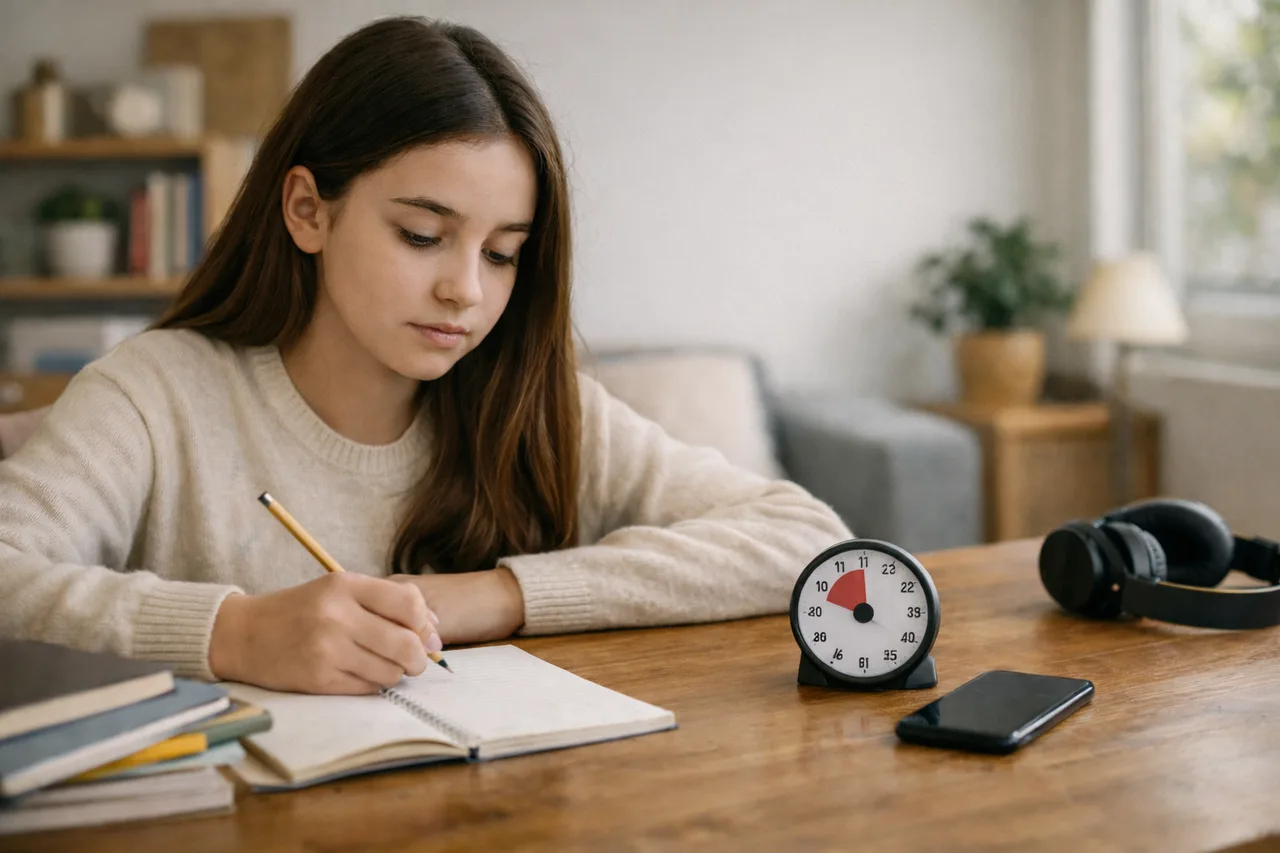
The most useful approach is not an abstract rule such as “music is forbidden” or “everyone can do what they want”. It is a simple testing protocol that is clear enough to prevent daily negotiation.
Classify the task first.
Ask: does this session require understanding, remembering, writing or reasoning? Or is it mainly execution of something already known? That distinction resolves a large part of the debate.Choose the sound condition before starting.
For a new or language-heavy task: silence. For a repetitive task: test one playlist only, at low volume, with no lyrics. No changing the rules halfway through.Separate music from distraction.
If possible, use a downloaded playlist, airplane mode, a dedicated device, or at least notifications switched off. Music that is allowed in principle but still controlled by a highly distracting phone loses most of its value.Build a three-minute start routine.
The real bottleneck is often the beginning. Open the right notebook, write down the session goal, lay out the materials, start a timer, begin with a micro-step that takes less than two minutes. That routine usually matters more than the music question.Work for a believable amount of time.
A short, clean session is better than a vague marathon. For many younger secondary pupils, twenty to thirty solid minutes already produce something real. Older teenagers and first-year university students can go longer, but not by confusing endurance with quality.End with evidence, not with a feeling.
By the end, the pupil should be able to explain what they have understood, answer a question, recall the essentials, or show a piece of work properly finished. That evidence is what lets you judge the sound condition.
For many families, a simple visible rule works best in the earlier secondary years: silence for learning, music only as a test for routine tasks that are already understood. In sixth form and the first year of university, more autonomy is reasonable — but only if the student accepts the adult logic: experiment, then look honestly at the results.
Simple indicators to see whether the routine is working
The classic trap is to judge music by immediate feeling alone. Pleasant background sound can create a sense of flow without improving understanding. For a week, follow a few simple indicators instead.
- Start-up time: does the pupil begin within five minutes, or do they still spend a long time setting up, choosing, adjusting and postponing?
- Number of micro-breaks: are they changing tracks, touching the phone, getting up, or rereading the same lines without moving forward?
- Visible quality of the work: are there fewer avoidable mistakes, fewer omissions, more coherent writing, or more complete answers?
- Immediate recall: can they explain what they have just learned without reopening the notebook?
- Next-day recall: do they still remember the essentials the following day, or did the session mainly create an impression of working?
- Family climate: is there less negotiation, less tension, and less need for close supervision?
If the session feels “nicer” but the start is still slow, the tracks keep changing, the errors remain, and the next-day recall is weak, the music is probably not helping learning. It is helping the pupil tolerate the effort. That is not worthless, but it is a different issue — and one that usually calls for work on task design, timing, fatigue or method.
The most robust family rule
For most families, the best rule is neither “always music” nor “never music”. It is calmer and more demanding than that:
- silence for understanding, memorising, writing and reasoning;
- music can be tested for simple, already mastered tasks;
- no verdict based on how the session feels in the moment, only on the quality of the work;
- if music becomes necessary for every single session, look for a deeper problem than the playlist.
In other words, do not treat music as an opinion. Treat it as a hypothesis. Test sparingly, measure simply, and keep only what genuinely helps learning.