

Parents often describe the same evening pattern: the child sits down, opens the right book, then somehow spends forty minutes doing almost nothing. A parent sees drifting, fidgeting, messages, music, another tab, a sudden need for a snack, and thinks: “Why can’t they just concentrate?”
The useful answer is not “more willpower”. Focus and attention improve when the study session is designed around how attention actually works: one clear task, a realistic length, fewer competing signals, a low-friction start, a short recovery break, and a quick check that learning really happened.
That matters because a child who “cannot focus” may be facing several different problems. One student is too tired. Another is avoiding a difficult task. Another has no idea what “revise this chapter” actually means. Another is being pulled out of attention by notifications every few minutes. These situations look similar from outside, but they need different responses.
Focus and attention: what has to be designed
A good focus plan protects three things at once.
First, it protects entry: the first few minutes when the student is most likely to wander, negotiate, tidy, scroll, or look busy without beginning. Second, it protects depth: the part of the session where the brain has to hold the task, remember the instruction, connect ideas, and resist distractions. Third, it protects exit: the moment when the student checks what has actually been learned instead of simply stopping because time has passed.
For families, this changes the conversation. Instead of asking “How do I make my child concentrate for longer?”, the better question is: “What is making attention leak out of this session, and what can we redesign?”
That question is kinder, but it is also more demanding. It means looking at fatigue, task clarity, emotional avoidance, screen habits, the room, the hour of the day, and the way success is measured. It also means accepting that some short, well-designed sessions beat long, dramatic evenings that create conflict and little learning.
First name the attention saboteur
The word “focus” can hide very different causes. Before adding a timer, banning the phone, or making the session longer, it helps to identify the most likely saboteur.
| What it looks like | What may be happening | A better first response |
|---|---|---|
| The student reads the same line again and again, becomes irritable, or works very slowly late in the evening. | Fatigue is reducing attention and memory. | Shorten the task, switch to light recall, or stop before the session damages sleep. |
| They open the book but do not know where to start. | The task is too vague. | Turn “study biology” into one observable action: answer five questions, explain one diagram, redo one exercise. |
| They stare at a difficult exercise, then drift. | Cognitive overload or a missing prerequisite may be blocking progress. | Reduce the task: review the example, identify the unknown step, or prepare one question for a teacher. |
| They tidy, negotiate, sharpen pencils, or repeatedly “just check something”. | Avoidance may be protecting them from discomfort, fear of failure, or boredom. | Make the first step very safe and small: two minutes, one line, one question. |
| They keep checking messages, music, feeds, or tabs. | The environment is creating repeated attention switches. | Move the phone away, close extra tabs, and make the session single-task by default. |
| They finish time on the chair but cannot recall anything. | The session was passive rather than learning-focused. | End with retrieval: close the notes and say, write, or answer what they remember. |
This is not a diagnostic table. It is a way to stop treating every attention difficulty as laziness. A teenager whose attention collapses after ten minutes may need sleep, a clearer task, a smaller starting point, or fewer interruptions before they need a lecture about discipline.
The same distinction matters for younger children too. “They can focus on games but not homework” does not prove bad character. Games often provide a clear goal, instant feedback, graduated challenge, and constant cues about what to do next. Homework often provides the opposite: an open-ended instruction, delayed feedback, and a large emotional cost if the child feels behind.
Four myths that make attention harder at home
Many family battles around focus begin with reasonable ideas that become too rigid.
Myth 1: a perfect desk will solve the problem
A calm work surface helps, but the desk is not magic. A student can drift in a beautiful room if the task is vague, too hard, or emotionally loaded. Conversely, some children can do a solid twenty minutes at a kitchen table if the task is clear and the interruptions are controlled.
The useful question is not “Is the place perfect?” but “Does this place reduce the next likely distraction?” For one child, that means silence. For another, it means being close enough to a parent to start. For another, it means being away from a bed, console, or phone.
Myth 2: long sessions are more serious
Long sessions often look impressive from outside. They can also hide slow work, repeated restarting, passive rereading, and fatigue. Attention is not proved by the number of minutes spent near a notebook. It is proved by the quality of engagement and by what remains when the notes are closed.
A shorter session can be more serious if it has a clear target, a protected block of attention, and a visible learning check. This is especially true for students who tend to procrastinate: asking for “two hours of study” may feel so heavy that they never truly begin.
Myth 3: music either always helps or always harms
Music is not one thing. Quiet instrumental background can help some students tolerate a noisy environment or reduce the boredom of a routine task. Lyrics, favourite songs, and constantly changing playlists can compete with reading, writing, memorising, or problem solving.
A practical test is simple: after ten or fifteen minutes, can the student explain what they have learned without looking? If the answer is weaker with music, the music is not helping that task, even if it makes the session feel easier.
Myth 4: phone multitasking is harmless because “they are used to it”
Students may become quick at switching, but switching is not the same as sustained attention. A message, a notification, a short video, or a quick tab check creates a break in the mental thread. The cost is not only the seconds spent away from the work; it is the effort needed to rebuild where they were, what they were doing, and why.
The goal is not to turn every home into a technology-free bunker. Screens can be useful for exercises, videos, dictionaries, calculators, shared documents, or teacher platforms. The real issue is whether the device is serving the task or repeatedly replacing it.
How to build a study session that holds
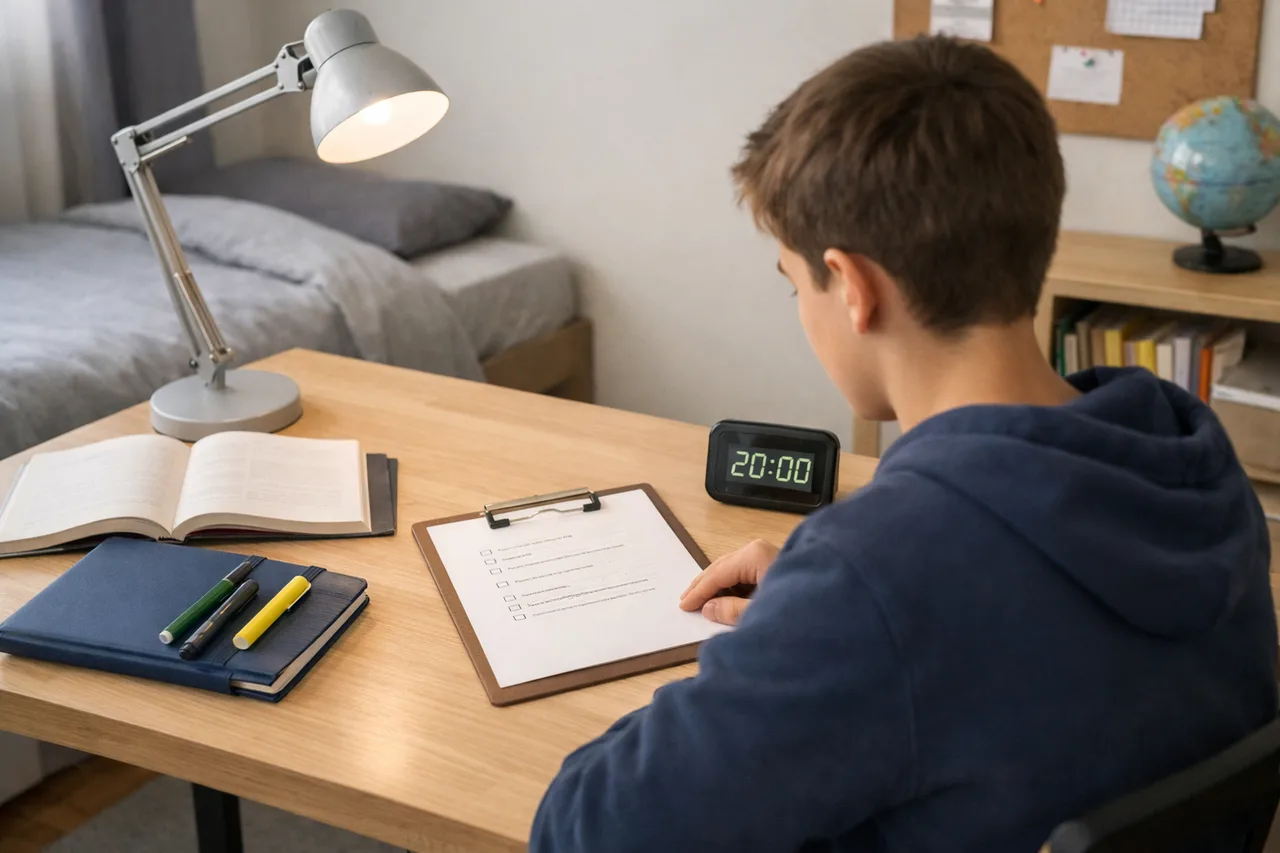
A focus-friendly session does not need to be elaborate. It needs a shape that the student can repeat.
1. Choose a finish line before choosing a duration
“Revise history” is not a finish line. “Explain the three causes of this event without looking” is. “Do maths” is not a finish line. “Redo the three exercises I got wrong and mark where I still get stuck” is.
The finish line should be visible enough that everyone knows when the session has worked. This reduces negotiation and makes attention less dependent on mood.
2. Prepare the materials before the timer starts
The session has not started if the student is still searching for the right sheet, charger, password, exercise, pen, or lesson photo. Preparation belongs before the focus block. Otherwise the first minutes train the brain to associate study time with friction.
A useful preparation check is: book or file open, task chosen, phone placed deliberately, water nearby if needed, and one blank space for answers.
3. Make the first move too small to argue with
The first move should be almost embarrassingly concrete: copy the title, answer the first question, read the first paragraph aloud, write three things already remembered, or set up the first calculation.
This matters because many students do not resist the whole task; they resist the transition into it. Once the first action is done, the session often becomes easier to continue.
4. Work in a realistic block, not an heroic one
There is no universal perfect duration. A tired younger child, a student with a difficult topic, and an older student preparing for a demanding test do not need the same block. As a starting point, many families do better with a short protected block that can be repeated than with one long session that slowly deteriorates.
For some students, ten to fifteen minutes is a valid first target. For many routine homework or revision tasks, twenty to thirty minutes is enough to create real progress. Older students may manage longer blocks when the task is clear and the phone is not competing. The test is not whether the block sounds impressive; it is whether the student can still think, retrieve, and continue without escalating conflict.
5. Put retrieval before the break
A break is more useful when the brain has first been asked to retrieve. At the end of the block, the student closes the notes and answers one of these:
- What are the three ideas I can remember?
- What type of mistake did I just fix?
- What question would I ask if this came up tomorrow?
- What still feels unclear?
This turns the session from “time spent” into “learning checked”. It also gives parents a better signal than watching from the doorway.
6. Make the break a reset, not a trap
A useful break changes state: stand up, stretch, drink water, look away from the screen, move to another room, or breathe for a minute. A risky break creates a new attention battle: social feeds, games, endless videos, or a conversation that becomes harder to leave than the work itself.
This does not mean every break must be austere. It means the break should make returning easier, not harder.
Change the environment before asking for more willpower
Willpower is easier to use when the environment is not constantly fighting it. For attention, small physical decisions often matter more than motivational speeches.
The phone should have a place. Not a vague place, such as “try not to use it”, but a deliberate place: outside the room, face down across the room, in a family charging spot, or in focus mode if it is genuinely needed for the task. The best choice depends on age, trust, the task, and the child’s history with the device. The key is that the decision is made before the session begins.
The work surface should show the current task, not the whole school life of the child. One lesson, one exercise, one notebook, one browser tab if possible. Piles of materials can look studious while making the next action harder to choose.
The room should match the problem. A bedroom may protect quiet but invite sleep, scrolling, or private avoidance. A kitchen table may help a child start but can create noise and interruptions. A living room may work for younger students who need gentle presence, but not for a teenager doing demanding writing. A library, study hall, or quiet public place can be useful when home is too emotionally charged or too full of cues.
The parent’s role also has to be designed. Constant supervision can create resistance; total absence can leave a child stuck. A balanced version is a short check-in at the start, one agreed mid-point if needed, and a calm review of the exit question. The message is: “I am helping you protect the session, not taking ownership of your brain.”
Measure improvement without turning attention into surveillance
Attention improves best when families measure the right signals lightly. The aim is not to monitor every minute. The aim is to notice whether the session is becoming easier to start, easier to sustain, and more useful for learning.
Good signals include:
- Start delay: how long it takes to begin the first real action.
- Number of avoidable interruptions: especially phone checks, tab switches, and repeated leaving.
- Return speed: how quickly the student comes back after a break or distraction.
- End-of-session recall: what the student can explain, answer, or redo without looking.
- Emotional cost: whether the same amount of work now creates less conflict or exhaustion.
Avoid turning these into a scoreboard. A child who feels watched may perform compliance rather than build attention. Use the signals to adjust the design: shorter block, clearer task, different room, earlier start, more active method, or a better break.
This is also where families need humility. If attention is poor across many settings, if fatigue is constant, if anxiety or low mood is visible, if reading and writing demands seem unusually hard, or if conflict around school is escalating, the answer may not be another productivity technique. It may be time to speak with a teacher, tutor, learning-support professional, or health professional, depending on what the family is seeing.
Evening study deserves special care. Late work can feel responsible, but attention and memory are not independent from sleep. When a student is simply pushing tired minutes around, the family may gain time on paper and lose learning in reality.
Questions parents ask about focus and attention
How long should a study session be?
Long enough to do one meaningful piece of work, short enough that the student can still think properly. Start shorter than the ideal if evenings are tense. A repeatable twenty-minute session with a retrieval check is often more useful than a planned hour that becomes half argument, half scrolling.
Are breaks a reward or part of learning?
Breaks are part of the design. They protect the next block of attention. The best breaks are short, predictable, and easy to return from. They are not a loophole for disappearing into a more addictive activity.
Should my child work in silence?
Not always. Silence helps many tasks, especially reading, writing, memorising, and complex problem solving. Some background sound may help in noisy homes or during routine practice. Test the result, not the preference: if recall or accuracy drops, the sound is competing with learning.
What should we do about the phone?
Make the phone decision before the session starts. If the phone is not needed, remove it from reach. If it is needed, define exactly what it is needed for and close everything else. A student who uses a phone for a dictionary, a lesson photo, or an exercise platform still needs protection from messages and feeds.
Should I sit beside my child while they work?
Sometimes, especially for younger children or students who struggle to start. But the goal is not permanent co-working. Try a light structure: agree the task, watch the first move if needed, step away, then return for the end-of-session check. Support should gradually transfer ownership back to the student.
What if my child says they focus better under pressure?
Some students do start faster when the deadline is close. That does not mean the method is healthy or reliable. Pressure can create urgency, but it can also reduce sleep, increase mistakes, and make learning fragile. A better compromise is to create a small artificial deadline: one block, one task, one check, then stop.
The practical recap: protect the session, not just the child’s motivation
Focus and attention are not personality traits that parents can simply demand into existence. They are partly biological, partly emotional, partly environmental, and partly a matter of task design.
For the next week, choose one recurring study moment and redesign only that. Pick a clear finish line. Prepare the materials before the block begins. Put the phone somewhere intentional. Start with the smallest possible first action. End by asking the student to retrieve something without looking. Notice whether the session starts faster, contains fewer interruptions, and leaves more learning behind.
That is enough to begin. Once the routine is calmer, families can refine duration, breaks, room choice, music, and independence. The aim is not a perfect child at a perfect desk. The aim is a student who can enter the work more easily, stay with one task for a realistic stretch, and leave the session knowing what has actually been learned.
From there, the most useful deeper reading is specific: look at why attention collapses quickly, or at the point where evening study stops supporting real learning. The better the diagnosis, the less the family has to rely on pressure.
Sources
Keep reading
Related reading

Why a teenager’s attention collapses faster than you think
A teenager who switches off quickly does not necessarily have an attention problem. Fatigue, avoidance, a vague task and constant micro-interruptions often explain far more.
Distinguish fatigue, avoidance and micro-interruptions before blaming willpower
Evening study: how late is too late for real learning?
There is no universal 9 pm or 10 pm cut-off for evening study. The real limit is the point at which work starts to damage sleep or is done in a state of fatigue that no longer supports real learning.
Decide when evening study has stopped supporting real learning
All articles in this category
Every published article in this topic, from newest to oldest.
- 25 minutes, 40 minutes or 60 minutes: what is a realistic study session length?
- Evening study: how late is too late for real learning?
- Studying with music: real help or just boredom relief?
- Why a teenager’s attention collapses faster than you think
- Why some students spend two hours on homework that could have taken 40 minutes