

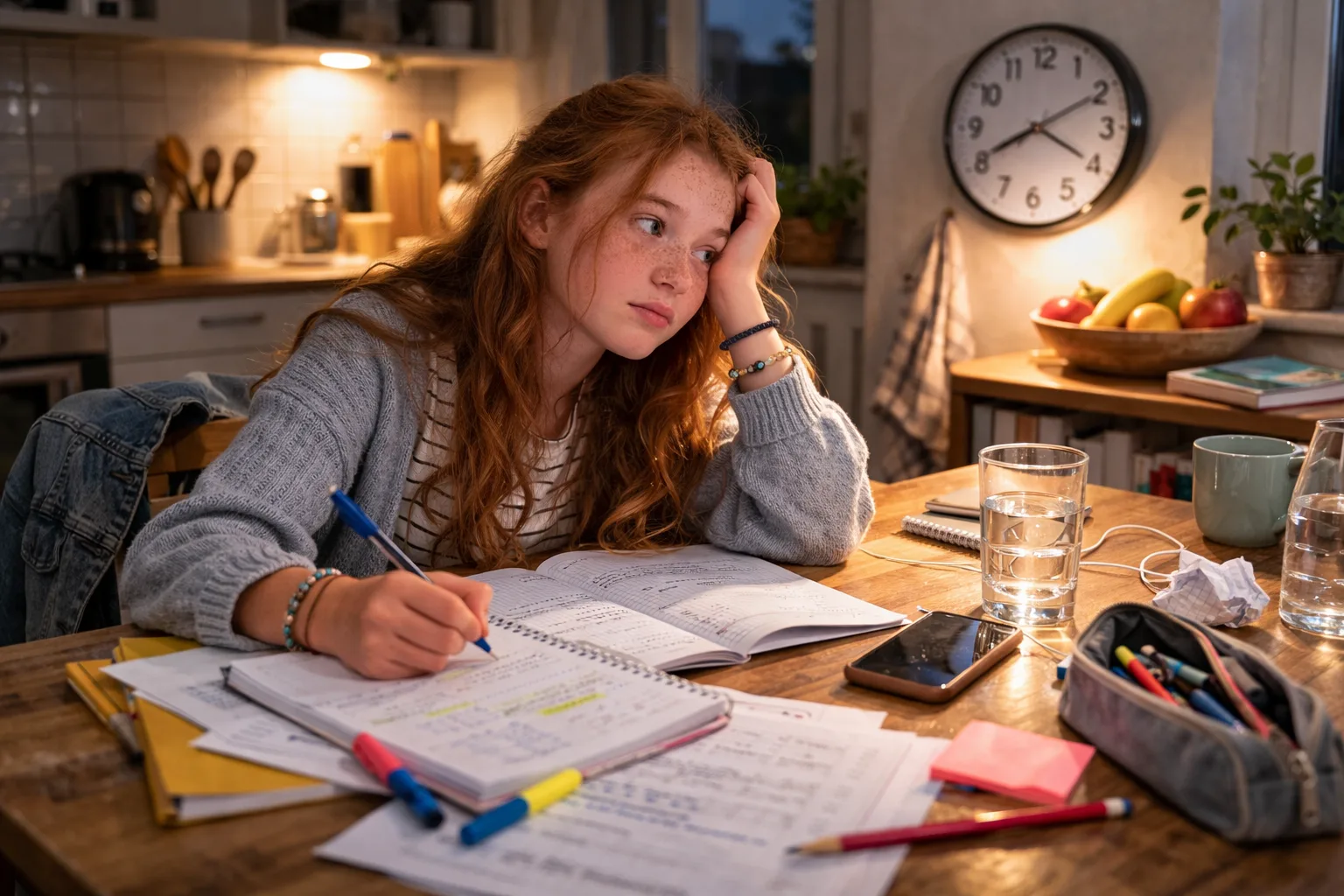
Two hours spent on homework do not mean two hours of real work. Very often, time stretches because part of the session is consumed by getting started, tiny interruptions, hunting for materials, tiredness or avoidance. In other words, the problem is not always that a student ‘just can’t focus’. The first job is to see where the time is actually being lost.
That matters for parents, because you do not fix tiredness with more authority, and you do not fix avoidance with a better desk. The reverse is true too: a child can look ‘slow’ when they are mostly paying the price of an environment that keeps cutting them away from the task.
Sitting there for two hours is not the same as working for two hours
When homework drags on, many adults measure the wrong thing: time spent at the table. But a long session can contain surprisingly little effective work. Ten minutes to get going, three interruptions, a buzzing phone, an instruction half understood and a moment of discouragement are enough to turn 40 useful minutes into a whole evening.
There is usually a real cost when attention has to switch away from a task and then return to it. A short interruption does not only add the time spent off-task. It also adds restart time: finding the thread again, recalling what the question was asking and rebuilding momentum.
That is why a student can honestly say they worked all evening when what actually happened was a repeated loop of trying to work, restarting, hesitating, drifting away and beginning again.
Four causes that are easy to mix up
Before changing the routine, you need to identify the main cause. The table below helps with a first sort.
| What you notice | What is often going on | What helps first |
|---|---|---|
| The student starts, then drops off at every noise, message or request. | Attention is being fragmented; every restart costs time. | Reduce interruptions and protect a short but continuous block. |
| They sit in front of the page, re-read without moving forward, yawn and slow down everywhere. | Cognitive or physical tiredness is dominating. | Create a real buffer after school, rethink the timing and check sleep. |
| They negotiate, delay, rub things out, start again, and say they do not know how to approach the task. | Avoidance has taken over, often because the task feels vague, unpleasant or risky. | Make the first step very small and very clear. |
| They lose time looking for their things, change rooms, forget the instruction, and keep asking what they are meant to do. | The working setup is poorly designed. | Prepare the materials, make the goal visible, and define the next action before starting. |
The same student can show two causes at once. That is common in teenagers: a bit of tiredness, a task they dislike, then an environment that does not help. But there is often one main cause to deal with first.
A useful clue: if the problem changes a lot depending on the time of day, the subject or how clear the instruction is, you are not necessarily looking at an attention disorder. You are often looking at a mix of mental load, organisation and restart costs.
The concrete triggers that sabotage the session
Families sometimes look for one grand explanation, when many failed homework sessions actually come down to a handful of very concrete triggers.
- A vague start. ‘Do your homework’ is too vague. The broader the instruction, the more the real beginning gets postponed.
- The phone is visible or audible. Even without a long scroll, a sound, a vibration or the simple anticipation of a message can fragment attention.
- Materials are scattered. Looking for an exercise book, calculator, sheet of paper or password breaks momentum before the real work has even begun.
- The task is too big to attack in one go. Many students are not avoiding effort in general; they are avoiding a first step they cannot define.
- It is the wrong moment of the day. Just after school, some children need a real buffer. Too late in the evening, tiredness makes everything longer.
- Family micro-interruptions. A reminder, a question, an immediate correction, another household request: each one looks tiny, but together they destroy continuity.
- The problem has been misread. Homework can drag on because the student does not really understand the task, not because they lack willpower.
For younger secondary pupils, the main saboteur is often the vagueness of the first step. For older teenagers and students in the first year or two of higher education, it is more often the open-ended task: too many documents, too much freedom, no clear threshold for starting.
A realistic focus protocol at home
The goal is not to run the house like a military camp. It is to put in place a structure simple enough that the student spends less energy starting and restarting.
Separate coming home from starting work.
Many students are not ready to learn the minute they walk through the door. A short decompression buffer often helps more than a forced start. But the buffer needs a shape: drink, snack, move, breathe. Not disappear into an endless stream.Define the deliverable before the session.
Not ‘do some history’. Better: ‘answer questions 1 to 3’ or ‘re-read the notes and write down five key facts’. A finite task is easier to enter than a vague intention.Write down the very first action.
The best question is not ‘are you motivated?’ but ‘what is the first visible thing you do?’. Open to the right page, highlight the instruction, write the heading, set out the numbers for the exercise: that first move lowers the start-up cost dramatically.Set up the workspace for one sequence only.
Only bring out what is needed now. The other books stay shut. The phone is out of sight and ideally out of reach during the work block. This is not a punishment; it is a way of not paying the restart cost twenty times.Protect a continuous block, not a heroic one.
For many students, especially when the routine is fragile, a block they can sustain is better than an ambitious one. For younger secondary pupils, that may be quite short. Later on, it can often be a little longer. The question is not the ideal duration in theory; it is the duration the student can actually hold without collapsing or renegotiating every two minutes.Plan the restart before any break.
Before getting up, the student writes the next micro-action: ‘go back to question 4 and calculate the second line’ or ‘learn the first three definitions’. That restart sentence prevents the blank moment on the way back.Let the parent set the structure, not run the whole session.
A parent can help with the launch, clarify the goal, check that the materials are there, then come back at the end of the block. Staying in permanent supervision often creates more dependence — and more interruptions — than concentration.
This protocol looks simple. That is the point. When homework is taking far too long, dramatic methods rarely help. What helps is less vagueness, fewer unnecessary transitions and better restarts after interruptions.
How to tell whether the new routine is working
The best indicator is not just whether things are faster. A useful routine also improves the quality of the session and the family atmosphere.
For 10 to 14 days, watch above all for these signs:
- Time to enter the work. How many minutes pass between the intended start and the first real action?
- Number of parental prompts. Two fewer reminders per evening is already a real gain.
- Continuity of a block. Can the student hold one stretch of work without getting up, renegotiating or switching tasks?
- Share of work genuinely finished. A shorter, more productive session is better than a long, sterile presence.
- Ability to restart independently. After a break or interruption, can they get going again without an adult re-explaining everything?
- Emotional climate. Less irritation, less conflict, less sense of failure: that is a major signal.
A realistic improvement does not need to be spectacular. If a homework session drops from two hours to 1 hour 20 minutes with less tension and more autonomy, that is already a very good direction. Pure speed sometimes comes after stability.
When you need more than a better routine
Not every kind of slowness is solved at home. Widen the lens if several of these signs appear together:
- the same difficulty appears in several settings, not just during homework;
- teachers also describe drifting, slow starts or marked disorganisation;
- the student struggles to understand what is being asked, even when they are trying;
- tiredness is overwhelming, sleep is poor or mood is persistently low;
- fear of making mistakes, fear of failing or obvious distress is taking over;
- despite a clearer structure for several weeks, the time hardly decreases and the strain remains high.
In those cases, the right reflex is not to increase the pressure. It is to collect precise observations: what time things get worse, in which subjects, after what kind of instruction, and with what bodily or emotional signs. Then you can talk with the student, with a teacher and, if needed, with a health professional or learning specialist.
The key point is simple: do not medicalise it too quickly, but do not reduce everything to willpower either.
What to take away
When homework that could have taken 40 minutes takes two hours, the problem is rarely one single thing called ‘poor concentration’. More often, it is a mix of costly transitions, tiredness, vagueness in the task, avoidance and an imperfect setup.
To help usefully, start with this logic:
- look at where the time is really being lost;
- identify the main cause;
- reduce vagueness at the start;
- protect a realistic continuous block;
- measure progress with a few simple indicators.
That kind of precision is what shortens homework. Not grand speeches about effort.