


Your child comes home with three pages of notes… and yet, when you ask what really matters, they hesitate. This is common. Many students still confuse note-taking with copying everything.
The key idea is simple: good note-taking is not about writing more. It is about listening to the structure of the lesson, selecting what matters, and rephrasing it in a form that can be reused later. A very full notebook can look serious while helping very little.
This matters at two moments. In class, it helps the student follow. After class, it determines how well they can revise. If notes are just a transcript, revision becomes passive rereading. If they are structured and rephrased, they support understanding, memory, and self-testing.
The real problem: full pages, limited understanding
Taking notes requires much more than writing quickly. The student has to understand what they hear, decide what is worth keeping, and write it fast enough to keep up. That is precisely why copying everything feels reassuring: it seems to protect the content. In reality, it overloads attention.
When a student tries to write everything down, three things usually happen. First, they stop listening to what comes next because they are finishing the previous sentence. Second, all information ends up at the same level, with no distinction between main ideas, examples, and details. Third, when revising, they face a block of text that invites passive rereading.
This is common among conscientious or anxious students. It is not laziness. Often, it is a protective strategy: “if I write everything, I won’t miss anything”. But school does not assess the ability to archive a lesson. It assesses the ability to understand, connect, remember, and reuse.
A simple test helps: can the student, by looking only at headings and a few keywords, explain the lesson in their own words? If not, the notebook is still more storage than learning tool.
During the lesson: a simple, repeatable method

Students do not need a complex system. They need a routine that works even in a fast lesson, at the end of the day, or in a subject they like less.
Spot the structure before filling the page. Write the date, title, and main question. Leave space. Listen for teacher signals such as “the key idea”, “you need to remember”, “however”, “for example”, “as a result”. These cues reveal the structure.
Write units of meaning, not full sentences. Keywords, short definitions, relationships, arrows, steps, examples. The more notes look like full sentences, the more likely the student is copying passively.
Rephrase as soon as possible. The goal is not to write faster than the teacher, but to translate what is said into a more compact version.
Example:
- heard: “Photosynthesis is the process by which plants produce organic matter using light.”
- useful note: “Photosynthesis = light + CO₂ + H₂O → organic matter + O₂”
Leave gaps instead of falling behind. If a word is missing, mark it with a question mark or leave space, then move on. The common mistake is to lose two minutes finishing one sentence.
Show hierarchy visually. Indentation, arrows, boxes, or light underlining are enough. Notes do not need to look “pretty”, but they must make ideas easy to find.
For a younger secondary student, a realistic goal is already strong: leave class with the title, three key ideas, one example, and one open question. In later years, students are expected to use more abbreviations, logical links, and post-class completion.
Handwriting or typing: the wrong debate
Writing by hand often helps because the slower pace forces selection. But the real issue is not the tool. It is how information is processed. A student who types keywords, organises ideas, and rephrases can take excellent notes digitally. A student who copies word for word on paper is still inefficient.
The student’s profile matters. If handwriting is slow or effortful, or if there are learning differences or fatigue, digital tools may be more appropriate. The goal is not to “do what others do”, but to remain selective and clear.
When teachers provide slides or structured handouts, notes should not copy them. They should capture what adds value: explanations, links between ideas, spoken examples, common mistakes, and nuances.
After the lesson: 10 minutes that change everything
Many students stop too early. They have written during the lesson and assume the work is done. In reality, notes become useful when they are revisited quickly, ideally the same day or within 24 hours.
This can stay short:
- fill in gaps and correct inaccuracies;
- add a three-line summary without copying the lesson;
- turn headings into questions;
- test yourself once without looking.
This is what turns notes into a revision tool. A question like “What caused the First World War?” or “Why does a linear function have a constant slope?” is already more active than highlighting.
For parents, the most helpful support is not rewriting the lesson. It is asking for a brief explanation: “Explain the lesson in one minute” or “Give me two key ideas without reading”. If the student cannot do it, return to the notes to identify what is missing: structure, vocabulary, or understanding.
Rereading is not useless. But rereading alone and passively is rarely enough. Effective notes should support spaced and active revision: recall, check, correct, and revisit later.
The same skill, different formats depending on the subject
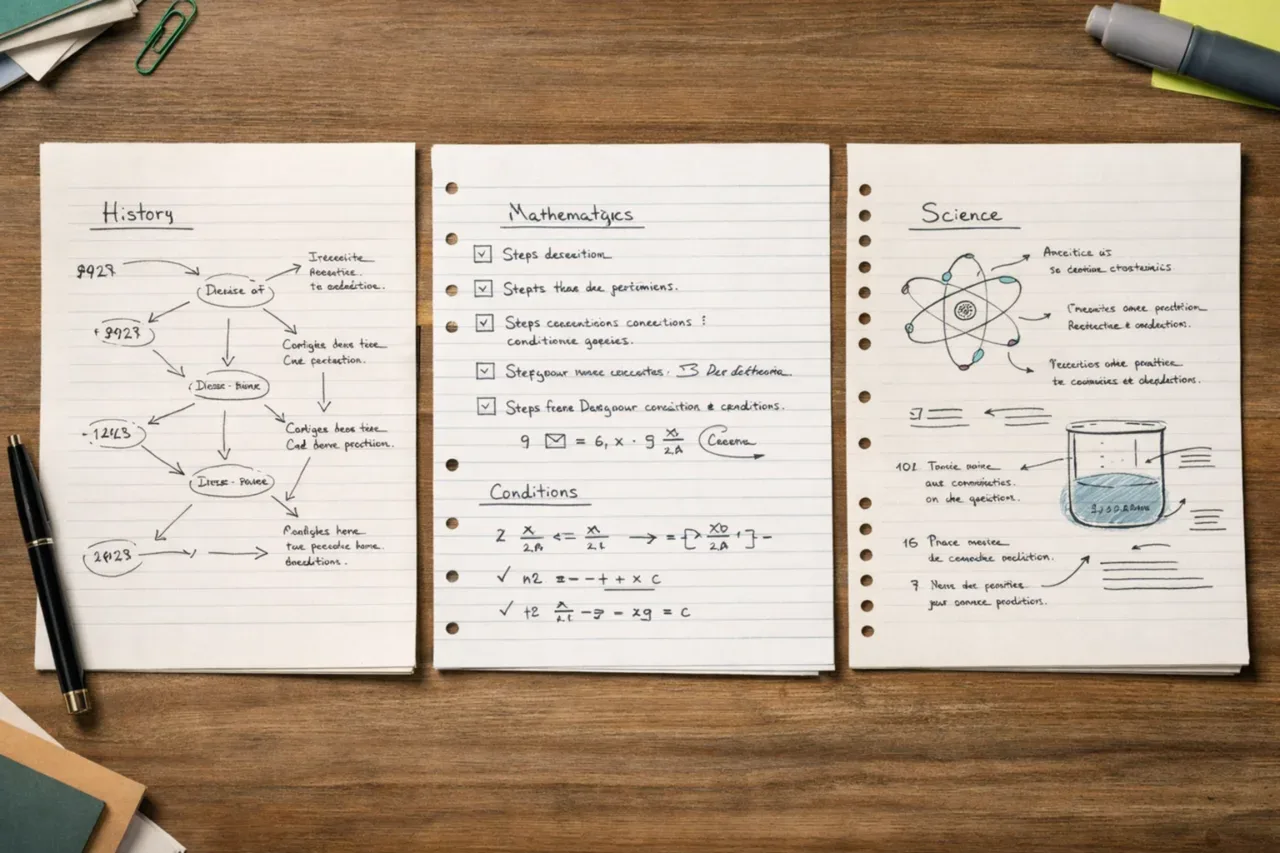
Listening, selecting, and rephrasing remain the core. What changes is the final form. A good maths notebook does not look like a good history notebook — and that is normal.
| Subject | What to capture during the lesson | Useful reformulation after |
|---|---|---|
| History & geography | key dates, causes, contrasts, examples | timeline, cause/consequence plan, three key concepts |
| Mathematics | conditions, steps of reasoning, common mistakes | “method sheet” with steps + one worked example |
| Science | definitions, diagrams, relationships, units | labelled diagram, cause/effect table, formulas with meaning |
| English & humanities | thesis, arguments, definitions, references | structured plan, distinctions, short useful quotes |
| Languages | sentence structures, exceptions, correct examples | table (form / meaning / example), reusable mini-sentences |
Transfer between subjects is essential. A student who thinks note-taking always means writing full sentences will tire quickly and learn poorly. A student who adapts the format starts thinking in the way each subject requires.
At lower secondary level, mastering two or three simple formats is enough: a timeline, a table, a labelled diagram. Later on, students can add more complex plans, procedure sheets, and question–answer formats.
When the issue goes beyond note-taking method
Sometimes, the advice “listen and select” is not enough. If note-taking remains very difficult despite serious effort, there may be underlying issues.
Some warning signs deserve attention:
- the student struggles to process spoken information quickly enough to select it;
- handwriting is so slow or effortful that it absorbs all attention;
- notes are disorganised across most subjects, not just one;
- the student understands orally but cannot produce usable written notes;
- anxiety leads to exhaustive copying out of fear of missing something.
In these cases, it is more useful to clarify the difficulty than to repeat general advice. A discussion with a teacher can help identify whether the main issue is speed, understanding, vocabulary, attention, or organisation. Depending on the situation, partial lesson outlines, explicit abbreviation training, board photos, digital tools, or accommodations can make a real difference.
In other words, poor note-taking is not always about effort. It can reveal a very concrete bottleneck. The parent’s role is not to diagnose alone, but to observe what is actually blocking progress.
Three simple markers to help without becoming your child’s secretary
To know whether a student is learning to take effective notes, three questions are enough:
- Do their notes show a clear hierarchy? You should see main ideas, sub-ideas, and examples.
- Can they rephrase the lesson without reading full sentences? If yes, the notes support understanding.
- Is there a short review after the lesson? Without this second step, even good notes lose much of their value.
Ultimately, the best notebook is not the fullest one. It is the one that helps the student retrieve an idea, understand it, and recall it a few days later. Learning to take notes well is therefore not about copying everything. It is about learning to listen, select, rephrase — and reuse what has been written.
Keep reading
Related reading

Cornell note-taking: which students does it really help?
Cornell note-taking does not help every student in the same way. Here is how it works, who benefits most, where it falls short, and how to introduce it at home without turning it into another battle.
Explore when structured systems like Cornell notes actually help students
Why students forget so quickly after a test
A decent mark does not guarantee lasting memory. Here is why students forget after a test, and how parents can try a simple active-recall routine over two weeks.
Understand why good notes alone are not enough for long-term memory