

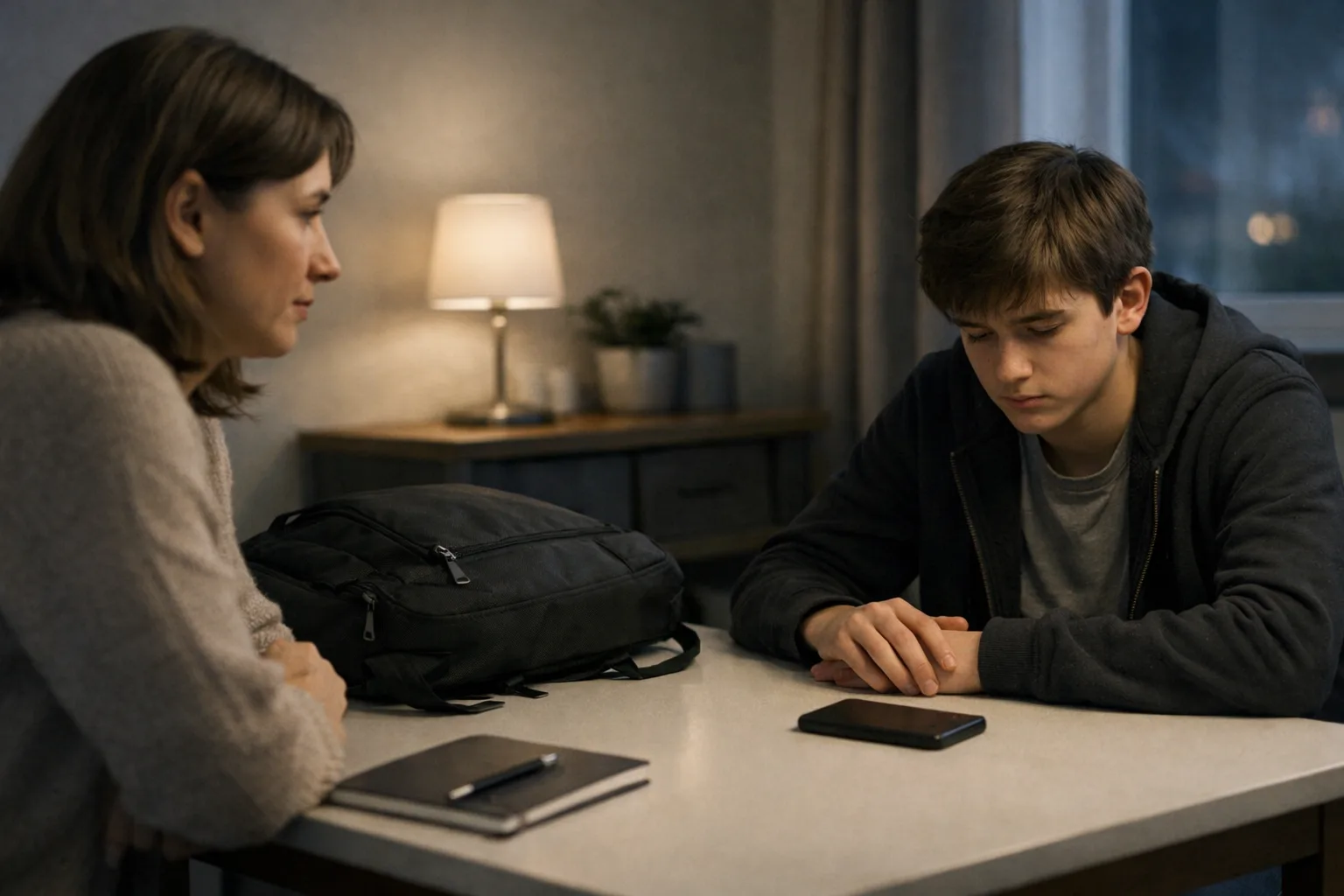
Bullying does not always show up as one obvious incident, one visible bruise or one clear disclosure. In many families, what appears first is much quieter: a child who no longer wants to get the bus, who says they have a stomach ache every Monday morning, who stops mentioning names from school, who comes home unusually hungry, who suddenly turns their phone face down, or who becomes edgy just after a notification.
The short answer is simple: the most important subtle signs are changes. Changes in your child’s relationship to school, friends, sleep, their body, their phone, and their sense of self. No single signal proves bullying on its own. But when several signs appear together, keep coming back, and cluster around school, peers or online life, it is time to stop waiting for perfect proof.
What parents often regret is not that they worried too early. It is that they explained these signs away for too long as a phase, puberty, laziness, ordinary friendship drama or “too much screen time”. The right response is not panic. It is calm, concrete and persistent attention.
Why these signs are so often missed
The first trap is assuming bullying must be visible. In reality it can be physical, verbal, relational or digital. Relational bullying is often the hardest to spot from home: organised exclusion, rumours, low-level humiliation, implied group rules about who gets left out, or jokes that stay just ambiguous enough to look “manageable” from the outside.
The second trap is treating every difficult peer situation as an ordinary falling-out. A normal conflict usually involves two young people of roughly similar power, with some shared responsibility and at least the possibility of a fairly balanced repair. Bullying is different because it settles into a power imbalance: popularity, a group against one child, social fluency, physical dominance, control of screenshots, or the ability to make others laugh or feel afraid. That asymmetry is what makes a child feel trapped.
The third trap is that many children do not describe clearly what is happening. They may feel ashamed, fear retaliation, think nobody will believe them, or worry that an adult will react too loudly and make the situation worse. Older teenagers often carry an extra fear: being treated like a little child, losing what little control they still have, or having to relive every detail in front of several adults.
Finally, the signs of bullying can look like other genuine difficulties: anxiety, disengagement, friendship tensions, tiredness, unstable mood, or a difficult relationship with a phone. That is exactly why it helps to think in clusters of clues, not isolated symptoms.
The subtle signs families minimise most
Before a child ever uses the word “bullying”, some patterns come up again and again. The table below helps separate the quiet sign from the too-fast explanation.
| Subtle sign | Why families often minimise it | What to check calmly |
|---|---|---|
| Stomach aches, nausea, headaches or tiredness before school | It sounds like a passing complaint, ordinary stress or a bad night’s sleep | When does it happen? Sunday evening? Before a specific lesson, the bus, the canteen, PE or break time? |
| Unusual refusal to go in, repeated lateness, sudden requests to be driven | It is read as demotivation or avoidance | Is there a particular place, journey or time of day that has become feared? |
| Friends suddenly disappear, invitations stop, social withdrawal increases | It gets dismissed as friendship drama or a changing group | Is your child simply less social at the moment, or being actively kept out? |
| Missing or damaged belongings, coming home hungry, repeated requests for money | It looks like distraction or poor organisation | Are these believable one-offs, or repeated problems around the same days and the same pupils? |
| Less willingness to work, homework avoided, marks slipping | Screens or study method get blamed first | Does the drop happen especially on days when your child has to face certain peers or certain spaces? |
| Unusual phone reactions: screen hidden, jumping at messages, anger, tears, deleted account, new account | It gets read as normal teenage privacy | Do these changes happen after messages, late at night, or in connection with school and the peer group? |
Taken one by one, these signs remain ambiguous. What matters most is the repeating pattern: the same morning, the same journey, the same changing room, the same group chat, the same after-school dip, the same activity being avoided.
With younger children, the body often speaks before words
In primary school and the early secondary years, the first sign is often physical. A child may not yet have the words for exclusion, implied mockery or the fear of the next break time. It is often easier for them to say, “My tummy hurts”, “Stay with me”, or “I don’t want to go”, than to explain a social atmosphere they do not fully understand.
You may also notice small everyday changes: they stop telling you about the day, stop mentioning classmates, eat very little at lunch but come home starving, cling more at drop-off, or suddenly want to change seat, bag, clothes or club.
With older pupils and young adults, the sign is often more social and digital
As children get older, bullying can become more relational and online. Parents then notice less of a direct complaint and more of an odd combination: a mood crash after checking the phone, a screen immediately turned over, a new account, an old account deleted, refusal to go out, avoidance of a class group, fear of public embarrassment, or harsh self-mockery.
A teenager can also keep “functioning” on the surface for quite a long time. They may still attend lessons, and sometimes even keep decent marks, but at the cost of constant hypervigilance, damaged sleep, irritability at home or growing isolation. That is one reason parents sometimes notice the problem late: school performance is still holding up, while the child’s inner sense of safety is already collapsing.
What these signals change before a child ever says “bullying”
Bullying does not only alter mood. It changes the way a young person moves through ordinary life.
At school, it becomes harder to concentrate, plan ahead, join in, cope with unstructured time and sometimes even stay present for a full day. Results may fall, but not always straight away. Some pupils compensate for a long time before they slip. Others keep a reasonable academic level while quietly exhausting themselves.
Emotionally, a child may become more irritable, sadder, more shut down, or sometimes more explosive at home because home is the only place where the tension comes out at all. They may also begin to believe that the problem lies in them: their body, voice, clothes, marks, way of speaking or simply the way they are. That is where shame starts to settle in.
Relationally, they may begin to avoid groups, birthdays, clubs, sport, group work, lunch spaces or any situation where they might be exposed. From the outside, parents can end up seeing “a child who doesn’t want anything any more” when the child may in fact be trying to reduce the number of situations in which they can be mocked, cornered or humiliated.
And the body often pays before the family has even named what is happening: broken sleep, nightmares, stomach aches, headaches, appetite changes and a background tiredness that never really goes away. When these signs keep circling back to school or the phone, the possibility of peer mistreatment deserves serious attention even if the whole picture is not complete yet.
What to do without panicking or playing it down
When several signs converge, the goal is not to get the full truth in one evening. The goal is to increase your child’s safety and understand enough to act. A careful sequence helps.
Start from what you have observed.
Avoid vague openings such as “You need to tell me everything.” Try something more concrete: “I’ve noticed you often feel sick on Mondays, you no longer want to go to the canteen, and you hide your phone after school. I’m not going to force you to explain it all at once, but I am taking it seriously.”Name the insecurity without forcing a conclusion.
You can say: “I don’t yet know exactly what is happening, but I can see that something is making school feel unsafe.” That protects much better than either “It’s nothing” or “You must be being bullied” said too quickly. It keeps the door open.Look for the concrete pressure points.
Which part is hardest: the journey, break time, lunch, the changing room, the class group chat, a lesson where they have to speak, the walk home? Who is present? Who laughs? Who copies? Which adult in school feels most trustworthy? These questions usually help more than asking for a perfect chronological account of every insult.Document the pattern without making your child relive it repeatedly.
Keep brief notes on dates, places, symptoms, absences, damaged belongings, requests for money and any useful screenshots. Save what matters, but do not make your child reread messages over and over or rebuild every detail in order to prove that they are distressed.Contact the school with specific observations and a clear request.
A factual message usually works better than a purely emotional one: what you have noticed, since when, what effect it is having, and what immediate protective step you want. Ask for one named contact, a review date, and a clear way to monitor what happens next, rather than a vague “keep us updated”. Depending on the setting, that might be a form tutor, head of year, pastoral lead or safeguarding lead.Get extra help quickly if health or safety is worsening.
If sleep is collapsing, your child is barely eating, is refusing school over time, is self-harming, is talking about wanting to die, or seems in immediate danger, this has moved beyond ordinary school handling. In Great Britain, contact your GP or NHS 111 for urgent mental health help; if anyone is in immediate danger, call 999 or go to A&E. If your child is under 19, Childline is also available.
Some parental reactions are understandable but can make things worse. It is usually better to avoid telling your child to ignore it, sort it out alone, “toughen up”, or go and confront the suspected bully face to face. It is also better to avoid contacting other parents in a rush without a clear plan, especially if that is likely to increase retaliation or turn the situation into an adult conflict.
Rebuilding safety takes longer than making the report
Making the report can relieve a parent. It does not always relieve the child straight away. Many young people stay on alert even after adults intervene, because they have learned to anticipate the next message, the next screenshot, the next laugh, the next moment of exposure.
The first step in rebuilding is not full trust. It is predictability. Your child needs to know who they can go to, where they can go, how the most fragile parts of the day will be handled, and what will happen if something starts again. An imperfect plan that is clear is often more reassuring than a general promise that “the school is dealing with it”.
The second step is restoring some room for action. You can ask: “What would help you feel a bit less exposed this week?” The point is not to make your child responsible for solving the problem. It is to give back a small amount of control: choosing the trusted adult, deciding whether a written message or a meeting feels easier, identifying one safe peer, or planning how to leave a situation.
The third step is not to reduce your child to what happened to them. Bullying often pushes a young person to define themselves through shame. Parents can help by reopening other spaces: an activity where they are not judged, a place where they still feel competent, a relationship that is not organised around the problem. That does not magically repair the harm, but it helps stop the whole identity from shrinking around the injury.
Finally, keep an eye on the after-effects. Some children look better for a while and then dip again on Sunday evening, before an oral presentation, on a particular journey, or when they return to a group. Gentle, regular attention is usually more helpful than anxious surveillance. The useful question is not only “Are you okay?” but also “What felt easiest today?” and “What felt hardest?”
The right threshold for concern
You do not need a full disclosure to take the situation seriously. Three questions are often enough to decide the next step:
- Is there a clear change in your child’s relationship to school, friends, their body or their phone?
- Does that change seem to cluster around certain places, times, groups or messages?
- Does your child seem more alone, more watchful, more ashamed or more worn out than before?
If the answer is yes to several of those questions, it is reasonable to open the conversation, keep a brief record and ask for help. With bullying, it is usually better to check a serious doubt than to wait for distress to harden into proof.
Sources
Keep reading
Related reading
Good grades, but at too high a cost: should you still ask for help?
Good grades do not prove that everything is fine. If a child is coping only through endless evenings, exhaustion, tears or constant parental steering, it can make sense to ask for help before the grades fall.
When decent marks hide a serious wellbeing cost
School portal: how often should parents check without over-monitoring?
Checking the school portal ten times a day can reassure a parent, but it rarely helps the student. A simple framework for choosing a useful rhythm, spotting the signals that matter, and talking about them without creating continuous surveillance.
A calmer way to monitor school signals without constant checking