

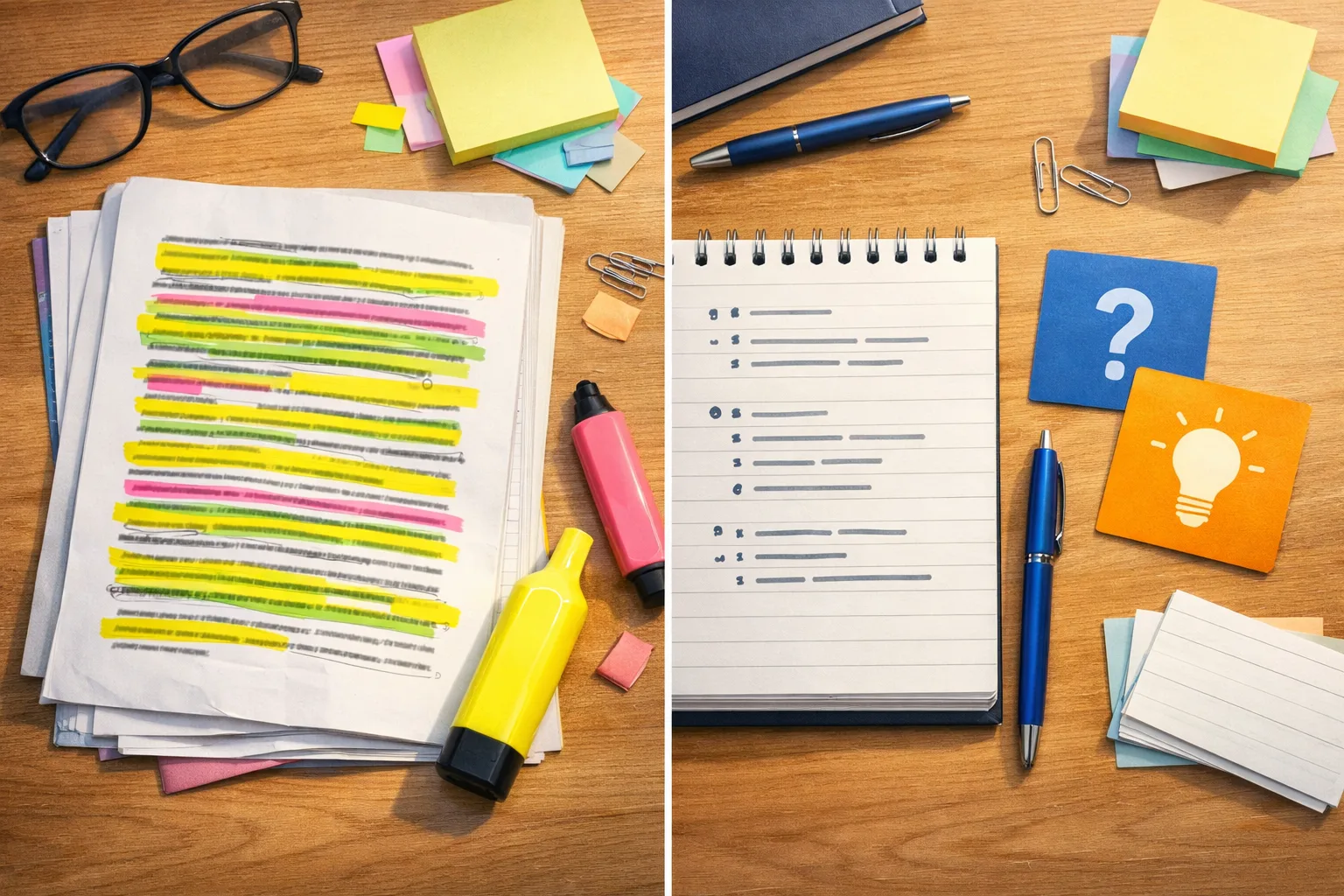
Your child has spent time on a chapter, the textbook is covered in yellow lines, and yet two hours later they cannot explain it. The issue is not necessarily effort. It is often a mismatch in the mental action: looking, spotting, rereading—rather than transforming the content.
The short answer is simple: highlighting helps you spot information, but rewriting helps you learn it. When a student puts an idea into their own words, they must select what matters, organise it, check their understanding, and notice what remains unclear. That is the work that prepares both memory and performance.
The real academic problem is not recognising the lesson, but being able to produce it
At school, students are rarely asked to recognise a sentence they have already seen. They are asked to define, explain, compare, justify, apply a method, comment on a document, or write a structured answer. In other words, they are asked to produce something from the lesson.
This is where many study habits that feel productive reach their limits. A colourful page can feel reassuring. A full notebook can look impressive. But neither proves that a student can respond without support.
Here is a clearer way to see what each study action actually tests:
| Study action | What the student really does | What it tests | Real usefulness |
|---|---|---|---|
| Highlighting | Spots parts of the text | Mainly whether they have seen it | Low if used alone |
| Copying | Rewrites almost identically | Attention and transcription | Useful to catch up, not to check understanding |
| Rewriting (in own words) | Rebuilds the idea | Understanding, structure, logic | Strong foundation for learning |
| Recall or self-questioning | Retrieves without support | Understanding, memory, gaps | Very useful for revision |
The goal is not to ban visual cues. It is to understand which action actually brings a student closer to the next test.
Why highlighting feels reassuring—and helps little on its own
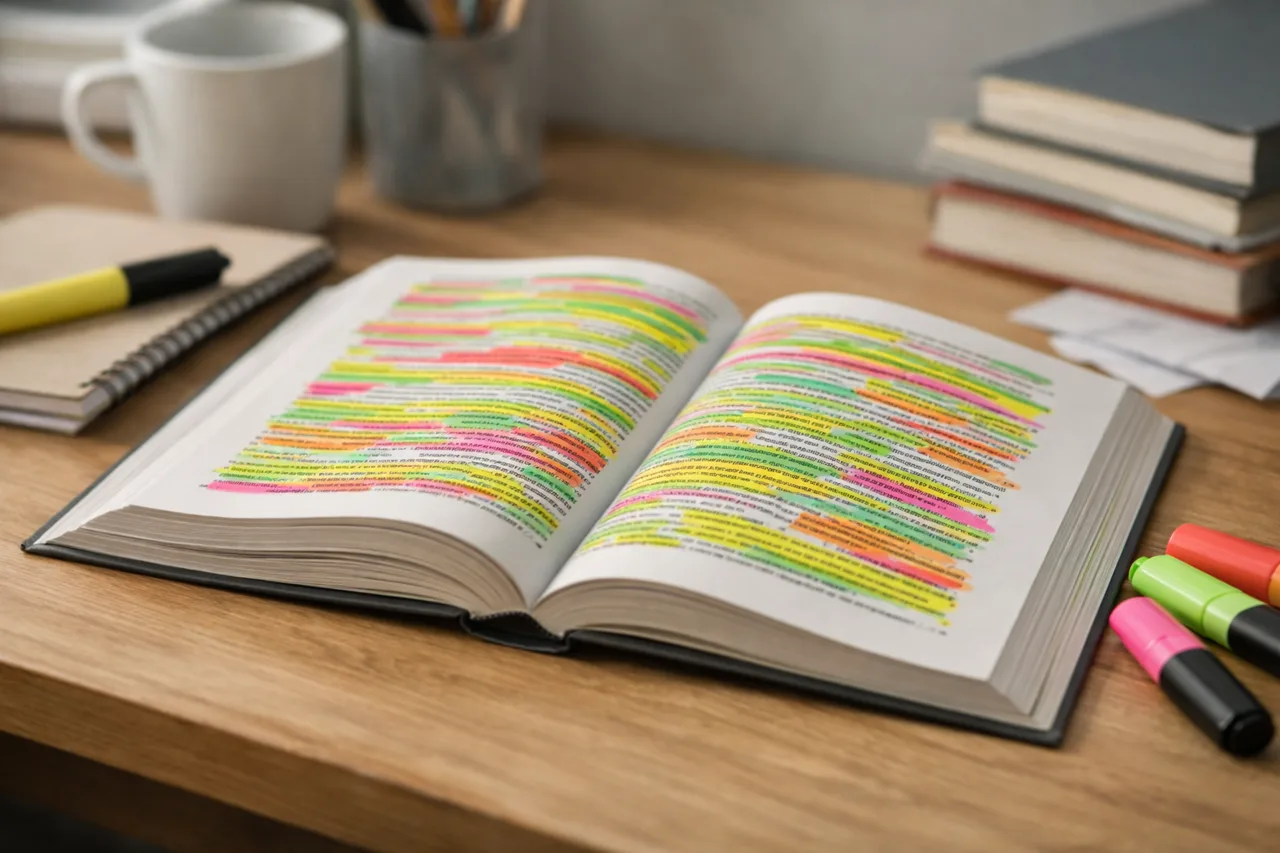
Highlighting is attractive because it is simple, quick, and visibly studious. It creates a sense of progress without exposing the student to mistakes. As long as the text is in front of them, everything feels clearer than it really is.
For parents, this is an important distinction: familiarity with a page is not the same as mastering its content. A student may recognise a sentence, remember where it was, even recall its colour—yet still be unable to explain it accurately.
Many students end up confusing three very different levels: I have seen it, I understand it, I can explain it on my own. Highlighting often maintains this confusion because it does not force deep selection or reconstruction of meaning.
Research reviews on learning strategies consistently place highlighting among low-impact techniques when used alone. That does not mean it is useless. Used sparingly, it can act as a marker: a definition, a key date, a logical connector, a step in reasoning.
The problem begins when everything is highlighted. At that point, nothing is prioritised, and colour replaces thinking.
A simple test reveals this: if a student cannot explain in one or two sentences what a highlighted passage means, then the learning has not yet happened.
Why rewriting in your own words leads to better learning
Rewriting does not mean swapping a few words. In a useful school sense, it means taking an idea and rebuilding it in a clearer, simpler, or more structured way—without distorting its meaning.
This is more demanding than highlighting. That is precisely why it works better. Research on writing to learn and generative learning activities shows that writing about content supports understanding across subjects—especially when students actively make meaning rather than simply reviewing or copying.
Rewriting forces students to choose what matters
To rewrite, a student must decide what is essential. They cannot keep everything. They must separate the main idea from examples, causes from consequences, mechanisms from vocabulary. This is not extra work—it is already part of learning.
Rewriting forces organisation
A good reformulation reorganises information into something coherent. In history, it becomes a chain of causes. In science, a process. In literature, an interpretation. In maths, a method with conditions—not just a recipe.
Rewriting reveals gaps
When a student gets stuck mid-rewrite, that is not failure. It is often the first useful signal of the session. They can now see what they do not yet understand or remember.
By contrast, a full session of highlighting can leave the impression that everything is fine—until the moment they must answer without the text.
Rewriting prepares for real assessment
Most assessments do not ask for verbatim recall. They ask for explanation, application, connection, argument. Rewriting is closer to what will be required.
One important nuance: rewriting can become passive if the student keeps looking at the text and simply changes a few words. What really helps is the effort to reconstruct—especially when followed by checking or short recall.
A short, repeatable method to rewrite without spending all evening

Many families give up on this idea because they imagine rewriting the entire lesson. That is not necessary. Effective rewriting can be brief.
Here is a simple routine to try:
Break the lesson into small chunks.
A subheading, a paragraph, a diagram, a short explanation. Smaller units are easier to transform.Read with a question in mind.
What is the main idea? How does it work? What causes what? When does this rule apply?Hide the material and write a few lines.
Two to five lines are often enough. The goal is not perfect phrasing, but correct meaning. For some students, speaking first works even better.Check and adjust.
Reopen the lesson, correct errors, add missing elements, note key terms. Do not rewrite everything neatly again.Turn it into a mini recall.
End with two questions, an example, or a short explanation out loud. This bridges into active recall.
A simple structure often helps: main idea, why it matters, one example. If a student can do this without looking, learning has started.
For younger students, slower writers, or those who get discouraged quickly, reduce the ambition: one clear sentence, a spoken explanation, or three linked keywords. Length matters less than meaning-making.
The same skill—but a different form in each subject
Rewriting is a cross-subject principle, but its useful form changes depending on the discipline.
- History and geography: connect facts—who acts, why, with what consequences, in what context.
- Science: explain mechanisms—what interacts, in what order, with what function.
- Mathematics: clarify when and why to use a method—not just how.
- English, languages, and essay subjects: move from spotting to meaning—explain an idea, summarise, interpret, reformulate an argument.
The key question is not how long the student looked at the lesson, but what they can now explain without their notebook. This shift often improves work quality more than simply increasing study time.
How to help at home without doing the work for them
The risk for parents is to compensate completely: rereading the lesson, dictating the correct wording, building the summary, asking all the questions. In the short term, it helps. In the medium term, it creates dependence.
The most useful support is often lighter.
First, ask for short output, not a perfect summary. Two sentences, a 30-second explanation, or an answer to “what does this mean?” is enough to check understanding.
Second, help refine rather than replace. Instead of giving the correct answer, ask a question that forces clarity: is it a cause or a consequence? Can you give an example? Which key word is missing?
Third, check later, not just immediately. A successful rewrite the same evening is useful. Being able to retrieve it two days later is much more powerful.
Some warning signs deserve attention:
- the student cannot rewrite even with the lesson open;
- sentences copy the text almost word for word;
- the difficulty appears across all subjects;
- the notes themselves are incomplete or unclear.
In these cases, the issue may go beyond method: poor notes, fragile understanding, slow writing, reading difficulties, overload, or fatigue. Not everything can be solved by effort alone, and a discussion with a teacher may help.
What to remember
Highlighting helps you spot. Rewriting helps you transform. Recall without support strengthens memory. That is the core logic.
If you want to change one habit this week, do not ask for a neater or more colourful page. Ask for one clear sentence—then another the next day without looking.
For most students, the effective sequence is: read, rewrite, check, then test yourself. It is less visible than a bright notebook—but much closer to what school actually requires.
Keep reading
Related reading

Why students forget so quickly after a test
A decent mark does not guarantee lasting memory. Here is why students forget after a test, and how parents can try a simple active-recall routine over two weeks.
See why knowledge fades quickly and how to reinforce it after learning
Cornell note-taking: which students does it really help?
Cornell note-taking does not help every student in the same way. Here is how it works, who benefits most, where it falls short, and how to introduce it at home without turning it into another battle.
Explore a structured note-taking method and its limits