

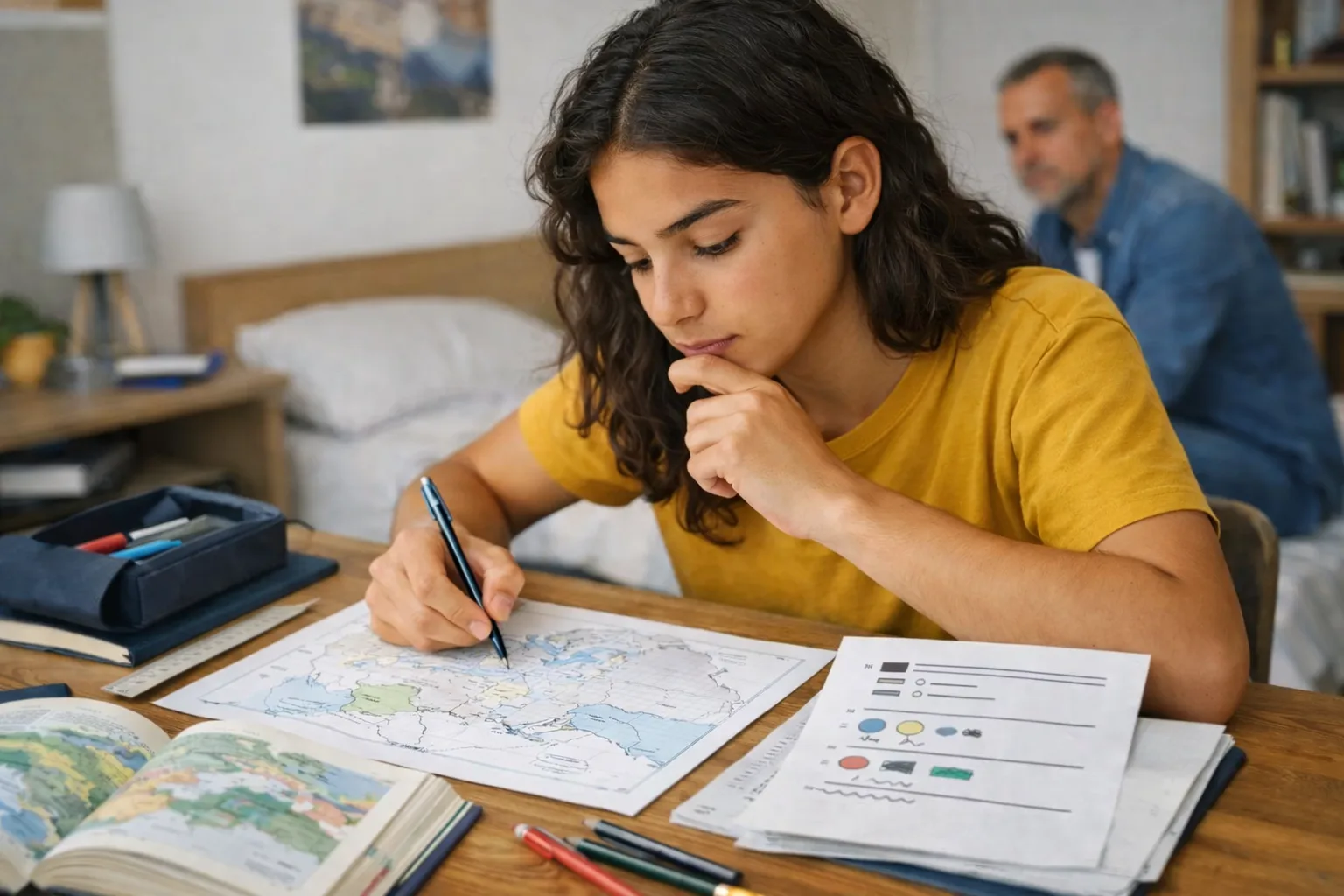
Your child spends time on maps, sketch maps, and diagrams. The notebook looks serious—sometimes even beautiful—yet the geography grades do not match the effort. That gap is common, and it does not automatically mean your child “has a poor memory” or “isn’t a visual learner.”
In geography, a map or diagram is only useful if it helps a student think about space: locate, sort, compare, connect, and explain. When the page becomes mainly something to copy or color neatly, it can create the appearance of hard work without building the understanding the subject actually requires.
The key point is simple: before studying, you need to know what kind of task the class or test is asking for. A student should not prepare in the same way for locational knowledge on a blank outline map, a map-analysis question, a summary sketch map, or an explanatory diagram.
What geography really asks of a student
The real difficulty is not always “they can’t remember the map.” Very often, students are mixing up several different tasks.
In geography, a visual support can ask them to do at least four things:
- locate places, boundaries, routes, physical environments, or major regions;
- read a spatial pattern: concentrations, contrasts, centers, peripheries, corridors, interfaces;
- connect space to a process: migration, urban growth, trade, risk, inequality, environmental change;
- communicate a clear idea through a sketch map, diagram, or short written explanation.
In other words, the map is not just a container of facts. It is a way of organizing reasoning. As students move from middle school to high school, and then into early college work, they are expected not just to recognize a document but to use it to make a sound claim from it.
To help your child, the best starting point is to identify where the blockage actually is:
- shaky locational knowledge: they cannot place the main features on a blank outline map;
- weak map reading: they can see the symbols, but cannot say what pattern they show;
- poor selection: they put everything into the sketch map because they do not know what matters most;
- unstable explanation: they follow the class discussion, but cannot reconstruct the idea alone later.
These problems do not improve with the same method. That is where a great deal of time gets lost.
The belief that wastes time: “if it’s visual, looking at it again is enough”
The classic trap is to assume that because geography uses maps and diagrams, the subject is mainly learned by looking at them again and again. The student rereads the legend or map key, colors neatly, copies out a map, highlights the headings, and gets a feeling of familiarity. But familiarity is not yet mastery.
In a quiz or test, they usually have to do something else: retrieve a place without the model, comment on a distribution, choose the right symbols, explain a contrast, or move from one document to a broader idea. All of that requires active production, not just visual recognition.
A neat map is not useless. Legibility and color coding can help. But they only help if they serve an already organized line of thought. When appearance becomes the goal, the map stops being a tool and turns into decoration.
Three signs usually show that a student is mostly working on appearance:
- they redraw the legend exactly as given, without regrouping the ideas;
- they remember the colors on the model, but not what the main zones or patterns mean;
- they recognize the page when it is open in front of them, but cannot redraw it from memory or explain it in a few sentences.
At that point, the answer is not “more maps.” It is a different kind of effort.
The right method depends on the task
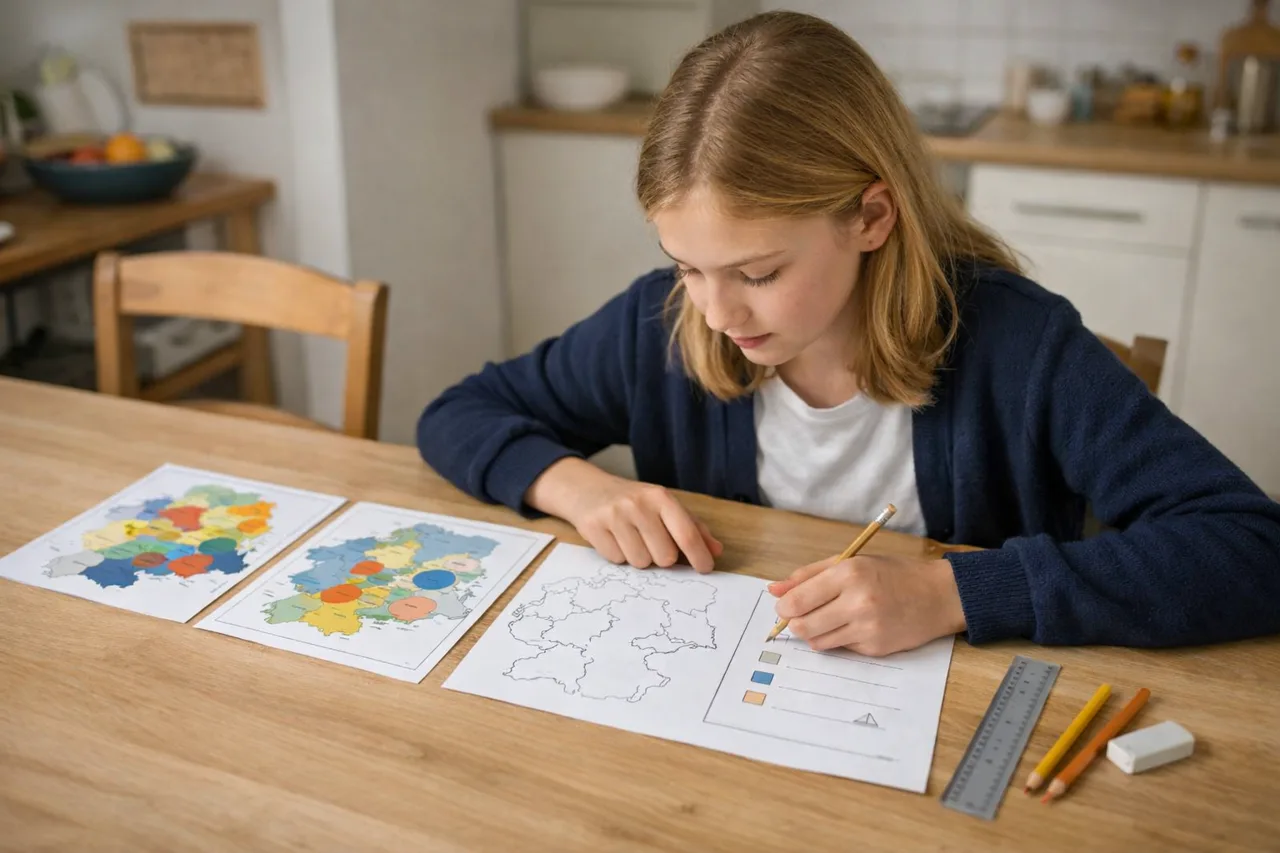
The useful question is not “how do you study geography?” but “what exactly does this task ask me to do?” Here is a simple way to adapt the work.
| Type of task | What to practice | Common mistake |
|---|---|---|
| Locational knowledge on an outline map | Place 5 to 10 features on a blank outline map, then check immediately | Rereading the textbook without ever testing yourself |
| Map or source analysis | Say what the map shows, at what scale, which patterns dominate, and which exceptions matter | Describing every detail without a main idea |
| Summary sketch map | Start from the chapter question, group the content into 2 or 3 ideas, then choose symbols and organize the legend | Trying to include everything so nothing is “missed” |
| Explanatory diagram | Simplify, connect, and show a process or chain of effects | Copying a complex picture that does not actually explain anything |
The common point is always the same: the map, sketch, or diagram should force the student to select and reformulate, not just recognize.
For locational knowledge, use outline maps and short sessions
If the problem is basic location, five to eight minutes usually works better than one long evening of copying. Place, hide, do it again. Above all, connect each place to an idea: a major metro region, a river valley, a mountain barrier, an energy corridor, an area exposed to wildfire, drought, or flooding. An isolated name is hard to retain; a name linked to a role sticks better.
For a sketch map or diagram, think before drawing
Many students start with the colors. In most cases, that is the wrong order. For a useful sketch map or diagram, the safest sequence is often this:
- write down the question the support is supposed to answer;
- sort the class content into two or three main ideas;
- only then choose the symbols, colors, and order of the legend;
- finish with a one-minute spoken explanation based on the finished support.
This feels less “artistic,” but it often produces something clearer, lighter, and much easier to reuse.
When several maps are involved, comparison often helps more than fixing one image in memory
When a unit uses several thematic maps, students gain by noticing what changes from one document to the next: the scale, the variable being mapped, the hierarchy of places, the exceptions, the blind spots. In geography, understanding often comes from the relationship between documents, not just from memorizing one image.
A good analytical sentence is sometimes worth more than an overloaded page: “here the concentration is strongest,” “here the network changes scale,” “this region is an exception.” That move from observation to interpretation is where progress usually begins.
How to tell whether your child is really improving
The best indicator is not the number of maps they have redrawn. It is what they can do without the model and with a clear instruction.
Real progress shows when they can:
- put the main places back on a blank outline map fairly quickly;
- explain the logic of a legend instead of reciting its order;
- state the main idea of a map in two or three sentences;
- compare two maps or documents and name at least one important contrast;
- build a simpler diagram than the one from class, but a more useful one for answering the question.
You can check this in three minutes without being a geography specialist. For example, ask:
- What question does this map or diagram help you answer?
- What are the two or three main ideas?
- If the model disappears, what can you still redraw or explain on your own?
By contrast, a few things can create a false sense of progress: a very neat notebook that still depends heavily on the model, a long legend with no hierarchy, or an oral answer that collapses as soon as the page is covered.
The grade does not always rise immediately. But when your child starts faster, hesitates less in front of a blank outline map, and says more clearly what they notice and why it matters, progress is usually underway.
What parents can do without becoming the geography teacher
You do not need to correct a sketch map as a teacher would. But you can still help your child study in the right direction.
- Bring the task back to its real question. Before they start, ask: “What exactly are you meant to be able to do?”
- Prefer a short spoken explanation to a prettier final page. Two minutes of clear explanation often matters more than another 15 minutes of coloring.
- Make room for active recall. Use a blank outline map, cover the legend, compare two documents, or ask for a short explanation from memory.
- Break study into several returns. In geography, repeated short returns are often more effective than one large copying session at the end of the unit.
- Look for the right kind of help if the blockage persists. If your child understands the class content but still cannot select or organize it, they may need methodological support. If they do not understand the vocabulary of the lesson itself, the problem sits further upstream.
The real goal is not a prettier map. It is a student who can use a map or diagram to think: locate, compare, rank, and explain.
In geography, maps and diagrams should help students think, not just decorate the page. That is still the simplest way to judge whether the study method is actually working.
Sources
Keep reading
Related reading

Going blank in revision: how to turn a lesson into a self-test
When a student seems to know a topic but freezes as soon as the notes are closed, the problem is not always memory. Here is how to turn one lesson into a simple self-test, with a two-week routine parents can support without constant supervision.
Turn a lesson into a short self-test once the map is closed
Highlighting is not understanding: why so many students rely on false signals
A brightly highlighted page feels reassuring, but it rarely proves real learning. Here is why highlighting is so appealing, what it actually does, and how to build a simple active reading routine that works across subjects.
Understand why neat-looking study habits can feel reassuring but mislead students
Mind maps: powerful tool or visual gimmick depending on how they’re used
A mind map can genuinely help a student understand and revise — but only if it forces them to organise, connect and recall ideas, not just rewrite the lesson in colour.
See when a visual study tool supports thinking instead of decoration
Taking notes: listen, select, rephrase — instead of copying everything
A full notebook is not always a useful one. Here is how to help a student take notes that actually support understanding, memory, and revision.
Learn how selecting and rephrasing make study notes more usable