

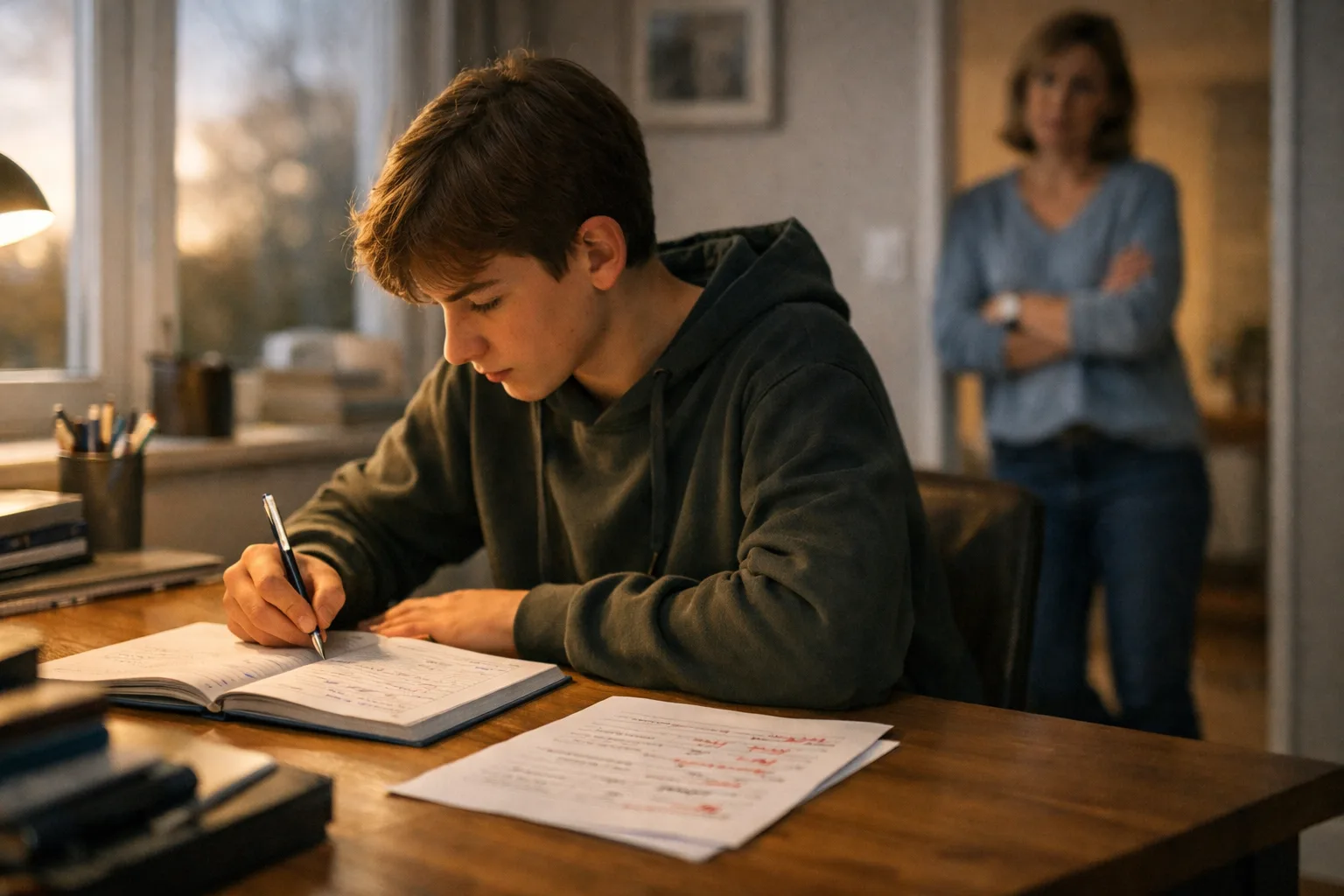
Your child redoes a problem just after reading the worked solution. This time, everything works. Should you be pleased? Yes — but not too quickly.
The useful answer for families fits into one sentence: redoing an exercise after seeing the answer can help with understanding, but it is a poor test of whether the idea is really mastered. Used as a revision method, especially right after seeing the answer, it often creates a false sense of mastery.
That confusion is common because it is reassuring. The student feels they are making progress, the parent sees correct work, and the uncomfortable moment of “I can’t remember” is avoided. But a quiz, test, or exam does not look like that: the answer is not in front of your child, and they have to retrieve it on their own.
Why redoing the same problem after seeing the answer can mislead
The cognitive trap is simple: recognizing a solution is easier than retrieving it from memory. When a student has just seen the worked answer, they are not really starting from scratch. They are following a path that has already been laid out: the steps feel familiar, the calculations “look right,” and the wording seems obvious. That ease is real, but it does not yet tell you much about what they will still be able to do tomorrow.
In other words, the brain easily confuses two very different situations: learning with the answer present, and succeeding without the answer present. That is one reason some students think “I know how to do this” at night, then freeze on a test two days later.
So the useful question is not only “Was it correct?” It is also “Under what conditions was it correct?”
| Situation | What it feels like | What it mostly measures |
|---|---|---|
| The solution is visible or has just been read | “I can see exactly how to do this” | Familiarity with the answer |
| The exact same problem is redone right away | “I’ve got it now” | Very short-term memory and imitation of the steps |
| The problem is redone later, without the solution | “This is a lot harder” | Genuine recall — the thing a test depends on |
| A similar but different problem is solved | “Now I really can do it” | Understanding and transfer |
That table explains why families are often misled in good faith: what feels easy at the desk is not always solid enough to last.
When a worked solution really helps
It would be wrong, though, to conclude that a worked solution, answer key, or sample response is useless. It is genuinely helpful when it is used to understand an error or a method, not when it is treated as final proof of mastery.
It is especially useful in three cases:
- When the topic is still new. Early in learning, a well-solved example helps a student see the logic that is expected.
- When the student got it wrong but does not know why. The correction can then pinpoint the problem: the wrong formula, an incomplete line of reasoning, a missed instruction, weak wording, or an answer that is not specific enough.
- When the student needs to learn a procedure. In math, physics, chemistry, and grammar, but also in essay writing, source analysis, and other structured written work, a good model shows what the method is supposed to look like.
Its value drops quickly, however, once you ask it to do something else: prove that the topic will still hold without help, in a different order, with different numbers, or after a delay.
For parents, the most useful distinction is this:
- The solution as a learning support: yes.
- The solution as a revision test: much less.
In highly procedural subjects, such as algebra or physics, that means moving fairly quickly from the worked solution to a nearby problem. In more writing-heavy subjects, it means that after reading a strong sample answer or detailed feedback, the student should rebuild on their own a plan, an introduction, an explanation of a source, or a line of argument.
The revision mistake families make most often
The familiar mistake almost always follows the same sequence:
- the student gets the problem wrong;
- they read the solution;
- they redo the same problem right away;
- because it works this time, they conclude that “it’s fine now.”
The problem is not that they looked at the solution. The problem is drawing too strong a conclusion from a situation that is still too easy.
Many students stop there because the feeling of fluency is pleasant. Many parents stop there too, because they finally see something correct and would rather not restart the conflict. That is completely human. But from a memory point of view, it is usually too early to conclude anything.
A more honest test should add at least one useful difficulty:
- a delay;
- the absence of the solution;
- a change of context;
- or a similar but not identical problem.
Without that, what you are mainly checking is immediate reuse, not durable learning.
A simple 10-to-14-day routine to test real learning

To get out of this false confidence without turning family life upside down, try a very simple routine on just one chapter, skill, or recurring mistake for about two weeks.
The principle
Use the solution first to understand. Then close it. Come back later and ask the student to retrieve the method without help, before checking again on a nearby problem.
A concrete version
| Time | What the student does | Suggested duration | What you are looking for |
|---|---|---|---|
| Day 0 | Study the solution and name the exact mistake | 5 to 10 min | Understand the method and the weak point |
| Day 0 or Day 1 | Redo the same problem on a blank sheet, without looking | 5 to 10 min | Check immediate recall without a model |
| Day 2 or 3 | Do a problem of the same type, with a small variation | 10 to 15 min | Test understanding, not just copying |
| Day 6 or 7 | Return to 2 or 3 mixed problems, old and new | 10 to 20 min | Strengthen retrieval after a delay |
| Day 10 to 14 | Do a short mini-test, with no solution and no hint | 10 to 20 min | Measure what really holds |
This routine has two big advantages: it stays light enough for real family life, and it replaces the vague criterion “that looked easy” with a much more reliable one: can the student retrieve it alone after a delay?
In middle school, these returns can stay very short; sometimes 5 to 10 minutes is enough. In high school and early college, you can usually space the attempts a bit more and mix chapters more quickly.
How to adapt it by subject
- Math, physics, chemistry, grammar: change a number, a piece of data, a sentence, or mix several problem types.
- World language classes: redo a transformation, a grammar point, a short translation, or a comprehension question without looking at the model answer.
- History, biology, geography, social studies: explain a key idea, redraw a diagram, answer a content question, or organize a short outline without notes.
- English and other writing-heavy classes: rebuild a plan, restate the main line of argument, write a shorter introduction, or explain why the model answer was stronger.
The traffic-light grid that changes everything
Instead of marking the attempt only as right or wrong, ask the student to sort each try into one of these three boxes:
- Green: managed alone;
- Yellow: managed with a hint;
- Red: impossible without help.
That self-assessment is much more useful than a vague overall feeling. It shows what is becoming independent and what still depends on outside support.
How to follow progress without checking everything
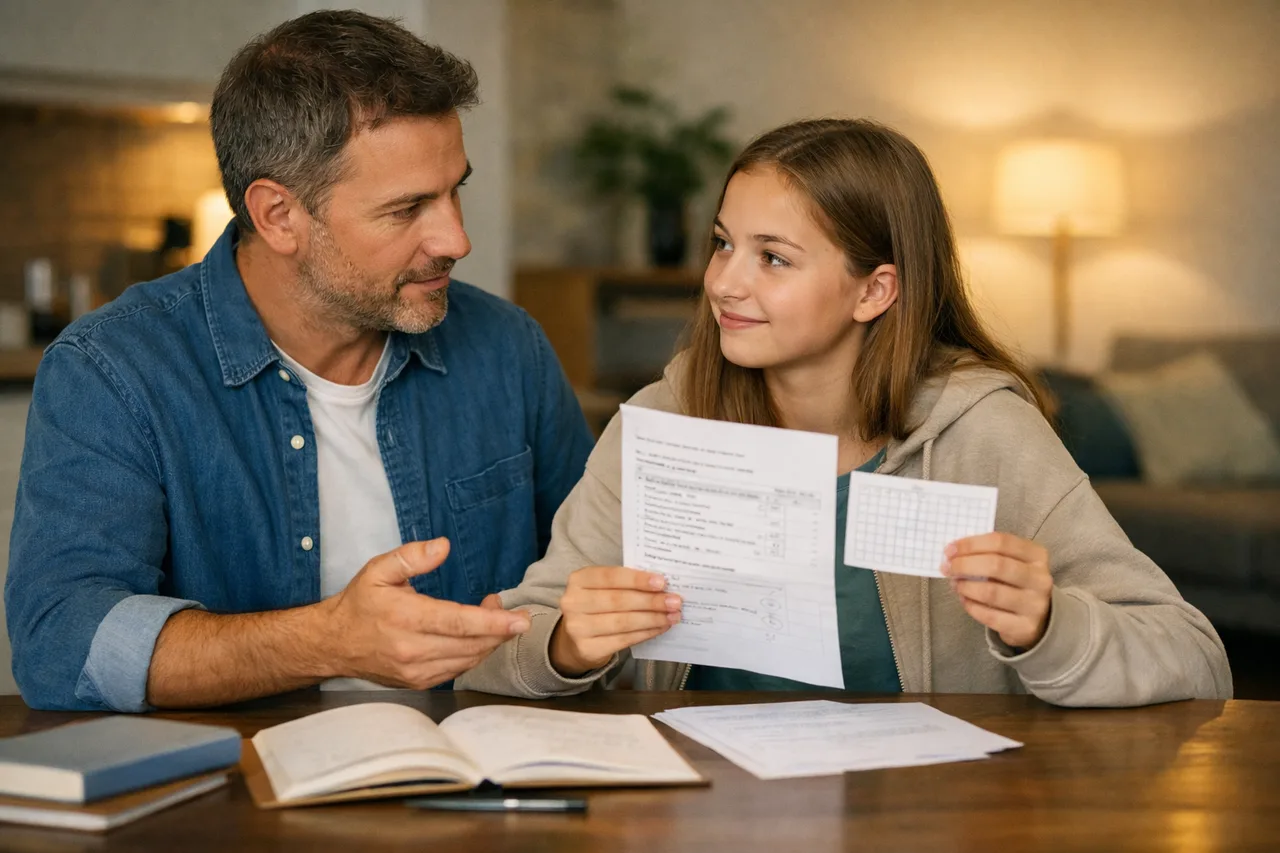
Parents do not need to inspect every line or supervise every evening. The most useful approach is often a short check-in, once or twice a week, centered on the quality of recall rather than the amount of time spent.
Three questions are often enough:
- Can you show me a problem you redid without the solution?
- Can you tell me exactly what you were doing wrong before?
- Which topic or problem do you need to come back to in two or three days?
Those questions shift the conversation. You move from “How long did you study?” to “What can you now do on your own?” That is much closer to real academic independence.
Here are a few signs that tell you more than study time alone:
- the student gets started more quickly, instead of spending ten minutes wondering where to begin;
- they are more willing to close the book or answer key;
- they succeed on a nearby problem, not just the original one;
- they can name their usual mistake;
- they plan a return session instead of treating the topic as permanently done.
On the other hand, some signs suggest that the problem may not be method alone:
- even after several spaced returns, the student still does not understand the basic logic;
- they only succeed on the exact problem already seen and struggle as soon as one detail changes;
- they panic as soon as the model disappears;
- the emotional load is so high that every session turns into conflict or major avoidance.
In those cases, it can help to ask the teacher for a clearer explanation or look for more targeted support. Sometimes the issue is not memory alone: it may be understanding, overload, missing foundations, or confidence.
The rule of thumb to keep in mind
Redoing an exercise after seeing the answer is not pointless. But on its own, it is not a good judge of real mastery. It works well as a way to understand a method. It works much less well as proof that the method will still be available later.
The better test is more demanding, but also more honest: can your child do it without the model, after a delay, and then succeed on a similar but different problem?
For many families, one change of question is enough to improve revision: replace “Did you redo it?” with “Could you do it again tomorrow without the answer?” It feels less reassuring in the moment, but it is far more useful for long-term memory.
Sources
- Illusions of competence during study can be remedied by manipulations that enhance learners’ sensitivity to retrieval conditions at test
- Improving Students' Learning With Effective Learning Techniques: Promising Directions From Cognitive and Educational Psychology
- Test-enhanced learning: taking memory tests improves long-term retention
- Metacognition and self-regulation: Evidence Review