

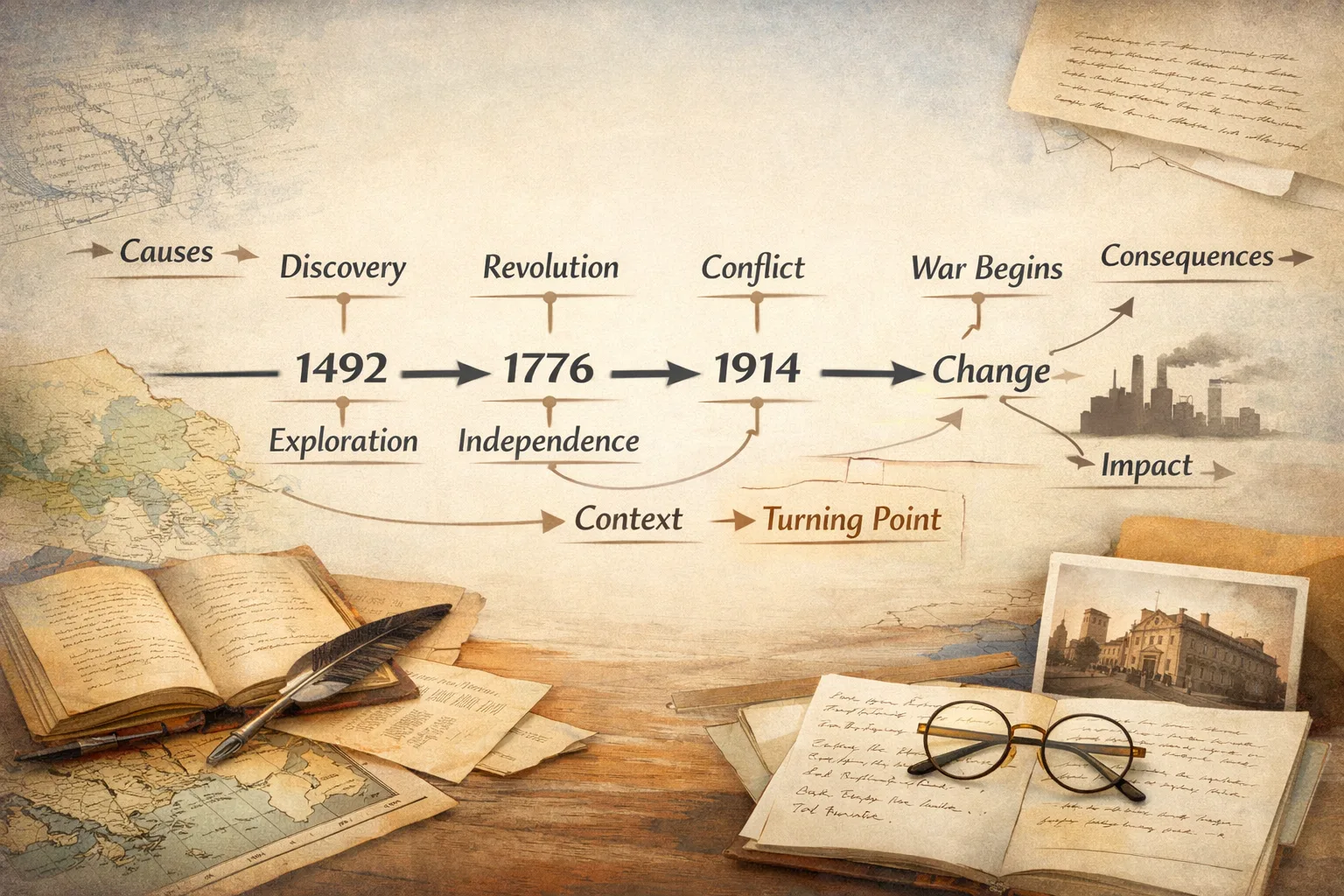
The scenario is familiar: a student can recite a few dates the night before a history test, then freeze as soon as they are asked what those dates mean, what they changed, or how to use them in a written answer. The problem is not only memory.
For parents, the real question is not “how do I make them repeat it for longer?”, but “how do I help them turn dates into usable reference points without spending the whole evening on it?”
In history, a date is not a password. It is a marker inside a process: there is a before and an after, causes and consequences, sometimes a rupture, sometimes continuity. Dates are remembered more securely when they are learnt with their historical function and then retrieved again with the notes closed.
In practice, that means less rereading of lists and more active recall, rebuilt chronology and explanatory questions. It is also the best way to avoid confusing “I recognise that date” with “I know how to use it”.
The real blockage is not always memory
When a child says, “I can’t remember the dates”, they may actually be describing several different difficulties.
The first is chronological: events are floating around without a stable order. The student may know a name or remember an image, but no longer know what comes before, after or at the same time. In that case, the mind does not yet have a clear enough structure to attach those reference points to.
The second is explanatory: the date is known, but its meaning is not. A student may know that 1914 matters without being able to say why that year marks a turning point, what prepared it, or what it set in motion afterwards.
The third is methodological: the student remembers some pieces, but does not know how to use them in the task they have been set. They may manage a quick oral recall and still struggle with an analytical paragraph, a short essay or a source-based question.
There are also difficulties that are not mainly about memorisation in the first place: incomplete notes, hard-to-read pages, historical vocabulary that has not really been understood, vague instructions, tiredness, or too many chapters learnt too late. In those cases, pushing even more recitation usually does not help.
The useful reflex, then, is to identify what is actually missing. When you help your child, three questions are often enough:
- Can they put three to five events from the chapter back in order?
- Can they explain why the lesson singled out that date?
- Can they use that reference point in an answer, not just recite it?
In history, dates mainly help students to place, connect and interpret. They matter because they organise a historical account, not because they are valuable on their own.
The belief that wastes time: rereading lists until they look familiar
Many students revise history as if they were memorising an access code: they reread a column of “date = event” pairs until the page starts to feel familiar. That feels reassuring, but the feeling is misleading.
Recognising is not recalling. Seeing “1789 — French Revolution” several times can create the impression of knowing it. Close the exercise book and ask: “Why is 1789 a rupture? What changes after it?” That is when useful knowledge becomes visible.
Rereading is not completely useless. It can help when a dense chapter is still new, or when scattered notes need putting back into order. But when rereading becomes the main technique, it often creates an illusion of mastery. The student ends up knowing the page better than the content.
The same problem appears with heavy highlighting or beautifully tidy summary sheets that are then reread passively. In history, progress rarely comes from one more exposure to the information. It comes from the moment the student has to retrieve it, rephrase it and attach it to a line of reasoning.
A very simple home check is this: on a blank sheet, the student writes one date and then has to add, without looking at the lesson:
- what happens;
- what prepares that event;
- what it changes afterwards;
- one actor, place or source that helps to put it in context.
If they can do this only partially, but with effort, they are already learning. If everything feels easy with the book open and collapses as soon as it is closed, the problem is not a lack of effort. It is the wrong form of effort.
The right method depends on the kind of task
The name of the task changes across year groups, countries and teachers. The underlying cognitive demand changes much less. A student should not revise in the same way for putting landmarks in order, explaining an event, and contextualising a source.
| Type of task | What the student has to do | What they need to retain | Most useful practice |
|---|---|---|---|
| Chronology checks, quizzes, short questions | Place, date, sequence | Pivot dates, order of events, start and end points of a period | Blank timeline to complete, cards to sort, very short oral recall |
| Written answer, analytical paragraph, short essay | Organise an explanation or a narrative | Pivot dates + chains of events + causes and consequences | Retell the chapter without notes in 60 to 90 seconds, answer “why?” and “how?” |
| Source analysis, document question, commentary | Contextualise and interpret | Date of the source, author, situation, what is at stake | A routine of “who is speaking, when, in what context, to defend what?” |
That is why a student can do well on a dates quiz and still look fragile in a written answer: the memory being tested is not exactly the same.
This is the decisive point: a date is almost never a complete answer. It usually supports something else. A student can therefore “know the dates” and still struggle if the assessment mainly expects context, explanation or comparison.
Before a test, it is worth checking the level of precision that is actually expected. Sometimes the exact year matters. Sometimes what matters most is the order, the period, or the ability to connect an event to a wider development. Many students learn too precisely what will not be assessed, and not precisely enough what will.
In the earlier secondary years, the first job is to stabilise landmarks and sequence. Later in secondary school, and at the start of higher education, dates become more like anchors for explanation, argument and context. The method should therefore mature with the student’s stage.
A simple routine for remembering dates without losing the meaning behind them

An effective routine does not need to be long. In fifteen to twenty-five minutes, a student can do work that is much more solid than an hour spent passively rereading a whole chapter.
- Choose only a few pivot dates. Start with five to seven genuinely structuring reference points in the chapter, not every secondary date.
- Give each date four hooks. For each one, complete mentally or on a small card:
- what happens?
- what prepares this event?
- what does it change afterwards?
- which context keyword helps me remember it?
- Turn the date into a question. Instead of “1914 = start of the war”, ask “why is 1914 a turning point?” Instead of “1945 = end of the Second World War”, ask “what does 1945 help us understand about the post-war period?”
- Rebuild without support. A blank timeline, an oral retelling, shuffled date cards to put back in order, a mini paragraph without notes: the essential thing is that the lesson is not in front of the student’s eyes.
- Come back after a gap. One recall the next day, another two or three days later, then another later still. That spaced return is what helps memory settle.
Take a simple example with 1914. The goal is not just to memorise “First World War”, but to be able to reformulate:
- what happens: the outbreak of war in Europe;
- what prepares it: rivalries, alliances, rising tensions;
- what it changes: mass conflict, mobilisation, a new political and social horizon;
- why this date remains a reference point: it marks a turning point for an era.
For younger students, one clear sentence per date may be enough at first. For older students, you can add the difference between long-term causes and the immediate trigger, or between rupture and continuity.
From the parent’s side, the most useful help is often light. There is no need to reteach the chapter or know everything yourself. One well-placed question is worth more than fifteen minutes of recitation: “What changes after that date?” or “What sort of question would you use that date to answer?”
How to tell whether the student is really improving
Real progress in history does not show up only in the number of dates that can be recited. It shows up in the way those reference points become usable.
The signs that matter
The most reliable indicators are these:
- the student can place several pivot dates on a blank timeline without a model;
- they can explain in one or two sentences why each one matters;
- they distinguish more clearly between the immediate trigger, the longer causes and the consequences;
- they can reuse those reference points in a new question, even when it is worded differently;
- their mistakes become more precise.
That last point matters. Moving from “I have no idea any more” to “I still mix up 1914 and 1918, but I know they frame the First World War” is already progress. The error becomes structured before it disappears.
False signs of mastery
By contrast, some signs look impressive but mislead:
- the lesson feels “known” as long as it stays open;
- the student recognises their summary sheet but cannot produce anything without a cue;
- they can recite a list but not answer a simple question in ordinary language;
- the whole chapter is revised in one block the night before.
If, after several weeks of more active practice, your child still cannot put nearby events in order, understand the wording of the lesson, or explain in very simple terms what a date stands for, it is worth looking beyond method alone: reading comprehension, note quality, workload, anxiety, or a broader difficulty with memorisation may all be involved. In that case, a conversation with the teacher may help more than another set of cards.
What to change this week
To remember dates in history without emptying them of meaning, the key is to change the question. Do not ask only “what is the right date?” Ask as well “what does it help explain?”, “where does it fit?” and “what changes after it?”
In concrete terms, you can put three simple habits in place this week:
- reduce the number of dates learnt in one go so the focus stays first on the real pivot points;
- attach every date to a before, an after and a meaning;
- plan several short recalls with the notes closed instead of one big session.
This method asks for a little more effort during revision, but it saves a great deal of wasted time afterwards. In history, memory becomes more durable when it carries meaning as well.
Keep reading
Related reading

Rereading is not revision: what parents should know
Rereading a chapter often creates a feeling of mastery without checking what a student can really retrieve. Here is the mechanism behind that illusion, the most common mistake, and a simple two-week method to try at home.
Why page familiarity is not real revision
Going blank in revision: how to turn a lesson into a self-test
When a student seems to know a topic but freezes as soon as the notes are closed, the problem is not always memory. Here is how to turn one lesson into a simple self-test, with a two-week routine parents can support without constant supervision.
Turn one lesson into a simple self-test
Memorise first or understand first? The right order for making progress
Should a child memorise definitions, formulas or dates before they really understand them? In practice, understanding and memory support each other, but not in just any order. Here is a simple way to avoid empty recitation and the endless wait for “perfect understanding”.
Put understanding and memory in the right order