


At some point, many parents notice the same thing: their child can do reasonably well at school and still look lost when a text mentions a writer, a conflict, a country, a work of art or an idea they are expected to recognise. The temptation is obvious: ask more questions, correct more often, turn dinner into an improvised quiz. In practice, that often produces the opposite of the intended effect.
Useful general knowledge — the kind that helps a student understand lessons, follow current affairs, write with more nuance and speak with more precision — is built less like a contest of right answers and more like a network of reference points. At home, the goal is therefore not to test constantly, but to expose, connect, discuss and revisit later what has already been encountered.
The real difficulty is often not memory
When a parent says, 'My child lacks general knowledge', they are not always naming the right problem. Very often, what they are actually seeing is one or more of the following:
- the student reads a text but misses some of its assumptions because the names, places or events it refers to mean very little to them;
- they sometimes know isolated pieces of information, but cannot connect them;
- their vocabulary is too thin to compare, nuance or explain with precision;
- they struggle to place information in time or space, or to distinguish a fact from an interpretation.
In other words, the problem is not only, 'They do not know enough things.' More often it is this: they do not yet have enough anchors to make sense of what they read, hear or notice. That matters, because it changes the way you help.
A teenager may seem very knowledgeable about manga, astronomy, football, music or gaming, and then look completely lost when faced with an article on the Industrial Revolution or an extract from a classic novel. That says less about ability than about how general knowledge grows: by domains, in layers, and through repeated encounters with the same reference points in different forms.
That is also why general knowledge is not only there to help a child sound clever. It supports comprehension in English, history, geography and the humanities, but also the ability to follow a debate, place a claim in context and judge what seems credible.
Why a permanent quiz usually misses the point
Quizzes, quick questions and general knowledge games are not bad in themselves. They can even be fun from time to time. The problem starts when they become the dominant family relationship to knowledge.
Why does that usually work badly in the long run?
- You measure before you have fed. Questioning a child on a topic they have barely encountered does not really broaden general knowledge. It mostly confirms that they are missing reference points.
- You privilege speed over understanding. Answering a closed question quickly is not the same as understanding a topic, linking it to another one or reusing it later.
- You turn ignorance into a small repeated humiliation. Even when the tone stays light, some teenagers experience being 'caught out' at home very badly.
- You reduce general knowledge to crumbs of information. A date, a capital city or an author's name is of limited value if it stays detached from a story, a work, a place, a problem or an era.
The result is predictable: the student guesses, shuts down, pretends not to care, or starts associating general knowledge with being tested. Yet the real engine of general knowledge is not the fear of getting it wrong. It is the possibility of understanding the world a little better and moving around it with less effort.
What actually broadens general knowledge
The good news is that you do not need to turn your home into a quiz-show set. General knowledge grows better through a few steady habits than through constant diffuse pressure.
Increase contact with varied material
General knowledge depends on repetition, but intelligent repetition. It is better to meet the same historical period, scientific question or work several times in different forms than to skim a new topic every week and forget it immediately.
In practice, that may mean a well-chosen article at the weekend, part of a documentary, a map or timeline, a novel, a non-fiction graphic book, a podcast in the car, an exhibition, a walk through a city, or a film that later opens a discussion. The medium does not have to be 'high culture'. What matters is the quality of the material and whether it leaves a trace.
Ask them to explain, not recite
A teenager usually learns more when they have to explain, compare, rephrase or connect ideas than when they simply have to produce the expected correct answer.
Questions like these are often more fruitful than quiz questions:
- What surprised you?
- What does that remind you of in something you studied recently?
- What does this change in your understanding of the topic?
- Is there a point on which two sources do not tell exactly the same story?
This kind of exchange gets words, ideas and links moving. It strengthens vocabulary, argument and the ability to bring knowledge in at the right moment.
Come back to it later — briefly
Knowledge met only once remains fragile. When it reappears a few days later in a conversation, another text or another context, it starts to settle.
This does not need to become heavy. One remark over dinner, a comparison with another topic, a note on a phone, a photo from an exhibition, a mini timeline, or a quick 'Do you remember the name we came across the other day?' is often enough. General knowledge grows less through cramming than through light reactivation.
Prefer themes to accumulation
Many students get scattered because they meet information without any structure around it. To avoid that, you can pick one theme for two to four weeks: empires, cities, energy, revolutions, major discoveries, migration, the press, inventions or the oceans.
The parent does not need to become an expert. Their main job is to create a thread. Once a thread exists, a child notices recurring reference points much more quickly.
Adapt the method to what you actually want to develop
You do not broaden general knowledge in exactly the same way depending on whether you want to help a child understand a text, speak more clearly, write better or follow current affairs with more distance. The table below helps avoid mixing those goals up.
| When the main goal is... | What really helps at home | What is better to avoid |
|---|---|---|
| Understanding a dense text in history, literature, humanities or social sciences | Before reading, give 3 or 4 anchors: one period, one place, two key terms and one guiding question | Throwing the student straight into the text and then checking every sentence like an oral exam |
| Speaking more clearly in class or at home | Ask for one idea, one example, then one nuance or objection | Demanding a full presentation on the spot |
| Enriching written work | Keep a small bank of reusable examples, works, characters or facts by theme | Stockpiling ready-made quotations the student only half understands |
| Following current affairs with some distance | Compare two sources, separate fact, context and opinion, and notice what is missing | Mistaking endless scrolling for solid information |
That distinction matters. At different moments, a child may need vocabulary, context, a reading method, reusable examples for writing or a way of sorting information. Simply saying, 'They lack general knowledge,' does not always help you aim accurately.
Adapt to age, profile and level of tiredness
The same strategy will not suit an 11-year-old, a teenager in the later years of secondary school, or a student at the start of higher education who mainly needs to learn how to document things independently. Fatigue matters too: an already overloaded teenager usually needs lighter, clearer input, not one more evaluative conversation late in the evening.
In the first years of secondary school, it often helps most to make things concrete: maps, timelines, short biographies, narratives, images and carefully chosen extracts. The goal is not yet to hold a highly refined view of everything, but to recognise names, periods, works and places, then know roughly where to put them.
In the later years of secondary school, you can move further towards links between subjects, tensions between sources, examples that can be reused in essays, and references that strengthen an argument. General knowledge becomes more clearly a support for understanding and reasoning.
At the start of higher education, parents usually need to step back slightly. At that age, the aim is no longer to animate curiosity on the young person's behalf, but to help them choose good material, vary their sources and check what they think they already know.
The student's profile matters just as much:
- curious but scattered: they mainly need a thread and one place to keep traces;
- doing well at school but anxious: they usually need less evaluation and more understanding and enjoyment;
- resistant or not much of a reader: it is better to start from a real interest than from a list of gaps;
- struggling more broadly: if comprehension, vocabulary or attention are weak across several subjects, do not relabel everything as 'lack of general knowledge'. A reading, language or study-skills difficulty may need another kind of help, with the school or a professional.
That nuance protects everyone: the teenager, because you avoid labelling them too quickly; and the parents, because they do not end up carrying alone a problem that is not always solved by more exposure to cultural material.
How to tell whether your child is really making progress
The best indicators are not only immediate answers. In general knowledge, the most useful progress is often quieter but more durable.
Over time, you can look for whether your child:
- makes links more easily between a lesson, a film, a conversation or a current event;
- asks better questions instead of freezing in front of an unfamiliar reference;
- places a person, country, period or work more quickly, even if only approximately;
- reuses an example spontaneously in a written task or an oral exchange;
- distinguishes a little better between a fact, an interpretation and an opinion;
- is more willing to say, 'I do not know yet,' and then check.
By contrast, reciting twenty capital cities on a Sunday and forgetting half of them the following week may flatter the adult without changing much in real understanding. The right test is not, 'How much does my child know now?' A better test is this: do they understand faster, connect better, and express themselves with more precision and confidence?
A simple home framework
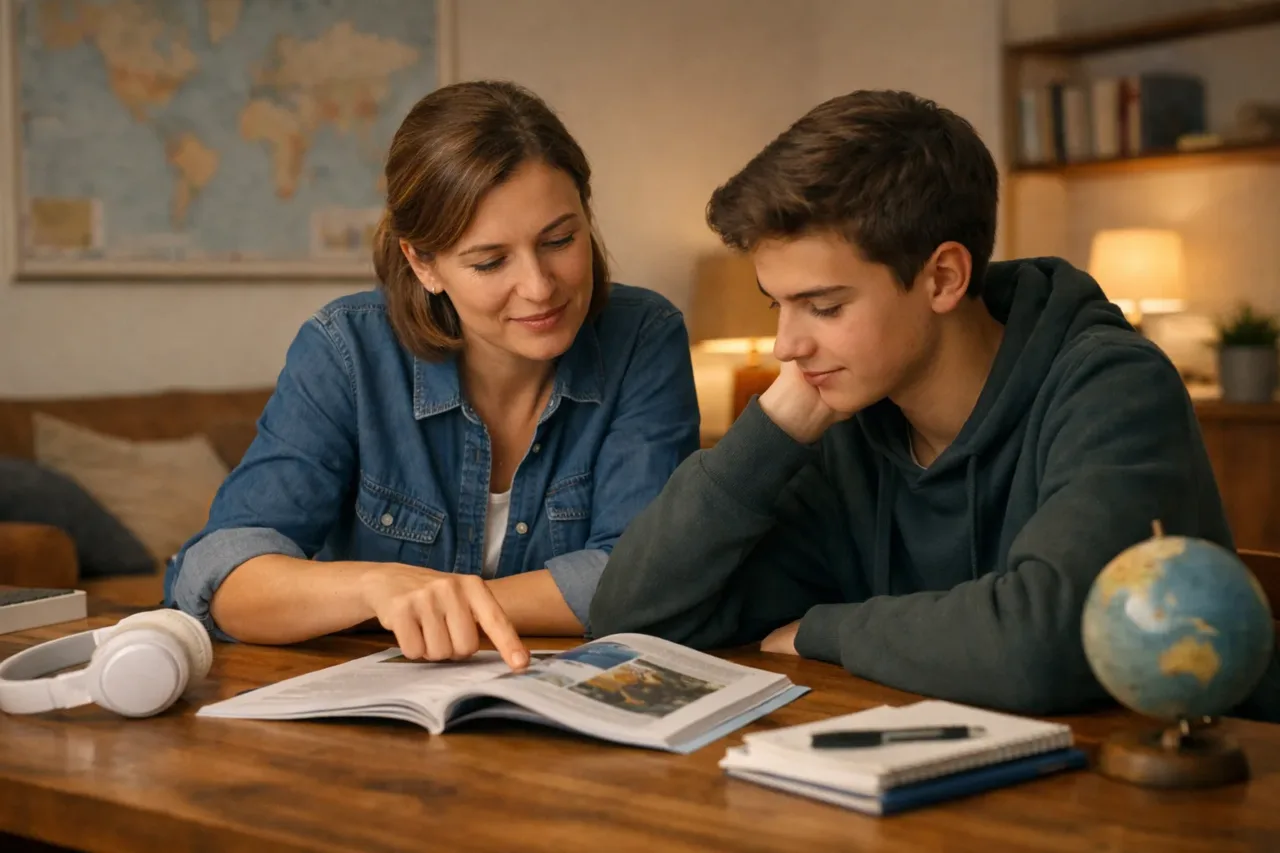
To move away from improvisation without making family life heavier, a light rhythm is often enough. Here is a realistic base.
- Choose one theme for two to four weeks. Not 'all of general knowledge', but for example the oceans, revolutions, major cities, energy, justice, the press or space exploration.
- Plan no more than two contacts a week. One short format and one richer one are enough: an article and a documentary, a podcast and a map, a film and a discussion, a visit and a quick look back.
- Keep one ten-minute conversation. Not to check, but to bring out one idea, one example, one surprise, one disagreement or one question.
- Leave a visible trace. A note, a photo, a mini timeline, three key words, one example to reuse later.
- Return to it a week later. One well-chosen question is worth more than a battery of daily prompts.
If the atmosphere turns heavy, that is usually a sign that you need to slow the pace or simplify the goal. Healthy family general knowledge is not the version that impresses guests; it is the version that makes conversations richer, lessons easier to read, and autonomy slightly stronger.
The aim is not to raise a child who can answer everything. It is to help them orient themselves, make connections, add nuance and look things up better. Strong general knowledge looks less like a display cabinet of facts than like a mental map becoming denser over time. At home, it grows better through guided curiosity than through permanent interrogation.
Sources
Keep reading
Related reading

Going blank in revision: how to turn a lesson into a self-test
When a student seems to know a topic but freezes as soon as the notes are closed, the problem is not always memory. Here is how to turn one lesson into a simple self-test, with a two-week routine parents can support without constant supervision.
Turn a topic into a light self-test without daily grilling
Writing to learn: why rewriting is better than highlighting
A brightly highlighted page feels reassuring, but it does not prepare a student to explain their lesson. Here is why rewriting in your own words works better—and how to build this habit across subjects.
Build reusable examples and explanations in your own words