

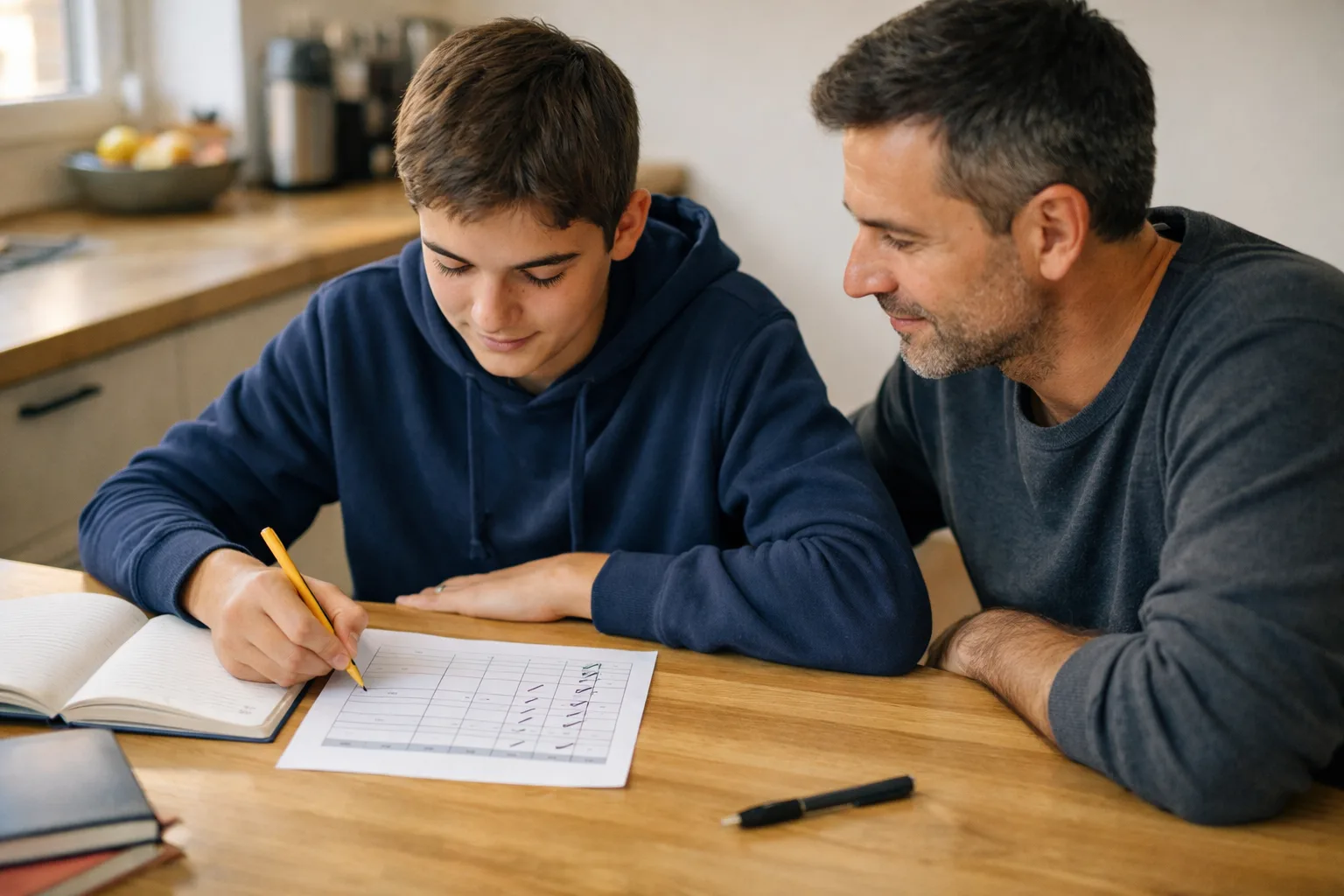
At home, many tensions around schoolwork start with a sensible intention: make sure the work actually begins, prevent backlog, stop things drifting. Then the follow-up thickens. There is a reminder, a look round the door, a question about progress, another check of the planner or exercise book. By the end of the evening, the parent has spent the whole evening steering, and the child has mostly learned to work under adult supervision.
The alternative is usually neither total hands-off freedom nor constant monitoring. It is simple follow-up: short, visible and repeatable. In practice, it is better to know whether effort has started and whether it happens again than to supervise every minute.
That sounds like a small shift. It is not. It often lowers conflict, makes the real problem easier to see and does more to build autonomy.
The real aim is not to see everything, but to see what matters
With constant monitoring, adults mostly see surface signs: an open exercise book, a body at the desk, a pen moving. But a student can look busy without doing useful work, and another can do a short, effective session with very little theatre.
Simple follow-up looks for simpler but more reliable signals: a clear starting moment, one small action completed, one visible trace that the work happened again. Often that is enough to tell whether the system is holding.
| What you are trying to do | Constant monitoring | Simple follow-up | Most likely effect |
|---|---|---|---|
| Get work started | Repeated reminders until they begin | A cue agreed in advance | Less negotiation |
| Make effort visible | Watch the time and the behaviour | A short trace of the start and the task completed | Clearer diagnosis |
| Protect the relationship | Checks scattered across the whole evening | One brief check-in at a set time | Less family wear and tear |
| Build autonomy | The momentum mainly comes from the parent | The student regains some control | More continuity when the adult steps back |
The important point is this: good follow-up is not about seeing more. It is about seeing less, but seeing the right things.
Why willpower on its own almost never holds
Many students genuinely want to be better organised. But wanting to do better and actually getting started are not the same thing. Between the two sits the friction of starting.
The cost is immediate, the benefit is delayed
Schoolwork asks for effort now in exchange for a benefit that often arrives later, feels uncertain or stays hard to see. A good mark may come much later. The discomfort of starting arrives straight away. When families rely only on motivation, they often underestimate this basic imbalance.
A vague instruction already uses up energy
“Revise history” is not really an action. It is a broad label that forces the student to decide where to start, how long to spend and how to know whether the session is doing any good. That mental steering already costs effort. Many sessions fail before the first move, not because of massive refusal, but because the entry point is too unclear.
Parental monitoring can get work started, but it borrows the adult's energy
When a parent reminds, insists and structures everything live, work sometimes begins. The problem is elsewhere: the impulse stays outside the student. What the child learns is mostly this: I get going when someone puts me back on track. As long as the adult pushes, the system moves. As soon as the adult steps back, it often collapses again.
What stays invisible is hard to reinforce
Families mostly see the gaps: forgotten work, late starts, screens, poor marks, time wasted. They see much less of the quiet repetition that actually moves learning forward: ten good minutes, three restarts in a week, one revision sheet reopened at the right moment. When useful effort stays invisible, the temptation is to increase surveillance again.
That is why the real lever is rarely a big speech about discipline. It is a system that reduces starting friction and makes small proofs of effort finally visible.
The simple system that really changes things
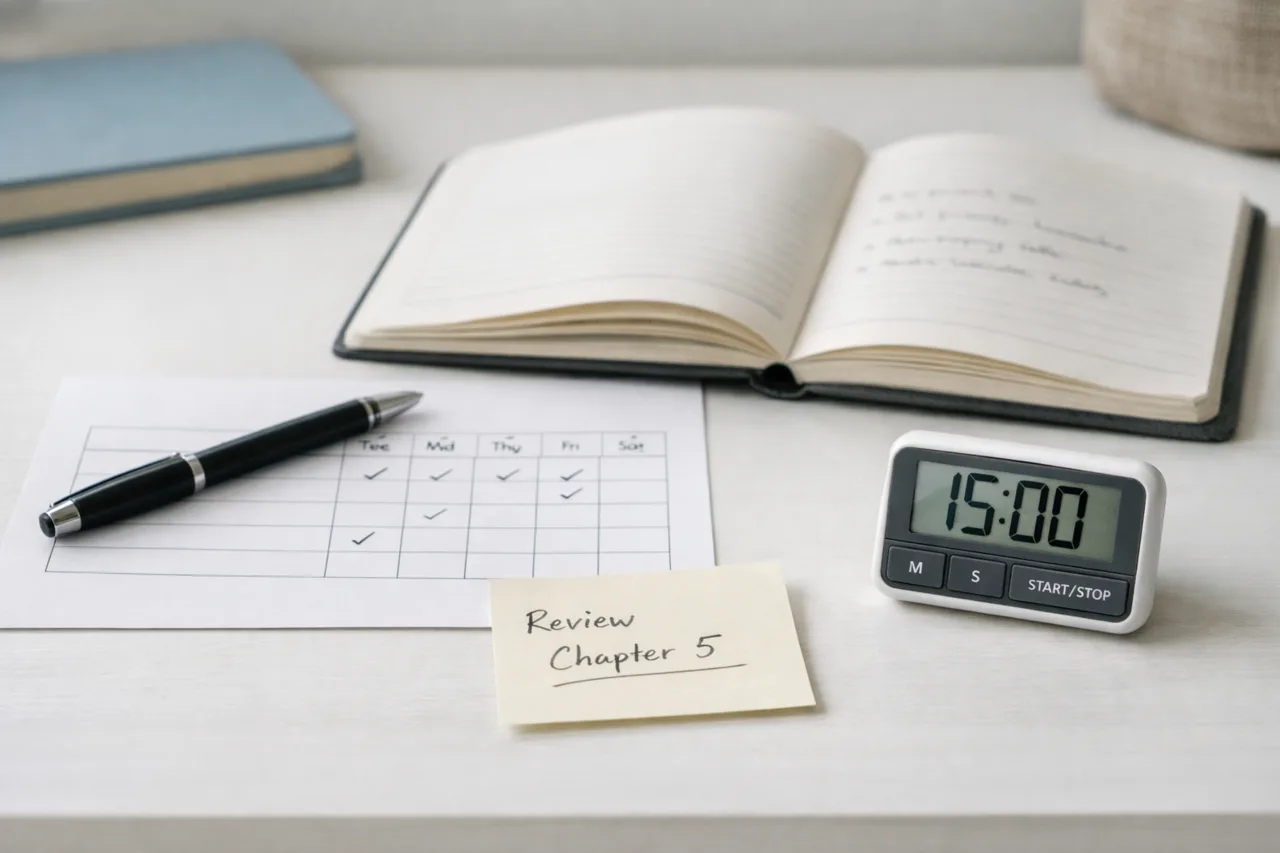
An effective system is rarely sophisticated. Most of the time, it rests on four parts that are modest enough to survive an ordinary evening.
Choose a stable cue. The best option is often a moment, not an ambition: after a snack, after a shower, after half an hour to unwind, just before dinner. The point is not perfection. The point is that the moment comes back often enough to avoid renegotiating every day.
Define a minimum action. The first step needs to be small enough to start even when there is no momentum. For example: open the exercise book and do two questions, reread one page and note three key ideas, prepare a revision card for the topic, answer five flashcards. As long as the first action stays vague, the parent will be tempted to replace the child with more control.
Put repetition before intensity. Four short sessions that actually happen are often worth more than one heroic Sunday session. Regularity gives predictability both to the brain and to family life. It also protects against the trap of “I'll do it when I have a proper hour”.
Track the trace, not every minute. Useful follow-up can fit on one sheet of paper, a whiteboard, a notebook or an app. You write down very little: whether the session started, the subject or task, and the next small action. That simplicity is not a weakness. It is exactly what makes the system sustainable.
A sufficient trace often looks like this:
- Monday: English, 12 minutes, flashcards done
- Tuesday: maths, exercise 1 started
- Thursday: nothing done, slot needs moving
With three short lines like these, you already understand more than you do after a whole evening of reminders. Simple follow-up does not measure virtue or suffering. It produces a reality signal: if the chain exists, you can encourage it; if it keeps breaking, you adjust the moment, the task or the level of help.
How parents can support without turning the house into a control room
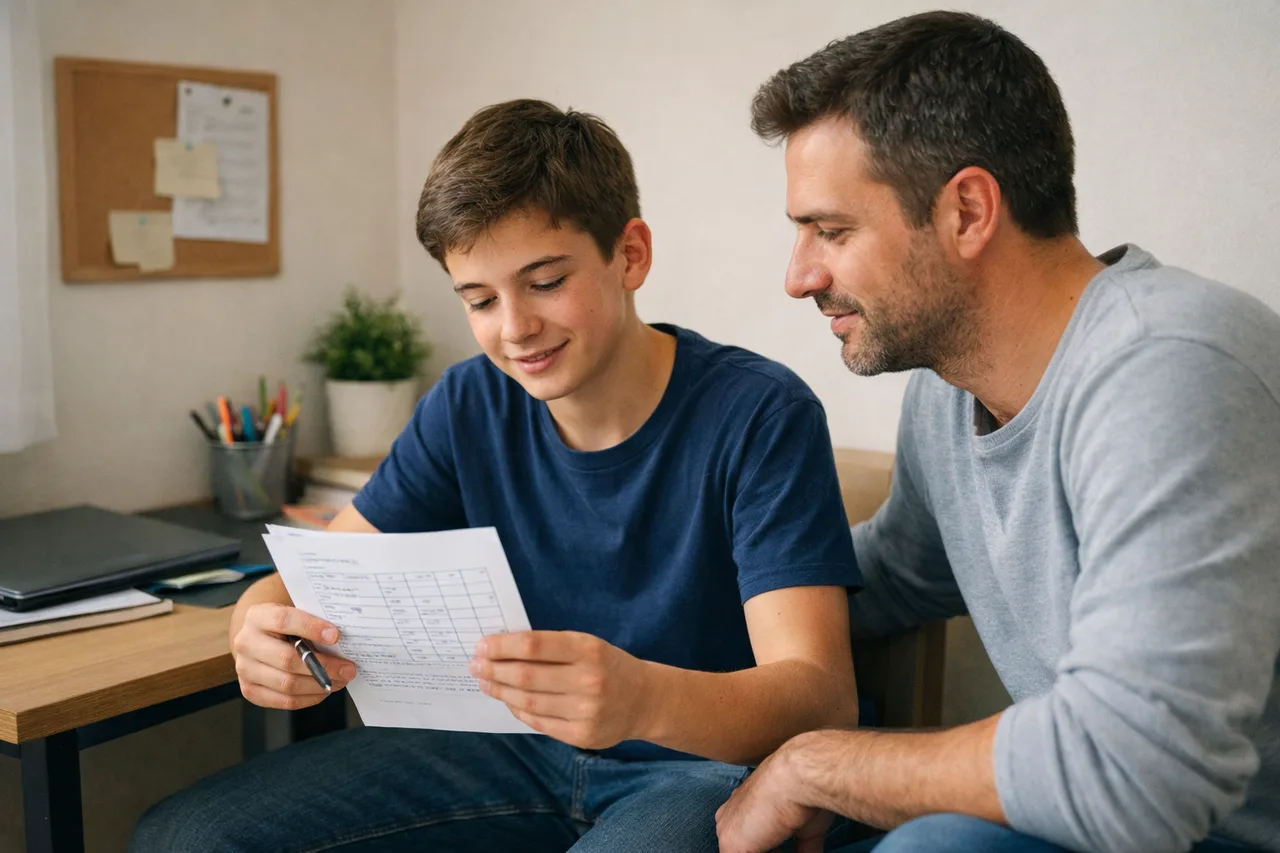
The parental role is not to comment on every minute. It is to hold the frame, look at the trace and adjust the system if needed.
A few habits help in a very concrete way:
- plan one short check-in instead of multiple interruptions;
- ask method questions, such as “What are you ticking off today?” or “What is the next small action?”;
- comment on the process rather than the student's identity;
- hand control back gradually as the routine becomes more solid.
Those questions are deliberately plain. They keep the conversation on the method instead of turning it into a judgement on character.
The true opposite of constant monitoring is not laissez-faire. It is clear structure with room for ownership. The student knows what is expected, but still has space to choose the subject, the order or the format of the small action.
For a younger secondary-school student, an almost daily check-in can still be useful. For an older teenager, two or three check-ins a week are often enough. At the start of higher education, direct parental support needs to become light and, above all, requested rather than imposed. As children grow, adults do better to support the system than to carry the whole session on their back.
Parents can directly influence the timing, the visibility of the routine, the reduction of friction and the tone of the relationship. They influence deep motivation, confidence and long-term meaning more indirectly. Keeping that distinction in mind stops family evenings from carrying goals that no extra reminder can solve.
When simple follow-up stops being enough
Simple follow-up is not a magic wand. It is, however, a very good diagnostic test. If it slightly reduces friction and slightly increases starts over a few weeks, the problem was at least partly organisational. If it changes almost nothing, you need a different diagnosis.
A few signs should make you widen the lens:
- the student starts but stalls quickly because they do not understand the lesson or the instruction;
- every session cuts into sleep or ends in exhaustion;
- materials are so scattered that there is nothing stable to reopen;
- anxiety, perfectionism or avoidance take up all the space;
- family conflict has become more central than the work itself.
In those cases, more control usually makes things worse. It is better to redefine the workload, clarify the method, speak with a teacher, get short-term help, or, if distress is spilling well beyond school, ask for professional advice. The right diagnosis matters more than an extra layer of surveillance.
What to do this week
Do not try to repair everything at once. Test a system that is small enough to survive normal evenings.
- Choose one stable cue for the next ten days.
- Decide on one genuinely doable minimum action.
- Create one visible trace in one place: a sheet, a board or a notebook.
- Plan one parental check-in only, brief and calm.
- After ten to fourteen days, judge the chain, not perfection.
A child does not learn autonomy because they are watched all evening. They learn it when the structure helps them start, restart and see what they have genuinely managed to keep going. Making effort visible is often more useful than trying to control everything.
Sources
- Implementation Intentions: Strong Effects of Simple Plans
- How are habits formed: Modelling habit formation in the real world
- Does Monitoring Goal Progress Promote Goal Attainment? A Meta-Analysis of the Experimental Evidence
- A Self-Determination Theory Perspective on Parenting
- Effects of Parental Autonomy Support and Teacher Support on Middle School Students' Homework Effort: Homework Autonomous Motivation as Mediator
Keep reading
Related reading

“He said he’d revised”: how to check the method without creating mistrust
When a child says they have revised, the real issue is not catching them out but making the method visible. Here is a simple framework for checking usefully, spotting what is really getting in the way and gradually handing control back.
Check the method without turning the conversation into a test
25 minutes, 40 minutes or 60 minutes: what is a realistic study session length?
The real question is not how long a student can stay at a desk, but how long they can do genuinely useful work. Here is how to choose between 25, 40 and 60 minutes for homework or revision without misreading the problem.
Choose a session length a teenager can realistically sustain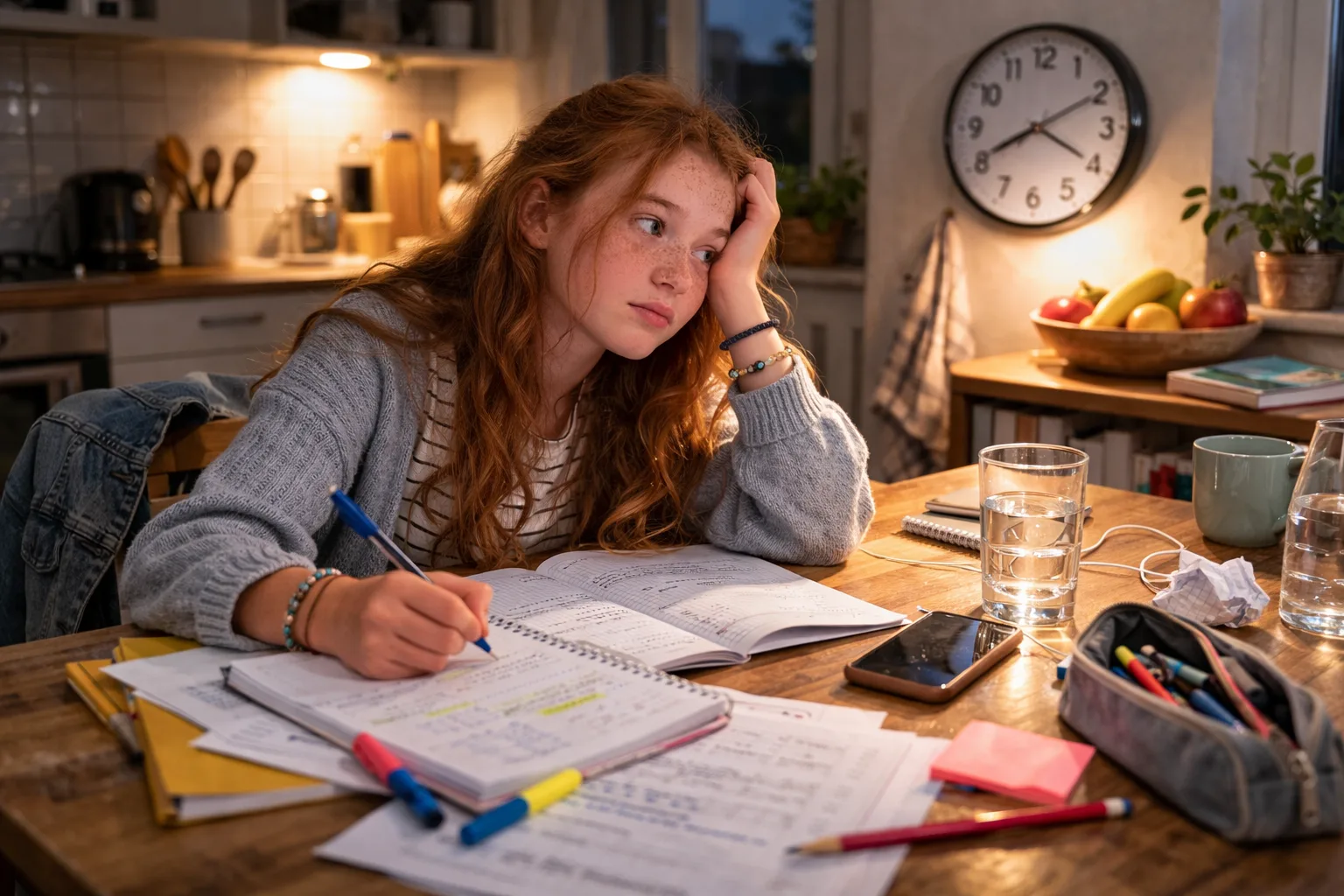
Why some students spend two hours on homework that could have taken 40 minutes
Two hours on homework do not always mean two hours of real effort. Tiredness, vague starts, distractions and avoidance often explain why a short task expands into a whole evening.
See why homework can swallow an evening without producing much
Evening study: how late is too late for real learning?
There is no universal 9 pm or 10 pm cut-off for evening study. The real limit is the point at which work starts to damage sleep or is done in a state of fatigue that no longer supports real learning.
Know when evening work starts to cost sleep more than it helps