


Your child may sometimes say they will 'get serious' from Monday, next month or after the next test. Yet a regular pattern never really settles in. Many parents conclude that the issue is simply motivation. In practice, that diagnosis is usually too short.
The useful answer is this: motivation matters, but it can almost never carry regular schoolwork on its own. It helps a student want to improve, make sense of effort and sometimes get off to a good start. But to work on ordinary days — when they are tired, slightly discouraged, in a rush, distracted or simply not especially keen — they need something else: a system simple enough to reduce decisions, vagueness and the mental cost of starting.
That is good news for families. If the problem is not just willpower, you can act more intelligently: make the start point clearer, shrink the first step, stabilise the context, make consistency visible, then adjust without turning the house into a control room.
Motivation sets a direction. It does not carry the whole routine
We often talk about motivation as if it were a steady fuel supply. That is not how it behaves in real school life. It rises and falls with tiredness, mood, confidence, the perceived difficulty of the task, the quality of the day at school, and even the way the student imagines the study session before it begins. A Year 8 pupil can genuinely want better marks and still keep delaying the moment they open the exercise book. A student in GCSE or sixth-form years can be sincerely worried about exams and still be inconsistent from one evening to the next.
In other words, motivation is very useful for answering the question why work at all? It is much less reliable when the daily question becomes why now, and what do I start with? Yet consistency is decided precisely there.
Habit research points in the same direction: when an action is repeated in a sufficiently stable context, it depends less on a burst of feeling in the moment and more on cues already associated with starting. Students do not work regularly because they feel inspired every evening. They work more regularly because getting into action costs them less mentally.
That is the shift that matters for parents. Instead of asking over and over whether a child is motivated enough, it is often more useful to ask what actually triggers the start of a session on an average day. Good days do not need much help. Ordinary days need architecture.
Why consistency is so easily knocked off course
When a student does not work regularly, the problem is often neither mysterious nor moral. A few very ordinary mechanisms are enough to derail the routine.
- Immediate relief often beats a distant benefit. In many cases, procrastination first works as a way to avoid discomfort: boredom, confusion, fear of being slow, fear of getting it wrong, or the feeling of already being behind. Saying 'I'll do it later' brings instant relief, even if it makes tomorrow worse.
- 'Do some work' is far too vague. Revise history, move on with maths, prepare for a test: all of that can remain abstract. The vaguer the starting action, the more the brain has to decide, sort and choose, and the more it resists.
- Each evening becomes a fresh negotiation. If the time changes, the place changes, and the materials are not ready, the student has to rebuild the whole start-up process. They are not following a routine; they are reopening a debate.
- The session is designed for ideal days. Many families build plans that are too ambitious: a full hour, several subjects, zero distraction, perfect energy. The system lasts three days, then breaks on the first difficult evening.
These blockages often feed a familiar spiral. The student delays, then feels guilty. Because they delayed, the task now looks bigger. Because it looks bigger, they avoid it even more. From the outside, that can look like a lack of effort. In practice, it is often a mixture of vagueness, friction and avoidance.
The practical consequence is important: this cycle is rarely broken by firmer speeches. It is more often broken by making the move into action smaller, clearer and easier to repeat.
The minimal system that really changes consistency

A student does not necessarily need a grand plan, a new desk or a dramatic surge of motivation to work more regularly. Most often, they need a minimal but sturdy system. Four elements are often enough to change the dynamic.
| Element | Question to settle | Realistic example |
|---|---|---|
| Trigger | Exactly when does the session start? | After a snack, as soon as the phone is left outside the room |
| Minimum action | What first step is still doable on a bad day? | Open the maths book and do the first question |
| Stable repetition | Which time slot and place can recur often enough? | Monday, Tuesday and Thursday at 6.15 pm at the kitchen table |
| Light tracking | How do you see that the session happened without constant checking? | One tick box, or one short line saying what got done |
The first lever is the trigger. A good trigger is not when you feel ready. It is a visible cue tied to a routine that already exists: after a snack, after a shower, just before dinner, after Tuesday training. The more precise it is, the less room it leaves for internal negotiation.
The second lever is the minimum action. This is often the missing piece. Families talk about a whole session; the student is facing the moment of starting. So the entry point has to be almost ridiculously clear: open the folder, reread one page, do two recall cards, answer the first question. Once they have started, it is often easier to continue. But the system should not depend on that continuation. It should already count as a success if it secures a real start.
The third lever is context stability. A slot that happens when we can sounds flexible, but it forces a new choice every time. A slot that is simply stable enough is often more powerful than a theoretically perfect slot that no one can keep. In some homes, that means three fixed evenings a week. In others, it means a short but systematic session on Wednesday and Sunday. Perfection is not required. Repetition is.
The fourth lever is light tracking. Many parents swing between two extremes: seeing nothing at all or commenting on every session. There is a more useful middle ground. Consistency can be made visible with a very simple marker: one ticked box, a photo of the finished page, a one-line note, a shared weekly board. The aim is not continuous surveillance. The aim is to make the work visible enough that the routine does not depend on memory or conflict.
A simple formula captures the idea well: if X happens, then I do Y. For example: If I put my bag down after school, then I open my English folder and revise for five minutes. That kind of plan does not make a student magically motivated. But it turns a vague intention into a concrete entry point.
One final truth matters here: a good school routine is designed for average days, not heroic ones. If the system only works when your child is rested, confident and highly willing, it is not yet a system.
How to help without turning home into a control room
A parent's role is not to provide all the energy on the student's behalf. It is to hold the structure that makes energy less necessary at the moment of starting. That requires real presence, but not minute-by-minute supervision.
What you can shape directly
You can influence a few very concrete variables:
- protect a small realistic slot rather than demanding one perfect block;
- prepare the starting conditions: materials within reach, phone out of sight, first task already chosen;
- tie the parental reminder to the agreed trigger instead of repeating instructions all evening;
- look at consistency over several days rather than treating each session as a verdict on the child's seriousness.
This kind of structure helps without humiliating. It says, in effect: You do not need to feel perfectly motivated. We are helping you know when to start and what to do first.
What is usually better to avoid
Some parental reactions sound logical but often worsen the problem:
- long speeches about the future every time work is delayed;
- comparisons with a brother, a sister or 'other children';
- very large goals set in the heat of one poor mark;
- constant checking that transfers all the organisational work back onto the parent.
When an adult comments on everything, the child may learn less to work independently than to work under observation. In the short term, that can produce some compliance. In the medium term, it weakens autonomy.
The right dose of support changes with age
In the early secondary years, a more explicit framework is often necessary. The adult can help choose the slot, lay out the materials, shrink the first step and briefly check that the start really happened.
In the GCSE and sixth-form years, it becomes more useful to co-build the routine. The student needs to feel that they still keep a share of the decision-making: which slot feels sustainable, what duration is realistic, how they want to show what has been done. The structure stays, but if you want real ownership, you avoid imposing every detail.
At the start of university or college, parental help can rarely be daily. It can still be useful as a checkpoint: asking how the week is organised, what is blocking progress most, and what small action would restart the system.
In all cases, the fine line is the same: support the system without taking responsibility away.
When the issue is no longer just motivation
Sometimes a better-designed routine improves things noticeably. Sometimes it does not, or not enough. That is the point at which the diagnosis needs to widen.
A few signs suggest you should look beyond consistency alone:
- the student sits down but still does not understand what they are meant to do;
- evening work regularly cuts into sleep or follows days that are already overloaded;
- each session triggers marked anxiety, tears, strong avoidance or obvious physical stress;
- difficulties with attention, planning or organisation show up across several contexts, not just in one subject;
- family conflict becomes daily even when the framework is simple and the expectations are reasonable.
In these situations, it is better to avoid a classic mistake: increasing the pressure in the belief that this will increase motivation. A routine cannot replace help with understanding, a serious look at workload, or school or professional support when the difficulty runs deeper.
The useful reflex is to distinguish three levels: what the family can adjust directly, what it can only influence indirectly, and what requires help from the school or an appropriate professional. That distinction protects everyone. Parents stop carrying the whole problem alone, and the child stops being reduced to a supposed character flaw.
A final reference point for parents
If you want to know whether you are moving in the right direction, ask yourself four simple questions:
- Is the start of the session tied to a visible and stable enough trigger?
- Is the first action small enough to stay doable even on a bad day?
- Does the follow-up make consistency visible without constant commentary?
- When the system keeps failing, are you looking for the right problem — tiredness, understanding, anxiety, organisation — rather than a moral defect?
Motivation still matters: it gives direction and meaning. But for regular schoolwork, it needs to be backed up by a structure that is simple, repeated and liveable. That is what helps a child move forward without depending each evening on a heroic burst of effort. And it is what allows parents to support without burning themselves out.
Sources
- Procrastination and the Priority of Short-Term Mood Regulation: Consequences for Future Self
- Implementation Intentions and Goal Achievement: A Meta-analysis of Effects and Processes
- Context Stability in Habit Building Increases Automaticity and Goal Attainment
- Parent Autonomy Support, Academic Achievement, and Psychosocial Functioning: a Meta-analysis of Research
Keep reading
Related reading

25 minutes, 40 minutes or 60 minutes: what is a realistic study session length?
The real question is not how long a student can stay at a desk, but how long they can do genuinely useful work. Here is how to choose between 25, 40 and 60 minutes for homework or revision without misreading the problem.
Choose a session length that survives real evenings
Why a teenager’s attention collapses faster than you think
A teenager who switches off quickly does not necessarily have an attention problem. Fatigue, avoidance, a vague task and constant micro-interruptions often explain far more.
See when fatigue or a vague task is killing concentration
Evening study: how late is too late for real learning?
There is no universal 9 pm or 10 pm cut-off for evening study. The real limit is the point at which work starts to damage sleep or is done in a state of fatigue that no longer supports real learning.
Protect sleep before evening study starts backfiring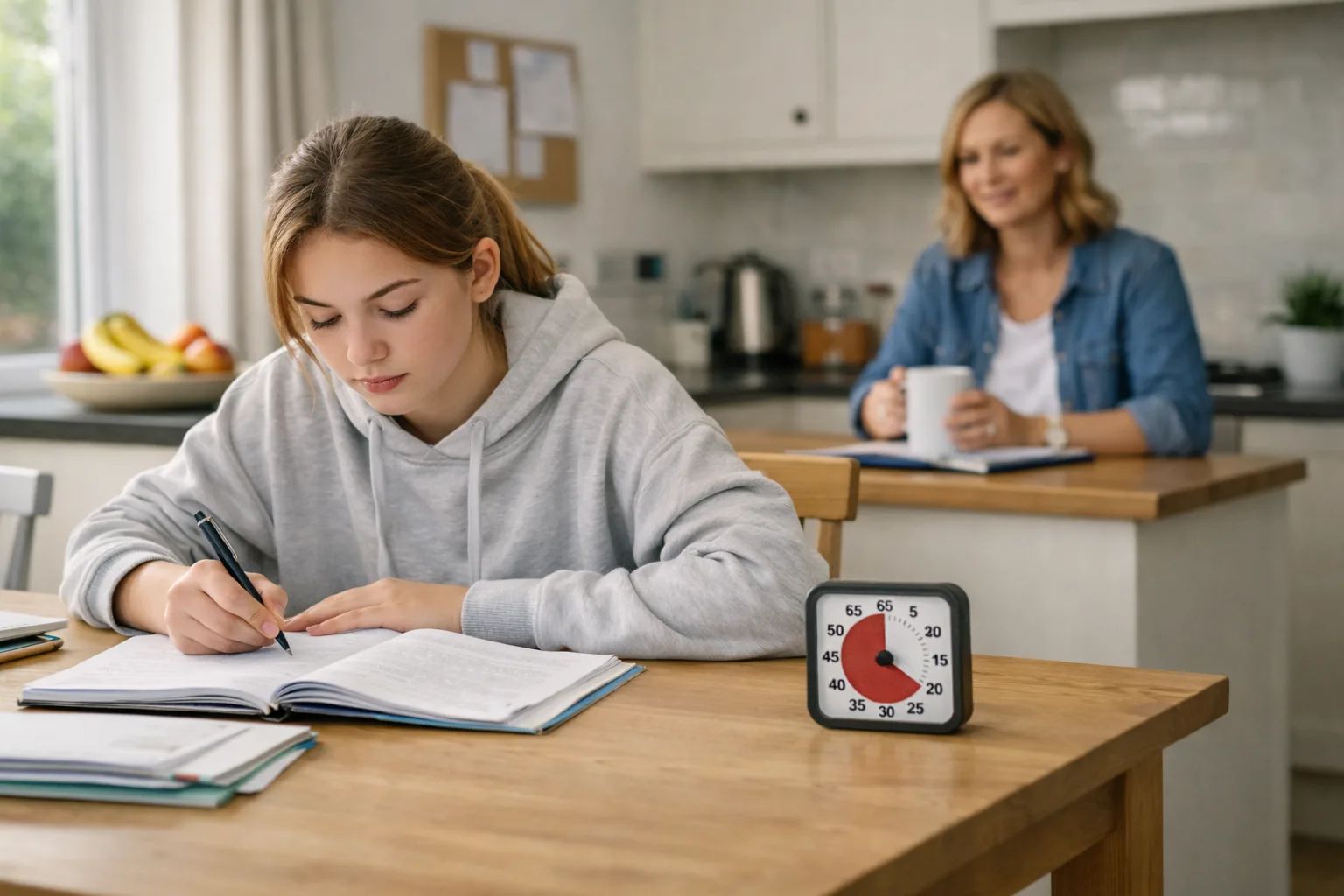
Schoolwork at the weekend: how to make it useful without making it stressful
Schoolwork at the weekend can calm the week or swallow it whole. The aim is not to recreate school at home, but to use short, clearly bounded sessions to consolidate learning, reduce Monday stress, and build autonomy gradually.
Use weekends to steady the routine without extra stress