

The real problem is not a lack of willpower
When a student only starts working in a rush, the visible problem looks simple: they waited too long. The deeper problem is usually more interesting. The work was vague, the first step felt uncomfortable, the reward was far away, and the family system accidentally made urgency the only reliable trigger.
The practical answer is therefore not “find more motivation”. Motivation helps, but it is too unstable to carry schoolwork by itself. A steadier system has four parts: a predictable cue, a very small first action, a work method that gives feedback quickly, and a restart rule for the days when the routine breaks.
That shift matters for parents. If procrastination is treated as a moral flaw, evenings become arguments about character. If it is treated as a system problem, the family can ask more useful questions: What exactly is the task? What makes starting unpleasant? What would count as the first five minutes? How will the student notice progress before the deadline panic arrives?
This page is a practical guide to habits, motivation and procrastination in school life. It is written for families who want regular work without turning every evening into surveillance, negotiation or guilt.
Why motivation is too fragile to carry the whole routine
Motivation is real, but it fluctuates with sleep, stress, interest, confidence, peer pressure, screen temptations and the emotional weight of the subject. A child may genuinely intend to study after school and still avoid it when the moment arrives. That does not mean the intention was fake. It means intention alone did not survive contact with the day.
A useful distinction is this:
| Word | What it means in practice | Why it is not enough alone |
|---|---|---|
| Motivation | “I want to do better” or “I care about this result” | It often appears after progress, not before it. |
| Trigger | The concrete moment that starts the routine | It needs to be attached to a specific action. |
| Habit | A repeated response to a stable context | It takes time and must stay small enough to repeat. |
| Identity | “I am someone who can restart and keep going” | It is built by evidence, not speeches. |
Many students and parents reverse the order. They wait for confidence before starting. In reality, a small start often creates the first evidence that confidence can grow from. The student does not need to feel like a disciplined person to open the notebook, answer three questions, or reread one corrected exercise. They need an entry point that is low-friction enough to begin on an ordinary day.
This is also why Sunday-night master plans often fail. A beautiful plan can feel reassuring, but if it depends on high energy, perfect cooperation and long uninterrupted blocks, it will collapse the first time the week becomes normal. A good routine is less impressive on paper and more reliable in real life.
The parent’s better question
Instead of asking, “How do I make my child motivated?”, ask, “What would make the first useful action almost obvious?” That question points toward cues, environment, task size and feedback. It also reduces shame, because the goal is not to force a personality change; it is to make the desired behaviour easier to repeat.
What school procrastination is often protecting against
Procrastination is not always laziness. Sometimes it is avoidance of a feeling: confusion, boredom, shame, fear of failing, fear of discovering how much work is left, or frustration with a subject that has felt hostile for months. Sometimes it is simple friction: the student cannot find the course material, does not know what “revise chapter 4” means, or starts with the largest task rather than the first action.
A practical diagnosis is more useful than a label. Before choosing a solution, look for the block.
| If the student says or shows... | The likely hidden block | A better first response |
|---|---|---|
| “I don’t know what to do” | The task is too vague | Turn it into one visible action: “Find the lesson and mark three parts you do not understand.” |
| “It’s too much” | The task is too large | Cut the first session to 10–20 minutes and define a finish line. |
| “I’ll do it later” | There is no reliable trigger | Attach work to a stable moment: after snack, after sport, after dinner, before entertainment. |
| “I’m bad at this subject” | The task threatens identity or confidence | Start with a low-stakes recall or one corrected example, not a full test. |
| “I revised but it didn’t work” | The method may be passive | Replace rereading with questions, practice problems or explaining aloud. |
| Constant arguments | The family system has become the trigger | Move from repeated reminders to a shared, visible routine and one calm check-in. |
The point is not to excuse every delay. Students still need to learn responsibility. But responsibility grows better when the adult response fits the real obstacle. A student who is confused needs clarification, not a lecture about effort. A student who is anxious needs a tolerable first step, not a dramatic promise to “work all weekend”. A student who has no routine needs a cue, not daily improvisation.
The urgency cycle
Many families get stuck in a loop: delay, panic, intense work, relief, exhaustion, then another delay. The cycle is powerful because urgency works in the short term. A deadline creates energy, narrows attention and removes choices. But it also teaches the brain that work only starts when stress becomes high enough.
Breaking the cycle means creating a gentler trigger before panic. That trigger can be small: a 20-minute session, a daily review of tomorrow’s lessons, three retrieval questions, or a short “open the material and choose the first action” ritual. The aim is not to replace all pressure with perfect calm. It is to make calm beginnings familiar enough that panic is no longer the only engine.
Build a routine that is small enough to survive real life
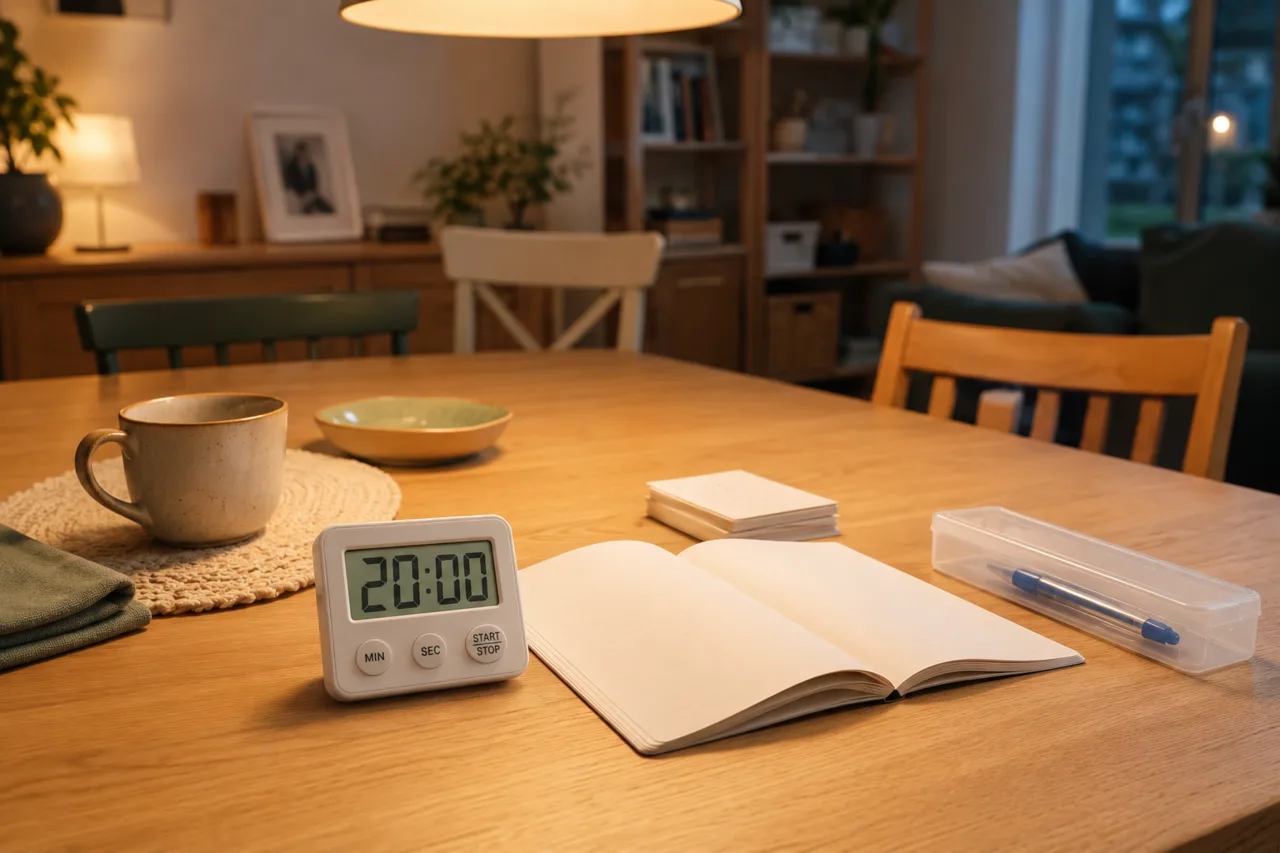
A study routine works best when it is concrete, repeatable and modest. The more fragile the student’s current habits, the smaller the routine should be at the beginning. This can feel counterintuitive to parents who are worried about falling behind, but an overambitious routine often becomes another failed promise. A small routine that actually happens is more valuable than a heroic plan that fails by Wednesday.
Use this structure:
- Choose a stable cue. “After I get home and eat,” “after dinner,” or “before I use entertainment screens” is clearer than “sometime in the evening.”
- Define the first action. Not “study science”, but “open the lesson, cover the page, answer five questions from memory.”
- Set a short finish line. A visible 15–25 minute block is often enough to start. Longer work can happen later, but the routine should not depend on it.
- Make materials easy to reopen. The notebook, lesson, questions, calculator or flashcards should not require a search mission.
- Track completion lightly. A small tick, note or shared log makes effort visible without turning parents into inspectors.
The cue matters because it removes negotiation. The first action matters because “work” is too abstract. The finish line matters because students who procrastinate often imagine the task as endless. Tracking matters because regularity is hard to believe in until it is visible.
What a minimal routine can look like
For a younger child, the routine might be: snack, empty school bag, choose one short task, work for 15 minutes near an adult, then explain what was done. The adult’s job is to keep the frame clear, not to correct every detail.
For a teenager, it might be: phone away, timer visible, open the subject folder, do 20 minutes of active recall or practice, note one point to ask about, then stop or continue by choice. The teenager’s autonomy matters, but autonomy is not the same as being left alone with a vague expectation.
A good test is this: could the routine still happen on a normal tired evening? If not, make it smaller. The first goal is not to cover everything. It is to create a repeatable beginning.
Make starting easier, then make the work count
Many students do technically “spend time” working but use methods that do not create much feedback. Passive rereading, highlighting and copying can feel safe because they avoid the discomfort of not knowing. They are sometimes useful for orientation, but they should not be the whole routine.
A better anti-procrastination method combines easy entry with active work:
- Open with a tiny action: write the date, open the lesson, find the exercise, or answer one question.
- Move quickly to retrieval: close the page and recall what matters, use flashcards, redo an example, or explain the idea aloud.
- Keep the session bounded: the student should know what “done for now” means.
- End with a next-action note: “Tomorrow: redo questions 4 and 5” is better than “continue revising.”
- Protect the first minutes: the phone, game, chat or video feed should not sit inside the starting zone.
The first action is psychologically important because it turns a large identity-heavy problem into a physical step. “I am behind in maths” is heavy. “Open the correction and redo one example” is possible.
The method also matters because students are more likely to repeat work that gives them a signal. Active recall is uncomfortable at first, but it quickly shows what is known, half-known and unknown. That makes the next session easier to define. The student no longer has to decide from scratch; the work itself gives information.
Reduce friction before asking for discipline
Parents often focus on discipline after the conflict has already started. It is usually more effective to reduce friction before the work moment arrives. Put the materials in one place. Choose the subject before the routine starts. Decide the first action earlier in the day. Make the phone rule predictable rather than negotiated every evening. Keep the first session short enough that the student can succeed while still tired.
This is not “lowering standards”. It is building the entry conditions for standards to become realistic.
Restart after a broken week without turning it into a drama
Every routine breaks. A student gets sick, a week becomes overloaded, a test goes badly, or the family simply loses the rhythm. The mistake is to treat a broken streak as proof that the whole effort was fake. That interpretation creates all-or-nothing thinking: if the routine is not perfect, there is no point restarting.
A better restart has three steps.
First, separate recovery from blame. Ask, “What needs attention now?” rather than “Why did you do this again?” The answer may be one subject, one assignment, one lesson, or one test coming soon.
Second, restart below the previous level. If the student had a 30-minute routine and lost it, restart with 10 or 15 minutes. The point is to regain contact with the work, not to compensate for every missed session immediately.
Third, define the next visible win. A visible win might be completing three practice questions, preparing tomorrow’s materials, revising one small lesson, or sending one question to a teacher or classmate. Confidence returns faster when it is attached to a concrete action.
After a difficult term
When a whole term has gone badly, families often want a complete reset: new planner, new rules, new identity, new promises. Some structure can help, but the first priority is triage. Which subjects are urgent? Which gaps block current learning? Which routines failed because they were unrealistic? Which adult support is truly needed?
A difficult term should lead to a narrower plan, not a more theatrical one. Choose one daily routine, one subject to stabilise first, and one weekly review moment. Then build from evidence. The student needs proof that improvement can begin before they feel fully confident.
Rewards, feedback and trust
Rewards can help when they acknowledge effort and make progress visible. They become less useful when they turn every study session into a negotiation or when the reward is so large that the work feels like a punishment to be endured. Feedback is often better than bribery: “You started twice this week without an argument” gives the student evidence of change.
Trust works the same way. It is not rebuilt by one promise. It is rebuilt by small repeated signals: starting when agreed, asking for help earlier, stopping honestly, showing what was done, restarting after a miss.
How parents can support without becoming the control tower
Parents need a difficult balance. Too little structure leaves many students alone with tasks they cannot organise yet. Too much control can make the parent the engine of every action, which delays autonomy and increases conflict.
The goal is not to disappear. It is to move from command to structure.
| Less helpful | More useful |
|---|---|
| “You never work unless I force you.” | “Let’s find the smallest start that can happen even on a tired day.” |
| “Go revise.” | “Which lesson will you open first, and what will you do for the first 10 minutes?” |
| “You promised, so now you have to do everything.” | “The routine broke. We restart smaller today.” |
| “Give me your whole evening plan.” | “Show me the first task and when you will start.” |
| “I don’t care how you feel; just work.” | “You do not need to feel ready. You need a first action that is possible.” |
A good parental check-in is short and predictable. It might ask three questions: What is the first task? When will you start? What will count as finished for today? The child or teenager should answer as much as possible. The parent can help make the answer more concrete.
For younger children, parents may need to set the physical frame: place, time, materials, quiet and a visible endpoint. For teenagers, the frame should increasingly become negotiated: what the routine is, what parents may check, and what the student owns.
When procrastination may need more than a routine
A routine is not a cure for every difficulty. If procrastination comes with persistent distress, sleep collapse, school refusal, intense anxiety, attention problems, major family conflict or signs of depression, the family may need help beyond study habits. In that case, the routine should stay gentle and supportive, while parents seek appropriate professional or school-based guidance in their context.
This distinction protects the child. It prevents everyday procrastination from being over-medicalised, but it also prevents serious distress from being dismissed as poor discipline.
Common questions parents ask
Should the routine be daily?
Daily is useful when the routine is very small and tied to reopening school material, not when it becomes a heavy second school day. For some students, five short sessions a week are more realistic than one long session. The important point is predictability: the student should not have to renegotiate the existence of work every evening.
How long should a study session be?
Start with a length the student can actually complete. For many families, 15–25 minutes is a better first target than a full hour. Older students may need longer blocks at certain times, but even then, the first block should have a clear task and a clear stop point.
What if my child refuses to start?
Do not begin with a debate about attitude. Begin by shrinking the action: open the notebook, choose the exercise, read the instruction, answer one question, or set the timer. If refusal is frequent and intense, look for the hidden block: fear, confusion, fatigue, attention difficulty, conflict, or a subject gap.
Are rewards a good idea?
Small rewards can support a new routine, especially for younger children, but they should not replace feedback about competence and progress. The best reward system makes the routine visible and finite. It does not require parents to negotiate a new prize every day.
Should screens be banned during homework?
A blanket rule is less important than a predictable starting rule. Entertainment screens are powerful because they offer immediate reward and no uncertainty. During the first work block, they usually need to be away from the starting zone. After that, families can choose rules that fit the child’s age, trust level and workload.
A practical recap for the next 48 hours
To reduce school procrastination, do not start by trying to transform motivation. Start by changing the conditions under which work begins.
Choose one school moment that often goes wrong. Define a cue, a first action and a short finish line. Prepare the material before the work moment. Use active recall or practice so the session produces feedback. Track completion lightly. If the routine breaks, restart smaller rather than turning the break into a judgment about the child.
The simplest useful plan is often this:
- Pick one subject.
- Pick one stable time.
- Define the first five minutes.
- Work for a short visible block.
- End by writing the next action.
- Repeat before increasing the ambition.
The child does not need to become a different person before regular work begins. They need a system that makes starting less dramatic, progress more visible and restarting normal.
Sources
- The Nature of Procrastination: A Meta-Analytic and Theoretical Review of Quintessential Self-Regulatory Failure
- Implementation Intentions and Goal Achievement: A Meta-Analysis of Effects and Processes
- Improving Students’ Learning With Effective Learning Techniques: Promising Directions From Cognitive and Educational Psychology
All articles in this category
Every published article in this topic, from newest to oldest.
- A 20-minute study routine can work better than a big Sunday catch-up
- Making effort visible: why simple follow-up works better than constant monitoring
- Sunday planning: useful, but only if it does not create a false sense of control
- Why motivation alone is rarely enough to create a regular study routine
- Why some students only work under pressure — and how to break the cycle