

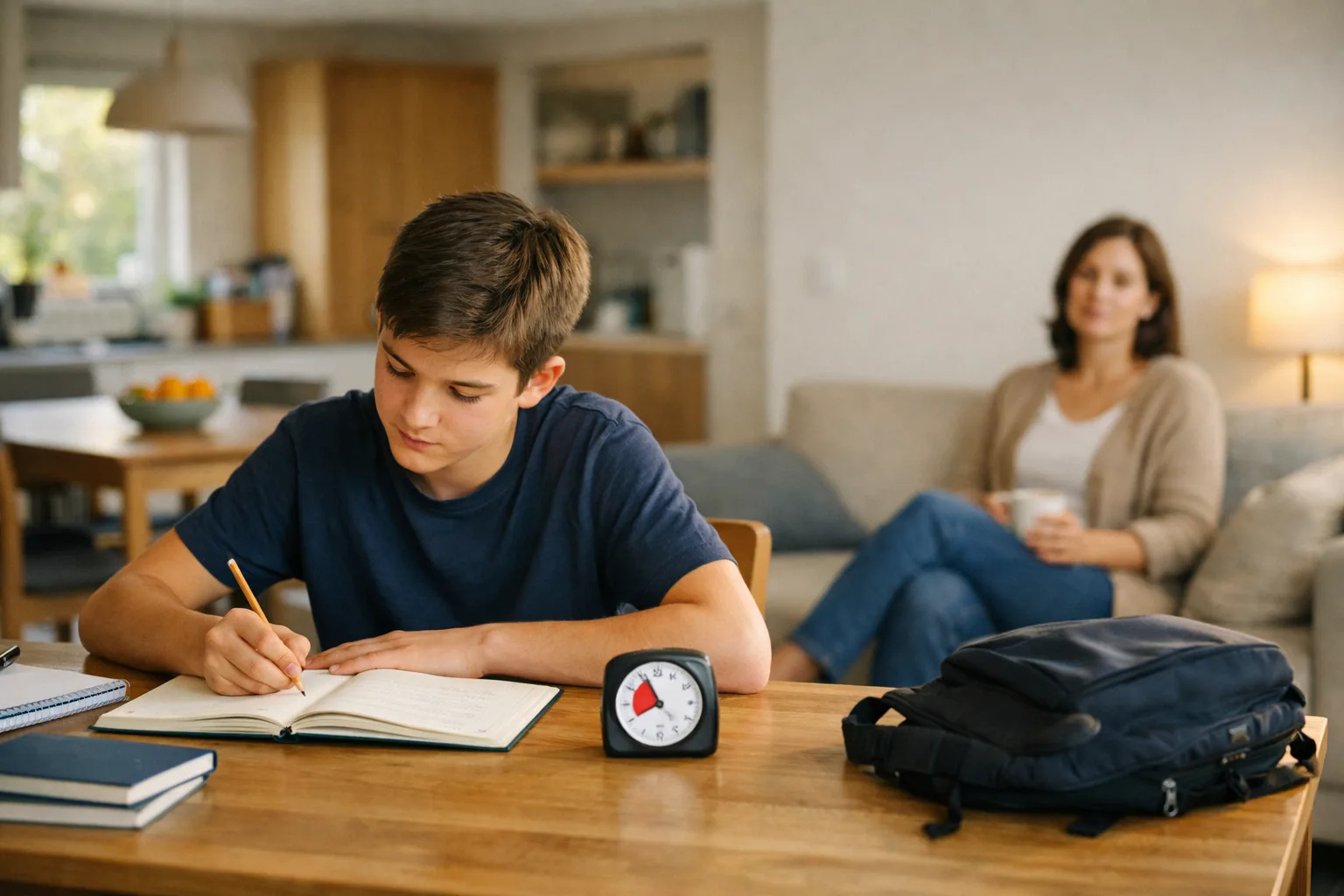
When the whole school week depends on a big Sunday catch-up, many families end up in the same pattern: things are postponed, promises are made, negotiations drag on, and then the weekend becomes heavy, tense or disappointing. The intention is sensible, but the system is fragile.
In many cases, a 20-minute routine works better than a big Sunday catch-up. Not because Sunday is useless, but because a short session repeated several times a week lowers the cost of getting started, keeps lessons in regular circulation, and stops all the work from resting on one moment of motivation.
This is not a magic number. For some students, the right entry point will be 10 minutes; for others, 25. The central idea is elsewhere: a modest session that can be restarted several times a week will often beat a grand theoretical plan that nobody really sustains.
Sunday can still have a useful role. It simply works better as a planning point, a targeted catch-up slot or a moment to put things back in order than as the single pillar of the week.
Why the big Sunday catch-up feels reassuring — then often disappoints
The big Sunday catch-up is attractive because it creates a feeling of taking control again. The parent thinks the week is not lost; the student thinks they will have, later on, the energy they do not have today. For a moment, everyone breathes out. But that relief is often just the problem being pushed back.
The main difficulty is simple: willpower is not a system. After lessons, sport, clubs, commuting or plain tiredness, a student already has to cross a significant mental threshold just to sit down and begin. If nothing small and concrete happens during the week, that threshold grows. By Sunday, the task is no longer just to open a notebook. It is to restart, find the sheets, work out what has been done, face the idea of a large block of work, and carry the guilt that has built up in the meantime. Starting becomes heavier at exactly the moment the family is counting on it.
There is another trap too: Sunday often combines three different tasks. The student has to organise, catch up and learn. Those are not the same effort. A session that begins by hunting for papers, rebuilding the week and arguing about priorities is not really a learning session, even if it takes time.
And when everything depends on one large weekly appointment, the whole setup becomes brittle. A birthday, a match, fatigue, a family visit or an unexpected disruption is enough to knock out the week’s only anchor point. This kind of organisation easily creates a stop-start rhythm: almost nothing for several days, then one compressed attempt at compensation. For memory, confidence and family atmosphere, that is not a very strong base.
What a 20-minute routine actually changes
A short routine does not solve everything, but it changes one decisive thing: it lowers the entry threshold. Twenty minutes is not pleasant for every student, but it is limited enough not to feel like the whole evening has been sacrificed. The brain does not need to accept a mountain; it only needs to accept a finished, identifiable and manageable task.
The contrast is clearer here:
| Approach | What it asks at the start | What it often produces | What it teaches the student |
|---|---|---|---|
| Big Sunday catch-up | A lot of energy, forward planning and negotiation | Catch-up work, fatigue, dense rereading, and a sense of failure when the plan slips | That schoolwork arrives in waves and under pressure |
| 20-minute routine | A lighter start that can be repeated | Frequent contact with lessons, mistakes noticed earlier, and less panic before tests | That you can start small, return often and make progress without drama |
The real strength of a short routine is therefore not just its length. It is repetition inside a stable frame. When a student works often at roughly the same time, with a recognisable cue, they spend less energy re-deciding every evening. Over time, the sequence becomes more familiar and less dependent on a burst of motivation.
For learning itself, short and frequent returns have another advantage: they stop everything being compressed into one block. Memory usually holds on to material better when it is revisited at intervals than when it is reread for a long time once. There is one condition, though: the 20 minutes need to be active. Passively rereading notes for 20 minutes is not the same as answering three questions from memory, redoing two short exercises, reciting a plan without looking, or checking what has actually been retained.
In other words, 20 minutes can be enough to do something useful, not everything. And that is precisely why they can be powerful. A short routine does not promise to fix the whole problem in one evening. It creates continuity.
Build a simple system that survives ordinary days

A routine that lasts is not a slogan. It is a small system. The simpler it is, the better its chances of surviving ordinary days.
Choose a stable cue.
Not a vague intention such as “I’ll do a bit later”, but a real marker: after a snack, after getting back from football, straight after dinner, after a shower, or once the school bag has been unpacked. The right cue is not the most ambitious one. It is the one that actually comes back.
Define one precise minimum action.
The starting task should be concrete: reopen today’s lesson and write down five ideas from memory, do two short questions, make three question cards for Thursday’s test, correct yesterday’s maths exercise, or close the page and summarise it without support. The vaguer the first step, the more room there is for negotiation.
Keep the same logic for several days in a row.
There is no need to aim for seven days a week. Four or five realistic days are better than an unstable ideal. Some families do not have five evenings available; that is fine. Three or four short returns that genuinely happen are still better than a weekly masterplan that collapses.
Track lightly, without turning the routine into a dashboard obsession.
One tick in a notebook, a paper chain on the fridge, or a simple mark in the planner is enough. The goal is not to create statistics. It is to make regularity visible. What matters first is that the session happened, not that it looked impressive.
Decide in advance what happens when a day is missed.
A solid routine is not one that never misses an evening. It is one that knows how to restart quickly. The useful rule is simple: if one slot is missed, pick up again at the next one without a dramatic speech and without trying to overcompensate.
Depending on age and stage, the function of those 20 minutes changes slightly:
- At the start of secondary school, they mainly help the student keep contact with lessons, get homework moving and begin memorising before the night before.
- Later in secondary school, they are more useful for avoiding pile-ups, anticipating tests and keeping weaker subjects alive.
- At the start of higher education, they often act as a launch ramp: a small block that sometimes leads into a longer session on the days when more is genuinely needed.
The key point stays the same: the right routine is not the one that looks impressive. It is the one modest enough to be repeated.
How parents can support without turning home into a control room
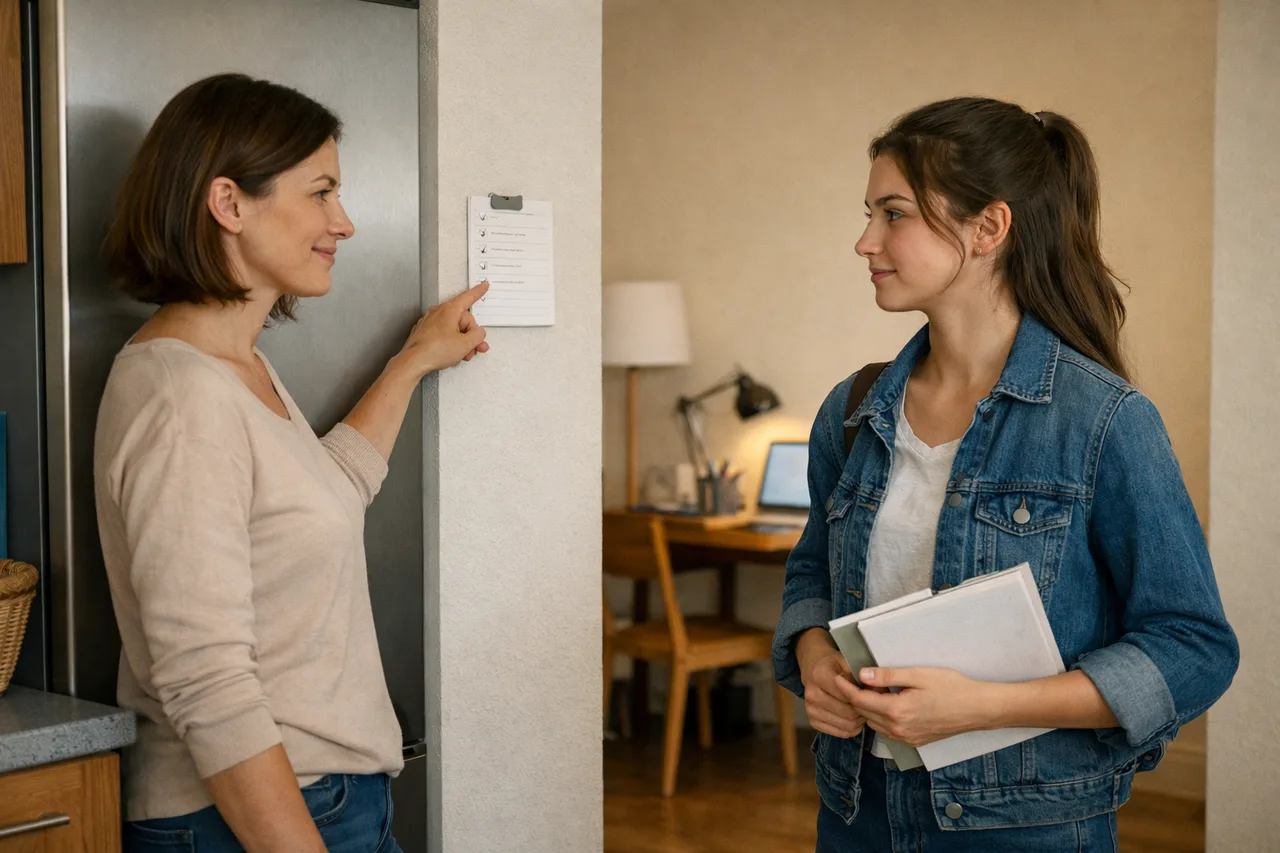
The parent’s job is not to comment on every minute or inspect every notebook. It is to support the system rather than take the place of the system. That distinction changes a lot.
In practice, a parent can help through four useful levers:
- protect a slot rather than repeating all evening that work needs to be done;
- clarify the starting task when the student does not know how to begin;
- keep the tone steady instead of turning each forgotten session into a verdict on motivation;
- look at the weekly pattern rather than judging the child’s value from one missed evening.
The most helpful sentences are often very plain: “What is your 20-minute task tonight?”, “What needs reopening this evening?”, “When are you restarting at the next slot?” They bring the conversation back to action. By contrast, remarks such as “you have no willpower” or “look how much time you waste” move the discussion towards identity, guilt or defence.
Supporting autonomy does not mean leaving a child alone with their difficulty. It means leaving them a real share of control inside a frame that is clear. A student at the start of secondary school often needs more scaffolding to get the routine going. An older teenager usually needs something else: an adult who stabilises the frame without taking the wheel every evening.
When parents become the centre of reminders, checking and running commentary, the house often produces surface compliance rather than useful work. The student learns to respond to pressure, not to restart by themselves.
Keep Sunday in its proper place
Sunday is not the enemy. It only becomes a problem when it carries the whole architecture of schoolwork on its own. Used well, it can be genuinely helpful for:
- looking ahead to the coming week;
- preparing the materials that need reopening;
- identifying one or two risk points;
- doing targeted catch-up in one specific subject if necessary.
In other words, Sunday is best used as a safety net or planning point, not as a session of academic penance.
It is also important to recognise the cases where 20 minutes are not enough. A short routine is a base, not a universal remedy. It will be too light if the student does not understand the lessons, if they are carrying a large backlog, if every homework task takes far too long, if evening fatigue is eating the whole slot, or if anxiety occupies the session from start to finish. In those cases, the right question is no longer only “How do we become more consistent?” but “What is the real problem here: understanding, method, workload, sleep, attention or stress?”
When the routine holds but the work is still ineffective, it may be necessary to change method, contact a teacher, lower some ambitions temporarily, or schedule occasional longer sessions that are more sharply targeted. Here again, Sunday can help, but as secondary support. It should not become the only moment when school exists.
What to keep in mind
If your child often promises to get properly back on track on Sunday, the issue is not necessarily a lack of good intentions. It is often a problem of weekday design.
The main points are these:
- a small repeated session is often better than one large random block;
- the best duration is the one that can be restarted often, not the one that looks impressive on paper;
- the routine needs a real minimum action, not a vague intention;
- parents help more by stabilising the frame than by commenting constantly;
- Sunday is useful as preparation or targeted catch-up, not as the only pillar of the week.
So the real question is not, “When will we finally find two or three hours?” It is: “What small sequence can we make clear enough, light enough and regular enough to survive even on an ordinary Tuesday?”
Sources
- How are habits formed: Modelling habit formation in the real world
- Improving Students' Learning With Effective Learning Techniques: Promising Directions From Cognitive and Educational Psychology
- The critical importance of retrieval for learning
- Implementation intentions and goal achievement: A meta-analysis of effects and processes
- Parent Autonomy Support, Academic Achievement, and Psychosocial Functioning: a Meta-analysis of Research
Keep reading
Related reading

25 minutes, 40 minutes or 60 minutes: what is a realistic study session length?
The real question is not how long a student can stay at a desk, but how long they can do genuinely useful work. Here is how to choose between 25, 40 and 60 minutes for homework or revision without misreading the problem.
Choosing a realistic study session length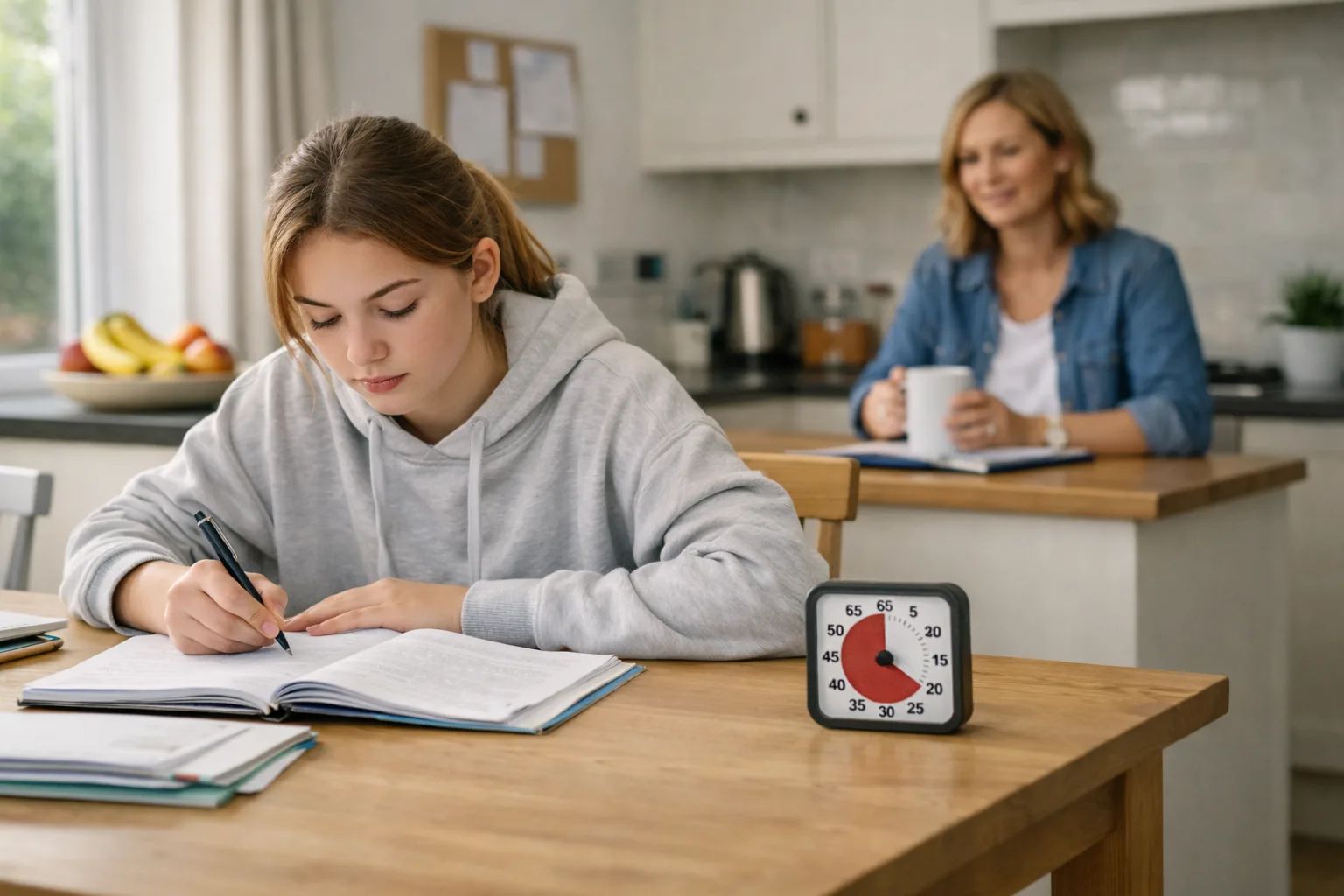
Schoolwork at the weekend: how to make it useful without making it stressful
Schoolwork at the weekend can calm the week or swallow it whole. The aim is not to recreate school at home, but to use short, clearly bounded sessions to consolidate learning, reduce Monday stress, and build autonomy gradually.
Making weekend schoolwork useful without letting it take over
Evening study: how late is too late for real learning?
There is no universal 9 pm or 10 pm cut-off for evening study. The real limit is the point at which work starts to damage sleep or is done in a state of fatigue that no longer supports real learning.
Seeing when evening study stops supporting real learning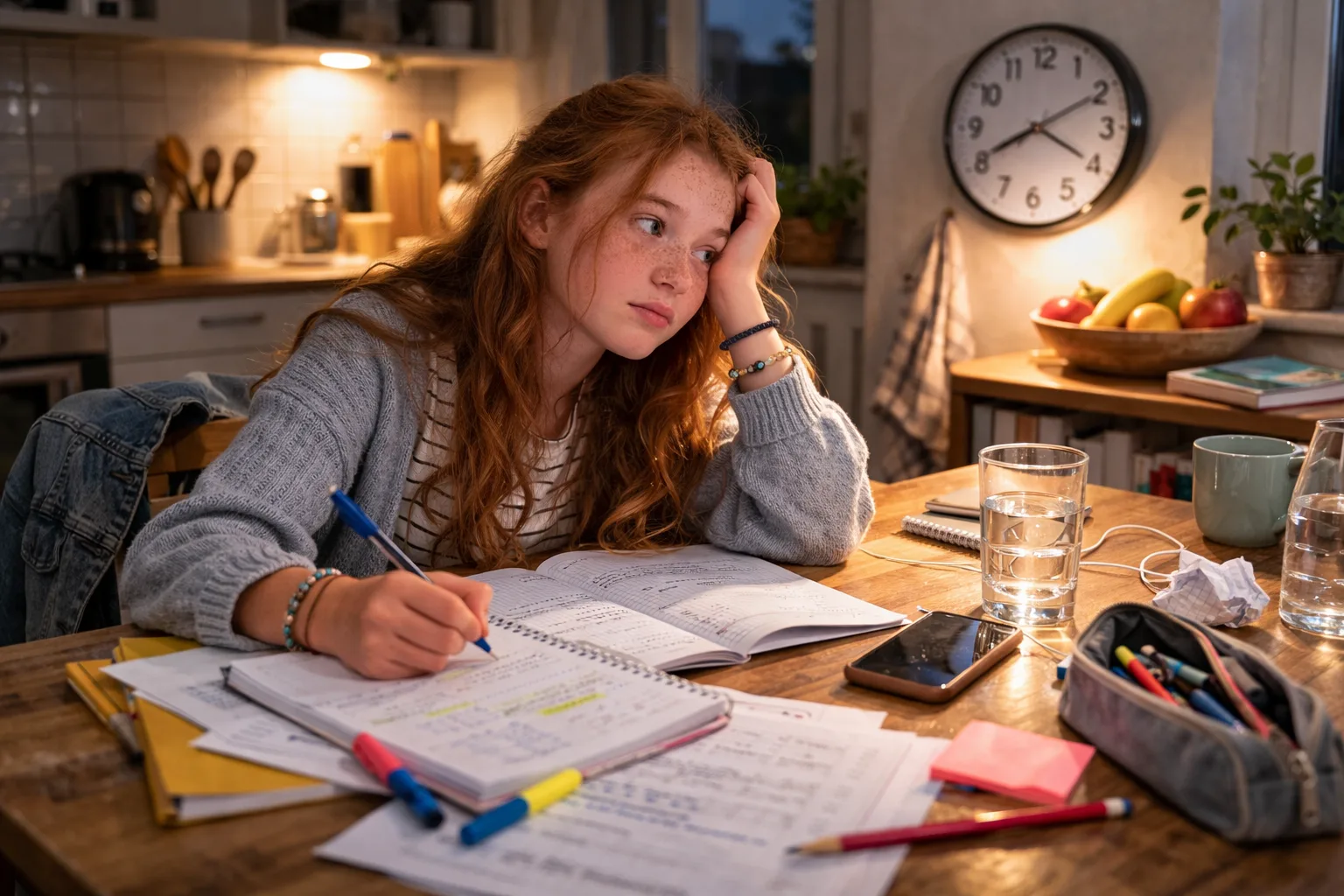
Why some students spend two hours on homework that could have taken 40 minutes
Two hours on homework do not always mean two hours of real effort. Tiredness, vague starts, distractions and avoidance often explain why a short task expands into a whole evening.
Understanding why short tasks sometimes swallow the whole evening