


Your child promises they will start earlier next time. Then, for several days, not much happens. The evening before a test or deadline, everything suddenly speeds up: tension, bargaining, a longer night, and sometimes the misleading feeling that they can work perfectly well when they choose.
Usually the problem is not that willpower appears by magic at the last minute. Urgency removes several obstacles in one go: vagueness about what to do, the option of postponing again, the distance from the consequence, and part of the discomfort of starting. In other words, the student does not suddenly become more serious; they are mainly more constrained by the situation.
That is why lectures about effort rarely do enough. To break the cycle, you need something other than last-minute pressure: a stable trigger, a very clear minimum action, repetition, and light follow-up that helps without turning home into a control room.
The problem is not willpower alone
When a student only works under pressure, it is easy to conclude that the issue is discipline. In practice, it is often more complicated. Many students put work off because the task costs them something immediately: boredom, confusion, fear of getting it wrong, the sense that the task will take too long, or simply not knowing where to begin.
In that moment, postponing brings immediate relief. That relief is what traps them. It does not solve the underlying problem, but it reduces present discomfort. For the brain, that small immediate improvement can weigh more heavily than a distant academic benefit.
That is why they could do it if they really wanted to is often too thin as an explanation. Of course responsibility matters. But asking for more willpower from a system that already runs on stress often means asking the student to keep using the very fuel that is exhausting them.
For some teenagers, another mechanism gets added. Starting late can protect self-image a little. If the outcome is mediocre, it is tempting to blame lack of time rather than face a real difficulty. This is not always conscious, and not always the main issue, but it does happen.
Why urgency keeps winning
Urgency works because it creates substitute structure.
While the test or deadline still feels far away, the student has to decide when to start, what to do first, how long to give it, and why this task deserves to come before everything else. That is a lot of micro-decisions for something that often feels abstract. Once the deadline is close, part of that debate disappears. The question is no longer whether work should happen. It becomes: what can I do now to limit the damage?
That proximity also changes the motivational balance. A distant reward or consequence stays vague. A deadline twenty-four hours away becomes concrete. The cost of not working moves closer, and that can finally trigger action.
There is also an activation effect. Pressure narrows the field of options, cuts off some distractions and creates a sense of absolute priority. Some students translate this as I work better under pressure. In reality, they often work faster to get started, not necessarily better to learn.
The costs are familiar: shallower work, weaker memory, careless mistakes, sleep being shaved away, family tension, and the feeling of always lagging behind your own intentions. When marks stay acceptable despite all this, the trap is even stronger. The brain learns that waiting is risky, but sometimes profitable enough.
The cycle that keeps the pattern going
For parents, it is often more useful to see the problem as a cycle than as a character flaw.
- A homework task, chapter or test is announced.
- The task feels vague, long, boring or threatening.
- The student postpones it, which brings immediate relief.
- The deadline gets closer, anxiety rises, and urgency finally forces a start.
- The last-minute rescue session sometimes produces an acceptable result and sometimes does not, but it still teaches a dangerous lesson: waiting remains an available strategy.
When this cycle repeats, starting often gets harder rather than easier. The student increasingly associates schoolwork with something unpleasant, conflict-ridden or late at night. The next session then feels even heavier to launch.
Parents can reinforce the pattern without meaning to. Tighter and tighter reminders start to replace internal planning. The child or teenager ends up waiting either for the catastrophe or for parental prompting. The system becomes: I start when I no longer have a choice — and sometimes even when someone makes me look at it.
If your child says I need pressure, it is often worth hearing something else underneath: I still cannot start without pressure. That is not the same thing, and it changes the response completely.
Build a system stronger than last-minute pressure
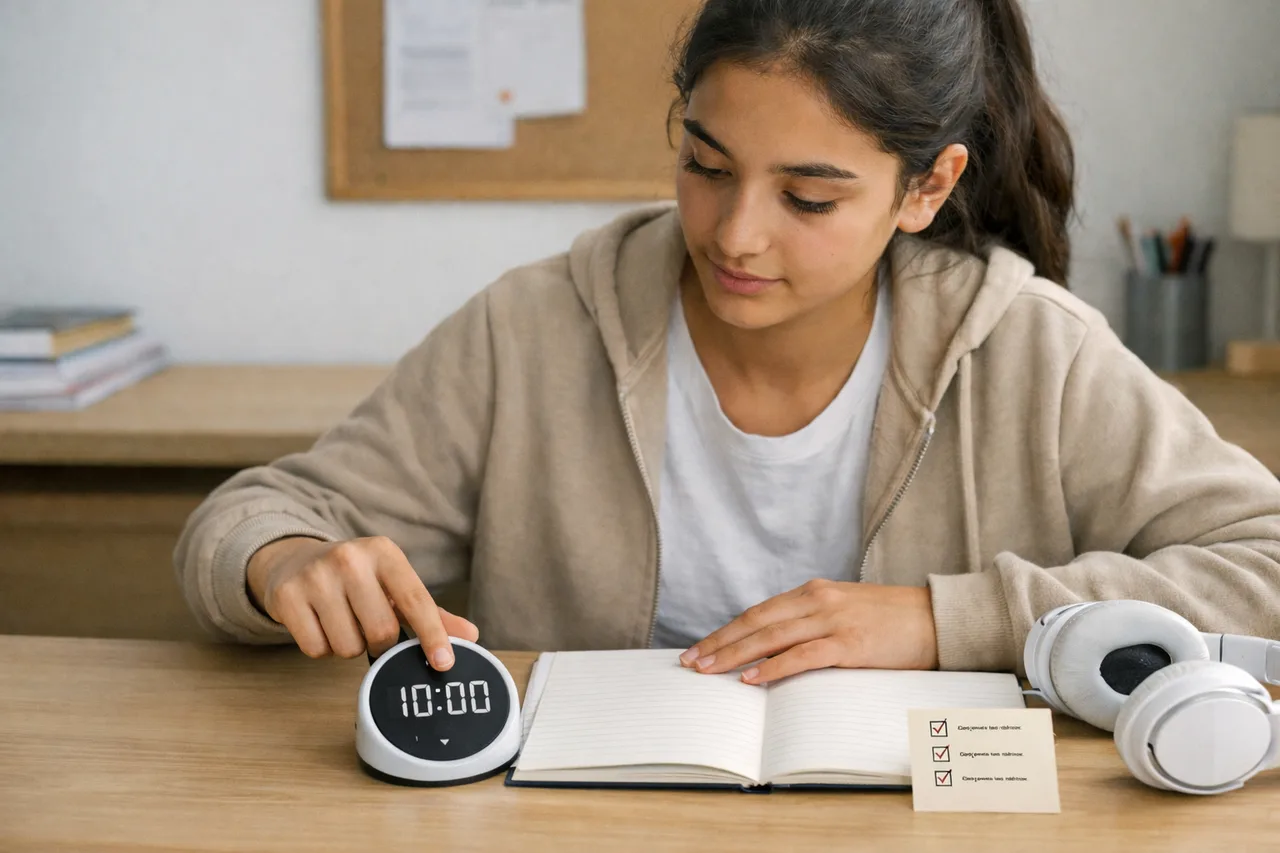
To break the cycle, you need to replace the brutal structure of urgency with something smaller, calmer and more repeatable. A good system is not spectacular. Its main job is to reduce the cost of the first step.
The simplest version has four parts.
| Part of the system | Realistic example | Why it helps | What the parent does |
|---|---|---|---|
| Stable trigger | After a snack, once the school bag is by the desk | avoids reopening the timing debate every day | helps choose a believable slot, then avoids constant reminders |
| Minimum action | 10 minutes of maths; 3 retrieval cards; 1 corrected exercise | lowers the barrier to entry and makes starting concrete | checks that the minimum still feels doable even on a bad day |
| Repetition | same days, same place, same first step for two weeks | builds an association between the context and starting | protects the slot as far as possible without demanding perfection |
| Light tracking | a tick box, a timer, a simple visible tracker | makes consistency visible without raising pressure | looks at the pattern once a week, not every ten minutes |
The most underestimated part is the minimum action. If the minimum already looks like a serious, ambitious session, it will be postponed. The minimum has to be almost impossible to refuse: five to fifteen minutes, one clearly defined first task, and a clear end point. On good days, the session can grow. On bad days, you at least protect the reflex of starting.
The trigger also needs to be precise. A sentence like I’ll do a bit of work tonight is too vague. An if-then formula works better: If I’ve finished my snack, then I open my science notes for ten minutes. The more concrete the starting point, the less internal negotiation is needed.
Context matters more than many families expect. Same place, same time, same first action: this is not rigidity for its own sake. It is a way of lowering mental effort. The best slot is not always the longest one. It is the slot the student can still genuinely use to learn. And if one day is missed, it should not be treated as proof of failure. A fragile system dies at the first slip; a robust system restarts at the next slot.
The minimum still has to produce learning
A short session only helps if it is active. To move away from emergency working, it is usually better to retrieve than to reread. Three questions with the book closed, a few retrieval cards, a mini exercise, or explaining a point out loud will often do more than ten minutes of passive rereading.
That matters even more for students who work late. When fatigue rises, rereading can feel serious without doing much. A small active-recall task reveals much faster what is understood and what is not. In the same way, not everything that makes the session feel easier improves learning: background music may reduce boredom without helping memory much.
In the earlier secondary years, adults often need to do more to set the frame and get materials ready. In the later school years and the first years of higher education, the principle stays the same, but the student should gradually take back more control over the slot, the minimum task and the tracking tool. The goal is not only that they work. It is that they learn how to start without permanent adult steering.
Help without taking over

The helpful parent is neither absent nor in charge of every detail. They build the frame, help with diagnosis, then leave the student to do their part.
A few practical reference points can change a great deal:
- Set one simple rule: for example, three slots per week, with a minimum defined in advance.
- Talk about starting before talking about results: Did you get started? is often a better question than How long did you work?
- Look for the real obstacle: tiredness, vagueness, fear of failure, scattered materials, an overloaded timetable, or a subject-specific block.
- Review it when everyone is calm: a short weekly check-in is usually more useful than ten reminders under tension.
What is best avoided matters just as much: long sermons, minute-by-minute reminders, daily bargaining over each task, and comparisons with a sibling or classmate. That kind of pressure can produce short-term compliance, but it often damages both the diagnosis and the relationship.
A good conversation often starts with a precise question: What blocks you before you even begin? Not why do you never make an effort? but what makes the first step hard today? You do not speak to a child the same way if they are avoiding work because they are distracted, because they did not understand the chapter, or because they fear confirming a poor image of themselves.
So the right parental role is to support consistency, not to occupy the whole schoolwork space. You want to know whether the system is holding, not take the controls for them.
When to look beyond habit
Not every student who works at the last minute has only a routine problem. Sometimes the delay is the visible symptom of something else.
Look further if several of these signs are present:
- the student still gets stuck even when the task is made very small and very clear;
- they avoid work mainly because they do not understand what is being asked;
- every session comes with strong anxiety, tears, shame or repeated blow-ups;
- the difficulty spills into other areas: damaged sleep, major forgetfulness, general disorganisation, constant exhaustion;
- they only work with an adult sitting next to them and do not move towards more autonomy;
- the difficulty has worsened after a school transition, a blow to confidence or a period of overload.
In these cases, it can help to speak to a teacher, form tutor, pastoral lead, tutor or health professional, depending on what you are seeing. The right reflex is not to dramatise. It is simply not to reduce everything to laziness. A difficulty with understanding, attention, fatigue or anxiety needs a different response from a straightforward starting problem.
What to remember
A student who only works under pressure does not necessarily need a harder speech. They usually need a lighter and earlier structure than last-minute panic.
Keep three ideas in mind:
- Urgency is not a method; it is an emergency structure, costly and fragile.
- The real leverage point is starting: a clear trigger, a minimum action, repetition and simple tracking.
- A parent does not need to become a permanent supervisor: the job is to set the frame, help identify the blockage, then reinforce consistency rather than control.
So the first goal is not that your child suddenly works for hours. It is more modest, and often more decisive: that they start earlier, smaller and more often.
Sources
- Procrastination and the Priority of Short-Term Mood Regulation: Consequences for Future Self
- Implementation Intentions and Goal Achievement: A Meta-analysis of Effects and Processes
- Improving Students' Learning With Effective Learning Techniques: Promising Directions From Cognitive and Educational Psychology
- Effects of Parental Autonomy Support and Teacher Support on Middle School Students’ Homework Effort: Homework Autonomous Motivation as Mediator
Keep reading
Related reading

25 minutes, 40 minutes or 60 minutes: what is a realistic study session length?
The real question is not how long a student can stay at a desk, but how long they can do genuinely useful work. Here is how to choose between 25, 40 and 60 minutes for homework or revision without misreading the problem.
Choose a session length a fragile routine can actually survive
“He said he’d revised”: how to check the method without creating mistrust
When a child says they have revised, the real issue is not catching them out but making the method visible. Here is a simple framework for checking usefully, spotting what is really getting in the way and gradually handing control back.
Check the method without turning into a detective
Evening study: how late is too late for real learning?
There is no universal 9 pm or 10 pm cut-off for evening study. The real limit is the point at which work starts to damage sleep or is done in a state of fatigue that no longer supports real learning.
See when late-evening work stops supporting real learning
Why some students spend two hours on homework that could have taken 40 minutes
Two hours on homework do not always mean two hours of real effort. Tiredness, vague starts, distractions and avoidance often explain why a short task expands into a whole evening.
Spot why a short task can quietly swallow the whole evening
Why a teenager’s attention collapses faster than you think
A teenager who switches off quickly does not necessarily have an attention problem. Fatigue, avoidance, a vague task and constant micro-interruptions often explain far more.
Separate avoidance, fatigue and attention collapse more clearly