
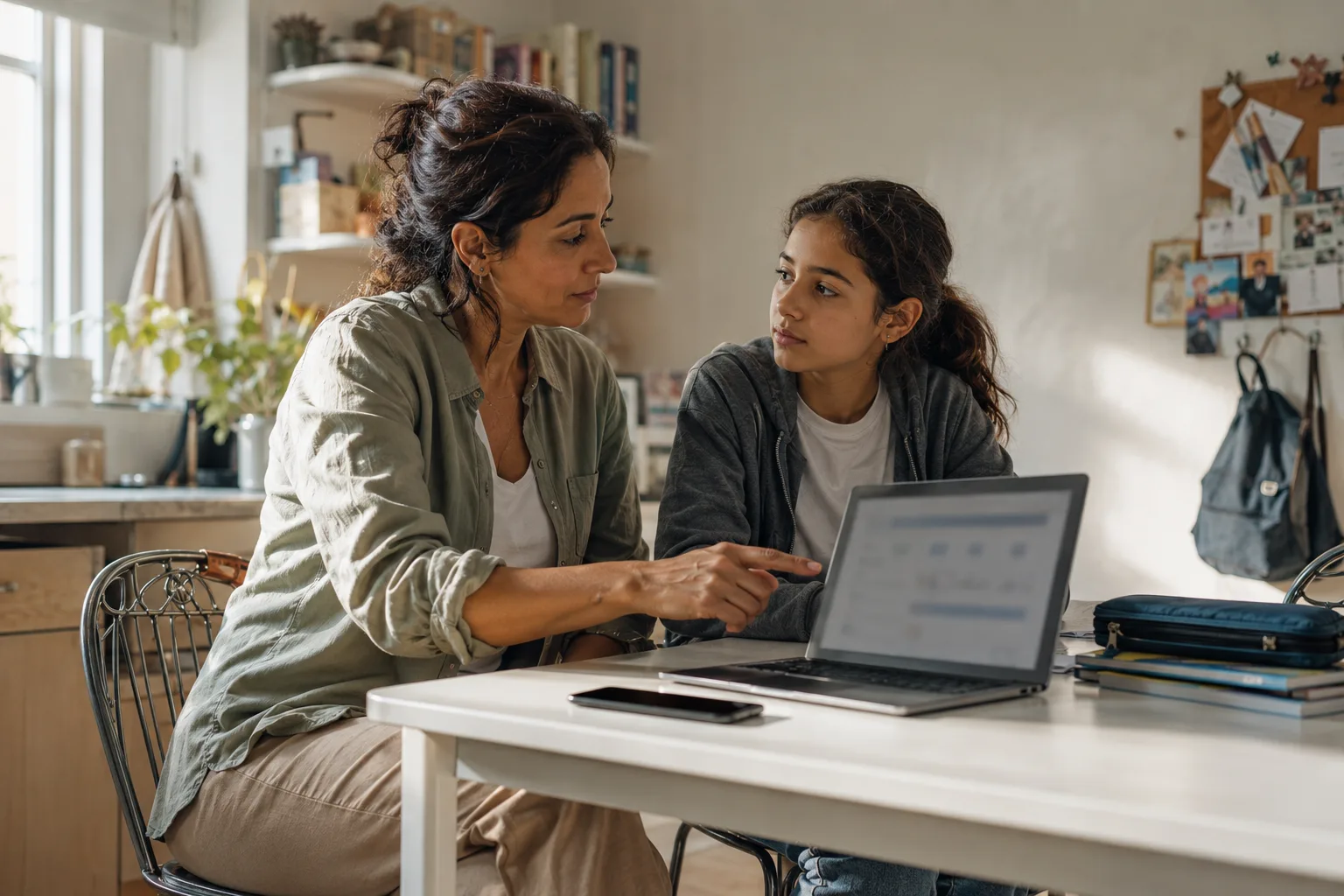
Parents are often asked to do two things that can pull in opposite directions: notice early signs of trouble, and avoid turning school life into a permanent inspection. That tension is the real issue behind parental vigilance and school safety.
The useful answer is not “check everything” or “trust blindly.” It is a calmer system: agree on what will be visible, look for patterns rather than isolated incidents, document concerns when safety is at stake, and keep the child’s trust at the center of every step.
A good rule of thumb is this: monitor enough to protect, but not so much that your child stops telling you what matters. School portals, messaging tools, smartphones, parent chats, screenshots, and teacher updates can all help. They can also fuel anxiety if every notification becomes a verdict. The goal is to use them as signals, not as a live feed of your child’s worth, friendships, or future.
What good parental vigilance really means
Parental vigilance is not a single behavior. It is a range of actions, from ordinary presence to emergency protection. Confusion starts when all of these actions are treated as the same thing.
A parent who asks how the group project went is not doing the same thing as a parent who secretly reads every private message. A parent who checks a school platform once or twice a week to understand patterns is not doing the same thing as a parent who reacts to every grade before the child has even seen it. A parent who saves screenshots after repeated harassment is not invading privacy in the same way as a parent who scrolls through unrelated conversations out of curiosity.
The distinction is purpose.
| Parental action | Useful when the purpose is... | Risk when it becomes... |
|---|---|---|
| Being present | Staying emotionally available and noticing changes | Interrogating every detail of the day |
| Routine school follow-up | Seeing attendance, assignments, messages, and workload patterns | Turning every notification into pressure |
| Digital boundaries | Protecting sleep, privacy, attention, and safety | Installing secret control as the default |
| Incident documentation | Preserving facts when bullying, exclusion, threats, or unsafe behavior may be involved | Collecting fragments to prove a theory too early |
| Escalation to adults | Getting the right people to act when the child cannot solve it alone | Bypassing the child without explanation in non-urgent situations |
Good vigilance has three qualities.
First, it is declared. Children should usually know what parents check, how often, and why. There are exceptions when immediate safety is at risk, but secrecy should not become the normal family operating system.
Second, it is proportionate. A younger child, a child with additional support needs, or a child going through a difficult period may need closer guidance. A teenager who has shown reliability should usually receive more privacy and more responsibility. The right level changes over time.
Third, it is reversible. If a parent increases oversight because something worrying has happened, there should also be a path back: what needs to stabilize, what will be checked less often, and how the child can regain room to manage school life independently.
Trust is not the absence of checking. Trust is the child understanding that checking has a protective purpose, a clear limit, and a possible end.
Use school tools as signals, not as a live feed
Many families now receive school information through digital gradebooks, learning platforms, attendance alerts, class messaging tools, parent emails, and informal group chats. These tools can be valuable because they make problems visible earlier. They can also make school feel endless, especially when parents open them several times a day or react before they understand the context.
The first question should not be “What can I see?” It should be “What decision will this information help me make?”
If the information will help you notice a pattern, support organization, contact the right adult, or ask a better question at home, it is probably useful. If it only gives you a reason to refresh, worry, compare, or criticize, it may be creating noise.
A workable routine often looks like this:
| What to check | A realistic rhythm | What it helps you notice | What to avoid |
|---|---|---|---|
| Attendance or unexplained absences | As soon as the school flags it | Safety, avoidance, administrative mistakes | Assuming blame before checking facts |
| Teacher messages | On school days, at a set moment | Requests, concerns, deadlines, appointments | Replying in anger or late-night panic |
| Missing work and assignment patterns | Weekly, or more often during a known difficulty | Overload, avoidance, misunderstanding, disorganization | Treating one missed item as a character flaw |
| Grades or feedback | At agreed intervals, not after every alert | Subject patterns, effort-feedback mismatch, support needs | Making every grade a family event |
| Informal parent chats | Sparingly and critically | Shared logistics or confirmed school information | Rumor loops, pile-ons, public speculation |
One useful family agreement is to separate information checks from child conversations. The parent can check the school platform at a predictable time, note two or three patterns, then speak to the child later in a calm setting. This prevents the dashboard from becoming a trigger for instant confrontation.
It also helps to decide what will not be monitored routinely. A parent may need access to attendance alerts and school messages, but not to every peer conversation. A parent may look at assignment patterns, but not ask for a live report on every homework minute. Boundaries make monitoring more credible because the child can see that the parent is not trying to occupy the whole school day.
Smartphones and online spaces need rules that can survive real life
School safety no longer stops at the classroom door. Friendships, group work, jokes, exclusions, rumors, invitations, and conflicts can continue through phones, games, class groups, social platforms, and private messages. Parents need a digital framework, but it has to be usable on an ordinary week, not only in a family meeting that everyone forgets.
The strongest family rules usually cover four areas.
Access. Decide where devices sleep, when they are charged, and what happens during homework, meals, late evenings, and mornings. For many families, the most protective rule is not a complex monitoring app but a clear night-time device location that protects sleep.
Privacy. Explain what remains private, what may be checked with the child present, and what becomes open to adult review if there is a serious safety concern. A child is more likely to ask for help if the rule is not “I will read everything whenever I want.”
Settings. Review privacy settings, contact permissions, location sharing, downloads, purchases, and reporting tools together. This turns safety into a skill-building moment rather than a one-way inspection.
Response. Agree in advance what the child should do if they receive a threatening message, humiliating image, repeated insults, exclusion from a class group, pressure to share personal content, or contact from someone who feels unsafe. “Come to me first” is easier to follow when the child knows they will not automatically lose the phone for being honest.
Parental controls can help, especially for younger children or during a specific risk period. But controls work best when they are transparent, limited, and paired with conversation. Used secretly as the default, they can teach a child to hide better rather than to judge better.
A practical phone rule is therefore not only a restriction. It is a sentence the child can remember under stress: “If something feels wrong, save it, stop replying, and bring it to an adult.”
When something feels wrong, move from impressions to facts

A parent’s first signal is often vague: a child becomes quieter, avoids school, complains of stomach aches, stops talking about friends, seems tense after checking messages, or suddenly wants to delete an account. These signs do not prove bullying or danger. They do say: slow down, ask, and start observing.
When there may be bullying, cyberbullying, intimidation, discrimination, threats, repeated humiliation, coercion, or unsafe behavior, the order of priorities matters.
- Stabilize the child first. Listen, reduce immediate exposure where possible, and make sure the child is not left alone with a situation they experience as unbearable.
- Preserve evidence without amplifying it. Save screenshots, dates, usernames, message links, images, voice notes, or relevant school messages when they exist. Avoid forwarding humiliating content widely.
- Build a simple timeline. Record what happened, when, where, who was involved, who saw it, what was said or shown, and how the child was affected.
- Separate facts from interpretations. “Three messages were sent after 10 p.m. calling him a name” is stronger than “everyone is against him,” even if the second sentence captures how it feels.
- Contact the relevant adults in writing. Give a concise summary, attach the most relevant evidence, ask what protective steps will be taken, and request a follow-up point.
- Escalate when safety or repetition demands it. If the situation continues, involves threats, sexual content, violence, blackmail, self-harm risk, or adults failing to act, use the appropriate school, platform, safeguarding, helpline, child protection, or emergency route in your own country or region.
Documentation is not about becoming a detective. It is about making it easier for responsible adults to act. Schools, platforms, and authorities generally respond better to clear chronology and preserved evidence than to scattered fragments, angry threads, or public accusations.
There are also things to avoid. Do not ask the child to “just ignore it” if the pattern is repeated or severe. Do not pressure them to confront the aggressor alone. Do not run your own investigation through other children’s private accounts. Do not post screenshots publicly as revenge. These reactions are understandable when a parent is frightened, but they can make the child feel less safe and can complicate resolution.
If there is any risk of immediate harm, the priority is not documentation perfection. It is safety: stay with the child, contact the relevant emergency or crisis support in your area, and inform the responsible school or safeguarding adults as quickly as possible.
Work with school firmly, concisely, and in writing
When parents are worried, school conversations can easily swing between two unhelpful extremes: a vague emotional complaint that is hard to act on, or an accusatory message that makes everyone defensive before the facts are clear.
The most effective first contact is usually calm, written, and specific. It should name the concern, describe the observable facts, explain the impact on the child, ask for a meeting or response, and clarify what would help the child feel safe enough to continue learning.
A useful structure is:
- What we are seeing: dates, incidents, repeated patterns, changes in the child’s behavior.
- What we have preserved: screenshots, messages, teacher notes, attendance alerts, or other concrete traces.
- What worries us: safety, exclusion, humiliation, fear of attending, online continuation, academic disruption.
- What we are asking for: a named contact, a plan to reduce exposure, supervision where relevant, follow-up communication, and a review date.
- What we are not asking for: private punishment details about another child, rumors, or instant certainty before the school has checked.
This last point matters. Parents deserve to know how their child will be protected, but schools may not be able to share every detail about another student. The practical question is not “What punishment did they receive?” but “What changes will reduce the risk for my child, and how will we know whether the plan is working?”
Keep records of school conversations. After a meeting, send a short recap: what was discussed, what actions were agreed, who is responsible for each action, and when the next check-in will happen. This reduces misunderstanding and creates continuity if different adults become involved.
If the first response is dismissive and the concern remains serious, do not simply send longer and longer emotional messages. Move up the appropriate chain calmly, using the same concise facts, the same timeline, and the same focus on safety and learning.
Talk to your child like an ally, not an investigator
The hardest part of parental vigilance is not collecting information. It is using it without making the child regret that information exists.
A child who feels interrogated may deny, minimize, hide, or hand over the phone while emotionally leaving the conversation. A child who feels believed and respected is more likely to share the missing context: the joke that was not a joke, the class group that turned hostile, the assignment they stopped opening because they felt ashamed, the friend they are afraid to lose.
Start with what you know, but do not pretend you know everything.
Try:
- “I noticed a few things that worry me. I do not want to jump to conclusions. Can you help me understand what is going on?”
- “You are not in trouble for telling me. My job is to help you stay safe and keep school manageable.”
- “What part do you want help with first: stopping the messages, talking to school, sleeping tonight, or figuring out what to save?”
- “Is there anything you are afraid I will do if you tell me the truth?”
Avoid:
- “Why didn’t you tell me?”
- “Give me your phone; I’m reading everything.”
- “I knew those friends were a problem.”
- “You must have done something to cause this.”
- “We are going straight to everyone’s parents right now.”
Sometimes a parent does need to take decisive action quickly. A child may be in danger, overwhelmed, threatened, or unable to protect themselves. Even then, explain as much as you can: “I need to involve adults now because this is about safety. I will tell you what I am doing, and I will not share more than necessary.”
After the immediate concern has passed, come back to the relationship. Ask what helped, what felt too much, and what would make it easier to ask for help earlier next time. Protection should not end with control; it should rebuild communication.
Rebuild autonomy after protection has done its job
A common mistake is to increase monitoring during a crisis and then never reduce it. The child improves, the risk fades, but the family system stays frozen in emergency mode. Over time, this can create resentment, secrecy, or helplessness.
Plan the step-down from the beginning.
| If the concern was... | Temporary oversight might include... | A step back toward autonomy could be... |
|---|---|---|
| Missing work or disorganization | Weekly review of assignments and school messages | Child prepares the review first, parent checks only unresolved items |
| Phone conflict or late-night use | Device charging outside the bedroom | Child helps set the sleep rule and earns more flexible weekend use |
| Cyberbullying or unsafe contact | Saving evidence and reviewing blocked or reporting settings together | Parent stops checking unrelated messages once the risk is contained |
| School avoidance | Shared log of mornings, triggers, and support actions | Child identifies early warning signs and asks for help before avoidance escalates |
| Repeated teacher concerns | Parent-school check-ins for a fixed period | Check-ins become less frequent once agreed indicators stabilize |
The step-down should be visible. Tell the child what is changing: “For the next two weeks, I will check the platform with you on Sunday evening. If the missing work is stable and you tell me when something goes wrong, we will move to every other week.”
This does not mean every child gets the same autonomy at the same age. Some children need longer support because of anxiety, neurodivergence, language barriers, family disruption, trauma, or previous unsafe experiences. The point is not to withdraw support prematurely. The point is to make support developmental: it should help the child gain skills, not simply keep the parent in permanent control.
Questions parents often ask
How often should I check school tools?
Often enough to notice patterns, not so often that you react to every update. For many families, a set weekly review plus timely attention to direct teacher messages is more sustainable than constant refreshing. During a known difficulty, the rhythm can temporarily increase.
Should I read my child’s private messages?
Not as a routine habit for curiosity or reassurance. A better default is transparent rules: what stays private, what may be reviewed together, and what changes if there is a serious safety concern. If you do need to review messages because of risk, keep the scope narrow and explain why.
What if my child refuses to show me anything?
Refusal can mean many things: shame, fear of punishment, normal privacy needs, or a real safety concern. Start by lowering the threat level: “I am not asking to search everything. I am trying to understand whether you are safe.” If the concern remains serious, involve an appropriate trusted adult or school contact rather than turning the whole relationship into a power struggle.
What counts as bullying rather than ordinary conflict?
Conflict is usually a disagreement between people with some balance of power. Bullying usually involves repetition, humiliation, intimidation, exclusion, coercion, or a power imbalance. One severe incident can also require urgent protection. The label matters less at the beginning than the practical question: is the child safe, and what needs to stop?
Should I contact the other child’s parents?
Sometimes this helps; sometimes it escalates. Before doing it, consider the severity, your relationship with the family, the school’s role, and your child’s safety. If there are threats, sexual content, discrimination, blackmail, violence, or repeated harassment, it is usually safer to involve the school or relevant protection route rather than negotiate parent to parent alone.
Should I take the phone away after cyberbullying?
Be careful. Removing the phone can reduce exposure, but it can also feel like punishment for telling the truth and may cut the child off from supportive friends. A more precise response may be blocking, reporting, changing group access, moving the device at night, or reviewing settings together. In serious cases, temporary restriction can be appropriate, but explain that the goal is protection, not blame.
How do I document cyberbullying without spreading it?
Save what is necessary, keep it private, and share it only with people who need it to protect the child or act on the report. Avoid forwarding humiliating content to other parents or posting it in group chats. A clear timeline with selected evidence is usually stronger than a large pile of screenshots without context.
The practical takeaway
Parental vigilance and school safety work best when they are built around a simple principle: follow enough to protect the child, but keep enough trust for the child to come back to you.
That means:
- agree on what school and digital information parents will check;
- use tools to notice patterns, not to police every moment;
- set phone rules that protect sleep, privacy, and help-seeking;
- document serious concerns with dates, screenshots, and a factual timeline;
- contact school or other responsible adults with concise written information;
- keep the child involved unless immediate safety requires urgent adult action;
- reduce monitoring again when the situation stabilizes.
The aim is not to become an invisible supervisor of school life. It is to create a family safety net that is calm enough for ordinary weeks and strong enough when something goes wrong.
Sources
All articles in this category
Every published article in this topic, from newest to oldest.
- How to talk to another parent after a school incident without escalating the conflict
- When a child suddenly stops wanting to go to school: how parents can investigate without jumping to conclusions
- After a school incident, what questions should you ask the school — and in what order?
- I saw a worrying message on my child’s phone: how do I talk about it without interrogating them?
- School portal: how often should parents check without over-monitoring?