

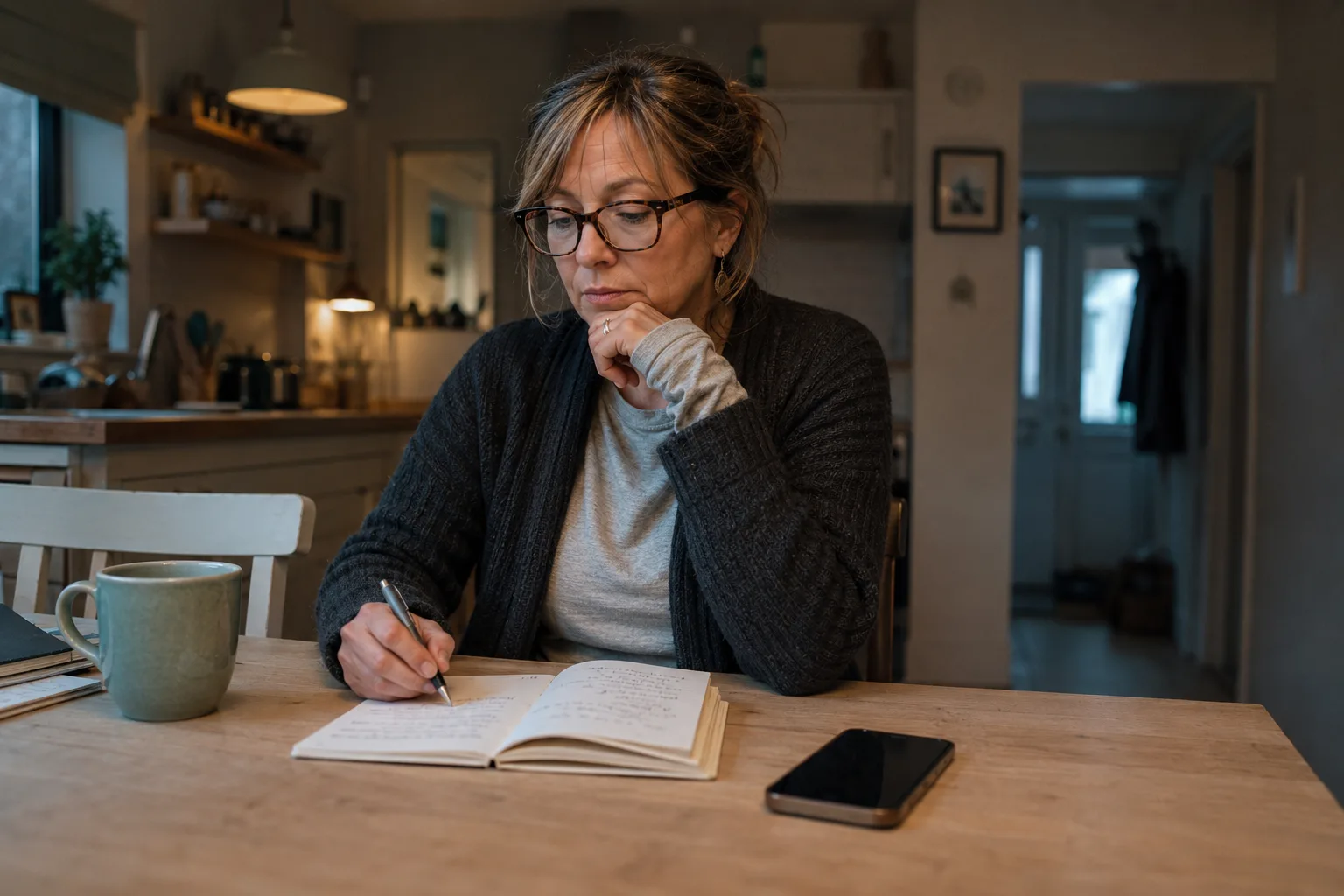
Your child is upset. Another child has been named. You may have the other parent’s number from a class group, a birthday party, a sports team or the school gate. The impulse to contact them is understandable. But one accusatory message can turn a child’s problem into a parent feud.
The question is how to talk to another parent after a school incident without making the next day harder. The answer is not “never”; it is to contact them only when the purpose is narrow, the risk is low, and you can keep the exchange factual. If the incident involves safety, repeated bullying, threats, discriminatory abuse, sexualised behaviour, serious online harassment or a child who is frightened to return to school, it should move through the school and, where necessary, the appropriate safeguarding or emergency route.
For ordinary one-off incidents, a careful parent-to-parent message can help. It should not become a private investigation, a trial, or a demand that the other family disciplines their child on your terms.
What talking to another parent can do — and what it cannot
A calm message can be useful when the incident is contained: a lost item, a playground argument, an unkind comment that may have been misunderstood, a birthday-party dispute that has spilled into school, or a class chat exchange that needs to stop before tomorrow.
In those cases, contact can:
- let both families know something has happened;
- compare what each child has said without treating one account as the whole truth;
- agree one immediate step, such as asking the children not to post about it or approach each other aggressively;
- show both children that adults can take a problem seriously without performing outrage.
But parent-to-parent contact has real limits. It cannot establish the full facts of an incident that happened in school. It cannot replace the school’s behaviour, anti-bullying or safeguarding process. It cannot guarantee that the other parent will react reasonably.
The mechanism matters. Children often give a sincere but partial account when they are upset. Parents then add fear, loyalty and previous history. By the third message, a factual question can become a judgement about another family’s values.
Your role is not to become the investigator. Your role is to protect your child while keeping the next adult step proportionate.
Decide whether to contact them, the school, or neither yet
Before contacting another parent, pause long enough to choose the safest route. The question is not “Am I angry enough to message?” It is “Which route is most likely to make the child safer and the situation clearer?”
| Situation | Best first route | Why |
|---|---|---|
| A one-off, low-level incident where no child is frightened, injured or repeatedly targeted | A careful parent-to-parent message may be reasonable | The aim is clarification and a small practical step, not discipline |
| The incident happened in school, on the way to school, or in a class-linked digital space, and the facts are disputed | Contact the school first, or bring school in if the parent exchange does not clarify things | Staff may see patterns, witnesses and context that neither family can see alone |
| There is a possible pattern: repeated exclusion, name-calling, intimidation, humiliation, threats or online pile-on behaviour | Move through the school | A pattern needs adult monitoring, records and a plan |
| The issue involves injury, assault, theft, discriminatory abuse, sexualised behaviour, sharing images, serious threats or immediate danger | Do not handle it parent-to-parent | This may require safeguarding, disciplinary, police or other official routes |
| The other parent has previously been aggressive, dismissive or likely to spread the issue in a group chat | Avoid direct contact | A private message may create more risk than clarity |
“Do not contact another parent directly” does not mean “do nothing”. It often means the opposite: act through a route that can record the concern, protect the child, and prevent the issue becoming two families fighting in parallel to the school.
There is also a middle option: gather your child’s account calmly, make brief notes, and wait until the next school day. Not every incident needs a message the same evening.
Separate facts, interpretations, feelings and requests before you write
Most escalating messages mix four things together: what happened, what you think it means, how you feel, and what you want the other parent to do. The more mixed they are, the more accusatory the message sounds.
Before writing, divide your thoughts into four parts.
Facts are the details you can state without overclaiming: “My daughter says this happened at lunch on Tuesday”, “There is a screenshot of this message”, “His PE kit was missing after the changing room incident”.
Interpretations are the meaning you are tempted to add: “They are targeting him”, “Your child is jealous”, “The group is trying to humiliate her”. These may turn out to be true, partly true, or wrong. They usually do not belong in the first message.
Feelings are real, but they should not run the conversation: “I am angry”, “I am worried”, “I feel protective”. Notice them before sending; do not use them as the structure of the message.
Requests are the practical next step: “Could you ask your child what they remember?”, “Can we both ask them not to continue this online?”, “Shall we let the school handle it tomorrow if there are different accounts?”
For example, “Your son has been bullying mine and you need to deal with him” is likely to produce defensiveness, even if something serious has happened. A calmer version would be: “Sam came home very upset and said there was repeated name-calling at lunch today. I do not want to assume we have the full picture. Could you ask Alex what they remember? If it sounds as though this has happened more than once, I think we should involve school so it is handled properly.”
That wording does not minimise the concern. It leaves room for facts.
How to write the first message without sounding like an accusation
A first message should be short enough that the other parent can read it without feeling attacked. It should also be specific enough that they understand why you are contacting them.
A useful structure is:
- name the incident narrowly;
- acknowledge that you may not have the full picture;
- ask them to check with their child;
- suggest one immediate practical boundary;
- leave the school route open if the issue is bigger than expected.
Here is a wording template you can adapt:
“Hi [name], I’m getting in touch because [child] came home upset about something that seems to have happened [when/where]. I’m not assuming we have the whole picture, and I know these things can look different from each side. Could you ask [your child] what they remember? I’d like us to keep it calm and help the children avoid this carrying on tomorrow. If it sounds more serious or repeated, I think we should take it through school.”
The exact words matter less than the stance behind them. You are not saying, “Prove your child is innocent.” You are saying, “Let’s slow this down, compare accounts, and stop it spreading.”
Avoid phrases that define the other child’s character: “bully”, “liar”, “nasty”, “violent”, “manipulative”. If bullying may be the issue, name the behaviour and route it through school. A child can have behaved badly without the first adult message turning them into a permanent label.
Also avoid sending screenshots to several parents “for awareness”. Screenshots can be evidence, but they can also become a new source of humiliation, gossip or privacy risk. Keep them; do not circulate them casually.
Keep the conversation bounded once it starts
If the other parent replies reasonably, it is tempting to keep discussing until you feel reassured. That can be a mistake. The longer the exchange, the more likely it is to drift into blame, old grievances or competing versions of the children’s personalities.
Keep the conversation bounded by agreeing what is being decided now.
You might say:
- “For tonight, I think the main thing is that neither child continues this by message.”
- “Let’s each speak to them calmly and see whether school needs to be involved tomorrow.”
- “We may not be able to settle the full facts between us, but we can agree not to let this spread in the group chat.”
- “If the accounts are very different, I’d rather ask school to help than have us argue over it.”
This is especially important with teenagers. They often need adults to reduce the social temperature, not to create a public adult drama around them.
If your own child contributed, say so plainly without turning the conversation into self-defence. “I have spoken to Maya about her part in this” is stronger than “Maya would never do that”.
When the conversation should move back through the school
Some incidents should not continue parent-to-parent, even if the first message was calm. Move the issue back through school when the concern is serious, repeated, unclear, or tied to the school environment.
That includes situations such as:
- repeated name-calling, exclusion, intimidation or humiliation;
- threats, assault, theft, damage to property or coercive behaviour;
- racist, sexist, homophobic, transphobic, disability-related or other discriminatory abuse;
- sexualised comments, sexual harassment, pressure to share images, or non-consensual image sharing;
- online harassment involving classmates, class groups or school relationships;
- a child who is frightened to attend, changing routes, hiding messages, becoming withdrawn or having physical symptoms before school;
- a parent-to-parent exchange that becomes hostile, dismissive or unproductive.
In a UK school context, the exact route depends on the school, age group and nation, but the practical sequence is usually similar. For a younger child, start with the class teacher. For a secondary pupil, it may be the form tutor, head of year, pastoral lead or safeguarding lead. Check the school’s behaviour, anti-bullying, safeguarding and complaints policies if the issue continues or if you feel it is not being taken seriously.
When contacting school, keep the message evidence-based and actionable:
- the date, place and type of incident;
- what your child has said, clearly marked as their account;
- any screenshots or evidence you have kept, without spreading them further;
- the impact on your child: sleep, attendance, anxiety, friendships, learning or safety;
- what you are asking school to do next: check facts, monitor a pattern, separate pupils temporarily, speak to both children, update you by a named point.
This route is not about “making trouble”. It is about putting the problem where it can be seen properly. Schools can notice patterns across pupils, previous incidents, corridor behaviour, group dynamics and online spillover that one family cannot see.
If there is immediate danger, use emergency routes. If the matter may involve criminal behaviour or child protection, do not rely on a private agreement between parents.
If the other parent reacts badly, stop trying to win the exchange
Even a careful message can receive an angry reply. The other parent may feel accused, embarrassed, defensive or convinced that your child is exaggerating. That does not mean you failed. It means the route is no longer useful.
Do not answer hostility with a longer argument. Do not send a chain of screenshots to prove your point. Do not move the dispute into the class group chat. Do not ask other parents to take sides unless there is a genuine collective safety issue that needs a school-led response.
A useful closing line is:
“I can see this is not going to be resolved well by message. I’m going to take it through school so the children can be supported properly.”
Then stop. Save the exchange. If necessary, send a brief factual message to school explaining that you tried to clarify the issue directly but the conversation is no longer productive.
This is not weakness. It is containment. Many school incidents escalate not because the original problem was impossible to solve, but because adults continue a conversation after it has stopped being safe or useful.
What if your child begs you not to contact anyone?
A child’s wish matters, but it is not the only factor. Sometimes they fear embarrassment, retaliation or being seen as the cause of trouble. Sometimes they are right that a parent message would make things worse.
Ask two questions. First, does this need adult action for safety, pattern or wellbeing? If yes, do not promise complete secrecy. You can say, “I will not rush into a message, and I will involve you in how we handle it, but I cannot ignore something that could affect your safety.”
Second, what is the least exposing adult step? That might be speaking to school without naming every detail at first, asking for general monitoring, or helping your child write down what happened before deciding whether to report formally.
With teenagers, explain the difference between protection and takeover: “I am not going to start a war with another parent. I am going to help make sure this does not keep happening.”
A calm decision rule for the next time
Talking to another parent after a school incident works best when the contact is small, factual and reversible. It should clarify, contain and prevent spillover. It should not accuse, investigate, discipline or gather allies.
Before you send anything, ask yourself:
- Is this a low-risk, one-off issue, or is there a safety or pattern concern?
- Can I describe the behaviour without labelling the child?
- What is the one practical request I am making?
- Would I be comfortable if this message were shown to the school?
- If the other parent reacts badly, am I ready to stop and move through school?
If the answer to those questions is yes, a brief message may help. If the answer is no, wait, write down the facts, and contact the school instead.
The goal is not to be the parent who reacts fastest. It is to be the adult who makes the next day safer, clearer and less socially explosive for the children involved.
Sources
Keep reading
Related reading

Bullying, anxiety and school climate
A calm, practical guide for parents who suspect bullying, cyberbullying or school-related anxiety: how to read weak signals, act safely, work with school and rebuild confidence.
School climate, bullying and anxiety guidance for parents
The subtle signs of bullying parents often spot too late
The early signs of bullying are rarely dramatic: stomach aches, withdrawal, a phone turned face down, and sudden reluctance to go in. Here is how to spot the pattern and act without panic.
Quieter signs when a child says less than they feel
School portal: how often should parents check without over-monitoring?
Checking the school portal ten times a day can reassure a parent, but it rarely helps the student. A simple framework for choosing a useful rhythm, spotting the signals that matter, and talking about them without creating continuous surveillance.
A balanced rhythm for vigilance without over-monitoring