

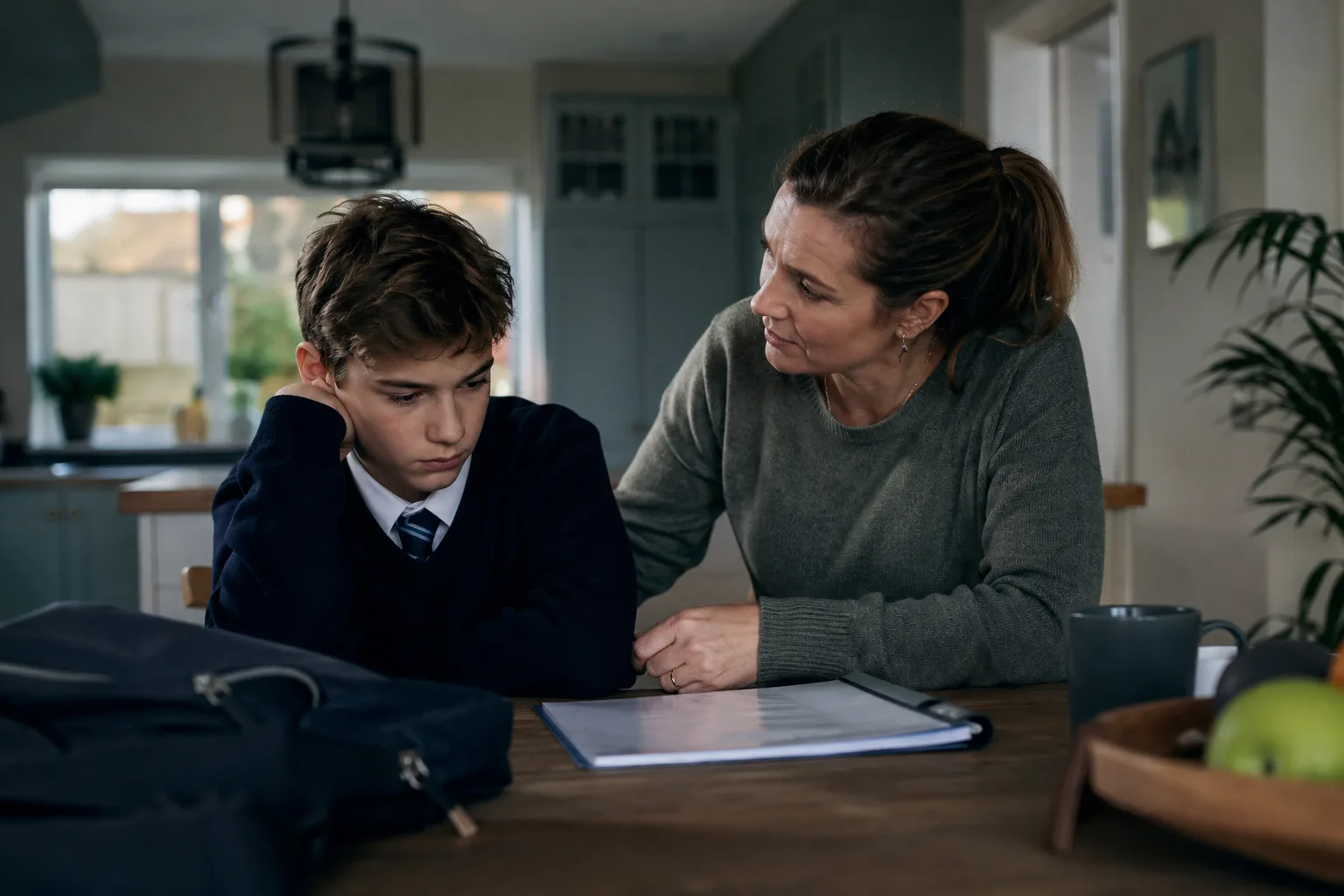
When a child suddenly stops wanting to go to school, start with curiosity, not a verdict
A sudden “I’m not going” can pull a parent in two opposite directions. One part of you wants to insist: school is not optional. Another part wonders whether something has happened that your child cannot yet explain.
Both instincts contain something useful. Attendance matters, but so does the reason behind the refusal. The first job is not to decide whether your child is being dramatic, anxious, bullied, exhausted or avoidant. The first job is to slow the situation down enough to find the pattern.
A useful starting position is this: take the reluctance seriously without treating your first theory as fact. Some children resist school because they are tired or have had a difficult week. Some are frightened of a peer, an adult, a corridor, a test, a bus route, a changing friendship group or the feeling of failing again. Some are avoiding academic pressure rather than school itself. Some are dealing with illness, sleep loss, neurodivergent overload, grief, family stress or a mental health difficulty.
The way you respond in the first few days can make the next conversation easier or harder. Panic can make a child shut down. Dismissal can make them feel alone. A calm investigation gives you a better chance of protecting your child, working with the school and avoiding unnecessary escalation.
Ordinary reluctance, fear and avoidance do not look identical
Not every complaint about school means there is a serious problem. Children and teenagers sometimes resist school because a day looks boring, a lesson feels hard, they are tired after a late night, or they would rather stay home. But a sudden change deserves attention when it is intense, repeated, linked to a specific pattern, or out of character.
The distinction that helps most is not “real problem” versus “excuse”. It is what function the refusal is serving. Is your child trying to escape danger, embarrassment, confusion, overload, shame, separation, social exposure or effort after falling behind?
This table can help you avoid jumping too quickly to one explanation.
| What you notice | One possible meaning | What to check next |
|---|---|---|
| Reluctance after a late night, illness or heavy week | Fatigue, low reserves, ordinary resistance | Sleep, physical symptoms, recent workload, whether it improves after recovery |
| Strong distress on one particular day of the week | A subject, teacher, group, PE lesson, test or transition may be involved | Timetable, seating, break times, homework deadlines, clubs and transport |
| Stomach aches, nausea, headaches or panic before leaving | Anxiety, fear, overload or a physical health issue | Whether symptoms ease once staying home, whether they also happen at weekends, whether medical advice is needed |
| Refusal after a poor mark, public mistake or missed work | Avoidance linked to shame or academic pressure | Recent feedback, missing homework, fear of being questioned, perfectionism |
| Sudden withdrawal, lost belongings, fear of the route or a named peer | Possible bullying, exclusion, intimidation or social humiliation | Names, locations, online messages, pattern of incidents, school observations |
| Distress after a move, bereavement, family separation or conflict at home | School may feel harder because the child’s emotional load is already high | Home changes, sleep, concentration, clinginess, mood, need for wider support |
| Refusal that grows each time they stay home | Avoidance may be bringing short-term relief while making return harder | How home days are structured, what support is in place, whether small return steps are possible |
The point of the table is not diagnosis. It is to stop one explanation from swallowing all the others. A child can be anxious and also behind in maths. A teenager can be socially embarrassed and genuinely exhausted. A pupil can say “the teacher hates me” when the deeper issue is that they no longer understand the work.
How to ask questions without turning your child into a suspect
When parents are worried, questions often come out too fast: “Who said what? When? Why didn’t you tell me? Is someone bullying you? Did you do something?” The intention is protective, but the child may experience it as pressure, disbelief or a demand for evidence.
A better approach is to make the conversation easier to enter. Choose a low-intensity moment if possible: in the car, on a walk, while making food, or sitting side by side rather than face to face. The aim is not to extract the full story in one sitting. It is to make it safe enough for the child to give you the first usable clue.
Try questions that locate the difficulty rather than accuse anyone:
- “Which part of the school day feels worst at the moment: leaving home, arriving, lessons, break, lunch, the journey, or after school?”
- “Is this about a person, a place, a lesson, the work, or the feeling in your body?”
- “If tomorrow had to be one tiny bit easier, what would need to change?”
- “Is there anything you are worried I will do if you tell me?”
- “Who at school feels safest to speak to, even a little?”
- “What do you want me to understand before I contact anyone?”
For younger children, drawing the school day as a simple map can work better than direct questioning. For older children and teenagers, writing a few words on a note or message may feel less exposing than speaking aloud.
Two limits matter. First, do not promise total secrecy. You can say, “I will not rush in dramatically, but if someone is unsafe, I do need to get help.” Second, do not require perfect consistency before you take a worry seriously. Children often tell difficult stories in fragments, especially when they feel ashamed, frightened or confused.
Map the pattern before you decide what the problem is
A sudden refusal can feel chaotic because the morning crisis is so loud. Pattern-mapping makes it quieter. For a few days, write down only concrete observations: dates, times, physical symptoms, words used, lessons missed, named people, transport problems, sleep, homework, phone incidents, and what helped even slightly.
You are not building a courtroom file. You are trying to answer four practical questions.
When does the distress rise? Some children are fine on Sunday afternoon and panicked on Monday morning. Others cope until the school gate, a particular corridor, a lesson, the changing room, lunchtime or the bus home. Timing often tells you more than a general conversation.
What does your child avoid most? A child who fears break time needs a different response from one who fears being tested in class. A teenager who cannot face handing in missing work may need academic repair, not only reassurance.
What changes when they stay home? If symptoms vanish immediately, that does not prove the child was faking. Anxiety can settle when the feared situation is removed. But it does tell you that avoidance is part of the loop and needs to be handled carefully.
What has recently changed? Look for changes in friendship groups, seating plans, sets, teachers, exams, puberty, illness, sleep, online conflict, family stress, moves between schools, or a new route home. Sudden school refusal rarely comes from nowhere, even when the child cannot name the trigger.
Keep the notes brief. A useful record might say: “Tuesday, PE day, stomach ache from 7.10, cried when uniform mentioned, said ‘they’ll laugh’, fine by 10.30 at home.” That is more useful than “refused school again”.
Some signs should be treated as urgent, even before you understand everything
Most school reluctance can be explored calmly over days. Some situations need faster action. The threshold is not whether you have proof. It is whether there may be risk, harm or serious deterioration.
Act quickly if your child mentions self-harm, suicide, threats, assault, sexual harassment, repeated intimidation, hate-related abuse, blackmail, coercion, serious online harassment or feeling physically unsafe. In immediate danger, contact emergency services. If the concern is mental health rather than immediate physical danger, seek urgent health advice through the appropriate NHS route, your GP, or local crisis support.
Other red flags deserve prompt contact with school and, where relevant, a health professional:
- unexplained injuries, damaged belongings or missing money;
- intense morning physical symptoms that repeat and interfere with attendance;
- major changes in sleep, eating, mood, hygiene or social withdrawal;
- panic, shutdowns or meltdowns around leaving home or entering school;
- a child who will not name the issue but repeatedly says they are scared;
- a teenager who is becoming hopeless, ashamed, isolated or unusually irritable;
- a pattern connected to a specific pupil, adult, route, changing room, toilet area or online group.
In the UK, the exact reporting route depends on the situation and where you live. In England, schools have attendance, safeguarding, behaviour and anti-bullying responsibilities, and some forms of bullying or harassment may also be police matters. You do not need to solve the legal category at the kitchen table. Your role is to preserve information, protect the child, and contact the right adults early enough.
How to involve the school without escalating too early

When a child suddenly stops wanting to go to school, contacting the school can feel like a declaration of conflict. It does not have to be. The first message can be factual, calm and open: “We are seeing a sudden change in attendance and distress. We are trying to understand the barrier. Could we speak with the tutor, pastoral lead or attendance team?”
In England, official attendance guidance expects schools, local authorities and families to work together to identify barriers to attendance and provide support where needed. That does not mean every school response will be perfect. It does mean that a parent does not have to choose between “force them in” and “keep them home indefinitely”. There should be a conversation about what is getting in the way and what can be tried.
Before the first conversation, bring fewer opinions and better information. Useful details include:
- the exact dates and mornings affected;
- the words your child used, without embellishment;
- any pattern in subjects, breaks, transport, peers, online incidents or teachers;
- physical symptoms and whether medical advice has been sought;
- recent academic triggers, such as missed work, tests or a poor mark;
- what you have already tried at home;
- what your child says would make the next day slightly easier.
Ask the school questions that invite observation rather than defensiveness:
- “Have you noticed any change in mood, friendship group, work completion or behaviour?”
- “Are there specific times of day when difficulties are more likely?”
- “Is there a safe adult my child can check in with on arrival?”
- “Could we adjust the arrival routine temporarily while we understand the problem?”
- “Is there anything in class, break time, the route or online groups that we should know about?”
- “When shall we review whether this is improving?”
If bullying is a possibility, be specific but careful. Say what has been reported or observed, ask the school to check its anti-bullying and behaviour procedures, and agree how incidents will be recorded. Avoid contacting another parent in anger before the school has had a chance to establish facts, unless there is an immediate safety issue.
What you do next depends on the strongest pattern
Once you have the first clues, the response should become more targeted. Broad reassurance rarely works if the barrier is specific. Broad punishment rarely works if the child is overwhelmed or unsafe.
If the pattern points to fatigue or illness, start with sleep, routine and medical common sense. A short period of recovery may be reasonable, but repeated “mystery illness” before school needs attention rather than endless ad hoc absences.
If the pattern points to academic pressure, reduce shame before you increase demands. Ask what work is missing, what lesson no longer makes sense, and what the smallest repair step is. For some pupils, the fear is not school as a whole; it is being exposed as behind.
If the pattern points to social fear or bullying, protect evidence without turning home into an interrogation room. Save screenshots, note dates and places, and ask the school for a named contact and follow-up date. Your child needs to know you believe the worry is serious, while also seeing that adults will act in an orderly way.
If the pattern points to anxiety or emotionally based school avoidance, do not rely on either force or total retreat. Many children need a plan that combines warmth, structure, school adjustments and gradual return steps. The longer the absence continues, the harder return can feel, so early professional advice is sensible when distress is intense or persistent.
If the pattern points to possible SEND, sensory overload or an unsupported learning need, speak to the SENCO or equivalent support lead. A child may refuse school because the day is repeatedly too confusing, noisy, unpredictable or humiliating. In that case, attendance conversations need to include support, not only reminders of rules.
If the pattern points to family stress, do not assume school is innocent or guilty. A child carrying grief, separation, illness, financial stress or conflict at home may have fewer reserves for normal school demands. School may still need to know enough to adjust expectations or provide pastoral support.
A practical checklist for the first 72 hours
The first three days are for stabilising the situation, not solving every cause. A simple sequence is often enough.
- Keep the morning safe and calm. Do not physically drag, shame or threaten. Also avoid turning staying home into a holiday.
- Record concrete clues. Date, time, symptoms, words, lessons, people, places, online events and what helped.
- Ask one or two better questions. Locate the hardest part of the day before asking for the whole story.
- Check urgent risks. Safety, self-harm, threats, assault, harassment and serious deterioration override the usual slow approach.
- Contact school early if the pattern repeats or feels serious. Start with the tutor, class teacher, pastoral lead, attendance contact, SENCO or safeguarding lead, depending on the concern.
- Agree the next small step. This might be a safe arrival point, a check-in adult, a temporary timetable adjustment, help with missing work, a monitored break-time plan, or a review meeting.
- Review quickly. If nothing changes after the first attempt, do not simply repeat the same morning battle.
A child who suddenly stops wanting to go to school is not giving you a finished explanation. They are giving you a signal. The parent’s task is to take the signal seriously, gather the right kind of information, and involve school or health support when the pattern demands it. Calm investigation is not passivity. It is how you avoid both underreacting to real distress and overreacting to an incomplete story.
Sources
Keep reading
Related reading
If you think your child is being bullied at school: what to do in the first 48 hours
You think your child may be being bullied, but they minimise it, go quiet or say they have no proof. The first 48 hours are for safety, listening, preserving evidence and alerting the school without making things worse.
Act safely in the first 48 hours if bullying becomes the leading concern
What evidence should you gather before asking for support or adjustments at school?
Before you ask a school for extra support or adjustments, collect fewer documents but better ones: dated pieces of work, brief notes on repeated patterns, the practical impact on school tasks, and the help already tried.
Collect useful evidence before asking school for support
Bullying, anxiety and school climate
A calm, practical guide for parents who suspect bullying, cyberbullying or school-related anxiety: how to read weak signals, act safely, work with school and rebuild confidence.
Understand bullying, anxiety and school climate without panic
Educational needs, accommodations and attendance
When attendance, exams or day-to-day learning start to break down, the question is not whether a child is trying hard enough; it is what barrier is getting in the way. This guide helps parents recognise when to ask for school support, what to document and how to protect both lear
Navigate attendance and support when barriers keep repeating
School portal: how often should parents check without over-monitoring?
Checking the school portal ten times a day can reassure a parent, but it rarely helps the student. A simple framework for choosing a useful rhythm, spotting the signals that matter, and talking about them without creating continuous surveillance.
Monitor school signals without creating constant surveillance