
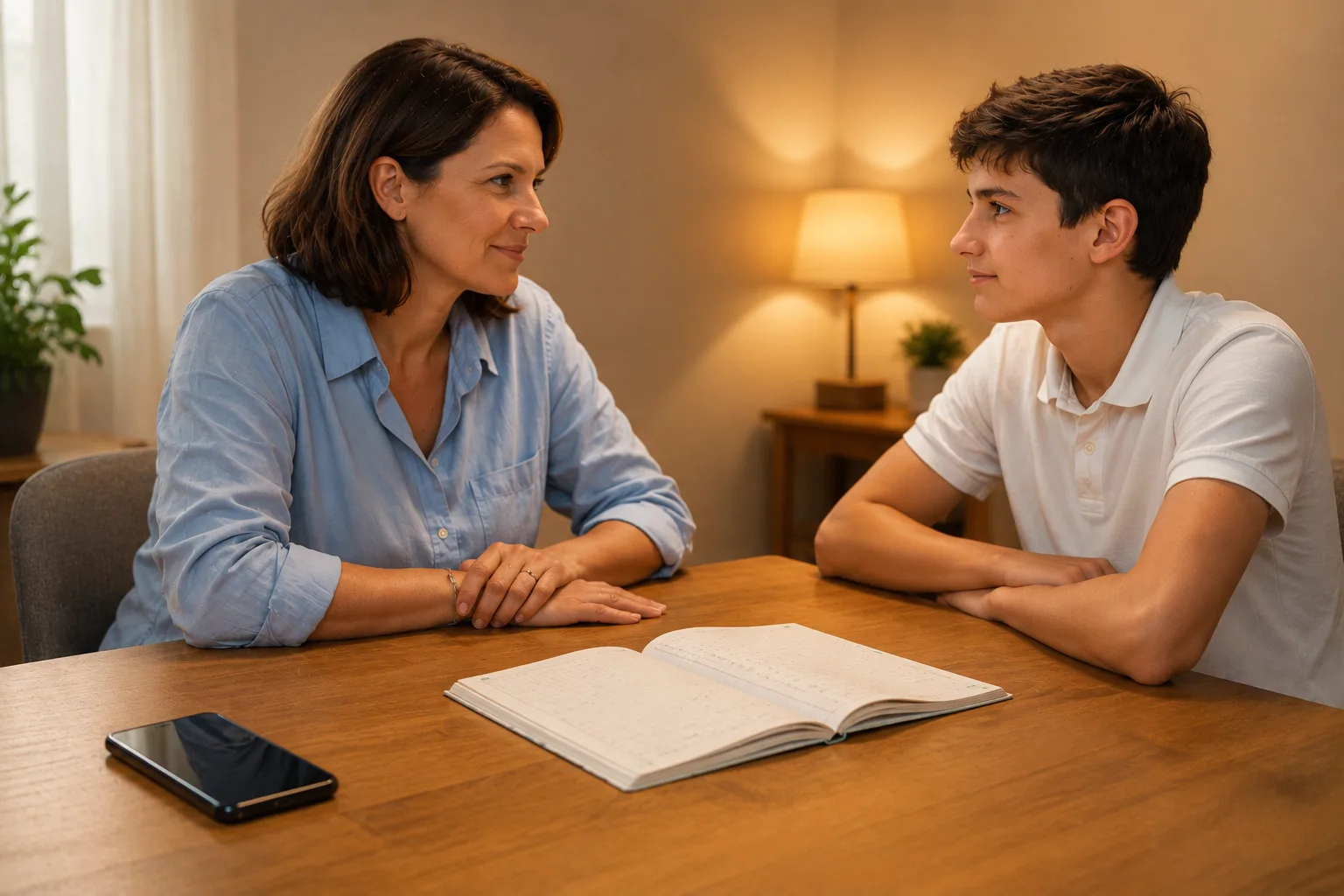
The real question is not “how many hours?”
Screens, smartphones and digital life affect school balance less through one single variable than through a chain of small choices: when the device is used, what it is used for, whether it interrupts attention, whether it delays sleep, and whether it crowds out movement, relationships or quiet work.
That is why the usual family debate — “screens are bad” versus “screens are normal, leave them alone” — rarely helps. A phone can be a timetable, a class group chat, a dictionary, a music player, a revision tool, a social lifeline, a distraction engine and a way to escape an unpleasant feeling after a difficult school day. Treating all of that as one thing creates rules that are either too harsh to last or too vague to protect anything.
A better family framework starts with three questions:
- What does this use do to attention right now? Does it help the child start, understand, retrieve or organise schoolwork, or does it scatter concentration?
- What does it do to the rest of the day? Does it push homework, sleep, meals, movement or family time later and later?
- What emotional state does it feed? Is the child relaxing, connecting and learning, or avoiding, comparing, doom-scrolling, arguing or trying not to feel a school disappointment?
This does not mean parents must track every minute. It means screen rules become easier to explain when they protect something concrete: sleep, focus, autonomy, safety, friendship, and enough space in the day for non-digital life.
It also protects children from a false message. The goal is not to make them afraid of technology. They will need digital judgment for school, friendships, work and culture. The goal is to help them recognise the difference between a tool, a break and a trap — and to make that difference visible in daily routines.
What most often damages school work
The biggest academic problem is not usually that a child “uses screens”. It is that certain digital conditions make sustained work harder than it already is.
Notifications fragment attention. A message does not need to be opened to pull the mind away. The sound, vibration or visible banner creates a pending question: Who wrote? Is it urgent? Am I missing something? For homework, reading and revision, the practical rule is simple: the phone should not be the centre of the work surface unless it is the tool being used for a specific school task.
Phone presence can keep temptation active. Some children can ignore a phone beside them; others spend mental energy resisting it. That resistance is not morally bad, but it is costly. When a student says “I’m not even checking it”, the family can answer: “Good — then it can wait in another place while you work.”
Late digital use harms the next day more than the evening may suggest. Sleep is one of the least negotiable parts of school balance. The issue is not only blue light. It is stimulation, emotional activation, autoplay, one more episode, group chat pressure and the absence of a clean ending. A child who goes to bed with the phone still available has to make good decisions at the time of day when self-control is lowest.
Social comparison and conflict travel home through the phone. A disappointing grade, an awkward message, a photo, a group joke or a class conflict can follow a child into the bedroom. In those moments, a screen rule is not only about school performance. It is also about giving the nervous system a break from social monitoring.
Avoidance scrolling looks like rest but does not always restore. After a hard assignment, a child may reach for short videos, games or chats to escape discomfort. That is understandable. But if the break has no end point, the original task becomes even more threatening. The family rule should not be “never take a break”; it should be “a break must make it easier to return”.
Video games are not all the same. Some games are social, strategic and finite. Others are designed around endless reward loops, late-night sessions or intense emotional arousal. The useful family question is not “Are games good or bad?” but “When does this game end, what mood does it leave the child in, and what does it push out of the day?”
A child’s digital life becomes risky for school when it repeatedly creates one of four patterns: fragmented attention, delayed sleep, emotional overload or hidden avoidance. Those patterns matter more than a single screen-time number.
Build family rules that can survive real life
Good rules are not perfect rules. They are clear enough to apply on a tired Tuesday, stable enough to reduce negotiation, and flexible enough to survive school projects, family travel, friendship needs and different ages.
Start with a small number of non-negotiables. A family can usually do more with three strong rules than with fifteen fragile ones. For example: no phone during focused homework blocks; no phone available in bed; notifications off during revision; games only after the necessary work has a defined stopping point; school group chats checked at planned times rather than continuously.
Then separate zones, times and purposes.
| Family problem | Rule to test | Why it helps |
|---|---|---|
| Homework is interrupted every few minutes | Phone outside arm’s reach during focused work | Reduces the number of decisions the child has to resist |
| Bedtime keeps sliding | Device charges outside the sleeping area, or at least away from the bed | Makes sleep the default instead of one more negotiation |
| School group chats feel unavoidable | Two or three check-in windows instead of permanent monitoring | Keeps social access without letting messages colonise the evening |
| The child says every screen is “for school” | Define the school task before opening the device | Turns vague screen use into an observable learning action |
| Rules become war every night | Agree the routine when everyone is calm, not during the conflict | Prevents the rule from feeling like an improvised punishment |
For younger children, the rule can be more adult-led: devices in shared spaces, co-viewing when possible, short sessions, clear endings. For teenagers, the frame should gradually become more collaborative: “Here is what must be protected; how do we design a routine you can actually follow?” Autonomy does not mean absence of boundaries. It means the teenager increasingly helps design the boundary and learns to manage it.
The phone-in-bedroom question deserves special attention. Families do not need to present it as a moral judgment. They can present it as sleep architecture: bedrooms should make sleep easier. If a child uses the phone as an alarm, replace that function. If the child fears missing an urgent message, define what counts as urgent and who can reach them. If the child feels punished, explain that the rule applies to the environment, not to their character.
Parental controls can help, especially with younger children, purchases, age-inappropriate content and late-night access. But controls are not a substitute for shared meaning. A child who only learns “my parent blocks me” has not yet learned “this use changes how I sleep, focus or feel”. The long-term aim is internal judgment, not permanent external policing.
When digital tools genuinely help learning

Digital tools help school when they make a learning action clearer, more active or easier to repeat. They become disguised distraction when they make the student feel busy without producing understanding, memory or a finished task.
A useful learning use usually has at least one of these features: a defined goal, a finite duration, an active output, and a way to check whether the child actually learned something. Watching an explanation video can help if the student pauses, writes the key idea, solves an example or compares it with the lesson. It is much weaker if the child watches three related videos and still cannot answer a basic question from the course.
The same distinction applies to language learning. Watching TV series in the original language can support listening, vocabulary and cultural familiarity, but it depends on level, subtitles, attention and timing. A tired student watching late at night with full subtitles in their own language may be resting, which is fine, but the family should not pretend it is equivalent to deliberate language work.
A practical test is to ask: What will be different after this screen session? If the answer is “I will have five flashcards”, “I will know how to solve this type of exercise”, “I will have heard the same useful phrases several times” or “I will have organised tomorrow’s revision”, the device is probably serving learning. If the answer is “I will have consumed more content related to school”, the use may be too passive.
Here is a simple distinction families can reuse:
| Useful digital tool | Distraction disguised as learning |
|---|---|
| A short video used to unblock one precise concept | A playlist that replaces the effort to work through the lesson |
| Flashcards that force the student to retrieve answers | Beautiful notes that are reread passively without self-testing |
| A language episode watched at the right level with attention | A late-night binge justified as “language practice” |
| A shared document used to plan a group project | A group chat that produces stress, copying or constant interruption |
| A revision app used for a defined daily mission | Opening a learning platform with no decision about what to do next |
The best digital learning tools reduce friction without removing effort. They should make the next useful action more obvious: retrieve, explain, solve, summarise, compare, plan, or repeat. If the tool only makes school feel more entertaining, it may be pleasant — but it is not automatically effective.
Common mistakes that make screen rules harder
The first mistake is trying to solve everything after the conflict has already started. A parent sees the phone, the child feels accused, the discussion becomes about trust, and the original issue — sleep, focus or homework — disappears. Rules work better when they are designed outside the crisis and applied with as little drama as possible.
The second mistake is making rules too global. “No screens on school days” may sound clear, but it can collide with homework platforms, class messages, language practice, shared documents, transport arrangements and social life. A more durable rule names the protected moment: no open-ended entertainment before the first homework block; no phone beside the bed; no notifications during revision; no gaming session without an agreed endpoint.
The third mistake is treating every problem as lack of willpower. Many digital products are designed to extend use. Autoplay, infinite scroll, streaks, reward cycles and social alerts are not neutral environments. A child who struggles to stop is not necessarily lazy or defiant. They may need a stronger external ending: device out of reach, app limits, a visible next activity, or a parent-agreed stopping point.
The fourth mistake is using the phone only as a punishment lever. Removing a phone may sometimes be necessary, especially for safety, sleep or repeated broken agreements. But if the phone becomes the permanent currency of discipline, the child may focus on winning it back rather than understanding the underlying habit.
The fifth mistake is forgetting the adult model. Children notice whether adults check messages during conversations, answer emails at the table or scroll when tired. Parents do not need perfect habits. They do need enough consistency to make the family rule credible: “We are all protecting certain moments from interruption.”
Finally, families sometimes confuse calm with success. A child who disappears quietly into a screen every evening may not be arguing, but the routine may still be eroding sleep, exercise, reading, friendships outside feeds, or independent schoolwork. The best screen rules are not only anti-conflict rules. They protect the whole ecology of a child’s day.
Practical scenarios: what to do tonight
When the topic feels too big, start with one high-impact routine rather than a complete digital overhaul.
If homework starts but never really starts, create a ten-minute launch ritual. The child writes the first task, puts the phone away, opens only the needed school material and begins with a small question or exercise. The aim is to cross the starting line before the phone can compete.
If the phone is in the bedroom, change the environment before debating motivation. Agree where it charges, how the child wakes up, and what happens if a real urgent message needs to pass through. Do not present the rule as “you cannot be trusted”. Present it as “sleep needs a protected place”.
If school group chats create pressure, define their job. They can be useful for checking a homework instruction, organising a group project or asking a quick question. They are not ideal for permanent reassurance, copying, late-night drama or replacing the child’s own planner. A check-in window after homework and another before packing the bag may be enough.
If games are the main tension, discuss endings before starting. “One hour” is often less clear than “one match”, “one level”, “until this agreed time”, or “after this session, the console is off before the evening routine”. The more immersive the game, the more important the exit plan.
If holidays or weekends destroy rhythm, keep a lighter version of the same structure. Later mornings and more entertainment may be fine, but sleep should not drift endlessly and the phone should not become the first and last activity of every day. A family can protect meals, outdoor time, reading, revision bursts or shared activities without turning breaks into school days.
If the child says digital tools are essential for learning, ask for the task, not the defence. “Show me what you need the screen for” is less accusatory than “You are just wasting time”. If there is a real task, keep the device. If the task is vague, define it before the screen opens.
The smallest useful change is often physical: phone in another room for one focused block, notifications off for revision, charger moved away from the bed, game ending agreed before play, or a visible list of what counts as school screen use.
FAQ: screens, smartphones and school balance
Should parents set a daily screen-time limit?
A daily limit can help, especially for younger children, but it is too blunt on its own. One hour of late-night scrolling is not the same as one hour of planned language practice, a family film, or a video call with relatives. Use time limits to prevent excess, but use rules about timing, place and purpose to protect school balance.
Should the smartphone stay out of the bedroom?
For many families, yes, especially when sleep is already fragile or the child struggles to stop at night. The bedroom rule works best when it is framed as sleep protection, not suspicion. Replace legitimate phone functions such as alarm, music or emergency contact with alternatives.
Are video games incompatible with school success?
No. The problem is not games as a category; it is displacement, late sessions, emotional intensity, unfinished schoolwork and conflict around stopping. A realistic rule defines when games happen, how they end, and what must be protected before play.
Can a child revise with music or background video?
Music may help some students begin or tolerate repetitive work, but background video usually competes for attention. The test is whether the child can still retrieve, explain or solve the material. If the task requires reading, writing or memorising, reduce competing speech and visual movement.
Are parental controls enough?
They are useful guardrails, not a complete education. They can limit access, purchases, content and late use, but they do not automatically teach judgment. Pair controls with conversations about attention, sleep, mood, social pressure and what the device is doing in that moment.
What if every rule becomes a fight?
Reduce the number of rules and make them more observable. Instead of debating “too much phone”, choose one protected routine: no phone during the first homework block, no phone in bed, or notifications off during revision. Apply it consistently, then review it when everyone is calm.
The useful goal: a livable digital frame
A good family digital frame is not a permanent war against screens. It is a way to protect the conditions that help a child learn and feel well: enough sleep, enough focused time, enough movement, enough real conversation, and enough autonomy to practise judgment.
Start with the pattern that causes the most damage in your home. If the issue is sleep, protect the bedroom and the last part of the evening. If the issue is homework fragmentation, protect the first focused block. If the issue is anxiety or social comparison, create screen-free recovery moments. If the issue is passive “learning” content, require an active output.
The most useful rule is the one a family can repeat calmly. Name the purpose, make the environment support it, and keep the focus on what the child is learning to manage: attention, emotion, time and choice. Digital life is now part of growing up. The family task is to make it legible enough that it does not quietly take over school balance.
Sources
Keep reading
Related reading
Watching TV series in the original language: real help for language learning or a cultural alibi?
Watching TV series in the original language can genuinely help with listening and vocabulary, but only in the right conditions. Subtitles, level, attention and sleep decide whether it is useful or just more screen time.
Use TV series in another language without turning them into vague extra screen time
All articles in this category
Every published article in this topic, from newest to oldest.
- School holidays and phones: how to keep digital life without losing your family’s rhythm
- Video games and school: moving beyond caricatures and building a workable framework
- Watching TV series in the original language: real help for language learning or a cultural alibi?
- YouTube for revision: how to tell if a video really helps
- Doomscrolling after a bad mark: the escape loop that keeps avoidance going